Curatorial and planning notes
This topic will include experimental photographic forms
- Using living forms to create photographs. This technique uses specially created negatives and the sun or a suitable light and heat source to allow grass to grow at differential rates and thereby create pictures. (For example: Heather Ackroyd and Dan Harvey)
- Printing photographs onto plants. (For example: Binh Danh)
|
Contents
| This theme includes example sections and will be revised and added to as we proceed. Suggestions for additions, improvements and the correction of factual errors are always appreciated. | Introduction 987.01 Experimental and manipulated photography > Manipulated photography Manipulated photography is a large topic which the "Faking It: Manipulated Photography before Photoshop" exhibition curated by Mia Fineman at the Metropolitan Museum of Art, New York (11 October 2012 - 27 January 2013) addressed with an accompanying well researched exibition catalogue. The exhibition is refreshing as it clearly demonstrated that photographers who claimed to be "straight photographers" such as Paul Strand, Ansel Adams and many others manipulated their negatives and photographs to obtain their desired goals.
Some of the techniques applied in the pre-digital era were:
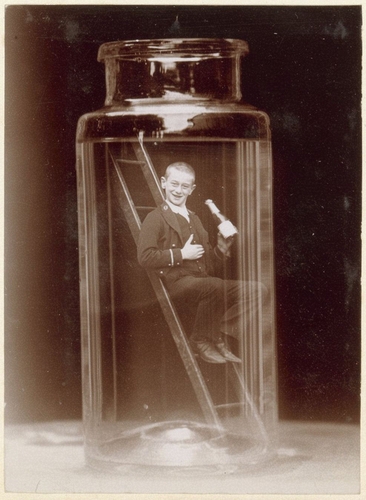
- Composite photographs where two or more negatives were used to construct a single photograph.
- Composite portraits where two or more negatives to create a portrait designed to show the characteristics of a class of people.
- Exaggeration postcards combined multiple images to create surreal images of American rural life. William H. 'Dad' Martin of Ottawa, Kansas became the most popular of these photographers although there were others including Henry M. Beach
- Painted photographs where paints were blown onto the photograph or applied with a brush.
- Backgrounds that provide an illusion of the location and/or activities of the sitter.
- Foregrounds scenes placed in front of the sitter where the head is visible above the scene or through a hole or window.
- Multiple exposures that were taken, deliberately or by accident, inside the camera or during the development process.
- Appropriation where original photographs have been used by a later photographer for a different purpose. This can be with or without the consent of the original photographer and can be done as a twisting of genres or a commentary on the nature of art and photography.
- Solarization is the deliberate or accidental intrusion of light into the darkroom during the development process.
- Alteration of the final print this may occur when the photographer deliberately defaces or cuts the print to alter the visual message.
- Distorting mirrors and lenses have been used by photographers including André Kertész, Bill Brandt and Weegee to flex their photographic visions.
Composite and combination prints 987.02 Experimental and manipulated photography > Composite and combination prints: Portraits
The use of Composite photographs has been employed in portraiture to combine groups of multiple individuals into a single image intended to capture the characteristics of the group as a whole. Distortions 987.03 Experimental and manipulated photography > Introduction to distortions The use of distorting mirrors and lenses creates elongated, squashed, stretched and crushed forms and this characterisic of fairground mirrors has been used by photographers to create unwordly forms and it is particularly suited to the taking of nudes.
Berenice Abbott is best known for her photographs of New York but she was also interested in scientific photography and patented the 'Distortion Easel' that was a device for controlling angles and levels of distortion that could be used for photography.
André Kertész in 1933 produced a remarkable series of photographs called 'Distortions' (published in 1976) in which mirrors were used to distort nudes into bizarre abstractions.
Weegee is remembered for his night shots of New York city crime scenes but he also shot distortions including a series in Paris with a twisted out of shape Eiffel Tower.
987.04 Experimental and manipulated photography > Examples of distortions
At various times photographers have experimented with placing some form of distorting device between the camera lens and the subject of the photograph. André Kertész using a distorting mirror of the type found in a fairground whilst Weegee used a plastic lens. Cliché verre 987.05 Experimental and manipulated photography > Cliché verre
Cliché-verre [Fr.] literally translated means "glass picture' and is a technique that combines art and photography and was used mainly by French artists including Jean Baptiste Corot, Jean François Millet, and Charles François Daubigny. It was normally done by using a smoking candle to coat a glass plate with soot. The desired picture was then drawn with a sharp instrument directly into the blackened surface and the resulting plate was used as a photographic negative and contact printed. Although mainly used in the 1860s the cliché verre technique has also be used by György Kepes and Abelardo Morell. Photograms 987.06 Experimental and manipulated photography > Photograms
Sculptural forms 987.07 Experimental and manipulated photography > Working with paper and card
Photographers 987.08 Experimental and manipulated photography > Man Ray: Solarized nudes About this photographer | Photographs by this photographer
987.09 Experimental and manipulated photography > Lotte Jacobi: Photogenics
987.10 Experimental and manipulated photography > Heinz Hajek-Halke: Experimentelle Fotografie: Lichtgrafik (1955) About this photographer | Photographs by this photographer
Heinz Hajek-Halke Experimentelle Fotografie: Lichtgrafik (Bonn: Athenäum Verlag, 1955), First edition. 4to. 108pp. Mottled tan cloth with brown lettering on cover and spine in original pictorial dust jacket. Groundbreaking work on abstract/experimental photography by Heinz Hajek-Halke (1898-1983). In his younger years Hajek-Halke worked as a press photographer, photo editor and commercial photographer, focusing on montage techniques. In the late 1940's he became a member of the Fotoform group, and later taught photography and graphic design at the Berliner Hochschule für Bildende Künste (Academy of Fine Arts, Berlin). He also contributed some of his work to avant-garde illustrated journals such as Uhu. He is considered a pioneer of expressive, abstract photography using a wide variety of darkroom techniques. Illustrated with 46 full-page reproductions in photogravure of some of Hajek-Halke's work. With a text contribution by Robert D'Hooghe, titled "Das schöpferische Element in der Fotografie" (The creative element in photography / L'élément créateur dans la photographie). Text in German, English and French. Translations by Herbert Weil and Jean Le Gall. Publisher's ordering postcard laid-in, as issued. 987.11 Experimental and manipulated photography > Edmund Kesting: Ein Maler sieht durch's Objektiv (1958) About this photographer | Photographs by this photographer
Edmund Kesting Ein Maler sieht durch's Objektiv (Halle: Fotokino, 1958). First edition. 4to. 47 pages of text with some in-text b/w drawings followed by 100 pages of b/w reproductions of photographs. Gray cloth with Kesting's signature stamped in blue on cover, blue lettering on spine in original pictorial dust jacket. Dj designed by artist. Color frontispiece of the Dresdner Frauenkirche after a painting by Kesting. In the early 1920's German photographer, painter & graphic designer Edmund Kesting (1892-1970) was closely involved with the artistic avant-garde. After 1925 he became well-known for his experimental photography, especially his masterful work in photomontage of which many examples are shown in this publication. Includes contributions by Hans Havemann, Edmund Kesting and Prof. Dr. Will Grohmann.
alan@luminous-lint.com |
General reading Fineman, Mia, 2012, Faking it: Manipulated photography before Photoshop, (New York: The Metropolitan Museum of Art) isbn-10: 0300185014 isbn-13: 978-0300185010 [Distributed by Yale University Press] [Δ] Rexer, Lyle, 2009, The Edge of Vision: The Rise of Abstraction in Photography, (Aperture) isbn-10: 1597111007 isbn-13: 978-1597111003 [Δ] Woodbury, Walter E., 1905, Photographic Amusements including a Description of a Number of Novel Effects Obtainable with the Camera, (New York: The Photographic Times Publishing Association) [Δ] Readings on, or by, individual photographers Bill Brandt Brandt, Bill, 1961, Perspective of Nudes, (London: The Bodley Head) [Δ] Heinz Hajek-Halke Hajek-Halke, Heinz, 1955, Experimentelle Fotografie: Lichtgrafik, (Bonn: Athenäum Verlag) [Δ] John Heartfield Zervigon, Andres Mario, 2012, John Heartfield and the Agitated Image: Photography, Persuasion, and the Rise of Avant-Garde Photomontage, (University Of Chicago Press) isbn-10: 0226981770 isbn-13: 978-0226981772 [Δ] André Kertész Kertész, André, 1976, Distortions, (Paris, Editions du Chęne) [Δ] Edmund Kesting Kesting, Edmund, 1958, Ein Maler sieht durch's Objektiv, (Halle: Fotokino) [Δ] László Moholy-Nagy Heyne, Renate & Neusüss, Floris M. (eds.), 2009, Moholy-Nagy: The Photograms: Catalogue Raisonné, (Hatje Cantz) isbn-13: 978-3775723411 [Δ] Moholy-Nagy, 2011, Laboratory of Vision: Photographs by Moholy-Nagy, (Kokushokankokai) [Δ] Floris M. Neusüss Immisch, T.O. (ed.), 2001, Floris Neususs Körperbilder: Fotogramme der sechziger Jahre, (Stiftung Moritzburg) isbn-10: 3861050927 isbn-13: 978-3861050926 [Δ] Roger M. Parry Fargue, Leon-Paul, 1930, Banalités, (Librairie Gallimand) [Photographs by Roger Parry] [Δ] Weegee Weegee, 1959, Weegee's Creative Camera, (Hanover House) [Δ] Weegee, 1964, Weegee's Creative Photography, (Ward, Lock & Co.) [Δ] If you feel this list is missing a significant book or article please let me know - Alan - alan@luminous-lint.com Hans Bellmer (1902-1975) • Bill Brandt (1904-1983) • Vladimir Brylyakov (1958-) • Ellen Carey (1952-) • Roger Catherineau (1925-1962) • Carl Chiarenza (1935-) • Xavier Damon (1969-) • Thomas Demand (1964-) • Adam Fuss (1961-) • Ernst Haas (1921-1986) • John Heartfield (1891-1968) • Florence Henri (1893-1982) • Dennis Hopper (1936-2010) • Lotte Jacobi (1896-1990) • André Kertész (1894-1985) • Man Ray (1890-1976) • Chris McCaw (1971-) • László Moholy-Nagy (check) • Jean Moral (1906-1999) • Floris M. Neusüss (1937-) • Pavel Odvody (1953-) • Roger M. Parry (1905-1977) • Alexander Rodchenko (1891-1956) • Franz Roh (1890-1965) • Jaroslav Rössler (1902-1990) • Werner Schnelle (1942-) • Victor Schrager (1950-) • Aaron Siskind (1903-1991) • Frederick Sommer (1905-1999) • Paul Strand (1890-1976) • Maurice Tabard (1897-1984) • Arthur Tress (1940-) • Pete Turner (1934-) • Raoul Ubac (1910-1985) • Brett Weston (1911-1993) • Minor White (1908-1976) • Willy Zielke (1902-1989) | Home > Themes > Experimental and manipulated photography
|