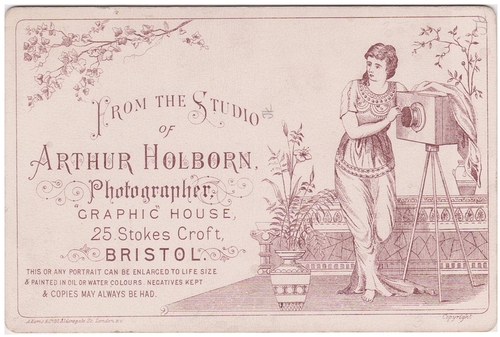
Curatorial and planning notes This theme concentrates on nineteeth century marketing. It will be extended to include examples of evites, iPhone and iPad applications, the use of social media and contemporary marketing strategies. |
Contents
| This theme includes example sections and will be revised and added to as we proceed. Suggestions for additions, improvements and the correction of factual errors are always appreciated. Status: Collect > Document > Analyse > Improve | Marketing techniques 773.01 Marketing > Photographs of the exteriors of nineteenth century photographic shops and studios
773.02 Marketing > Illustrations of the exteriors of nineteenth century photographic shops and studios
773.03 Marketing > Marketing: Signage and banners
773.04 Marketing > Richard Beard: Trade card About this photographer | Photographs by this photographer
The text below the image says:
A RELIC OF THE FIRST PHOTOGRAPHER IN BRITAIN OF 107 YEARS AGO:
RICHARD BEARD'S TRADE CARD.
The Trade Card reproduced above is an important item in the history of photography. In the year 1839, Daguerre‘s process of photography on a metal plate had been announced to the world, and in 1840 the English patent was acquired by Richard Beard, a London coal merchant. The original card was printed by chromo-lithography and, although its exact date is unknown, we do know that in 1842 Beard had the three studios proclaimed above: at Parliament Street, King William Street and Regent Street, for in that year The Illustrated London News was founded and in its issue dated July 23 there appears Beard's first advertisement bearing the same three addresses, and stating that his charge for a miniature portrait bust was one guinea, two guineas for a full-length, and "10s 6d. For each additional likeness to form a group." Our reproduction is published by courtesy of Mr. George H. Gabb, F.C.S.
Reproduced in The Illustrated London News Christmas Number, 1947,p. 14 773.05 Marketing > Marketing: Cased photographs
The cases used to protect photographs, mostly notably daguerreotypes and ambrotypes but not exclusively, offered additional ways of marketing for a photographer including:
- Embrossing and gilding the exterior of the case if it was leather as was done by William Edward Kilburn in London.
- Marking the velvet lining with the photographer's name as with Marcus Aurelius Root of "Root's Gallery" of Philadelphia and Robert H. Vance and his "Premium Daguerrean Galleries" of "San Francisco, Sacramento and Marysville".
- Using stamped metal preservers that held in the protective glass and this was used by A.M. Allen, Jenks Bros. (Patterson, NJ), Rufus P. Anson and many others.
773.06 Marketing > Marketing: Banknotes and premiums
773.07 Marketing > Handbills, broadsides and paper-based promotional material
773.08 Marketing > Marketing: Business cards of Daguerreotypists
773.09 Marketing > Marketing: Business cards
773.10 Marketing > Marketing: Business stationary
773.11 Marketing > Carte de visites: Advertising for photographers
773.12 Marketing > Marketing: Sample books
773.13 Marketing > Marketing: Commercial catalogues
773.14 Marketing > Marketing: Advertisements in newspapers
773.15 Marketing > Marketing: Advertisements in publications
773.16 Marketing > Marketing: In the popular press
773.17 Marketing > Marketing: Trade directories
773.18 Marketing > Marketing: Photographic publications
773.19 Marketing > Marketing: Photographer and studio labels
773.20 Marketing > Marketing: Stamps
Stamps can be divided up in two ways.
- The first is the type a wet stamp where ink is used and the second embossed, also known as a blind ("uncoloured") stamp where a metal stamp with text, a picture or decoration is applied with pressure causing a raised relief on the matte or photograph.
- The second is the purpose of the stamp this can be for a photographer, studio, distribution organisations such as an image library, collective or publication, estate stamps that are used to indicate the prints at the time of death or those produced after the death of the photographer, and stamps used by collectors and institutions.
The preparation of chronological series of well-authenticated stamps for a photographer can be useful for dating prints. Sets of stamps are rarely published with Man Ray, Walker Evans and a few others being notable exceptions.
As the value of photographs has risen so has the temptation to produce fraudulent copies and so stamps need to be carefully checked. Some prints were never meant to sold and may be indicated by a stamp that says "Complimentary copy" but as with anything else these now have a commercial value and are purchased by those who don't know better. 773.21 Marketing > Marketing: Studio marks in negative
773.22 Marketing > I.W. Taber: Contemporary account of meeting the photographer in San Francisco About this photographer | Photographs by this photographer Captain S.H. Jones-Parry, My Journey Round the World via Ceylon, New Zealand, Australia, Torres Straits, China, Japan, and the United States, Two Volumes (London: Hurst and Blackett, 1881), Volume II, p.145-146.
In this travel account the visit is to the studio of "Mr. Tabor" but it is presumably a misspelling of "Taber":
I must not leave this part of my journey without a word on that for which this place bears a world-wide renown; I allude to photography. The first morning after my arrival, when I got up to take in my boots, I found outside my door two envelopes addressed to me, each containing a cabinet photograph of some evidently well-known actress, and a card requesting me to visit the studio of the sender. As I had already collected a large assortment of photographic views on my travels, I now determined to add to it a collection of portraits as specimens of the art in the States. I called at several studios to make purchases, and at each place a lovely specimen of art was gratuitously given, in addition to what I bought. I think, as I have before said, that the San Francisco portraits rank first in my collection. The photographers themselves were highly intellectual men, and I owe much to Mr. Tabor and Mr. Boyd, for many pleasant moments spent in their studios. The former took the trouble to send after me to New York a duplicate of a work of art that I had much admired in his collection. 773.23 Marketing > Marketing: Touting for business
773.24 Marketing > Marketing: En pleine air
773.25 Marketing > Marketing: Photographing celebrities
773.26 Marketing > Marketing: Posters
773.27 Marketing > Marketing: Showcasing photographs
Marketing for photographic studios 773.28 Marketing > Mathew B. Brady: Brady's Daguerrean Gallery
773.29 Marketing > Mr. Pratt's Gallery at Richmond, VA - Coloring Daguerreotypes (1851)
Published in "The Photographic Art Journal, Volume 2, 1851, p.235-236.
MR. PRATT'S GALLERY AT RICHMOND, VA COLORING DAGUERREOTYPES.
Richmond, October 10th, 1851.
Mr. H. H. Snelling : Dear Sir: I at length have found a few moments to devote to you, and I assure you that it is at the earliest period, as you may be sure the cares of so extensive an establishment as ours, after three months-absence, preclude the possibility of giving much time to any other purpose.
You already have published a description of the interior of our establishment, and I will now give the best I can of its outside, but the illustration itself affords almost all that could be desired. The object was to obtain as much boauty as possible, consistent with utility, and to make the alterations without disturbing the original building more than I could avoid. The immense bay window which forms the principal ornament in front, is eight feet wide by about 16 feet in height, and in combination with the gothic screen work above, also filled with glass, forms our operating light, which is about thirty feet from the floor of the room and runs back about ten feet. This window projects two feet into the street, and forms a conspicuous object in connection with the parapet above from nearly every part of the city. The entire front has been remodelled and painted so as to present the hall-like appearance which the illustration portrays, and as it forms the centre of the finest row of buildings in Richmond, we think that we have obtained the objects most to be desired in a Daguerrean establishment, viz.: Publicity, an immense northern window in combination with a sky-light, a fine operating room in the third-story, surrounded with the necessary offices for cleaning, buffing, &c., and a show room, which in all my travels I have not yet seen surpassed except in point of size.
I would take the opportunity here to mention that no attention has been paid to either convenience or beauty of arrangement in the European galleries. I visited nearly all in England and in Paris, and found them, generally speaking, below mediocrity. Their pictures, too, were so inferior to those of America, with two exceptions, (Thomson and Mayall, both formerly of Philadelphia,) as to occasion no surprise at the great want of popularity of the daguerreotype in England. Their great object seems to be to disguise it by colors, varnishes, &c., to hide all the beauty of the original proof, and to produce instead an inferior specimen of miniature painting; true, some of the French have, by the exquisite pencil of their finest artists, produced pictures which both astonish and delight, but these alas ! Are, from their very nature, (viz.: being worked up with gum colors,) liable to turn of a rusty hue, which destroys their beauty, and leaves them with the aspect of a faded engraving after being exposed in a shop window. Mr. Beard claims to have discovered a method by which these difficulties are obviated, but unless I am much deceived, it is the same as that practised by me, and of which I have specimens four years old. For the information of your readers I will detail it.
After your picture- is gilded and dry, pour over it quickly and steadily, a thin solution of bright copal varnish, and let it drain off either in the sun or before a gentle fire a stove is best; when perfectly hard, which it will be in the course of a day, color it as usual with dry colors. An exposure to the gentle heat of a spirit lamp will cause them to sink in and become permanent, thus giving all the effect of enamel. After this is completed you may coat it over with varnish, until you get sufficient to rub down, and you will obtain an imperishable enamelled daguerreotype.
This has probably been tried by more than one besides Mr. Beard, and only proves that "there is nothing new under the sun," in coloring daguerreotypes, at least, for where such a host of operators are engaged, the probability is, that nearly everything has been attempted of this kind that afforded any chance of success. Very respectfully yours,
William A. Pratt. 773.30 Marketing > Jeremiah Gurney: J. Gurney's Premium Daguerreotype Gallery About this photographer | Photographs by this photographer
773.31 Marketing > Jeremiah Gurney: Premiums About this photographer | Photographs by this photographer
Companies selling reproductions of works of art in the nineteenth century 773.32 Marketing > Companies providing photographic reproductions of art in the nineteenth century
Socializing 773.33 Marketing > Camera clubs and get-togethers of photographers
Contemporary marketing 773.34 Marketing > Evites
"Ephemera is transitory written and printed matter, not intended to be retained or preserved. The word derives from the Greek, meaning things lasting no more than a day." (Wikipedia, May 24, 2008)
Emails containing invitations, Evites, concerning gallery exhibitions, art fairs, book signings and artists receptions are increasingly commonplace and not designed for preservation even by the organizations that create them. They are however a part of the history of photography and this exhibition includes some examples for your visual delight. 773.35 Marketing > iPhone applications
773.36 Marketing > iPad applications
alan@luminous-lint.com | General reading Chalabala, Mark S., 2013, American Backmark: The Art and Artistry of the Carte de Visite Imprint 1860-1890, (Privately printed) [Δ] Craig, J.S., 1994, Craig’s Daguerreian Registry, (Torrington, Conn.: John S. Craig) [Δ] Henisch, Heinz K & Henisch, Bridget A., 1993, The Photographic Experience, 1839–1914: Images and Attitudes, (University Park, PA: Pennsylvania State University Press) [Δ] Mann, Charles & Collins, Kathleen, 1984, ‘Studio Sample Sheet‘, History of Photography, vol.8, no.3, pp.197-200 [Δ] Pritchard, H. Baden, 1882, The Photographic Studios of Europe, (London: Piper and Carter) [Δ] Smith, Roger, 1988, ‘Selling Photography: Aspects of Photographic Patronage in Nineteenth-Century Britain‘, History of Photography, vol.12, no.4, pp.317-326 [Δ] Readings on, or by, individual photographers Man Ray Manford, Steven, 2006, Behind the Photo: The Stamps of Man Ray, (Carnet de Rhinocéros jr.) isbn-10: 2849400211 isbn-13: 978-2849400210 [Limited edition] [Δ] If you feel this list is missing a significant book or article please let me know - Alan - alan@luminous-lint.com I.W. Taber (1830-1912) | Home > The business of photography > Marketing |