Contents
| This theme includes example sections and will be revised and added to as we proceed. Suggestions for additions, improvements and the correction of factual errors are always appreciated. Status: Collect > Document > Analyse > Improve | 752.01 Nature > Weather: Clouds
752.02 Nature > Gustave Le Gray: Combination prints About this photographer | Photographs by this photographer
These albumen prints prepared around 1857 by Gustave Le Gray show two distinct seascapes a subject the photographer was noted for. An examination of the clouds shows that they are combination prints as the same negative of the sky has been used in both. 752.03 Nature > George N. Barnard: Rebel Works in front of Atlanta About this photographer | Photographs by this photographer
An examination of the skyline and the edges of the tree branches in the photograph Rebel Works in front of Atlanta, No. 1 by American Civil War (1861-1865) photographer George N. Barnard shows that this is a composite made from multiple distinct negatives. 752.04 Nature > Charles Marville: Vue du ciel de Paris, de la fenetre de l'artiste About this photographer | Photographs by this photographer
752.05 Nature > Henry Stuart Wortley: Seascapes with clouds About this photographer | Photographs by this photographer
752.06 Nature > Carlo Baldassare Simelli: Cloud studies About this photographer | Photographs by this photographer
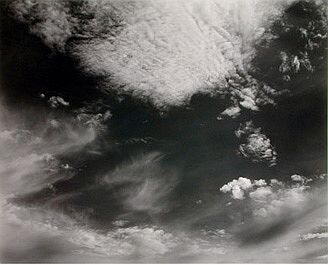
752.07 Nature > Alfred Stieglitz: Equivalents About this photographer | Photographs by this photographer
From 1922 to around 1935 Alfred Stieglitz took a series of photographs of clouds that he named Equivalents. The photographs were not intended as literal series of meteorological studies but as an examination of states of mind - a study in abstraction.
Stieglitz, Alfred (1923) How I came to Photograph Clouds, Amateur Photographer and Photography, vol.56, no.1819, pp.255.
Last summer when manuscripts were sent in by the various contributors for the issue of the publication, "M.S.S." devoted to photography, and its aesthetic significance, Waldo Frank—one of America's young literary lights, author of Our America, etc.—wrote that he believed the secret power in my photography was due to the power of hypnotism I had over my sitters, etc.
I was amazed when I read the statement. I wondered what he had to say about the street scenes—the trees, interiors—and other subjects, the photographs of which he had admired so much: or whether he felt they too were due to my powers of hypnotism. Certainly a lax statement coming from one professing himself profound and fair thinking, and interested in enlightening.
It happened that the same morning in which I read this contribution my brother-in-law (lawyer and musician) out of the clear sky announced to me that he couldn't understand how one as supposedly musical as I could have entirely given up playing the piano. I looked at him and smiled—and I thought: even he does not seem to understand. He plays the violin. The violin takes up no space: the piano does. The piano needs looking after by a professional, etc. I simply couldn't afford a piano, even when I was supposedly rich. It was not merely a question of money.
Thirty-five or more years ago I spent a few days in Murren (Switzerland), and I was experimenting with ortho plates. Clouds and their relationship to the rest of the world, and clouds for themselves, interested me, and clouds which were difficult to photograph— nearly impossible. Ever since then clouds have been in my mind, most powerfully at times, and I always knew I'd follow up the experiment made over 35 years ago. I always watched clouds. Studied them. Had unusual opportunities up here on this hillside. What Frank had said annoyed me: what my brother-in-law said also annoyed me. I was in the midst of my summer's photographing, trying to add to my knowledge, to the work I had done. Always evolving—always going more and more deeply into life—into photography.
My mother was dying. Our estate was going to pieces. The old horse of 37 was being kept alive by the 70-year-old coachman. I, full of the feeling of today: all about me disintegration—slow but sure: dying chestnut trees—all the chestnuts in this country have been dying for years: the pines doomed too—diseased: I, poor, but at work: the world in a great mess: the human being a queer animal—not as dignified as our giant chestnut tree on the hill.
So I made up my mind I'd answer Mr. Frank and my brother-in-law. I'd finally do something I had in mind for years. I'd make a series of cloud pictures. I told Miss O'Keeffe of my ideas. I wanted to photograph clouds to find out what I had learned in 40 years about photography. Through clouds to put down my philosophy of life— to show that my photographs were not due to subject matter—not to special trees, or faces, or interiors, to special privileges—clouds were there for everyone—no tax as yet on them—free.
So I began to work with the clouds—and it was great excitement— daily for weeks. Every time I developed I was so wrought up, always believing I had nearly gotten what I was after—but had failed. A most tantalizing sequence of days and weeks. I knew exactly what I was after. I had told Miss O'Keeffe I wanted a series of photographs which when seen by Ernest Bloch (the great composer) he would exclaim: Music! Music! Man, why that is music! How did you ever do that? And he would point to violins, and flutes, and oboes, and brass, full of enthusiasm, and would say he'd have to write a symphony called "Clouds." Not like Debussy's but much, much more.
And when finally I had my series of ten photographs printed, and Bloch saw them—what I said I wanted to happen happened verbatim.
Straight photographs, all gaslight paper, except one palladiotype. All in the power of every photographer of all time, and I satisfied I had learnt something during the 40 years. It's 40 years this year that I began in Berlin with Vogel.
Now if the cloud series are due to my powers of hypnotism I plead "Guilty." Only some "Pictorial photographers" when they came to the exhibition seemed totally blind to the cloud pictures. My photographs look like photographs—and in their eyes they therefore can't be art. As if they had the slightest idea of art or photography— or any idea of life. My aim is increasingly to make my photographs look as much like photographs that unless one has eyes and sees, they won't be seen—and still everyone will never forget them having once looked at them. I wonder if that is clear.
752.08 Nature > Mitch Dobrowner: Storms About this photographer | Photographs by this photographer
The images produced in this series represent the beginning of a new project that started as an experiment in the summer of 2009.
Growing up on Long Island, NY I've always loved being caught in thunderstorms. Since childhood the memories have been seared into my brain. Now fast forward to today – and while photographing the landscapes of the Southwest I’ve always gone out in the nastiest, most unstable weather possible. Thus I decided my next move was to locate the most severe weather I could. This brought me to Tornado Alley and the Great Plains of the USA.
The Trips
The trips to the Great Plains are an adventure unto itself. As I write this I sit in Tucson Arizona preparing go out on my 4th trek….. chasing after monsoon thunder/lightning storms. In each of the last 3 trips we have traveled 5600, 4800 and last month 6100 miles (over 16,000 miles in total) – seeing over 14 states. Besides the great storms I’ve had the honor of seeing the midwest and central states - whose small, tight knit communities make up a majority of the United States. But that’s another story (and maybe another project).
The Storms
The first time I witnessed a structured supercell thunderstorm was June 12th, 2009. What I saw would give me a fresh prospective on the power of Mother Nature and how small and insignificant we really are.
One memory is of June 13th, 2009 in Valentine, Nebraska: I was standing in a wheat field with wind gusts eclipsing 50mph, witnessing lightning strikes every few seconds, hearing the rumble of hail – all while standing in front of a 60,000 foot high mesocyclone. I could not believe what I was seeing; it was unlike anything I’ve even see before in my life.
It was also then that I realized that these storms are living, breathing things. They are born everyday, they fight against their environment to stay alive, change their form as they age, they lose their strength – and eventually they die. Standing in front of one of these phenomena of nature is an adventure into the extreme. For me, I’ve had the honor to witness Nature in her beauty (illustrated in landscapes) but these storms (besides being beautiful) represent Mother Nature in a fluid, ever-changing manner. Seeing Nature in this manner is an extremely personal level experience as it has helped move my relationship with nature and our planet to a newer level.
The hope is that the images presented communicate how I feel while standing in front of these amazing forces of nature.
Mitch Dobrowner
[January 2011]
alan@luminous-lint.com | Readings on, or by, individual photographers Alfred Stieglitz Steiglitz, Alfred, 1923, ‘How I Came to Photograph Clouds‘, The Amateur Photographer & Photography, vol.56, no.1819, pp.255 [Δ] If you feel this list is missing a significant book or article please let me know - Alan - alan@luminous-lint.com Mitch Dobrowner (1957-) • Gustave Le Gray (1820-1884) • Charles Marville (1813-1879) • Carlo Baldassare Simelli (1811-1877) • Alfred Stieglitz (1864-1946) • Edward Weston (1886-1958) • Henry Stuart Wortley (1832-1890) | Home > Themes > Nature > Weather > Clouds
|
