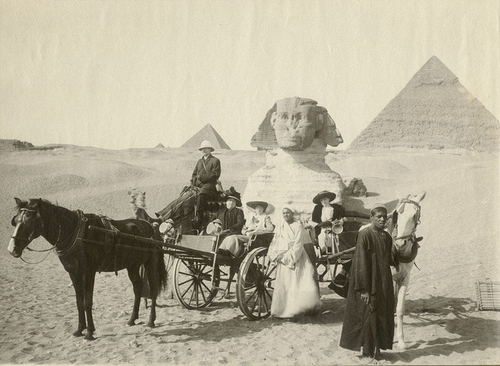
Curatorial and planning notes Details on individual tourist sites such as the Colosseum, the Acropolis, the Pyramids and many others are included in the "Geographical regions" section. I'd like to extend this section with information related to the tours of Thomas Cook, railroad excursions, early family travel albums and the diaries of photographers as they toured the world. If you have examples I'd be grateful if you'd let me know. |
Contents
| This theme includes example sections and will be revised and added to as we proceed. Suggestions for additions, improvements and the correction of factual errors are always appreciated. Status: Collect > Document > Analyse > Improve | The growing popularity of travel 507.01 Travel > Photographers on the Grand Tour
A number of early photographers in the mid-1850's onwards were interested in the commercial possibilities of taking images in exotic locations and then selling the resulting images in the developing European markets. When leaving their own countries the photographers gravitated towards the locations popularized by the 'Grand Tour' most notably Italy and Greece.
There were a great many other photographers who went to the classical sites and recorded them either as amateurs or for publication in albums. Some names that are worthy of further investigation include Dmitri Constantine, Petros Moraites, James Robertson, the Rev. George Bridges, the first Greek photographer Philippos Margaritis, Francis Bedford, Eugene Piot, and the Reverend Calvert Richard Jones with his photographs of the Roman colosseum. 507.02 Travel > Thomas Cook
507.03 Travel > Travel in popular culture
Travel photographers at work 507.04 Travel > Carleton Watkins: #925 Spring Valley Water Works About this photographer | Photographs by this photographer
The following comments by Will Dunniway and Robert Szabo, two contemporary wet-plate collodion photographers, explain the significance of this rare yellow-mount stereoview "#925 Spring Valley Water Works" by Carleton E. Watkins:
The items inside the tent:
- The spigot for his water supply. It is not possible to see what the container was made of, but most likely it would have been copper or brass for weight considerations.
- Three of the four visible bottles appear to be leather wrapped. This is to prevent the glass from breaking from a rough wagon ride between shoots.
- There is an open wooden box and it is uncertain what it would have been used for. It was most likely to have been used for transporting chemicals and photographic paraphernalia.
The items outside the tent:
- As can be seen here Carleton Watkins used a vertical bath to process his mammoth plates. It has been suggested that he used a tray as his bath to sensitize his plates but this is conclusive. There is a further point about this bath tank. He is said to have NOT used a glass liner to contain his bath. Instead it was believed he asphalt painted the inside, or something along this line. In this image, it appears that there is not a glass liner. To seal this bath for traveling, usually the glass tank will extend above the wooden rim.
- A mammoth plate storage box.
- These boxes appear to be the 5x8 inch plate storage boxes for making stereo images. They are about the right size for two rows of plates, with a divider in the middle. They are on top the large mammoth plate boxes not being used at this moment of exposure, thus, these 5x8 plate boxes are sequentially in order.
- A glass plate cleaning vise.
- The lid clamp to a silver bath tank. The metal clamp with thumb screws was used for the sealing off this bath tank when traveling. The wooden lid for this huge mammoth plate silver bath tank appears to be with this clamp.
The tent itself:
The dark tent is lined with what I think is yellow, or a very warm colored material. As you know, collodion is a blue sensitive emulsion (it is called 'Ordinary'). This being what this is, the blue will NOT be seen, where as the yellow (red or warm tones) would be seen as dark. The outer material seems to be plain white canvas duck. The white outer shell is so the interior of this dark tent would not heat up in direct sun. This color choice was a must on warm days. After about 90oF outside, the inside of the tent would elevate the silver bath to above 80o F in no time at all. At this temperature, silver bath starts to act up, and will produce flawed plates.
It is not certain that the person on the left is Carleton E. Watkins and this remains to be confirmed. 507.05 Travel > Coventry-rotary, Photo-tricycle, M.D. Rudge and Co. (Great Britain)
Stereo sets 507.06 Travel > Stereoview libraries for the armchair traveler
Photographic souvenirs 507.07 Travel > Photographs for the growing number of travelers
As the number of tourists expanded with improved transportation, particularly railways, during the nineteenth century the market opportunity of selling photographs to them grew. This market was addressed by local photographers providing prints or albums either directly from their studios or through intermediaies such as booksellers and sellers of prints. Some photographers published extentive catalogues of the photographs they had available for purchase.
Examples of photographers servicing the tourist market include:
507.08 Travel > Auguste Lesouëf - Pompeii (1880) About this photographer | Photographs by this photographer
These four hand colored photographs, from an album of twelve, in the Bibliothèque nationale de France are by Auguste Lesouëf (1829-1906). They were produced as souvenirs for the many tourists who visited the excavations.
The Roman city of Pompeii was covered by the eruption of Mount Vesuvius in 79 A.D but in the nineteenth century Fausto and Felice Niccolini were documenting the extensive archaeological excavations and published the results in their four volume work Le case ed i monumenti di Pompei disegnati e descritti that was published between 1854 and 1897. 507.09 Travel > Marketing: Commercial catalogues
507.10 Travel > Karl Baedeker's Handbooks for Travellers
The travel handbooks of Karl Baedeker provided tips on where to purchase the finest photographs whlst traveling.
- Beirut
Karl Baedeker (firm) Palestine and Syria. Handbook for Travellers (Leipsic: Karl Baedeker, 1876), p.439.
Photographers. Dumas, in the street leading from the two principal hotels into the town. The photographs, generally good and cheap, should be bought of the photographers themselves, and not from the dealers who offer them at the hotels. Unmounted photographs should be rolled on a piece of wood, or packed in a tin box which may be bought at the bazaar for a few piastres.
- Jerusalem
Karl Baedeker (firm) Palestine and Syria. Handbook for Travellers (Leipsic: Karl Baedeker, 1876), p.145
Books, Photographs. Shapira, Christian Street. is the best shop; then Bergheim, in the same street. Photographs of every part of Palestine, medium size 18 fr. per dozen. They should be bought unmounted, and rolled on a round piece of wood to facilitate transport.
- Cairo
Karl Baedeker (firm) Egypt. Handbook for Travellers. Part First: Lower Egypt, with the Fayum and the Peninsula of Sinai (Leipsic: Karl Baedeker, 1878), p.234-235.
Photographs. Schoefft, Abbasiyeh Street (Place Faghalla), with a good background for groups: also a fine collection of groups of natives, and a few desert scenes, some of which are very striking (various prices ; a collection of 25, of small size, is sold for 25 fr.). Helios, Rue du Tribunal, with a handsome studio; Calamidia, Kosetti Garden: Bechart, in the Ezbekiyeh Garden, and others. Among the numerous photographs of Egyptian landscapes and temples the best are those by Sebah of Constantinople, which may be purchased at his depot, adjoining the French consulate in the Ezbekiyeh, or at Kauftmann's. Hr. E. Brugsch, the keeper of the Bulak Museum (p. 293), has caused a number of the objects in the museum to be photographed. This collection, which costs 25 fr., maybe purchased at the museum, or at Kauffmann's, but is not sold by the photographers.
- London
Karl Baedeker (firm) London and its Environs: Including Excursions to Brighton, the Isle of Wight, etc. Handbook for Travellers. (Leipsic: Karl Baedeker, 1885), p.22.
Photograph-sellers : J. Gerson, 5 Rathbone Place (photographs of the pictures in the National Gallery, etc.); Hauff, 46 Southampton Row, Holborn (Braun's photographs of the pictures in the National Gallery); Autotype Fine Art Gallery, 74 New Oxford Street; Mansell, 271-273 Oxford Street; Marion (photographic materials), 23 Soho Square; London Stereoscopic Company, 54 Cheapside and 108 Regent Street; Spooner, 379 Strand.
- Florence
Karl Baedeker (firm) Italy. handbook for travellers. First part: Northern Italy (Leipsic: Karl Baedeker, 1886), p.376.
On the Cafes of Florence: Visitors to the cafe's are frequently importuned by hawkers of photographs, etc., who often sell their wares at one-third or one-half of the price at first demanded, and by the well-known Fioraje, or flower-girls.
- Venice
Karl Baedeker (firm) Italy. handbook for travellers. First part: Northern Italy (Leipsic: Karl Baedeker, 1886), p.234
Photographs: Naya, in the Piazza of St. Mark, views of Venice, from the smallest at about 50 c. to the large and expensive size (28 by 36 inches), copies from drawings I 1/2, from original pictures 4 fr
507.11 Travel > Souvenir photograph albums
507.12 Travel > Souvenir sets of travel photographs
Reminiscences and the armchair traveler 507.13 Travel > Théophile Gautier: Wanderings in Spain (1853) About this photographer | Photographs by this photographer
Théophile Gautier Wanderings in Spain (London: Ingram, Cooke, and Co., 1853), p.22.
The sun was setting when we entered Vittoria; after threading all sorts of streets, of but middling architectural style and very bad taste, the coach stopped at the parador vejo, where our luggage was scrupulously examined. Our Daguerreotype especially alarmed the worthy custom-house officers a good deal; they approached it with the greatest precautions, like people who are afraid of being blown up; I think they imagined it to be an electrifying machine, and I took care not to undeceive them.
507.14 Travel > Mr. E. K. Tenison, of Kilbonan Castle, exhibited a number of photographs of very large size, representing views in Spain (1853) About this photographer | Photographs by this photographer
Edward King Tenison was one of the earliest photographers taking calotypes in Spain. Some of his calotypes were shown at The Irish Industrial Exhibition of 1853. In 1854 he published an album Memories of Spain (Recuerdos de Espana) which contained forty calotypes of Spanish towns that had been taken between 1852 and 1854. His wife Lady Louisa Mary Anne Tenison wrote about her time in Spain in various magazine articles and her book Castile and Andulucia (London, 1853).
John Sproule The Irish Industrial Exhibition of 1853: A Detailed Catalogue of its Contents (Dublin: James McGlashan, 1854), Class X, p.234-235.
Mr. E. K. Tenison, of Kilbonan Castle, exhibited a number of photographs of very large size, representing views in Spain. Although we have seen some French photographs, especially those of M. Martens, of Pans, far superior to those views, yet, when we take their great size into account, they were certainly remarkable examples, and showed what may be expected from this branch of art, when fully perfected. The finest and most effective specimen in the whole collection was a view of the city of Toledo; the view of the east end of Burgos Cathedral was also admirable; as were those of the Church of San Pablo. at Valladolid; and the Royal Palace of Madrid. There were two examples of the effects of treating (the pictures with solutions of certain substances. One was a charming view of Cordova, of a peculiar and exceedingly agreeable warm yellow tint, produced by immersing the positive picture in extemely dilute muriatic acid. There was another example of this fine sunny, sepia-like tint, in a pretty view of the Gate of Cordova. The second example of the effect of certain solutions was a view of the Palio de los Reyes, or Escurial, which had a curious violet tint, produced by immersing the picture in a solution of chloride of gold in aqua regia. It was, in fact, to some extent, an example of the chrysotype of Herschel, above alluded to. Several of these photographs exhibited great inequality of tints, such as the Portal of Leon Cathedral, which was too black in the doorways; and the Congresso de los Deputados, or Chamber of Deputies, at Madrid, the fore-ground of which was absolutely black. It is probable, that had the negatives of these pictures been weakened by the process of Blanquart-Everard, they would have been excellent. This defect is most likely to occur in taking views of buildings where there is a great contrast of light and shade, and hence the process alluded to for weakening the negative is worthy of attention.
507.15 Travel > Roger Fenton: The Conway in the Stereoscope (1860) About this photographer | Photographs by this photographer
507.16 Travel > Louis de Clercq: Voyage en Orient (1860) About this photographer | Photographs by this photographer
507.17 Travel > Francis Bedford: The Prince of Wales and his trip to the East (1862) About this photographer | Photographs by this photographer
The Royal Collection in the UK includes The Prince of Wales's diary which contains insights into his 1862 Tour.
4 March 1862
We then proceeded on the dromedaries (not at all an unpleasant mode of conveyance) to the celebrated Pyramids of Ghizeh - They quite exceeded my expectations, & are certainly wonderful mementoes of our forefathers. We visited the Sphinx just before sunset, which is also very curious and interesting. We had a charming little encampment just below the Pyramids where we slept for the night'
13 March 1862
"....The ruins of Philae are beautiful and most interesting and Mr. Bedford the photographer, who came from England with me and our party took some very good views...."
14 March 1862
"....Mr. Bedford (the photographer who accompanied us from England) took some very successful views of the temple (at Edfoo)".
21 April 1862
".... We lunched under a figtree at 12 o'clock on the site of where once the city of Capernaum is said to have stood, + Mr. Bedford photographed us 'en groupe'."
4 May 1862
"At about 10 we left our camp to lionize thoroughly the fine temple (at Baalbec) + we were much pleased with what we saw. We remained about two hours going over it; Mr. Bedford took some excellent views of it, which will be a great addition to his collection of photographs...."
Bill Jay "Royal Command - Francis Bedford's photographs of the educational tour of the Middle East by the Prince of Wales, 1862"
http://www.billjayonphotography.com/Royal%20Command-%20Francis%20Bedford.pdf 507.18 Travel > Francis Bedford: The Prince of Wales and his trip to the East - Covers (1863) About this photographer | Photographs by this photographer
507.19 Travel > J. Payne Jennings: Book covers About this photographer | Photographs by this photographer
The rapid growth of an urban middle class in England during the nineteenth century went hand-in-hand with the expansion of a comprehensive railway system providing leisure opportunities. Picturesque regions like the Lake District and the Norfolk Boards in East Anglia were particularly popular and the scenic photographs of J. Payne Jennings were used by the Great Eastern Railway Company to encourage rail travel to rural idylls far removed, and yet accessible, from the major cities. 507.20 Travel > Photographically illustrated books for the armchair traveler
Travel literature 507.21 Travel > Jules Verne: Around the World in Eighty Days - What would Phileas Fogg and Passepartout have seen in 1872?
The world as it was when Phileas Fogg and his valet Passepartout passed through on their fictional voyage around the world in 1872.
What would the dashing pair have witnessed along the way during their intrepid travels?
When Jules Verne's book Around the World in Eighty Days was published in 1873 the world was at a stage of rapid industrial development.
Only a few years earlier the Suez Canal had been opened greatly reducing the time required to travel from Western Europe to India and the Far East. On 10 May 1869 the rails were joined at Promontary Summit for the Transcontinental railway in the United States. The railway station in Yokohama opened in 1872 symbolizing the immense changes in Japan which had been largely closed to foreigners until the Black Ships of Admiral Perry arrived in 1853. Emmigration and immigration during this period was enormous and ships such as the S/S Manhattan of the Guion Line crossed from Liverpool to New York six times between 1870-1872 and companies like the Pacific Mail Steamship company plied the routes between San Francisco, Panama, Yokohama, Hong Kong and Singapore.
The times were far from tranquil: Lieutenant Camus had been killed in Japan in 1868 by Samurai who objected to the presence of foreigners; San Francisco had an earthquake also in 1868, and between 1870 and 1871 there were the Orange Riots in New York. The bison mentioned in the novel were being exterminated in the US and the Battle of the Little Bighorn would happen only a few years later in 1876 changing the ways of the Plains Indians forever.
The setting for this online exhibition is the two and a half months from 2nd October 1872 until 21st December 1872 as the fictional Phileas Fogg and his valet Passepartout circumnavigate the globe to win a wager of £40,000. This exhibition follows the approximate route they took and shows the places as they were when the fictional pair passed through. The exact route has not been slavishly followed, nor have the exact dates, but rather they are explored through the visual remains of a long gone world.
Following the popularity of Around the World in Eighty Days by Jules Verne the adventurous journalist Nellie Bly set out in 1889 to prove that the journey was viable. Supported by her newspaper, the New York World she completed the trip within 72 days and her book, Around the World in Seventy-Two Days, was also a best seller. 507.22 Travel > Francis Frith: Illustrations for Henry Wadsworth Longfellow's Hyperion (1865) About this photographer | Photographs by this photographer
Francis Frith is best known for his views of Egypt, his photographically-illustrated books on Egypt, Sinai and Palestine and the company he established that became a major seller of postcards and illustrated books on different regions especially within Great Britain.
In 1865 Francis Frith spent six weeks travelling down the Rhine viewing the landscapes and visiting the cities and points of interest along the way in Switzerland, Austria and Germany. He used the photographs he took along the route to illustrate the novel Hyperion by Henry Wadsworth Longfellow which had been published in 1839 by Samuel Coleman, incidently 1839 was the year photography publicly announced. In the novel the fictional character Paul Flemming travels through Germany whilst pondering his own revelations on nature, romanticism and his religious belief. The passages within the novel led Longfellow enthusiasts to use it as a travel guide to accompany them on their own journeys within Germany. The photographs of Francis Frith attempt to capture both the locations and the mood of the novel. 507.23 Travel > Mark Twain attempting to photograph the Matterhorn (1880)
Mark Twain A Tramp Abroad, Vol.II, Third edition, (London: Chatto & Windus, 1880), p.100
But lonely, conspicuous, and superb rose that wonderful upright wedge, the Matterhorn. Its precipitous sides were powdered over with snow, and the upper half hidden in thick clouds which now and then dissolved to cobweb films and gave brief glimpses of the imposing tower as through a veil. A little later the Matterhorn 1 took to himself the semblance of a volcano; he was stripped naked to his apex around this circled vast wreaths of white cloud which strung slowly out and streamed away slantwise toward the sun, a twenty-mile stretch of rolling and tumbling vapour, and looking just as if it were pouring out of a crater.
1 Note. I had the very unusual luck to catch one little momentary glimpse of the Matterhorn wholly unencumbered by clouds. I levelled my photographic apparatus at it without the loss of an instant, and should have got an elegant picture if my donkey had not interfered. It was my purpose to draw this photograph all by myself for my book, but was obliged to put the mountain part of it into the hands of the professional artist because I found I could not do landscape well.
Albums and diaries 507.24 Travel > Albums and travel diaries created by travelers
507.25 Travel > Luis Pastorino: Fotografias de Montevideo (1880) About this photographer | Photographs by this photographer
This 1880 album "Fotografias de Montevideo" consists of 24 albumen prints taken by Luis Pastorino, Fotografo, 94A Calle Minas, Montevideo. 507.26 Travel > Enrico Van Lint: Ricordo di Pisa (ca 1875-1880)
507.27 Travel > Frank Jay Haynes: Alaska Views (ca. 1891) About this photographer | Photographs by this photographer
An album of 24 vintage albumen prints from the series "Alaska Views" taken by the noted Western photographer F. Jay Haynes (1853-1921) circa 1891.
Each view is mounted on boudoir-size card (5.25 x 8.5 inches) with reverse imprint for "Alaska Views ... Photographed and Published by F. Jay Hayes & Bro., Official Photographers N.P.R.R. 392 Jackson St., Cor. 6th, St. Paul, Minn. Yellowstone Park and Northern Pacific Views." along with a list of views in the series. The print size is 5 x 8.25 inches (13 x 21 cm). 507.28 Travel > Album of cyanotypes of Florence, Italy (1880s or later)
Cyanotypes are rarely found in Italy. Cyanotype views are even rarer, while twelve topographical cyanotypes in a studio album format are virtually unknown, at least in my experience as a collector. Unfortunately, the studio which produced these images is not indicated, though the maker would appear to be a professional photographer who had worked in Florence. He used more than one lens, and he had access to privileged viewpoints, which would not have been available to amateurs or visiting foreigners. The subjects reflect the typical itinerary of the ‘grand tour’ souvenir album of the city, and they were probably derived from glass plates made at an earlier date, probably the early 1880s. The positioning of the camera and the absence of shadows suggests that each view was taken at the most appropriate time of the day, i.e., they are the result of a sustained and costly effort to capture the moment when each subject could be photographed to its best advantage. If albums such as this were intended as a commercial enterprise, however, we can reasonably conclude that the attempt was not a commercial success.
Michael G. Jacob
Spoleto, Italy 507.29 Travel > Clara Whitcomb`s diary: Egypt and the Levant (1898-1899)
In December 1898, Clara Whitcomb, a young woman from Chicago, chronicled her trip to Egypt and the Levant in 1898-1899 in a diary. What makes her remarkable to us, one hundred and eight years later, is that her diary was preserved, allowing us to experience her adventures in the present. Clara illustrated her concise and often witty descriptions of the local people, architecture, and geography with souvenir photographs, hotel receipts, stationery and postcards.
For more on this vintage photograph album and many others see:
Barbara Levine & Kirsten Jensen Around the World: The Grand Tour in Photo Albums (Princeton Architectural Press, 2007) 507.30 Travel > Photograph album - An Unknown Street Photographer in Paris (1896)
These photographs come from a small, olive green Kodak album with the handwritten inscription on the inside cover, "Paris, 1896". The size of the prints, 1½ x 2 inches, indicates they were taken with a Pocket Kodak Camera, first released the year before. There are 92 photographs in all.
So much for the technical information; the real value of this album is that it represents the work of an amateur street photographer during the very earliest years of snapshot photography. More than that, the composition of a lot of the images is enigmatic. It anticipates an aesthetic that didn’t become popular until the introduction of the SLR camera some thirty years later and it leads us to wonder whether some of the photographs are the accidents they first appear to be.
The photographer has left a few, spare clues about his identity. The shadow cast in one photograph indicates it is a man and from two images it appears he may have been wandering the streets in the company of a friend. The inscriptions written in faint pencil on the album pages are in French although we can’t assume that was his native language. Tourists often give the local names for landmarks. One thing seems certain; though he may have been an amateur by inclination, his eye for photography is sophisticated, suggesting previous experience, a background in visual arts or at the least, a natural affinity.
A sizeable number of photographs in the album have to do with motion; bicyclists, horse drawn buggies and pedestrians hurrying through the streets. In December the previous year the Lumiére brothers had given the first public exhibition of their cinematograph and Etienne Jules Marey was still perfecting chronophotographic cameras. Capturing motion was constantly discussed in photographic journals and in newspapers and though no capable high speed cameras were commercially available in 1896, they were an inevitability. The new Pocket Kodak had a shutter speed of 1 1/25 of a second, still not fast enough to eliminate blur but it was small and light enough to exert some control over the image. As the photographer strolled through the Bois de Boulogne and snapped at bicyclists, he was as interested in experimenting with the possibilities of his new camera as he was in documenting city life.
Most amateur photo albums contain at least one image with an exact and revelatory composition that holds our attention. Generally we put that down to coincidence, but with this album the composition in so many images is carefully considered. Take, for example No. 14, a woman pushing a pram. The balance and pattern of the image, with the baby’s head placed under the dome and the woman at the centre is very neat. It appears as though the photographer saw the image materializing, perhaps as she was a few metres away, and positioned himself, steadying the camera against his chest and watching for the moment through the viewfinder.
With other images he intrudes, pushing his camera as close as possible without attracting obvious attention. In one of the most mysterious images (No. 19), a woman’s face is cropped neatly in half, the Pont Royal in the background. We could accept this as a lucky accident but the same apparent haphazardness is found in other images and on closer view they all reveal a harmony in the composition that begins to look deliberate. In the photograph of several men sitting on park benches (No. 25), the man in the right foreground is cropped, again, in half. The whole shape of the photograph leads towards the top hatted figure at the rear but it’s the hand on the silver topped cane that draws us back. In No. 24, another photographer (his friend?) is shot adjusting his camera. His head is cut off. Had a photographer like Andre Kertesz taken this in the 1930s we’d get the pun immediately and talk about it in terms of vision and identity. Only the date and this photographer’s anonymity prevent us from thinking he may have been making the same point.
Other photographs evoke Walker Evans’ streetscapes and (not surprisingly) J. H Lartigue’s juvenile snapshots. Looking at the album in its entirety, it’s clear that although he has photographed many landmarks, the photographer is less interested in Paris as a subject than in the possibilities it offers for exploring something more intangible. If not an artist by profession, he was by disposition.
John Toohey (August 2009) 507.31 Travel > G.K. Ballance: Travel in Switzerland and Italy (1900-1910) About this photographer | Photographs by this photographer
English photographer G.K. Ballance, of Menton, England was active in the early 1900s and was part of the naturalist movement. He is known primarily for his platinum prints and while he worked throughout Europe he was most prolific in Switzerland, Italy and England. In 1908, while in Switzerland, he exhibited at the Fifth Annual Exhibition of Photographs of the Worcester Art Museum (UK). Later in 1930 and 1931, while active in the pictorialist’s circles in England, he exhibited at the Annual Exhibition of the Royal Photographic Society. 507.32 Travel > Charles Breed: The Wellcome Photographic Exposure Record and Diary - 1910 - French trip About this photographer | Photographs by this photographer
Photographer Charles Breed travelled to France in 1910 and between the 15 June and 1 September he recorded each of the photographs he took in a The Wellcome Photographic Exposure Record and Diary - 1910. The page of the book are divided into columns, Date / No. of Slide / Plate or Film (this column the photographer changed so he could note the Lens used) / Time of Day / Light / Stop / Exposure / Subject, notes on lighting etc. / No. of Negative and he filled them in diligently. Along with his photographic endeavours he noted some of the presents he purchased including lace, gloves and two pipes. Autochromes and early colour travel photography 507.33 Travel > Autochromes: From around the world
Albert Kahn
"A reconciled world in which every civilization could communicate and live in perfect harmony": such was the Utopia pursued by the banker Albert Kahn (1860-1940) as soon as he made his fortune.
In the gardens he had landscaped between 1895 and 1910 as the backdrop to his solitary life, Albert kahn juxtaposed the diverse scenes which reflected the world of his dreams. The Around the World travel grants (1898), the Around the World Society (1906), the Archives of the Planet (1909), the National Committee of Social and Political Studies (1916) and the Social Documentation Center of the French Ecole Normale Supérieure (1920) were all foundations that saw the light of day in his property in Boulogne and shared the same objective: to bring nations closer together, to bring about a deeper understanding of other realities throughout the world.
The Archives of the Planet consist in 72,000 Autochromes and 183,000 meters of film shot in around fifty countries of the world between 1909 and 1931.
© Albert Kahn Museum
14, rue du port
92100 Boulogne-Billancourt
France
Email : museealbertkahn@cg92.fr
Gabriel Veyre
The French photographer Gabriel Veyre was 25 years old when he was engaged by the Lumière brothers as a cinematograph operator with the mission to show to the world their new invention. From 1896 to 1900 he traveled around the globe (Cuba, Mexico, Colombia, Venezuela, Panama, Japan, China, Indo-China and Canada) and brought back many films and photographs.
In 1901 he became the photographer and cinematographer of the Sultan of Morocco. Still in contact with the Lumière brothers who have just marketed the Autochrome, Gabriel Veyre became one of its more enthusiastic ambassadors, finding in the light of Morocco an inexhaustible source of inspiration.
He died at the same time as the autochrome plate in 1936, leaving behind hundreds of remarkable images which today are part of the visual memory of Morocco.
© Philippe Jacquier / Gabriel Veyre collection - www.gabrielveyre-collection.org
Fred Payne Clatworthy
Fred Payne Clatworthy was born in Dayton, Ohio in 1875. The son of a minister, the family moved to Evanston, Illinois in 1884. Though trained as a lawyer, Clatworthy‘s passion was photography. In 1905, Clatworthy moved to Estes Park, Colorado, eventually setting up a studio, curio shop, and gallery on it’s main street.
In 1914, Clark Blickensderfer an accomplished amateur photographer introduced Clatworthy to the autochrome process. As John Wood noted in The Photographic Arts (1997) Clatworthy "perfected his art with countless experimentation. He did not make a few autochromes, a few hundred, or even a few thousand, but more than ten thousand."
As Clatworthy became proficient with the process, he soon felt compelled to re-photograph many of the scenes that he had previously photographed in black-and-white. As a practical matter, Clatworthy sold hand-colored versions of his black-and-white images in his studio. These would vary in size, the coloring applied either in watercolor or in oil. He also sold "Albertype" postcards that were lithographic reproductions of hand-colored black-and-white postcards.
Clatworthy‘s association with National Geographic began in 1916. His first autochrome series appeared in the April 1923 issue. Titled "Western Views in the Land of the Best," it featured views of Colorado and the American Southwest. Clatworthy would not submit another series to Geographic due to the low amount of monetary remuneration (see section National Geographic and the Autochrome). However, once that situation improved, Clatworthy published an additional series beginning with the June, 1928 issue, "Photographing the West in Colors," followed by the August, 1929 series, "Scenic Glories of the Western United States." Another series appeared in July 1930, "Adventures in Color on Mexico‘s West Coast followed by a series in the July 1932 series called, "Colorado: Among the Peaks and Parks of the Rockies". The last series Clatworthy did for National Geographic was on California and appeared in November 1934: "A Sunshine Land of Fruits, Flowers, Movies, and Sport." By that point in time, autochromes were being replaced by newer color processes including Dufay, Finlay, Agfacolor, and, eventually Kodachrome.
Clatworthy would embark on an autochrome lecture circuit during the winter months when tourist season was virtually non-existent in Estes Park. Immensely popular, these lectures were delivered in all the principle cities of the US in front of crowds numbering from a few hundred to more than 3,000. It was in this endeavor, carried out over a number years, coupled with his many published autochromes that lead John Wood to declare Clatworthy "responsible for truly introducing autochromes to the American people."
Though Clatworthy was one of the most well known autochromists of his day, he, like many, if not most, of the other photographers who worked in the process, save for the Photo-Secessionists, have faded into an undeserved obscurity. This obscurity is not so much the result of the quality or importance of his work, but rather from the lack of attention photographic historians have in general paid to the autochrome process. When John Wood writes of Clatworthy, "There was no one like him in the history of the American autochrome; he was our Jules Gervais-Courtellemont" one cannot help but wonder if more than a handful of the most dedicated photo-historians know with whom he is being compared. Fortunately, the ease with which autochromes can be viewed on a computer monitor may signal a rise of awareness and interest. A chapter has been given to Clatworthy in John Wood’s The Photographic Arts (1997) and a new biography of Clatworthy by Richelle Cross Force is scheduled for release in 2006.
© Mark Jacobs 2006
Pierre Grange
Born in 1878 in France, a graduate of scientific and medical schools, Pierre Grange was an early adopter of the Autochrome process. From 1908 to 1938 he was an untiring traveler with his camera going through Switzerland, Belgium, Italy and France.
A scientific man, he stretched the capabilities of the Autochrome process, discovering for example how to push or slow down the development of the plate independently of the length of the pose.
In all, he took over 3,300 Autochromes during his many trips. Being a pioneer of the audio-visual, he lectured with projected Autochromes from his collection to the public at well attended shows."
© Philippe Grange - 2006 - jerpspitz@gmail.com 507.34 Travel > Fernand Cuville: Greece: Mount Athos About this photographer | Photographs by this photographer
alan@luminous-lint.com |
General reading 1893, The United States of America: One Hundred Albertype Illustrations, (New York: A. Wittemann) [Δ] Armstrong, Carol, 1998, Scenes in a Library: Reading the Photograph in the Book, 1843-1875, (The MIT Press) [Δ] Beveridge, Erskine, 1922, Wanderings with a Camera 1882-1898, (Edinburgh: Privately printed) [Δ] Blottiere, Alain, 2009, Vintage Egypt: Cruising the Nile in the Golden Age of Travel, (Flammarion) isbn-10: 2080301136 isbn-13: 978-2080301130 [Revised edition] [Δ] Fabian, Rainer & Adam, Hans Christian, 1983, Masters of Early Travel Photography, (New York: Vendome Press) [Δ] Foster, Sheila;, Heiting, Manfred & Stuhlman, Rachel (eds.), 2007, Imagining Paradise: The Richard and Ronay Menschel Library at The George Eastman House, (Rochester. Göttingen, Germany and London: Steidl) [Δ] Hershkowitz, R., 1980, The British Photographer Abroad. The First Thirty Years, (London: Robert Hershkowitz Ltd) [Δ] Howe, K.S., 1993, Excursions Along The Nile: The Photographic Discovery Of Ancient Egypt, (Santa Barbara: Santa Barbara Museum Of Art) isbn-10: 0899510892 isbn-13: 978-0899510897 [Δ] Howe, K.S., 1997, Revealing The Holy Land. The Photographic Exploration Of Palestine, (Santa Barbara: Santa Barbara Museum Of Art) [Δ] Howe, K.S., 2004, First Seen. Portraits Of The World's Peoples 1840-1880 From The Wilson Centre For Photography, (London: Santa Barbara Museum of Art; Third Millennium Publishing) [Δ] Jacobson, K., 2007, Odalisques & Arabesques: Orientalist Photography 1839-1925, (London: Quaritch) isbn-10: 095508525X isbn-13: 9780955085253 [Δ] Krauss, Rolf E., 1979, ‘Travel Reports and Photography in Early Photographically Illustrated Books‘, History of Photography, vol.3, no.1, pp.15-30 [Δ] Micklewright, Nancy, 2003, A Victorian Traveler in the Middle East: The Photography and Travel Writing of Annie Lady Brassey, (Ashgate Pub Ltd) isbn-10: 0754632024 isbn-13: 978-0754632023 [Δ] Okuefuna, David, 2008, The Dawn of the Color Photograph: Albert Kahn's Archives of the Planet, (Princeton University Press) isbn-13: 978-0691139074 [Δ] Taylor, John, 1992, ‘Aristocrats of Anthropology: A Study of P. H. Emerson and Other Tourists of the Norfolk Broads‘, Image, vol.35, no.1/2, pp.3-24 [Δ] Thomson, John, 1907, ‘Geographical Photography‘, Scottish Geographical Magazine, vol.23, no.1, pp.17 [Δ] Vaczek, L & Buckland, G, 1981, Travelers In Ancient Lands: A Portrait Of The Middle East, 1839-1919, (Boston: New York Graphic Society) [Δ] Verne, Jules, 1873, Around the World in Eighty Days, (Paris: Pierre-Jules Hetzel & Cie) [Δ] Verne, Jules, 1898, Superb Orénoque, (Collection Hetzel) [Δ] Woodbury, Walter Bentley (ed.), 1875, Treasure spots of the world: A selection of the chief beauties and wonders of nature and art, (London: London: Ward, Lock, and Tyler) [ Illustrated with 28 high-quality photo-mechanical prints created by the Woodburytype type process] [Δ] Readings on, or by, individual photographers Francis Bedford Badr El-Hage & Gordon, Sophie, 2012, The Middle East in early photographs: Francis Bedford's royal tour of 1862, (London: Royal Collection) [Δ] Bedford, Francis, 1863, Photographic Pictures Made By Mr. Francis Bedford During the Tour in the East in which, by command, he accompanied His Royal Highness the Prince of Wales, (London: Day & Son) [Δ] Thompson, W.M. & Bedford, Francis, 1860s, The Holy Land, Egypt, Constantinople, Athens: a series of forty-eight photographs, (London: Day) [Text and introduction by W.M. Thompson, photographs by Francis Bedford] [Δ] Wheatley-Irving, Linda, 2007, Summer, ‘Holy Land Photographs and Their Words: Francis Bedford and the 'Tour in the East'‘, Jerusalem Quarterly, vol.31, pp.79-96 [Δ] Samuel Bourne Rayner, Hugh (ed.), 2009, Photographic Journeys in the Himalayas 1863-1866 Samuel Bourne, (Pagoda Press) isbn-13: 978-1904289647 [Δ] Louis de Clercq de Clerq, Louis, 1860, Voyage en Orient 1859-1860, villes, monuments et vues pittoresques [Six volumes with 222 calotypes] [Δ] Édouard Delessert Delessert, Édouard, 1854, Ile de Sardaigne: Cagliari et Sassari, 40 Vues Photographiques, (Goupil) [Δ] Francis Frith Longfellow, Henry Wadsworth, 1865, Hyperion, (London) [Third edition. Illustrated with twenty-four photographs of the Rhine, Switzerland, and the Tyrol, by F. Frith.] [Δ] Arnold Genthe Genthe, Arnold & Tchen, John Kuo Wei, 1984, Genthe's Photographs of San Francisco's Old Chinatown, (Dover Publications) isbn-10: 0486245926 isbn-13: 978-0486245928 [Δ] Joseph-Philibert Girault de Prangey 1998, Girault de Prangey (1804-1892): dessins, peintures, photographies, études historiques, (Langres: Musées de Langres / D. Guéniot) [Exhibition catalogue] [Δ] 2003, 20 May, Important Daguerreotypes by Joseph-Philbert Girault De Prangey from the Archive of the Artist - Part I - Christie's London, (London: Christies) [Δ] 2004, 18 May, Important Daguerreotypes by Joseph-Philbert Girault De Prangey from the Archive of the Artist - Part II - Christie's London, (London: Christies) [Δ] Burton Holmes Barber, X. Theodore, 1993, March, ‘The Roots of Travel Cinema: John L. Stoddard, E. Burton Holmes and the Nineteenth-Century Illustrated Travel Lecture‘, Film History, vol.5, no.1, pp.68-84 [Δ] J. Payne Jennings Cotterell, Constance, 1895, Summer Holidays in North East England. Illustrated with photographs by Payne Jennings, etc., (London: Walter Scott) [Δ] Jennings, Payne, 1875, The English Lakes, ([London?]) [Δ] Jennings, Payne, 1897, Photo Pictures in East Anglia by Payne Jennings. With descriptive letterpress by A. Berlyn, (Ashtead: Art Photo Works) [Δ] Jennings, Payne, 1897, Sun Pictures of the Norfolk Boards: . One Hundred Photographs from Nature of the Rivers and Broads of Norfolk and Suffolk, (Ashtead: Art Photo Works) [With letterpress description by E. R. Suffling] [Δ] John Shaw Smith Pelizzari, Maria Antonella, 2000, ‘The Inclusive Map of John Shaw Smith’s 1850-1852 Photographic Tour‘, Visual Resources, vol.16, pp.351-75 [Δ] John Lawson Stoddard Taylor, Daniel Crane, 1935, John L Stoddard: traveller, lecturer, litterateur, (New York: P. J. Kennedy & Sons) [Δ] Claudius Galen Wheelhouse Wheelhouse, Claudius Galen & El-Hage, Badr (ed.), 2006, Narrative of a Yacht Voyage in the Mediterranean, 1849/1850, (London: Folios) [Δ] If you feel this list is missing a significant book or article please let me know - Alan - alan@luminous-lint.com Louis de Clercq (1836-1901) • Francis Frith (1822-1898) • Burton Holmes (1870-1958) • J. Payne Jennings (check) • John Shaw Smith (1811-1873) • John Lawson Stoddard (1850-1931) • Wilfred Thesiger (1910-2003) • John Thomson (1837-1921) | Home > Themes > Travel
|