Luminous-Lint - for collectors and connoisseurs of fine photography
HOME  BACKFREE NEWSLETTER

Getting around


HomeWhat's NewContentsVisual IndexesOnline ExhibitionsPhotographersGalleries and DealersThemes
AbstractEroticaFashionLandscapeNaturePhotojournalismPhotomontagePictorialismPortraitScientificStill lifeStreetWar
TimelinesTechniquesLibraryImages and WordsSupport 
 

Social media

Share |


HomeContentsThemes > Expeditions and exploration

Contents

Introduction
434.01   Introduction to nineteenth century scientific expeditions
434.02   Expeditionary Art: An Appraisal
434.03   Surveying
Mexico
434.04   John L. Stephens: Incidents of Travel in Yucatan (1848)
434.05   Désiré Charnay: Cités et Ruines Americaines. Atlas (1863)
434.06   Dr. Augustus and Alice Le Plongeon: Archaeological research in Mexico (1870s)
Japan
434.07   Eliphant Brown: Daguerreotypist on Commodore Perry's voyage to the China Seas and Japan (1850s)
Canada
434.08   Humphrey Lloyd Hime: Assiniboine and Saskatchewan Exploring Expedition (1857-1858)
434.09   Joseph Burr Tyrell: Expedition to the barren lands (1893)
France
434.10   Bisson frères: Mt. Blanc (1860s)
USA
434.11   Landscape surveys of the American West
434.12   Geological Exploration of the Fortieth Parallel - Clarence King (1867-1869)
434.13   Timothy O'Sullivan: The sand dunes of Carson Desert, Nev.
434.14   U.S. Geological and Geographical Survey - Ferdinand V. Hayden (1867-1869)
434.15   Survey west of the 100th Parallel - George Montague Wheeler (1869-1879)
434.16   Timothy O'Sullivan: Explorations and Surveys West of the 100th Meridian (1871-1874)
434.17   River explorations - John Wesley Powell (1869-1872)
434.18   Edward S. Curtis: Harriman Alaska Expedition (1899)
Panama
434.19   John Moran: Darien Expedition (1871)
Chile
434.20   HMS Topaze and Easter Island, Chile (1868)
Middle East
434.21   Palestine Exploration Fund
434.22   Ordnance Survey of Jerusalem
434.23   Ordnance Survey of the Peninsula of Sinai
434.24   American Palestine Exploration Society
434.25   Louis de Clercq: Voyage en Orient (1860)
434.26   Francis Bedford: The Prince of Wales and his trip to the East (1862)
434.27   Louis Vignes: Voyage d'Exploration a la Mer Morte a Petra et sur la River Gauche du Jourdain par M. Le Duc de Luynes (1868-74)
Nubia (South Egypt / Northern Sudan)
434.28   The Breasted Expeditions to Egypt and the Sudan (1905-1907)
434.29   Photographing in the interior of the Great Temple at Abu Simbel (1906)
434.30   Photographing the Temple of Amun and Amunhotep III at Soleb (1907)
Africa
434.31   Royal Geographical Society Expedition: Nyassa
Arctic
434.32   Richard Beard: British Naval Northwest Passage Expedition (1845-1848)
434.33   Richard Beard: Sir John Franklin
434.34   Captain Edward Augustus Inglefield: Inglefield Expedition (1850s)
434.35   William Bradford, John Dunmore and George Critcherson: The Arctic Regions (1873)
434.36   Thomas Mitchell: The British Arctic Expedition (1875-1876)
434.37   The Greeley Arctic Exploring Expedition (1881-1884)
434.38   Prince Roland Bonaparte's ethnographic expedition to Lapland (1884)
434.39   Nils Strindberg: S.A. Andrée's Arctic balloon expedition (1897)
Antarctica
434.40   Herbert Ponting: British Antarctic Expedition - Scott - Terra Nova (1910-1913)
434.41   Frank Hurley: Imperial Trans-Antarctic Expedition (1914-1917)
Pack animals
434.42   Pack animals - mules, donkeys, burros and horses
434.43   L.A. Huffman: The Rage of Huffman and the Calmness of Nig (1883)
Dark tents and dark boxes
434.44   Contemporary accounts of nineteenth century dark tents
434.45   Dark tents and dark boxes
434.46   Carleton Watkins: #925 Spring Valley Water Works
434.47   William Henry Jackson: Photographing in High Places
434.48   John Burke: Fixing the Negative
National Geographic
434.49   National Geographic photographers on assignment
Field note books
434.50   Smithsonian Field Book Project
Fiction and the reality of travel
434.51   Jules Verne: Around the World in Eighty Days - What would Phileas Fogg and Passepartout have seen in 1872?
This theme includes example sections and will be revised and added to as we proceed. Suggestions for additions, improvements and the correction of factual errors are always appreciated. 
  
Status: Collect > Document > Analyse > Improve
 
  
Introduction 
  
434.01   Scientific >  Introduction to nineteenth century scientific expeditions 
  
Thumbnail Thumbnail  
  
This theme makes no claim to being comprehensive given the vast number of expeditions that were carried out during the 19th century. The intention is rather to stimulate interest in this area for more a complete survey of the subjects. Within this exhibition there are images that will be new to most visitors.
 
Future additions to this theme will include:
  • Heinrich Barth and his work with the Central African Mission (1849-1855)
  • John Hanning Speke and the search for the source of the Nile (1857-1863)
  • Robert O'Hara Burke and his crossing of Australia (1860-1861)
  • Francis Garnier and the Mekong River Expedition (1866-1868), the travels of Commander Doudart de Lagrée and the expeditions of Henri Mouhot (1826-1861) one of the first Westerners to visit Angkor
  • Nikolai Przhevalsky, remembered for the wild horses named after him, whose expeditions led to a far greater understanding of Central Asia (1871-1888)
  • Charles Doughty and his memorable travels in "Arabia Deserta" (1876-1878)
  • The Swedish explorer Adolf Erik Nordenskiöld and the North East Passage (1878-1879)
  • Francis Younghusband (1863-1942) and his work in Tibet
  • Mary Kingsley and her explorations in West Africa (1893-1895)
If you have a series on these, or any other scientific expeditions, I'd be fascinated to learn about it. 
  
   Scientific Expeditions 
View exhibition 
Title | Lightbox | Checklist
 
  
434.02   Scientific >  Expeditionary Art: An Appraisal 
  
Thumbnail Thumbnail Thumbnail Thumbnail Thumbnail Thumbnail Thumbnail Thumbnail  
  
The following table has been reproduced from Roger Balm’s essay, "Expeditionary Art: An Appraisal" (Geographical Review, October 2000) and is included here to provide a starting point for the analysis of the objectives of pictorial recording for expeditionary artists in the nineteenth century.
 
Expeditionary Fields of Inquiry Objectives, Artists’ Subjects and Pictorial Information
 
Physical environmentCultural environment
Expeditionary objectives
Mapping and navigation
 
Resource inventory and exploitation
 
Territorial acquisition
 
Surveillance
 
Military deployment
 
Documentation, collection and classification of specimens
Contact and communication
 
Territorial acquisition
 
Surveillance
 
Military deployment
 
Survey of the cultural landscape
 
Documentation, collection and classification of specimens
Artists' studies
Inland and coastal topography and landmarks
 
Marine conditions
 
Climatic conditions
 
Water sources and waterways
 
Geological outcroppings
 
Vegetation
 
Fossil remains of flora, fauna and invertebrates
People
 
Buildings
 
Patterns of resource use
 
Artefacts, including archaeological remains and antiquities
Pictorial information
Record of physical environmental features
 
Reference point of assessing change in the physical landscape
 
Taxonomic record
 
Expedition modus operandi and record of reaction to conditions
Record of cultural environmental features
 
Record of sequent occupancy
 
Record of skills and practices
 
Pictorial reconstruction
 
Reference point of assessing change in the cultural landscape
 
Expedition modus operandi
 
  
   Scientific Expeditions 
View exhibition 
Title | Lightbox | Checklist
 
  
434.03   Scientific >  Surveying 
  
Thumbnail Thumbnail Thumbnail Thumbnail Thumbnail Thumbnail Thumbnail  
  
The measurement of the land, the naming of features, and the establishment of boundaries has been a fundamental part of non-nomadic societies. The building of roads, canals and railways has necessitated survey expeditions to plan routes and the civil engineering necessary to accomplish the tasks. Standards became necessary as urban centres grew or expeditions were necessary to explore new territories. The reasons for the surveys were numerous - scientific, archaeological, military, natural resources and the common factor was mapmaking and surveying. Photography was a supplement to these and provided the visual evidence.
 
The importance of photographers is preserved in the nomenclature of the landscape features with mountains named after them - examples include Mount Watkins in Yosemite which was named after Carleton Watkins in 1865, Masa Knob in Great Smoky Mountains National Park named after George Masa in 1961 and Mount Ansel Adams in the Sierra Nevada of California named in 1984. 
  
Mexico 
  
434.04   Scientific >  John L. Stephens: Incidents of Travel in Yucatan (1848) 
  
Thumbnail Thumbnail Thumbnail Thumbnail Thumbnail  
  
John Lloyd Stevens, Incidents of Travel in Yucatan, vol. 1, p. 175.
... We had with us a Daguerreotype apparatus, the best that could be procured in New-York, with which, immediately on our arrival at Uxmal, Mr. Catherwood began taking views; but the results were not sufficiently perfect to suit his ideas. At times the projecting cornices and ornaments threw parts of the subject in shade, while others were in broad sunshine; so that, while parts were brought out well, other parts required pencil drawings to supply their defects. They gave a general idea of the character of the buildings, but would not do to put into the hands of the engraver without copying the views on paper, and introducing the defective parts, which would require more labour than that of making at once complete original drawings. He therefore completed everything with his pencil and camera lucida, while Doctor Cabot and myself took up the Daguerreotype; and, in order to ensure the utmost accuracy, the Daguerreotype views were placed with the drawings in the hands of the engravers for their guidance.

Book review, The Ladies' Repository, and Gatherings of the West (Cincinnati), Volume 3, May, 1843, p.160.
Incidents of Travel In Yucatan. By John L. Stephens, author of "Incidents of Travel in Egypt, Arabia Petra, and the Holy Land," "Incidents of Travel in Central America, Chiapas, and Yucatan," etc. Illustrated by 120 Engravings. Two vols., 8vo. New York: Harper & Brothers. 1843. We are indebted to the publishers at New York for a copy of this work. Its form is much like that of the ''Incidents of Travel in Central America." The author, with Mr. Catherwood, proceeded to his second examination of the ruina of Yucatan well prepared lo explore, examine, and prepare full and accurate reports of American antiquities. In accordance with this preparation, Mr. Stephens visited forty-four ruined cities; some of them were almost unknown to the citizens of the capital, and had probably never been visited by the white inhabitants. The engravings in these volumes are the finest of their kind. They are from Daguerreotype views, and of course are accurate, and must render all the aid that could possibly be derived from pictorial representations of the objects described. They add inconceivably to the interest, as well as to the value of the work. Probably no traveler of modern times excels Mr. Stephens in accuracy of observation, or in the felicity of his descriptions. His journals have all the interest of the most exciting novels. He can clothe the most common incidents of a journey in a garb which renders them romantically, humorously, or instructively entertaining. Those who have read his former ''Incidents of Travel," in the east and in the west, will need no recommendation of this new work.
 
On sale at the Cincinnati Book Concern.
 
  
434.05   Scientific >  Désiré Charnay: Cités et Ruines Americaines. Atlas (1863) 
About this photographer | Photographs by this photographer 
  
Thumbnail Thumbnail Thumbnail Thumbnail Thumbnail Thumbnail Thumbnail  


434.06   Scientific >  Dr. Augustus and Alice Le Plongeon: Archaeological research in Mexico (1870s) 
About this photographer | Photographs by this photographer 
  
Thumbnail Thumbnail Thumbnail Thumbnail Thumbnail Thumbnail Thumbnail  
  
Husband and wife team (Augustus and Alice D. Le Plongeon formerly Alice Dixon) of archaeologists who worked in Mexico in the 1807s uncovering many of the key Mayan sites. Interestingly Augustus Le Plongeon also wrote Manuel de Fotografia (New York: Scovill Manufacturing Co.) a Spanish-language manual on photography that was published in 1873. 
  
Japan 
  
434.07   Scientific >  Eliphant Brown: Daguerreotypist on Commodore Perry's voyage to the China Seas and Japan (1850s) 
About this photographer | Photographs by this photographer 
  
Thumbnail Thumbnail Thumbnail Thumbnail Thumbnail  
  
Eliphalet Brown Jr. was the daguerreotypist on the voyage of Commodore M. C. Perry (U. S. Navy) to the China Seas and Japan.
Published in "Reports of Committee: 36th Congress, 1st Session, Rep. Com. No.144", p.1-2,
IN THE SENATE OF THE UNITED STATES
March 14, 1860 - Order to be printed
Mr. Hale made the following
REPORT.
[To accompany Bill S. 286.]
 
The Committee on Naval Affairs, to whom was referred the petition of Eliphalet Brown, jr., asking for compensation for services rendered as an artist in the Japan expedition, have had the same under consideration, and ask leave to submit the following report:
 
The authority to employ artists for the Japan expedition was not directly conferred by Congress on the department having charge of it. As the employment of artists was so very essential to the success of an expedition like that in charge of Commodore Perry, the failure on the part of Congress to confer the authority may be safely charged to inadvertence rather than design. Commodore Perry foresaw what he supposed must be the evil results of this inadvertency, and engaged artists to join the expedition. They were enlisted as master's mates, with the understanding and expectation that they would seek a suitable compensation from Congress after the return of the expedition.
 
It appears from the rolls on file in the Treasury Department, that Mr. Brown served as master's mate on board the several vessels of the Japan expedition from the 24th of March, 1852, to the 15th of December, 1854, two years, eight months, and twenty-two days, for the insufficient sum of $300 per annum. He was the daguerreotypist of the expedition, as well as draughtsman, &c., and to him the country is undoubtedly largely indebted for much of the accurate delineations of the inhabitants, costumes, buildings, landscapes, &c., of that remarkable and heretofore almost unknown people and country.
 
Besides being employed in various ways on shipboard and on shore, in different artistic employment, he provided himself with all the apparatus necessary to the daguerreotypist, and took over four hundred pictures, all of which became the property of the government, and many of which were used in illustrating Commodore Perry's work on the expedition.
 
Commodore Perry, in a letter dated February 19, 1857, says: "I take pleasure in stating that Mr. E. Brown was employed as one of the artists of the naval expedition to Japan, and executed his work with talent and skill, and to my entire satisfaction."
 
As Mr. Brown left a profitable business, and joined the expedition on invitation of those having charge thereof, trusting to the equity of his country for only a just remuneration, your committee report a bill granting him a compensation at the rate of $1,500 per annum, for his entire services as artist and master's mate while attached to and engaged in the expedition.
 
  
Canada 
  
434.08   Scientific >  Humphrey Lloyd Hime: Assiniboine and Saskatchewan Exploring Expedition (1857-1858) 
About this photographer | Photographs by this photographer 
  
Thumbnail Thumbnail Thumbnail Thumbnail Thumbnail  


434.09   Scientific >  Joseph Burr Tyrell: Expedition to the barren lands (1893) 
  
Thumbnail Thumbnail  
  
J.B. Tyrrell, Report on the Doobaunt, Kazan and Ferguson Rivers, the north-west coast of Hudson Bay, and on two overland routes from Hudson Bay to Lake Winnipeg (Ottawa: S. E. Dawson, 1897)
"I beg to present a report on the geology and general resources of the region explored in 1893 and 1894, embraced in an area of about 200,000 square miles, lying north of the 59th parallel of latitude, and west of Hudson Bay. The explorations include the examination and survey of Telzoa or Doobaunt, Kazan, Ferguson, Chipman and Cochrane Rivers, Chesterfield Inlet, and the east coast of Hudson Bay from Chesterfield Inlet to Churchill, and two overland routes, traveled in winter with dog-teams and sledges, between Churchill and Nelson Rivers" (J.B. Tyrrell 1897:11/2).
 
  
France 
  
434.10   Scientific >  Bisson frères: Mt. Blanc (1860s) 
About this photographer | Photographs by this photographer 
  
Thumbnail Thumbnail Thumbnail Thumbnail Thumbnail Thumbnail Thumbnail Thumbnail Thumbnail Thumbnail Thumbnail  
  
Scientific Intelligence: A Photographic Ascent of Mont Blanc, The London Review, No.60, Vol.III, August 24, 1861, p.236
M. Auguste Bisson, the well-known Alpine photographer, has recently put into execution a project which has occupied his thoughts for some years past. This is no less than the ascent of Mont Blanc with all the paraphernalia necessary to the obtaining large photographic views from the summit; but, in spite of the well-known energy and talent of this operator, and the experience he has gained during his many photographic excursions at lower elevations, so formidable an enterprise occasioned many of M. Bisson's friends to have serious misgivings as to the success of the attempt. He started from Chamonix with the guide, Auguste Balmat, and twenty-five porters; for in order to carry the large amount of apparatus to such an altitude it was necessary that it should be well distributed. When they reached the Petits Mulets they encountered a terrible storm of wind, accompanied with avalanches falling on every side, whioh compelled the party to beat a retreat to the Grands Mulets. Arriving there, some of the bearers were too ill to proceed, and had to be sent back, while the party waited until seven hardier porters could be sent up to them from below. Upon these arriving the ascent was recommenced, and at length the summit was reached. There, almost all the party were so overcome by sleep or exhausted by fatigue and suffering as to be unable to move, leaving Balmat and Bisson, whose photographic ardour sustained his strength, the only ones capable of thinking of the reproduction of that magnificent panorama which lay stretched out beneath them. The photographer and his brave companion set up the tent and arranged the materials, but when they attempted to melt the snow in order to supply themselves with water, the fuel which they had brought with them for this purpose refused to light on account of the rarity of the atmosphere. In spite of all these difficulties three pictures were obtained, of which two are said to be very satisfactory. The time occupied on the summit of the mountain did not exceed two hours and a half.
 
  
USA 
  
434.11   Scientific >  Landscape surveys of the American West 
  
The early mapping of the American West had fallen to pathfinders and explorers such as the Lewis and Clark expedition (1804-1806), the Zebulon Montgomery Pike expedition (1806-1807) and the work of the California Geological Survey (1860-1874) headed by Josiah Whitney with the field botanists William H. Brewer and Henry N. Bolander.
 
The American Civil War (1861-1865) had put pressures upon natural resources and Congress appreciated that there had to be topographical surveys and an analysis of the geological resources of country. There were four key surveys from 1867 onwards and each of them was accompanied by one or more photographers who recorded, often for the first time, the varied landscapes.
Geological Exploration of the Fortieth Parallel - Clarence King (1867-1869)
Photographer: Timothy H. O’Sullivan
 
U.S. Geological and Geographical Survey - Ferdinand V. Hayden (1867-1869)
Photographer: William Henry Jackson
 
Survey west of the 100th Parallel - George Montague Wheeler (1869-1879)
Photographers: William H. Bell, Timothy H. O’Sullivan
 
River explorations - John Wesley Powell (1869-1872)
Photographers: Elias Olcott Beaman, James Fennemore, John K. Hillers
 
  
434.12   Scientific >  Geological Exploration of the Fortieth Parallel - Clarence King (1867-1869) 
  
On 2 March 1867 Congress authorized funds for a geological survey along the fortieth parallel that was the projected route for the trancontinental railway. The twenty five year old geologist Clarence King was put in charge as one of his team he appointed a photographer.
 
Photographer: Timothy H. O’Sullivan 
  
434.13   Scientific >  Timothy O'Sullivan: The sand dunes of Carson Desert, Nev. 
About this photographer | Photographs by this photographer 
  
Thumbnail Thumbnail Thumbnail  


434.14   Scientific >  U.S. Geological and Geographical Survey - Ferdinand V. Hayden (1867-1869) 
  
Thumbnail Thumbnail Thumbnail  
  
On 2 March 1867 Congress authorized the General Land Office to carry out a survey of the geological resources and topographical features of Nebraska. Ferdinand V. Hayden was placed in charge and had considerable experience from previous expeditions. In 1868 and 1869 his work was extended to include Wyoming and Colorado and it evolved into the Geological and Geographical Survey of the Territories under the control of the Department of the Interior.
 
Photographer: William Henry Jackson 
  
434.15   Scientific >  Survey west of the 100th Parallel - George Montague Wheeler (1869-1879) 
  
Thumbnail Thumbnail Thumbnail  
  
In 1869 a further exploration was led by the army engineer Lieutenant George Wheeler to create military maps of the areas as far west as the head of navigation on the Colorado river. In 1871 he mapped the areas of eastern Nevada and Arizona and there was an appreciation that stand alone route maps were insufficient and it would be preferable to map complete areas - on 10 June 1872 Congress allocated funds to complete his survey.
 
Photographers: William H. Bell, Timothy H. O’Sullivan
 
First Lieutenant (later Captain) George Montague Wheeler supervised a series of geographical expeditions between 1869 and 1879 west of the US 100th meridian. The area to be covered was south of the Central Pacific Railroad with the intention of preparing maps and collecting accurate topographical information. Beyond the map making he was to collect information on Indian tribes and the resources of the vast areas covered which now includes the states of New Mexico, California, Nevada, Arizona, Utah, Colorado, Idaho, Oregon, Wyoming, and Texas. This is an area of 1,443,360 square miles.
 
The expeditions were accompanied by Timothy O'Sullivan (1840 - 1882) who took the photographs that were a significant part of the undertaking. He recorded the landscapes, the activities of the teams and significant findings such as the carved inscriptions of 17th century Spanish travelers who had passed through what is now the El Morro National Monument (New Mexico).
 
The other photographer on the expeditions was William Bell (1830 - 1910) and in addition to albumen prints from wet collodion negatives they took stereographic views and portraits of the Indian tribes including the Zuni, Mojave, Navajo, Apache, and Ute.
 
[The original field notebooks are held by the Special Collections Department of the University of Nevada at Reno - Wheeler Survey - Field Notebooks Of The U.S. Geographical Survey West Of The 100th Meridian - Collection no. NC319] 
  
434.16   Scientific >  Timothy O'Sullivan: Explorations and Surveys West of the 100th Meridian (1871-1874) 
About this photographer | Photographs by this photographer 
  
Thumbnail Thumbnail Thumbnail Thumbnail Thumbnail Thumbnail Thumbnail Thumbnail Thumbnail Thumbnail Thumbnail Thumbnail Thumbnail Thumbnail Thumbnail Thumbnail Thumbnail Thumbnail Thumbnail Thumbnail Thumbnail Thumbnail Thumbnail Thumbnail Thumbnail Thumbnail Thumbnail Thumbnail Thumbnail Thumbnail Thumbnail Thumbnail Thumbnail Thumbnail Thumbnail Thumbnail Thumbnail Thumbnail Thumbnail Thumbnail Thumbnail Thumbnail Thumbnail Thumbnail Thumbnail Thumbnail Thumbnail Thumbnail Thumbnail Thumbnail Thumbnail Thumbnail Thumbnail Thumbnail Thumbnail Thumbnail Thumbnail Thumbnail Thumbnail Thumbnail Thumbnail Thumbnail Thumbnail Thumbnail Thumbnail Thumbnail Thumbnail Thumbnail Thumbnail Thumbnail Thumbnail Thumbnail Thumbnail Thumbnail Thumbnail Thumbnail Thumbnail Thumbnail Thumbnail Thumbnail Thumbnail Thumbnail Thumbnail Thumbnail Thumbnail Thumbnail Thumbnail Thumbnail Thumbnail Thumbnail Thumbnail Thumbnail Thumbnail Thumbnail Thumbnail Thumbnail Thumbnail Thumbnail Thumbnail Thumbnail Thumbnail  


   Timothy H  Osullivan 
View exhibition 
Title | Lightbox | Checklist
 
  
434.17   Scientific >  River explorations - John Wesley Powell (1869-1872) 
  
Thumbnail  
  
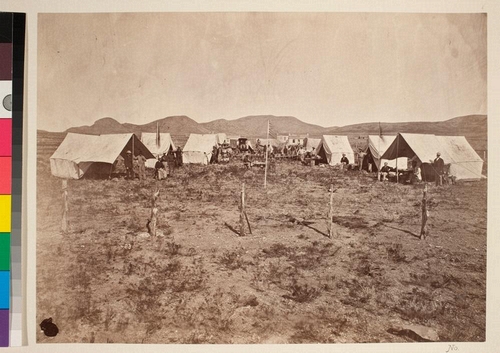
On 14 May 1869, John Wesley Powell, Professor of Geology at Illinois State Normal University, led a party of nine on a privately funded river expedition out of Green River in Wyoming to explore the west. Although the team was reduced by many hardships they passed through the Grand Canyon on 13 August 1869. In later years he was awarded funds by Congress to complete his expeditions. There was no photographer on the first expedition but this lack was remedied on the second and it was one of the oarsmen John K. Hillers who showed an interest in photography and became one of the most respected photographers of the American west.
 
Photographers: Elias Olcott Beaman, James Fennemore, John K. Hillers
 
The photograph shows the First Camp of the Second Powell Expedition at Green River, Wyoming (4 May 1871).
 
Shown from left to right are: Professor Almon Harris Thompson, Andrew Hattan, S.V. Jones, John F. Steward, W.C. Powell, Frank C.A. Richardson, Frederick Dellenbaugh, and F.M. Bishop. Green River, Wyoming. May 4, 1871. 
  
434.18   Scientific >  Edward S. Curtis: Harriman Alaska Expedition (1899) 
About this photographer | Photographs by this photographer 
  
Thumbnail Thumbnail Thumbnail Thumbnail  


Panama 
  
434.19   Scientific >  John Moran: Darien Expedition (1871) 
  
Thumbnail Thumbnail Thumbnail Thumbnail Thumbnail  


Chile 
  
434.20   Scientific >  HMS Topaze and Easter Island, Chile (1868) 
  
Thumbnail  
  
The moai or stone statues of Easter Islands (Rapu Nui) in Polynesia were known to Western expeditions through the oil painting of William Hodges who was the artist on Captain Cook's visit to the island on a survey mission in 1774.
 
In 1868 the English ship HMS Topaze commanded by Richard Ashmore Powell collected the four ton statue Hoa Hakananai'a (thought to mean 'stolen or hidden friend') and took it out on a raft to the ship. In Valparaiso in Chile Paul-Émile Miot photographed the statue on the deck of HMS Topaze enroute to Great Britain where it is now in the British Museum
  
Middle East 
  
434.21   Scientific >  Palestine Exploration Fund 
  
Thumbnail Thumbnail Thumbnail Thumbnail Thumbnail Thumbnail Thumbnail Thumbnail Thumbnail Thumbnail Thumbnail Thumbnail  
  
Karl Baedeker (firm) Palestine and Syria. Handbook for Travellers (Leipsic: Karl Baedeker, 1876), p.125-126.
Lastly we must mention the valuable services rendered to science by the society of the 'Palestine Exploration Fund', whose labours have extended over nearly ten years, but which unfortunately has not received pecuniary support commensurate with the importance of its objects. (Subscriptions are received by the Secretary, Walter Besant, Esq., 9 Pall Mall East, London.) The object of the society is the 'accurate and systematic exploration of the topography, geology, natural history, and ethnology of the Holy Land, particularly with a view to the interpretation of the Bible'. The society publishes ' Quarterly Statements', sent gratis to every subscriber, the substance of which down to the end of 1872 is comprised in two very interesting works. The larger of these is the 'Recovery of Jerusalem' by Major Wilson and Capt. Warren, edited by W. Morrison (London, 1871), and the smaller, which is to a great extent abridged from the other, 'Our Work in Palestine' (London, 1873). The Society first sent out Major Wilson, R.E., and Captain Anderson, R.E., to report on the best method of proceeding. These officers made a reconnaissance in Galilee and along the watershed to Nabulus; they took a great number of photographs and discovered several of the Galilean synagogues. The Fund next turned its attention to the archaeology of Jerusalem. In 1867 Capt. Warren, R.E., was sent out. His work was continued till 1870, and consisted mainly in making excavations. He, however, also made reconnaissances in Philistia, the Jordan Valley, and Moab. The results of the Jerusalem work are extremely valuable to scholars, especially in fixing the character and dimensions of the great Temple platform and the original rock surface of the Temple hill.
 
In 1871 the Society sent out Professor Palmer, accompanied by Mi. Tyrwhitt Drake. These gentlemen made an adventurous journey through the Negeb and an expedition into Moab.
 
In 1872 the most important undertaking of the Fund was started, being the topographical survey of Western Palestine to the scale of 1-inch to the mile. The party was commanded by Captain Stewart, R.E., and included Mr. Tyrwhitt Drake. Captain Stewart fell ill at the commencement of the work and was succeeded by Lieut. Conder, R.E., who is still in command. At the present date the survey of the whole country from Beersheba to Safed in Galilee, 4600 sq. miles in area, is complete, while 1400 sq. miles remain to be surveyed in upper Galilee. Mr. Tyrwhitt Drake died at his work from fever in June 1874. On 11th July, 1875, the survey party was attacked by a fanatical armed mob at Safed. Lieut. Conder was wounded, as well as Lieut. Kitchener, R.E., the second in command, and nearly every other member of the party. In consequence of this attack, and of the spread of cholera, the party was withdrawn for the winter. It is hoped that the survey will be completed in 1876, and published about a year later.
 
This work will probably prove the most important yet done in Palestine. The Biblical discoveries have been numerous and important; the number of sites explored and names collected is six or seven times greater than that on any published map; careful observations of natural history, geology, architecture, etc., have been made, and large scale plans of important towns, ruins, or buildings, have been drawn. Between 30 and 40 new churches have been found in various parts of Palestine, and some 200 of the rock-cut tombs have been planned.
 
The map will be published in ten large sheets, each accompanied by a memoir with plans and lists of names in English and Arabic. An endeavour will be made to give a description of every ruined site in the whole country from Dan to Beersheba. Numerous photographs have also been taken by the party, which are now being published.
 
In 1874 the Fund also sent out M. Clermont-Ganneau to Jerusalem. His work was principally epigraphic, and his most valuable discovery was that of a fine Hebrew inscription defining the limits of the city of Gezer, which he had already identified from independent considerations.
 
  
434.22   Scientific >  Ordnance Survey of Jerusalem 
  
Thumbnail Thumbnail  
  
"Relics and Photographs from the Holy Land", The Scattered Nation, Volumes 3-4, July 1, 1869, January, p.194
The Committee of the Palestine Exploration Fund have opened the Dudley Gallery, Egyptian Hall, Piccadilly, for an exhibition of great interest, which may form the nucleus of the desired Biblical Museum.

The centre piece of the Gallery is a large Ordnance Survey Plan of Jerusalem and its environs, telling very forcibly to the eye the nature of the country, with its well-known historic liills and sacred sites. The walls of the Gallery are hung with nearly 350 admirable photographic views of scenes in Palestine and Syria, taken by Sergeant Phillips under the orders of Captain Wilson and Lieutenant Warren. These pictures are a study in themselves. After looking at them we seem to be familiar with landscapes, now desolate and ruin bestrewn, once so rich and fertile, "with milk and honey blest," that land, "Over whose acres trod those blessed feet."
 
  
434.23   Scientific >  Ordnance Survey of the Peninsula of Sinai 
  
Thumbnail Thumbnail Thumbnail Thumbnail Thumbnail Thumbnail  


434.24   Scientific >  American Palestine Exploration Society 
  
Thumbnail  
  
The American Palestine Exploration Society was founded in New York in 1870 as a privately funded society for archaeological and geographic exploration of the Holy Land. A forerunner of the American Schools of Oriental Research, the organization conducted its second expedition to the Holy Land in 1875 and hired French photographer Tancrede Dumas, who owned a studio in Beirut, to accompany the expedition.
 
Boston Univerversity houses the American Palestine Exploration Society (APES) Photograph Collection. 
  
434.25   Scientific >  Louis de Clercq: Voyage en Orient (1860) 
About this photographer | Photographs by this photographer 
  
Thumbnail Thumbnail Thumbnail Thumbnail Thumbnail Thumbnail Thumbnail Thumbnail Thumbnail Thumbnail Thumbnail Thumbnail  


434.26   Scientific >  Francis Bedford: The Prince of Wales and his trip to the East (1862) 
About this photographer | Photographs by this photographer 
  
Thumbnail Thumbnail Thumbnail Thumbnail Thumbnail Thumbnail Thumbnail Thumbnail Thumbnail Thumbnail Thumbnail Thumbnail Thumbnail Thumbnail Thumbnail Thumbnail Thumbnail Thumbnail Thumbnail Thumbnail Thumbnail Thumbnail Thumbnail Thumbnail Thumbnail Thumbnail Thumbnail Thumbnail Thumbnail Thumbnail Thumbnail Thumbnail Thumbnail Thumbnail Thumbnail Thumbnail Thumbnail  
  
The Royal Collection in the UK includes The Prince of Wales's diary which contains insights into his 1862 Tour.
 
4 March 1862
We then proceeded on the dromedaries (not at all an unpleasant mode of conveyance) to the celebrated Pyramids of Ghizeh - They quite exceeded my expectations, & are certainly wonderful mementoes of our forefathers. We visited the Sphinx just before sunset, which is also very curious and interesting. We had a charming little encampment just below the Pyramids where we slept for the night'
13 March 1862
"....The ruins of Philae are beautiful and most interesting and Mr. Bedford the photographer, who came from England with me and our party took some very good views...."
14 March 1862
"....Mr. Bedford (the photographer who accompanied us from England) took some very successful views of the temple (at Edfoo)".
21 April 1862
".... We lunched under a figtree at 12 o'clock on the site of where once the city of Capernaum is said to have stood, + Mr. Bedford photographed us 'en groupe'."
4 May 1862
"At about 10 we left our camp to lionize thoroughly the fine temple (at Baalbec) + we were much pleased with what we saw. We remained about two hours going over it; Mr. Bedford took some excellent views of it, which will be a great addition to his collection of photographs...."
Bill Jay "Royal Command - Francis Bedford's photographs of the educational tour of the Middle East by the Prince of Wales, 1862"
http://www.billjayonphotography.com/Royal%20Command-%20Francis%20Bedford.pdf 
  
   Francis  Bedford Tour 
View exhibition 
Title | Lightbox | Checklist
 
  
434.27   Scientific >  Louis Vignes: Voyage d'Exploration a la Mer Morte a Petra et sur la River Gauche du Jourdain par M. Le Duc de Luynes (1868-74) 
  
Thumbnail Thumbnail Thumbnail Thumbnail  


Nubia (South Egypt / Northern Sudan) 
  
434.28   Scientific >  The Breasted Expeditions to Egypt and the Sudan (1905-1907) 
  
James Henry Breasted led two expeditions (1905-1906 and 1906-1907) for the University of Chicago to record the archaeological monuments of Nubia which was an ancient land along the Nile now part of southern Egypt and northern Sudan between the First and Sixth Cataracts of the Nile. The official photographers on the expedition were Friedrich Koch in the first season (1905-1906) covering Lower Nubia taking glass plate negatives and Horst Schliephack for the second season in Upper Nubia (1906-1907). Horst Schliephack was fired after he was found to have carved "H. Schliephack 1906" into the walls of the temples at Naga and Musauwarat. In the second season both glass plate negatives and roll film were used; the latter for candid photography and ethnographic documentation. Other members of the expedition including the American engineer Victor Smith Persons and the expedition leader James Henry Breasted also took photographs. Almost 1,200 photographs were taken from these expedition seasons and they are at The Oriental Institute of the University of Chicago. During the expedition blueprints were made from the photographs of inscriptions which could be checked on-site with the originals. 
  
434.29   Scientific >  Photographing in the interior of the Great Temple at Abu Simbel (1906) 
  
James Henry Breasted
The 1905–07 Breasted Expeditions to Egypt and the Sudan - First Season - Field Diary
The Oriental Institute - University of Chicago

Monday, February 12, 1906

"With some interruptions it took about two weeks to facsimile the big marriage stela. Meantime Persons had been drawing off his plan of the Halfa temple, and Koch was making negatives in the great hall of the temple. Persons was constantly called on to leave his plans and build scaffolds for Koch. We have twelve ladders with us, which we had made in Cairo. These with a supply of timbers, planks and boxes, furnish us with all necessary material for such scaffold-building. As soon as I was free from the big marriage stela, I took Koch's prints and collated all inscriptions from ladders. This work I finished on the two long walls yesterday. We have now secured facsimile records of all the historical documents in the temple, the first ever made ... .
 
The work of securing our negatives has continually involved a host of problems, many of them difficult. The great hall was only conquered after many experiments. As it is hewn into the mountain we were obliged to use artificial illumination. The placing of the both camera and light was interfered with by the huge pillars, and it was constantly necessary to place the light directly in range of the objective so that it was sometimes necessary to veil the light when 25 feet from the floor. All focusing had to be done by means of lighted candles placed one at each corner and one in the middle of the section of wall to be photographed. All this on lofty scaffolds or on ladders many feet from the floor was slow and often experimental. These and other difficulties by way of proper exposure, once overcome, the dark room also proved a fruitful source of obstacles. The Nile carries so much sand that the water must be filtered before it can be used for washing plates, and the frequent sand-storms often leave our dried plates with a gelatin surface like sand-paper. Nevertheless the negatives of the great hall are clear, beautiful, and in spite of enforced positions in focusing, are not distorted. We shall be able to make a superb volume of this matchless temple."
John A. Larson Lost Nubia. A Centennial Exhibit of Photographs from the 1905-1907 Egyptian Expedition of the University of Chicago (Oriental Institute Museum Publications No.24. The University of Chicago, 2006), p.37 
  
434.30   Scientific >  Photographing the Temple of Amun and Amunhotep III at Soleb (1907) 
  
James Henry Breasted
The 1905–07 Breasted Expeditions to Egypt and the Sudan - Second Season - Field Diary
The Oriental Institute - University of Chicago

Monday, February 9, 1907 - Sedeinga

"We had a hard ten days at Soleb. The wind rose again and made work so difficult as to be well nigh impossible. But the place amply repaid our labor. I found two important new monuments the. First the entire pylon front of which only the north tower is partially preserved, bears reliefs of Ikhnaton, made before he changed his name and overthrew Amon worship... . The second monument is two series of reliefs representing elaborate ceremonies in the celebration of the king's (Amunhotep III's) Thirty Years' Jubilee. These walls are high and I had been unable to bring our large ladders on this long journey. It seemed impossible to reach them. I finally secured four palm trunks from the natives, and, with our two gangplanks, and sole poles and oars from the boats we contrived a tall scaffolding from which, by erecting our ladders upon it, we reached the top of the lofty wall, and photographed all the way down, section by section to the base - over 30 large negatives. The difficulty was much increased by the high wind which at one time almost blew down our scaffold. In such a wind it is impossible to use artificial illumination, as the draft quite dissipates the flame and hence also the light of the magnesium. The highest wall never received any sunlight at all, and as artificial light was impossible, I built a large mirror of new sheet tin, and by standing at one projecting end of the scaffold I could illuminate a small section of the wall with sunlight from the tin mirror while Schliephack worked at the camera. This was trying work, as the mirror exposed a large surface to the wind, and it often in the midst of an exposure threatened to carry off the scaffold. But I could not entrust it to any one else, as the mirror required constant movement within a given surface in order to illuminate all parts uniformly and to secure a uniform impression on the plate. The other wall fortunately received the sunlight at a good angle for an hour each day, and we slowly accumulated all the negatives by rapid work during that hour each day."
John A. Larson Lost Nubia. A Centennial Exhibit of Photographs from the 1905-1907 Egyptian Expedition of the University of Chicago (Oriental Institute Museum Publications No.24. The University of Chicago, 2006), p.47 
  
Africa 
  
434.31   Scientific >  Royal Geographical Society Expedition: Nyassa 
  
Thumbnail Thumbnail  


Arctic 
  
434.32   Scientific >  Richard Beard: British Naval Northwest Passage Expedition (1845-1848) 
About this photographer | Photographs by this photographer 
  
Thumbnail Thumbnail Thumbnail  


434.33   Scientific >  Richard Beard: Sir John Franklin 
About this photographer | Photographs by this photographer 
  
Thumbnail Thumbnail Thumbnail Thumbnail Thumbnail  
  
The 1845 daguerreotype three-quarter length portrait of Sir John Franklin seated and holding a telescope was taken prior to his departure on H.M.S. Erebus on the ill-fated British Naval Northwest Passage Expedition (1845-1848). The daguerreotype was taken before photographs could be printed in publications and therefore had to be copied on to a woodcut or engraving prior to print. This series of images show how quality was lost as the portrait was copied. 
  
434.34   Scientific >  Captain Edward Augustus Inglefield: Inglefield Expedition (1850s) 
  
Thumbnail Thumbnail Thumbnail  


434.35   Scientific >  William Bradford, John Dunmore and George Critcherson: The Arctic Regions (1873) 
About this photographer | Photographs by this photographer 
  
Thumbnail Thumbnail Thumbnail Thumbnail Thumbnail Thumbnail Thumbnail Thumbnail  
  
William Bradford was a popular artist, traveler and Arctic explorer. His book The Arctic Regions, Illustrated with Photographs Taken on an Art Expedition to Greenland (London: Chiswick Press for Sampson Low, Marston, Low and Searle, 1873) is one of the classic works of photographic history. The photographs in his book are usually credited to John Dunmore and George Crichterson but it is now believed that Bradford took many of the photographs himself.
William Bradford, a popular American artist, was a traveler and adventurer fascinated with the Arctic landscape. His magnificent volume, "The Arctic Regions," the result of six expeditions to the area, is considered a landmark in the history of the photographically illustrated book. Sumptuously bound and profusely illustrated with original photographs, the text combined sober scientific observation with romantic hyperbole. It features 141 spectacular albumen photographs, including a 2-part panorama, which set it apart from other accounts that were illustrated with engravings. The Art Journal of London hailed the publication as "the most instructive work on the frozen seas that has ever appeared."
 
Working under Bradford''s supervision were John Dunmore and George Crichterson, photographers associated with the prominent firm, James Wallace Black Studio, in Boston. Although these men are credited with the photographs it is now believed that Bradford himself may have taken many of the pictures, which feature remarkable scenes of icebergs and ice floes in addition to pictures of indigenous people ("Eskimaux") and moored ships.
 
A source of great interest throughout the nineteenth century, the Arctic blossomed in the public imagination, manifesting itself through a widespread desire for images, stories, and interpretations of the seemingly desolate area. The images in "The Arctic Region" depict views of an alien, frozen land and its exotic inhabitants.
 
Recounting his voyage, Bradford described working under adverse conditions. The harsh weather often caused major setbacks and annoyances among the ship''s crew. Dunmore also described a dangerous instance in which both their equipment and lives were at stake: "We sailed about sixty miles to the mouth of a glacier, where the icebergs break off, to take some views. Just as we were landing a large berg broke off which sent the water up twenty feet all over us, and washed away collodion, developing glass, green baize, etc., and came very near taking is along with them." Yet, despite these challenges, they produced remarkable photographs of a stunning, and now endangered, landscape. The volume is a tribute to Bradford''s heroic vision and the photographers who skillfully worked in the most difficult of circumstances.
 
[Courtesy of Swann Galleries - New York] 
  
434.36   Scientific >  Thomas Mitchell: The British Arctic Expedition (1875-1876) 
  
Thumbnail Thumbnail Thumbnail  


434.37   Scientific >  The Greeley Arctic Exploring Expedition (1881-1884) 
  
Thumbnail Thumbnail Thumbnail  


434.38   Scientific >  Prince Roland Bonaparte's ethnographic expedition to Lapland (1884) 
  
Thumbnail Thumbnail Thumbnail Thumbnail Thumbnail Thumbnail Thumbnail Thumbnail Thumbnail Thumbnail Thumbnail Thumbnail Thumbnail Thumbnail Thumbnail Thumbnail Thumbnail Thumbnail Thumbnail Thumbnail Thumbnail Thumbnail Thumbnail Thumbnail Thumbnail Thumbnail Thumbnail Thumbnail Thumbnail Thumbnail Thumbnail Thumbnail Thumbnail Thumbnail Thumbnail Thumbnail Thumbnail Thumbnail Thumbnail Thumbnail Thumbnail Thumbnail Thumbnail Thumbnail Thumbnail Thumbnail Thumbnail Thumbnail Thumbnail Thumbnail Thumbnail Thumbnail Thumbnail Thumbnail Thumbnail Thumbnail Thumbnail Thumbnail Thumbnail Thumbnail Thumbnail Thumbnail Thumbnail Thumbnail Thumbnail Thumbnail  
  
An aristocratic relation of Napoleon, Prince Roland Bonaparte (1858-1924) took a 19th century gentleman‘s interest in the sciences and in particular, during the earlier part of his life, in the study of anthropology. Like others of the period, he looked on photography as a scientific tool for preserving data from his expeditions, and used it to document the Amerindians, Surinames, Hottentots and other unusual peoples brought to European exhibitions.
 
In 1884 Bonaparte organized an ethnographic expedition to Lapland, an artic region in northern Europe, which described by F. Escard in an 1886 monograph Le Prince Roland Bonaparte in Laponie. A portfolio of collotypes Lapons (Laplanders) was also issued from the negatives taken during the trip by "the Prince‘s usual photographer" (Escard 1886, viii). The collotype plates, which are quite uncommon, document each sitter in paired frontal / profile views reminiscent of modern criminal mugshots. The images measure 6 x 4.5 inches (15x12 cm), printed on sheets 12 x 17 inches (30x44 cm).
 
Bonaparte‘s work is grounded in the anthropology of his time, which focussed on the documentation of physical characteristics, and in particular on shape and dimensions of the skull as a means of establishing relations between the human races. This tack had been given to European anthropology by its pioneers earlier in the century, notably Paul Broca, whose thinking was informed by the discovery of the first fragments of early man and whose standard field guide for anthropologists involved a complex series of physical measurements. The hard scientific results of Bonaparte‘s expedition were thus conclusions of the sort that Laplanders were "brachycephalic," had little facial hair, and possessed a "mean nasal index of 74.59 for the men, 73.64 for the women" (Escard 1886, xiii). This attitude is clear in Bonaparte‘s images, yet paradoxically the sitters role as human specimens, accentuated further by the numbered cards held next to each on a short stick, allows them a status and often a dignity which would be lacking in more commonplace photography.
 
Further reading
 
Escard, F., Le Prince Roland Bonaparte in Laponie: Episodes et Tableaux. Paris, G. Chamerot, 1886.
 
© Christopher Wahren (2006) - Used with permission 
  
   Scientific Ethnographic Lapps 
View exhibition 
Title | Lightbox | Checklist
 
  
434.39   Scientific >  Nils Strindberg: S.A. Andrée's Arctic balloon expedition (1897) 
About this photographer | Photographs by this photographer 
  
Thumbnail Thumbnail Thumbnail Thumbnail  
  
Nils Strindberg was a participant in Salomon August Andrée's ill-fated Arctic balloon expedition of 1897 that attempted to reach to the North Pole using a balloon. Strindberg was tasked with making a photographic record he documented both the early stages of the preparations, flight and the tragic attempts to survive as the ill-equipped party attempted to gain safety. The remains of the expedition were discovered by the Bratvaag Expedition in 1930 along with five rolls of film and 93 of the photographs were saved. 
  
Antarctica 
  
434.40   Scientific >  Herbert Ponting: British Antarctic Expedition - Scott - Terra Nova (1910-1913) 
About this photographer | Photographs by this photographer 
  
Thumbnail Thumbnail Thumbnail Thumbnail Thumbnail Thumbnail Thumbnail Thumbnail Thumbnail Thumbnail  


434.41   Scientific >  Frank Hurley: Imperial Trans-Antarctic Expedition (1914-1917) 
About this photographer | Photographs by this photographer 
  
Thumbnail Thumbnail Thumbnail Thumbnail Thumbnail Thumbnail Thumbnail Thumbnail Thumbnail Thumbnail Thumbnail Thumbnail Thumbnail  


Pack animals 
  
434.42   Scientific >  Pack animals - mules, donkeys, burros and horses 
  
Thumbnail Thumbnail Thumbnail Thumbnail Thumbnail Thumbnail  


434.43   Scientific >  L.A. Huffman: The Rage of Huffman and the Calmness of Nig (1883) 
About this photographer | Photographs by this photographer 
  
Thumbnail  
  
G.O. Shields Rustlings in the Rockies: Hunting and Fishing by Mountain and Stream (Chicago: Belford, Clarke & Co., 1883), Chapter X, "Through the Canyon of the Little Big Horn", p.82-86
And this recalls to my mind an incident of the trip that must not be overlooked. Soon after leaving the forks of the stream, we reached a point where it became necessary to cross it in order to avoid a long detour around a bend. We therefore selected the most favorable point we could find a place where the banks were low and the water not more than two feet deep and started in with Huffman in the lead. I followed him with Blinkie, my white pony, and the pack mules followed me, Jack remaining for the time in the rear to drive them across. Chicken, one of the pack mules, crossed and climbed the bank all right, when Nig, a large black mule, who was always disposed to be willful and contrary, and who was never willing to follow his file leader when he. saw an opportunity of making an annoying "break," walked down the first bank into the water, then turned and waded slowly and deliberately down the stream toward a deep hole that lay a few yards below the crossing. His load consisted principally of Huffman's photographic outfit, camera, dry plates, dark tent, etc.; and when Huffman saw that they were placed in jeopardy that the dry plates were in imminent danger of being transformed into wet plates by a process that would render them utterly worthless to him that the camera was liable to be soaked with water and ruined he became frantic.
 
He dismounted and rushed madly down the bank of the stream, yelling, throwing clubs, trying in every possible way to head Nig off; but the ugly brute would not head worth a cent. He looked mildly at the woe-begone artist out of his left eye, stopped and drank a few swallows of water, took a step or two, and looked again, first at Huffman and then at Jack, who was on the opposite side of the river, shouting, and throwing clubs, rocks and other dibris at the long-eared vandal.
 
"Jack!" shouted the artist, "drive that cantankerous brute out of that deep water, quick, or he'll drown my photograph gallery! Jump in and catch him quick! Blank blank that blanked long-eared son-of-a-gun to blankety blank!"
 
"Jump in yourself," said Jack, "I don't want to get my feet wet."
 
And still the mule moved slowly down the stream, every step taking him into deeper water, bringing his precious load, valued at three hundred dollars, nearer and nearer to the destroying element, while an artist to the mountains bound cries, " Conley, do not tarry and I'll give thee a silver dollar to drive that doggoned mule o'er the ferry."
 
"Now, who be ye would cross Big Horn, this deep and muddy water?"
 
"Oh, I'm the artist from Miles City, and this my precious plunder. And fast upon these saddle mules three days we've rode together, and should he wet them in the creek they wouldn't be worth a feather."
 
Outspoke the hardy Emerald wight, "I'll go, my chief, I'm ready. It is not for your dollar bright, but for some pretty pictures; and by my word, that cussed mule in the water shall not tarry, so though the waves are raging white, I'll drive him over the ferry or break his blanked neck! G'lang, Nig, git out of there, you son-of-a-gun!" But still, as wilder blew the wind, and as the artist grew madder, adown the stream walked that pesky mule where the water still was deeper.
 
"Oh, haste thee, haste!" the artist cries. "Though tempests round us gather, I'll meet the raging of the water, but if I lose that outfit I'll walk home to-night."
 
The mule has left a sultry land, a cool bath is before him, when' oh! too strong for human hands, he don't care how many clubs come o'er him. And still they howled amidst the roar of waters fast prevailing, the artist reached that fatal shore, his wrath was changed to wailing. For sore dismayed through storm and shade his mule he did discover, one lovely hand he stretched for the bridle but, oh, he couldn't reach it.
 
'' Come back, come back,'' he cried in grief across this muddy river, "and I'll forgive the wayward cuss, my donkey, oh, my donkey." 'Twas vain; the loud waves lashed his sides, return or aid suggesting, the waters wild kind o' frightened him, and he turned and came out on the bank o. k.
 
We took his load off, opened it, and found that though the lower corners of both boxes were wet, the moisture had not reached their contents. We congratulated Huffman on the fact that his dry goods were still dry that his stock had not been watered, so to speak and went'on our way rejoicing.
 
  
Dark tents and dark boxes 
  
434.44   Scientific >  Contemporary accounts of nineteenth century dark tents 
  
Thumbnail Thumbnail Thumbnail Thumbnail Thumbnail Thumbnail Thumbnail  
  
Contemporary accounts of dark tents and dark boxes:
  • D.L. Mundy
     
    My usual plan of proceeding was to erect an ordinary digger's tent, supported upon a couple of forked poles and well fastened down with guy-ropes; then, from the ridge of the structure, suspending a square photographic tent made of mackintosh material, with black calico skirts resting on the ground and kept securely fixed with stones. In fine weather this supplementary operating-tent was erected outside the ordinary dwelling; but at other times better protection was afforded by suspending it within the larger tent. A square window of yellow oiled silk, measuring about 18 inches in both dimensions, admitted enough light to work by, and was of course proof against fracture during my journeys. A packhorse carried a couple of strong leather trunks slung from the saddle, in one of which the chemicals were packed, while the apparatus was placed in the other.
     
    D.L. Mundy, "Photographic Experiences in New Zealand.", The Photographic Journal, No.254, Dec 11, 1874, p.87.
     
  • Samuel Bourne
     
    Or, if we wish to make sure of our pictures on the spot, and lug about a huge tent and a score or two of bottles, in addition to what is required for a dry process, the thing absolutely becomes the work of a slave. Great as is my liking for photography, I confess that were I always compelled to adopt the latter expedient when I wanted to take a picture far away from home, my journeys abroad for that purpose would be something like angels' visits—" few and far between." How many photographers could relate pleasing narratives of certain not over-pleasing incidents connected with their pictorial wanderings!—how, being mistaken for a pedlar, they have been told, when about to plant their camera to take a view of some curious old farm-house or uninhabited ruin, that they need not unpack their traps, as there was "nothing wanted;"—how many limes they have had to mourn over an upset bath of nitrate of silver, or a collodion bottle from which an ejected stopper has allowed all the precious fluid to escape;— how the perspiration has streamed from them as with lightning rapidity they popped in and out of the suffocating tent;—how some curious bull, anxious to know the contents of the suspicious-looking camera, has playfully employed his horns to lift it up for that purpose; and how they have stood looking on in silent and pensive amazement, while a gust of wind has sent tent, bottles, and camera on a rolling expedition down the mountain's side. Such are a specimen of what every photographer may expect to meet with and undergo, in the ardent pursuit of his favourite study.
     
    Samuel Bourne, "On Some of the Requisites Necessary for the Production of a Good Photograph" read before the Nottingham Photographic Society, Jan 31, 1860 and published in The Photographic News, Feb 24, 1860, p.297. This article has been reprinted in Hugh Raynor (ed.) Photographic Journeys in the Himalayas - Samuel Bourne (Bath: Pagoda Tree Press, 2001).
     
  • Color Sargeant D.G. Crotty
     
    In the afternoon, while busy cleaning our guns, a thundering noise is heard. Looking in the direction of the sound, a monster shell is observed approaching. We all drop a courtesy, a la Japanese, by getting on our knees. It passes over and thuds into the ground behind the photographic tent of Fred H___, who runs out, white as a sheet, to learn the cause of the noise, and observes behind his tent, a hole large enough to bury a mule in, caused by the shell. He immediately packed up his pictures, vamoosed the camp, and it is said, never stopped until he was safe in his own valley city, in Michigan, nor did he take any more pictures on the sacred soil.
     
    Color Sargeant D.G. Crotty, Third Michigan Volunteer Infantry, Four Years Campaigning in the Army of the Potomac (Grand Rapids, Mich.: Dygert Bros. & Co., 1874), p.41.
     
  • Paul D. Du Chaillu
     
    My photographic apparatus, or at least what remained of it, was much admired by friend Mayolo. He was the most inquisitive man of his tribe, none of whom were wanting in curiosity, and he was never weary of asking me questions and inspecting my wonderful stores. When I first took out the photographic tent from its box, he was amazed, after seeing it fixed, to discover what a bulky affair could come out of so small a box. After fixing the tent I withdrew the slide and exposed the orange-coloured glass, and invited the mystified chief to look through it at the prairie. At first he was afraid and declined to come into the tent; but on my telling him that he knew I should never do anything to harm him, he consented. He could not comprehend it. He looked at me, at my hands, then at the glass, and believed there was witchcraft at the bottom of it. After Mayolo had come out of the tent unharmed, the rest of the negroes took courage, and my tent was made a peep-show for the remainder of the day.
     
    Paul D. Du Chaillu, A Journey to Ashango-Land, and Further Penetration into Equatorial Africa, (New York: Harper & Brothers, 1871), Chapter IX, p.194. There is a very similar account of this event in his later book The Country of the Dwarfs (New York: Harper & Brothers), p.176. The illustrations in his books were questioned by his contemporaries - see for example "Art. VI Equatorial Africa, and its Inhabitants" in The Westminster Review, No.CXLIX, July 1861, p.75 onwards where one of his illustrations looks very similar to a photograph of a gorilla taken by Roger Fenton in the collections of the British Museum.
 
  
434.45   Scientific >  Dark tents and dark boxes 
  
Thumbnail Thumbnail Thumbnail Thumbnail Thumbnail Thumbnail Thumbnail Thumbnail Thumbnail Thumbnail Thumbnail Thumbnail Thumbnail Thumbnail Thumbnail Thumbnail  


434.46   Scientific >  Carleton Watkins: #925 Spring Valley Water Works 
About this photographer | Photographs by this photographer 
  
Thumbnail Thumbnail Thumbnail Thumbnail Thumbnail Thumbnail Thumbnail Thumbnail Thumbnail Thumbnail Thumbnail Thumbnail Thumbnail Thumbnail  
  
The following comments by Will Dunniway and Robert Szabo, two contemporary wet-plate collodion photographers, explain the significance of this rare yellow-mount stereoview "#925 Spring Valley Water Works" by Carleton E. Watkins:
 
The items inside the tent:
  1. The spigot for his water supply. It is not possible to see what the container was made of, but most likely it would have been copper or brass for weight considerations.
     
  2. Three of the four visible bottles appear to be leather wrapped. This is to prevent the glass from breaking from a rough wagon ride between shoots.
     
  3. There is an open wooden box and it is uncertain what it would have been used for. It was most likely to have been used for transporting chemicals and photographic paraphernalia.
The items outside the tent:
  1. As can be seen here Carleton Watkins used a vertical bath to process his mammoth plates. It has been suggested that he used a tray as his bath to sensitize his plates but this is conclusive. There is a further point about this bath tank. He is said to have NOT used a glass liner to contain his bath. Instead it was believed he asphalt painted the inside, or something along this line. In this image, it appears that there is not a glass liner. To seal this bath for traveling, usually the glass tank will extend above the wooden rim.
     
  2. A mammoth plate storage box.
     
  3. These boxes appear to be the 5x8 inch plate storage boxes for making stereo images. They are about the right size for two rows of plates, with a divider in the middle. They are on top the large mammoth plate boxes not being used at this moment of exposure, thus, these 5x8 plate boxes are sequentially in order.
     
  4. A glass plate cleaning vise.
     
  5. The lid clamp to a silver bath tank. The metal clamp with thumb screws was used for the sealing off this bath tank when traveling. The wooden lid for this huge mammoth plate silver bath tank appears to be with this clamp.
The tent itself:
 
The dark tent is lined with what I think is yellow, or a very warm colored material. As you know, collodion is a blue sensitive emulsion (it is called 'Ordinary'). This being what this is, the blue will NOT be seen, where as the yellow (red or warm tones) would be seen as dark. The outer material seems to be plain white canvas duck. The white outer shell is so the interior of this dark tent would not heat up in direct sun. This color choice was a must on warm days. After about 90oF outside, the inside of the tent would elevate the silver bath to above 80o F in no time at all. At this temperature, silver bath starts to act up, and will produce flawed plates.
 
It is not certain that the person on the left is Carleton E. Watkins and this remains to be confirmed. 
  
   Carleton Eugene  Watkins Spring Valley Water Works 
View exhibition 
Title | Lightbox | Checklist
 
  
434.47   Scientific >  William Henry Jackson: Photographing in High Places 
About this photographer | Photographs by this photographer 
  
Thumbnail Thumbnail Thumbnail  
  
Nathaniel Langford, "The Ascent of Mount Hayden: A New Chapter of Western Discovery", Scribner's Monthly, Vol.VI, No.2, June, 1873, p.129-157
Mr. Jackson, our persevering photographic artist, took a great number of views of the scenery in this vicinity including many of the cascades in the Cafion, and the Tetons from all points of the compass. He is an indefatigable worker, and as often camps alone in some of the wild glens as with the company. Give him fine scenery, and he forgets danger and difficulty in the effort to "get a negative."
Nathaniel Pitt Langford was a prominent member of the Washburn Expedition of 1870, a lobbyist for making Yellowstone the first national park, and the first park superintendent. Mt. Langford in eastern Yellowstone is named after him. 
  
434.48   Scientific >  John Burke: Fixing the Negative 
About this photographer | Photographs by this photographer 
  
Thumbnail  
  
An engraving of a sketch by Frederic Villiers [1851-1922] that was published in The Graphic, July 12, 1879
'Mr. J. Burke the photographic artist attached to our Indian Army to illustrate the advance of the troops and the grand scenery of Afghanistan, was permitted by the Ameer of Cabul (sic) to take a series of pictures of himself and his suite at the camp at Gandamak. One of my sketches illustrates the process of 'posing' the Ameer, who indulged in a quiet smoke during the preparation of the photographic plates. After Mr. Burke had taken him in his gorgeous uniform of white and gold, the Ameer showed great anxiety to see the results, and Major Cavagnari explained to him the process of photography.'
This illustration has been reprinted in Omar Khan, From Kashmir to Kabul: The Photographs of Burke and Baker (Prestel Verlag/Mapin Publishing, 2002). 
  
National Geographic 
  
434.49   Scientific >  National Geographic photographers on assignment 
  
Thumbnail  
  
The National Geographic Society was founded on the 27th January 1988 as "a society for the increase and diffusion of geographical knowledge." To achieve this the society has funded over 10,000 scientific research, conservation, expedition and exploration projects. These projects have included oceanic research, archaeology, palaeontology, polar exploration and anthropology.
 
In 1980 the Alexander Graham Bell Medal of the National Geographic Society was awarded to mountain and aerial photographer Bradford Washburn and his wife Barbara Washburn for their seven years mapping the Grand Canyon. 
  
Field note books 
  
434.50   Scientific >  Smithsonian Field Book Project 
  
Thumbnail Thumbnail Thumbnail Thumbnail Thumbnail Thumbnail  
  
The Smithsonian Field Book Project (FBP) commenced in 2010 to put online the thousands of field books and research notes created by the scientists. Although this registary has commenced with the material held within the numerous Smithsonian collections the intention is to extend it to include field books from around the USA. The photographic richness within these collections has yet to be explored.
 
The Field Book Project 
  
Fiction and the reality of travel 
  
434.51   Scientific >  Jules Verne: Around the World in Eighty Days - What would Phileas Fogg and Passepartout have seen in 1872? 
  
Thumbnail Thumbnail Thumbnail Thumbnail Thumbnail Thumbnail Thumbnail Thumbnail Thumbnail Thumbnail Thumbnail Thumbnail Thumbnail Thumbnail Thumbnail Thumbnail Thumbnail Thumbnail Thumbnail Thumbnail Thumbnail Thumbnail Thumbnail Thumbnail Thumbnail Thumbnail Thumbnail Thumbnail Thumbnail Thumbnail Thumbnail Thumbnail Thumbnail Thumbnail Thumbnail Thumbnail Thumbnail Thumbnail Thumbnail Thumbnail Thumbnail Thumbnail Thumbnail Thumbnail Thumbnail Thumbnail Thumbnail Thumbnail Thumbnail Thumbnail Thumbnail Thumbnail Thumbnail Thumbnail Thumbnail Thumbnail Thumbnail Thumbnail Thumbnail Thumbnail Thumbnail Thumbnail Thumbnail Thumbnail Thumbnail  
  
The world as it was when Phileas Fogg and his valet Passepartout passed through on their fictional voyage around the world in 1872.
Great Britain
Egypt
India
Hong Kong
Japan
America
Ireland
Great Britain
What would the dashing pair have witnessed along the way during their intrepid travels?
 
When Jules Verne's book Around the World in Eighty Days was published in 1873 the world was at a stage of rapid industrial development.
 
Only a few years earlier the Suez Canal had been opened greatly reducing the time required to travel from Western Europe to India and the Far East. On 10 May 1869 the rails were joined at Promontary Summit for the Transcontinental railway in the United States. The railway station in Yokohama opened in 1872 symbolizing the immense changes in Japan which had been largely closed to foreigners until the Black Ships of Admiral Perry arrived in 1853. Emmigration and immigration during this period was enormous and ships such as the S/S Manhattan of the Guion Line crossed from Liverpool to New York six times between 1870-1872 and companies like the Pacific Mail Steamship company plied the routes between San Francisco, Panama, Yokohama, Hong Kong and Singapore.
 
The times were far from tranquil: Lieutenant Camus had been killed in Japan in 1868 by Samurai who objected to the presence of foreigners; San Francisco had an earthquake also in 1868, and between 1870 and 1871 there were the Orange Riots in New York. The bison mentioned in the novel were being exterminated in the US and the Battle of the Little Bighorn would happen only a few years later in 1876 changing the ways of the Plains Indians forever.
 
The setting for this online exhibition is the two and a half months from 2nd October 1872 until 21st December 1872 as the fictional Phileas Fogg and his valet Passepartout circumnavigate the globe to win a wager of £40,000. This exhibition follows the approximate route they took and shows the places as they were when the fictional pair passed through. The exact route has not been slavishly followed, nor have the exact dates, but rather they are explored through the visual remains of a long gone world.
 
Following the popularity of Around the World in Eighty Days by Jules Verne the adventurous journalist Nellie Bly set out in 1889 to prove that the journey was viable. Supported by her newspaper, the New York World she completed the trip within 72 days and her book, Around the World in Seventy-Two Days, was also a best seller. 
  
   Around The World in Eighty Days 
View exhibition 
Title | Lightbox | Checklist


alan@luminous-lint.com


HomeContents > Further research


Thumbnail Thumbnail Thumbnail Thumbnail Thumbnail Thumbnail Thumbnail  
  
General reading 
  
1843, May, ‘Incidents of Travel In Yucatan. By John L. Stephens‘, The Ladies' Repository, and Gatherings of the West (Cincinnati), vol.3, pp.160 [Book review] [Δ
  
Gannett, Henry; Chester, C. M. & Tittmann, O. H., 1910, 5 May, ‘Commander Peary's Expedition to the North Pole‘, Nature, vol.83, no.2114, pp.283-286 [Δ
  
Escard, F., 1886, Le Prince Roland Bonaparte in Laponie: Episodes et Tableaux, (Paris: G. Chamerot) [Δ
  
Hanbury-Tenison, Robin, 2006, The Seventy Great Journeys in History, (Thames & Hudson) [Δ
  
Howe, K.S., 2004, First Seen. Portraits Of The World's Peoples 1840-1880 From The Wilson Centre For Photography, (London: Santa Barbara Museum of Art; Third Millennium Publishing) [Δ
  
Huntford, Roland, 1987, The Amundsen Photographs, (Atlantic Monthly Press) isbn-10: 0871131714 isbn-13: 978-0871131713 [First US edition] [Δ
  
Kelsey, Robin, 2007, Archive Style: Photographs and Illustrations for U.S. Surveys, 1850-1890, (University of California Press - An Ahmanson-Murphy Fine Arts Book) isbn-13: 978-0520249356 [Δ
  
Larson, John A., 2006, Lost Nubia. A Centennial Exhibit of Photographs from the 1905-1907 Egyptian Expedition of the University of Chicago, (Oriental Institute Museum Publications No.24. The University of Chicago) isbn-10: 1885923457 [Δ
  
Naef, Weston J. & Wood, James N., 1975, Era of Exploration: The Rise of Landscape Photography in the American West, 1860–1885, (Buffalo: Albright-Knox Art Gallery; New York: The Metropolitan Museum of Art) [Δ
  
Palmquist, Peter E. & Kailbourn, Thomas R., 2000, Pioneer Photographers of the Far West: A Biographical Dictionary, 1840–1865, (Stanford, CA: Stanford University Press) [Δ
  
Palmquist, Peter E. & Kailbourn, Thomas R., 2005, Pioneer Photographers from the Mississippi to the Continental Divide: A Biographical Dictionary, 1839–1865, (Stanford, CA: Stanford University Press) [Δ
  
Peary, Robert, 1898, Northward Over the Great Ice, (London: Methuen And Company) [Δ
  
Perkins, John, 1981, To the Ends of the Earth with the American Museum of Natural History: Four Expeditions to the Arctic. the Congo, the Gobi, and Siberia, (New York: Pantheon Books) [Δ
  
Shields, G.O., 1883, Rustlings in the Rockies: Hunting and Fishing by Mountain and Stream, (Chicago: Belford, Clarke & Co.) [Includes the description of photographer L.A. Huffman and his trials with Nig, a difficult mule.] [Δ
  
Stevens, John Lloyd, 1843, Incidents of Travel in Yucatan, (New York, Harper & Brothers) [Δ
  
Theye, T., 1989, Der Geraubte Schatten. Eine Weltreise im Spiegel der Ethnographischen Photographie, (Munich & Lucerne: Bucher) [Δ
  
Tyrrell, J. Burr, 1897, Report on the Doobaunt, Kazan and Ferguson Rivers, the north-west coast of Hudson Bay, and on two overland routes from Hudson Bay to Lake Winnipeg, (Ottawa: S. E. Dawson) [Δ
  
Wilson, David M., 2011, The Lost Photographs of Captain Scott: Unseen Images from the Legendary Antarctic Expedition, (Little, Brown and Company) isbn-10: 0316178500 isbn-13: 978-0316178501 [Δ


Readings on, or by, individual photographers 
  
Francis Bedford 
  
Gordon, Sophie, 2013, Cairo to Constantinople: Francis Bedford's Photographs of the Middle East, (Royal Collection Publications) isbn-10: 1905686188 isbn-13: 978-1905686186 [Δ
  
Hugo Bernatzik 
  
Byer, D., 1999, Der Fall H. A. Bernatzik. Ein Leben zwischen Ethnologie und Öffentlichkeit 1897-1953, (Cologne: Böhlau) isbn-10: 3412083992 [German] [Δ
  
Auguste Rosalie Bisson 
  
1861, 24 August, ‘Scientific Intellience: A Photographic Ascent of Mont Blanc‘, The London Review, vol.3, no.60, pp.236 [Auguste Rosalie Bisson] [Δ
  
Samuel Bourne 
  
Rayner, Hugh (ed.), 2009, Photographic Journeys in the Himalayas 1863-1866 Samuel Bourne, (Pagoda Press) isbn-13: 978-1904289647 [Δ
  
William Bradford 
  
Bradford, William, 1873, The Arctic Regions, Illustrated with Photographs Taken on an Art Expedition to Greenland, (London: Chiswick Press for Sampson Low, Marston, Low and Searle) [The photographs were taken by John Dunmore, George Critcherson and William Bradford] [Δ
  
Richard Buchta 
  
Buchta, Richard, 1881, Die Oberen Nil-Länder: Volkstypen und Landschaften. Dargestellt in 160 Photographien, nach der Natur aufgenommen von Richard Buchta, (Berlin: Verlag Von J. F. Stiehm) [Δ
  
Thomas, H.B., 1960, ‘Richard Buchta and Early Photography in Uganda‘, Uganda Journal, vol.25, no.1 [Δ
  
Solomon Nunes Carvalho 
  
Berman, Elizabeth, 1989, Solomon Nunes Carvalho: Painter, Photographer, and Prophet in Nineteenth Century America, (Baltimore: Jewish Historical Society of Maryland) [Δ
  
Thomas Joshua Cooper 
  
Jurovics, Toby, 2010, Shoshone Falls: Thomas Joshua Cooper & Timothy O'Sullivan, (Radius Books) isbn-10: 1934435252 isbn-13: 978-1934435250 [Δ
  
George P. Critcherson 
  
Bradford, William, 1873, The Arctic Regions, Illustrated with Photographs Taken on an Art Expedition to Greenland, (London: Chiswick Press for Sampson Low, Marston, Low and Searle) [The photographs were taken by John Dunmore, George Critcherson and William Bradford] [Δ
  
Louis de Clercq 
  
de Clerq, Louis, 1860, Voyage en Orient 1859-1860, villes, monuments et vues pittoresques [Six volumes with 222 calotypes] [Δ
  
Tancrède Dumas 
  
Cobbing, Felicity J., 2005, April, ‘The American Palestine Exploration Society and the Survey of Eastern Palestine‘, Palestine Exploration Quarterly, vol.137, no.1, pp.9-21 [Δ
  
Hallote, Rachel; Cobbing, Felicity & Spurr, Jeffrey B., 2012, The Photographs of the American Palestine Exploration Society, (Annual of the American Schools of Oriental Research) isbn-10: 0897570987 isbn-13: 978-0897570985 [Volume 66] [Δ
  
Palestine Exploration Society, 1876, Catalogue of photographs: taken expressly for the American Palestine Exploration Society, during a reconnaissance east of the Jordan in the Autumn of 1875, (New York) [Photographs taken by Tancrède Dumas] [Δ
  
John L. Dunmore 
  
Bradford, William, 1873, The Arctic Regions, Illustrated with Photographs Taken on an Art Expedition to Greenland, (London: Chiswick Press for Sampson Low, Marston, Low and Searle) [The photographs were taken by John Dunmore, George Critcherson and William Bradford] [Δ
  
Dunmore & Critcherson 
  
Bradford, William, 1873, The Arctic Regions, Illustrated with Photographs Taken on an Art Expedition to Greenland, (London: Chiswick Press for Sampson Low, Marston, Low and Searle) [The photographs were taken by John Dunmore, George Critcherson and William Bradford] [Δ
  
Humphrey Lloyd Hime 
  
Huyda, R., 1975, Camera in the Interior: 1858, H.L. Hime, Photographer [Δ
  
Frank Hurley 
  
Ennis, Helen, 2010, Frank Hurley's Antarctica, (National Library of Australia) isbn-10: 0642276986 isbn-13: 978-0642276988 [Δ
  
Hempleman-Adams, David, Stuart, Emma & Gordon, Sophie, 2009, The Heart of the Great Alone: Scott, Shackleton, and Antarctic Photography, (Bloomsbury USA) isbn-10: 1608190072 isbn-13: 978-1608190072 [Δ
  
Ponting, Herbert & Hurley, Frank, 1979, Antarctic Photographs, 1910-1916: Scott, Mawson and Shackleton Expeditions, (Pan Macmillan) isbn-10: 0333275454 isbn-13: 978-0333275450 [Δ
  
William Henry Jackson 
  
Hales, Peter B., 1988, William Henry Jackson and the Transformation of the American Landscape, (Philadelphia: Temple University Press) [Δ
  
Jackson, Clarence S., 1947, Picture Maker of the Old West: William Henry Jackson, (New York: Charles Scribners & Sons) [Δ
  
Jackson, William Henry, 1986, Time Exposure: The Autobiography of William Henry Jackson, (Albuquerque: University of New Mexico Press) [Introduction by Ferenc M. Szasz] [Δ
  
John Kirk 
  
Foskett, Reginald (ed.), 1965, The Zambesi Journal and Letters of Dr. John Kirk, 1858 – 63 (Edinburgh: Oliver & Boyd [John Kirk, pp. 50-51] [Δ
  
Albert Londe 
  
Londe, Albert, 1893, La photographie dans les voyages d'exploration et les missions scientifique, ([Paris?: Association Pour L'Avancement des Sciences?]) [Δ
  
Paul-Émile Miot 
  
Chomette, Michèle & Richard, Pierre-Marc, 1995, Paul-Émile Miot (1827-1900), un marin photographe 1857-1870, (Paris: Éditions Galerie Michèle Chomette) [A series of four booklets with the following titles: I. Terre-Neuve 1857-1859; II. Amérique du Sud 1868-1870; III. Océanie 1869-1870 et Sénégal 1871; IV. La croisade de l'Astrée 1868-1871 avec Félix Auguste Leclerc 1838-1899] [Δ
  
Timothy H. O'Sullivan 
  
Davis, King F. & Aspinwall, Jane L., 2011, Timothy H. O'Sullivan: The King Survey Photographs, (Nelson Atkins Museum) isbn-10: 0300179847 isbn-13: 978-0300179842 [Δ
  
Jurovics, Toby, 2010, Shoshone Falls: Thomas Joshua Cooper & Timothy O'Sullivan, (Radius Books) isbn-10: 1934435252 isbn-13: 978-1934435250 [Δ
  
Jurovics, Toby; Johnson, Carol; Stapp, William F. & Willumson, Glenn, 2010, Framing the West: The Survey Photographs of Timothy O'Sullivan, (Yale University Press) isbn-10: 0300158912 isbn-13: 978-0300158915 [Δ
  
Kelsey, Robin, 2000, Photography in the Field: Timothy O’Sullivan’s Photographs for the Wheeler Survey, 1871-74, (Ph.D dissertation: Harvard University, Department of History of Art and Architecture) [Δ
  
Kelsey, Robin, 2004, January, ‘Les espaces historiographiques de Timothy O'Sullivan‘, Etudes Photographiques, no.14, pp.4-33 [Δ
  
Kelsey, Robin E., 2004, December, ‘Viewing the Archive: Timothy O'Sullivan’s Photographs for the Wheeler Survey, 1871-74‘, The Art Bulletin, vol.86, no.4, pp.702-723 [Δ
  
Newhall, Beaumont & Newhall, Nancy, 1966, T.H. O'Sullivan, Photographer, (Rochester, N.Y.: George Eastman House) [Δ
  
Samson, John [pseud.?], 1869, September, ‘Photographs from the HIgh Rockies‘, Harper's New Monthly Magazine, vol.39, pp.232 [Δ
  
Snyder, Joel, 1981, American Frontiers: The Photographs of Timothy H. O’Sullivan, 1867–1874, (New York: Aperture) [Δ
  
Wilson, Richard B., 1979, American Vision and Landscape: The Western IMages of Clarence KIng and Timothy O'Sullivan, (Ph.D dissertation: University of New Mexico) [Δ
  
Herbert G. Ponting 
  
Hempleman-Adams, David, Stuart, Emma & Gordon, Sophie, 2009, The Heart of the Great Alone: Scott, Shackleton, and Antarctic Photography, (Bloomsbury USA) isbn-10: 1608190072 isbn-13: 978-1608190072 [Δ
  
Ponting, Herbert, 2004, With Scott to the Pole: The Terra Nova Expedition, 1910-1913, (Bloomsbury Publishing PLC) isbn-10: 0747569681 isbn-13: 978-0747569688 [Δ
  
Ponting, Herbert & Hurley, Frank, 1979, Antarctic Photographs, 1910-1916: Scott, Mawson and Shackleton Expeditions, (Pan Macmillan) isbn-10: 0333275454 isbn-13: 978-0333275450 [Δ
  
Wilson, David M., 2011, The Lost Photographs of Captain Scott: Unseen Images from the Legendary Antarctic Expedition, (Little, Brown and Company) isbn-10: 0316178500 isbn-13: 978-0316178501 [Δ
  
Carleton E. Watkins 
  
Nickel, Douglas R.; Hambourg, Maria Morris & Palmquist, Peter E., 1999, Carleton Watkins: The Art of Perception, (San Francisco: San Francisco Museum of Modern Art) [Δ
  
Palmquist, Peter E. & Sandweiss, Martha A., 1983, Carleton E. Watkins: Photographer of the American West, (Albuquerque: University of New Mexico Press) [Δ
  
Rule, Amy (ed.), 1993, Carleton Watkins: Selected Texts and Bibliography, (Boston: G.K. Hall) [Δ
  
Watkins, Carleton E., 1989, Carleton E. Watkins, Photographs, 1861–1874, (San Francisco: Bedford Arts Publishers) [Δ


If you feel this list is missing a significant book or article please let me know - Alan - alan@luminous-lint.com 
  

HomeContentsPhotographers > Photographers worth investigating

 
Auguste Rosalie Bisson  (1826-1900) • Charles Bodmer  (1809-1893) • Richard Buchta  (1845-1894) • Solomon Nunes Carvalho  (1815-1897) • Jean Chaffanjon  (1854-1913) • Désiré Charnay  (1828-1915) • George P. Critcherson  (1823-1892) • Edward S. Curtis  (1868-1952) • Louis de Clercq  (1836-1901) • Tancrède Dumas  (1830-1905) • John L. Dunmore • Dunmore & Critcherson • Bruno L. Hamel • Heinrich Harrer  (1912-2006) • Humphrey Lloyd Hime  (1833-1903) • Thomas Henry Huxley  (1825-1895) • William Henry Jackson  (1843-1942) • John Kirk  (1832-1922) • Alice D. Le Plongeon • Augustus Le Plongeon  (1826-1908) • Augustus & Alice D. Le Plongeon • John William Lindt  (1845-1926) • A.P. Low  (1861-1942) • Paul-Émile Miot  (1827-1900) • Thomas Mitchell • John Moran  (check) • Eadweard Muybridge  (1830-1904) • Timothy H. O'Sullivan  (1840-1882) • Herbert G. Ponting  (check) • Michael Rockefeller  (1938-1961) • Vittorio Sella  (1859-1943) • Nils Strindberg  (1872-1897) • Josef Székely  (check) • Wilfred Thesiger  (1910-2003) • George White
HomeThemesScientific > Expeditions and exploration 
 
A wider gazeRelated topics 
  
Antarctica 
Arctic 
Dark tents and dark boxes 
Landscapes of North America 
Pack animals - mules, donkeys, burros and horses 
Travel 


HomeContentsOnline exhibitions > Expeditions and exploration

Please submit suggestions for Online Exhibitions that will enhance this theme.
Alan - alan@luminous-lint.com


ThumbnailAntarctica - Le Grand Blanc 
Title | Lightbox | Checklist
Released (November 21, 2010)
ThumbnailBisson frères - Mt. Blanc 
Title | Lightbox | Checklist
Released (December 4, 2010)
ThumbnailCarleton Watkins - Spring Valley Water Works 
Title | Lightbox | Checklist
Released (January 29, 2011)
ThumbnailMichael Rockefeller: In the Highlands of West Papua 
Title | Lightbox | Checklist
Released (January 5, 2008)
ThumbnailPrince Roland Bonaparte's ethnographic expedition to Lapland (1884) 
Title | Lightbox | Checklist
Improved (August 17, 2006)
ThumbnailScientific: 19th Century Expeditions 
Title | Lightbox | Checklist
Released (September 19, 2010) Suggestions for additional expeditions that utilized photography are most welcome.
ThumbnailTimothy O'Sullivan: Explorations and Surveys West of the 100th Meridian (1871-1874) 
Title | Lightbox | Checklist
Released (March 23, 2008)


HomeVisual indexes > Expeditions and exploration

Please submit suggestions for Visual Indexes to enhance this theme.
Alan - alan@luminous-lint.com


   People 
  
ThumbnailCharles Darwin 
ThumbnailHenry Morton Stanley 
ThumbnailLouis Agassiz 
ThumbnailRobert Falcon Scott 
 
  
   Photographer 
  
ThumbnailBisson frères: Mt. Blanc 
About this photographer | Photographs by this photographer 
ThumbnailBruno L. Hamel: An Album of Photographic Views 
ThumbnailCaptain Edward Augustus Inglefield: Inglefield Expedition (1850s) 
ThumbnailCharles Lewis Gazin: Field note books 
ThumbnailCharles Piazzi Smyth: Teneriffe - An Astronomer’s Experiment 
About this photographer | Photographs by this photographer 
ThumbnailDr. Augustus Le Plongeon: Excavations and photography 
About this photographer | Photographs by this photographer 
ThumbnailEdward Chapin: Field note books 
ThumbnailEdward S. Curtis: Harriman Alaska Expedition (1899) 
About this photographer | Photographs by this photographer 
ThumbnailFrank Hurley: Imperial Trans-Antarctic Expedition (1914-1917) 
About this photographer | Photographs by this photographer 
ThumbnailHenry N. Sweet: Thompson-Peabody Museum expedition to Uxmal, Kabah, Sayil, and Labná (1888-1891) 
About this photographer | Photographs by this photographer 
ThumbnailHerbert Ponting: British Antarctic Expedition - Scott - Terra Nova (1910-1913) 
About this photographer | Photographs by this photographer 
ThumbnailHumphrey Lloyd Hime: Assiniboine and Saskatchewan Exploring Expedition (1857-1858) 
About this photographer | Photographs by this photographer 
ThumbnailJean Chaffanjon: The Venezuelan Amazon 
About this photographer | Photographs by this photographer 
ThumbnailJohn Moran: Darien Expedition (1871) 
About this photographer | Photographs by this photographer 
ThumbnailJohn Moran: Limon Bay 
About this photographer | Photographs by this photographer 
ThumbnailJoseph Burr Tyrell: Expedition to the barren lands - Geological Survey (1893) 
ThumbnailLouis de Clercq: Voyage en Orient 
About this photographer | Photographs by this photographer 
ThumbnailNils Strindberg: S.A. Andrée's Arctic balloon expedition (1897) 
About this photographer | Photographs by this photographer 
ThumbnailRichard Beard: British Naval Northwest Passage Expedition (1845-1848) 
About this photographer | Photographs by this photographer 
ThumbnailRichard Beard: Sir John Franklin 
About this photographer | Photographs by this photographer 
ThumbnailRichard Buchta: Bari woman 
About this photographer | Photographs by this photographer 
ThumbnailRichard Buchta: Ethnographic expedition to Southern Sudan (1877-1879) 
About this photographer | Photographs by this photographer 
ThumbnailRichard Buchta: Shilluk girl 
About this photographer | Photographs by this photographer 
ThumbnailRichard Buchta: Zande 
About this photographer | Photographs by this photographer 
ThumbnailThomas Mitchell: The British Arctic Expedition (1875–76) 
ThumbnailWilliam Henry Jackson: 104. Rocks near Platte Canyon 
About this photographer | Photographs by this photographer 
ThumbnailWilliam Henry Jackson: Holy Cross 
About this photographer | Photographs by this photographer 
ThumbnailWilliam Henry Jackson: Pack animals 
About this photographer | Photographs by this photographer 
ThumbnailWilliam Henry Jackson: Photographing in High Places 
About this photographer | Photographs by this photographer 


   Connections 
  
ThumbnailTimothy H. O'Sullivan - Charles Lewis Gazin 


   Themes 
  
ThumbnailDocumentary: Organizations: American Palestine Exploration Society 
ThumbnailDocumentary: Organizations: Ordnance Survey of Jerusalem 
ThumbnailDocumentary: Organizations: Ordnance Survey of the Peninsula of Sinai 
ThumbnailDocumentary: Organizations: Palestine Exploration Fund 
ThumbnailScientific: Astronomy: Transit of Venus 
ThumbnailScientific: Expeditions: British Antarctic Expedition - Shackleton - Nimrod (1907-1909) 
ThumbnailScientific: Expeditions: Greeley 
ThumbnailScientific: Expeditions: The 19th century American surveys 
ThumbnailScientific: Expeditions: Wheeler Survey (1871-1874) 
ThumbnailSmithsonian Institution: Field Book Project 
ThumbnailThe relationships between science and the World Fairs and International Exhibitions 
ThumbnailTransportation: Pack animals - mules, donkeys, burros and horses 
 
  
   Geography 
  
ThumbnailAntarctica 
ThumbnailArctic 
 
  
Refreshed: 25 May 2013, 07:29


HOME  BACKFREE NEWSLETTER
 Facebook LuminousLint 
 Twitter @LuminousLint