| | Contents
| This theme includes example sections and will be revised and added to as we proceed. Suggestions for additions, improvements and the correction of factual errors are always appreciated. Status: Collect > Document > Analyse > Improve | Introduction 4.01 Landscape > Landscape photography Landscape remains one of the commonest genres for the photographer with most using the camera as a memory machine but with little inner reflection on the underlying reasons for their choice of shot. The fact that it is a view of the Pyramids or the Eiffel Tower is sufficient and the resulting images are a means of demonstrating that the taker has been to the location and it really is as remarkable as people say it is. For others the selection is more reflective and the resulting images allow the viewer to dissect their own emotional and socio-political reactions and add their own interpretations, correct or incorrect, to what the photographer intended. 4.02 Landscape > Surveying
The measurement of the land, the naming of features, and the establishment of boundaries has been a fundamental part of non-nomadic societies. The building of roads, canals and railways has necessitated survey expeditions to plan routes and the civil engineering necessary to accomplish the tasks. Standards became necessary as urban centres grew or expeditions were necessary to explore new territories. The reasons for the surveys were numerous - scientific, archaeological, military, natural resources and the common factor was mapmaking and surveying. Photography was a supplement to these and provided the visual evidence.
The importance of photographers is preserved in the nomenclature of the landscape features with mountains named after them - examples include Mount Watkins in Yosemite which was named after Carleton Watkins in 1865, Masa Knob in Great Smoky Mountains National Park named after George Masa in 1961 and Mount Ansel Adams in the Sierra Nevada of California named in 1984. Nineteenth century landscape photography 4.03 Landscape > Nineteenth century landscape photographers To understand the origins of landscape photography there are different pages that cover regional areas during the nineteenth century. The reason for this is that in each area the cultural motivations and styles have subtle differences worthy of examination.
- Europe
In Europe, particularly in France and Great Britain where the early inventions in cameras and processes took place, had traditions of landscape painting, drawing and engraving that extended back over centuries. Some pioneering photographers, such as André Giroux and Gustave Le Gray, were talented artists and their vision was influenced by their training and the composition rules of contemporary artworks. Many of these photographers travelled widely.
Great Britain:
William Henry Fox Talbot,
Francis Bedford,
Roger Fenton,
Francis Frith,
John Thomson,
Henry White,
George Washington Wilson,
James Valentine
France:
André Giroux,
Gustave Le Gray,
Louis-Rémy Robert,
Camille Silvy
Elsewhere:
Knud Knudsen,
Hermann Krone
- Classical Worlds
Italy and Greece had locations beloved by the educated and leisured classes on the Grand Tour who sought refinement by visiting the ancient cities and archaeological excavations. Within months of the announcement of the daguerreotype process in 1839 photographers set out to take images of these sites and sell them to an appreciative populace.
Joseph-Philibert Girault de Prangey,
Francis Bedford,
Reverend Calvert Jones,
Robert MacPherson,
Philippos Margaritis,
Eugene Piot,
Giorgio Sommer,
William J. Stillman
- Middle East
With its dual connection to Biblical sites and exotic Egyptian monuments the Middle East offered the mysteries of orientalism blended with the places sacred to Judeo-Christian beliefs.
Francis Bedford,
Felix Bonfils,
Maxime Du Camp,
Joseph-Philibert Girault de Prangey,
Francis Frith,
John Beasly Greene,
Pierre-Gustave Joly de Lotbinière,
Gustave Le Gray,
Auguste Salzmann,
Pascal Sebah,
Charles Piazzi Smyth,
Félix Teynard,
Zangaki Brothers
- Asia
During the nineteenth century enormous changes took place in Asia as local rulers came under colonial influences. The best known photographers of India, China and Japan were a combination of European military officers, missionaries and travelers who recorded the campaigns, landscapes and later the people and customs of the nations they traversed or administrated.
European:
Felice Beato,
Samuel Bourne,
John Burke,
Adolfo Farsari,
John Murray,
Father Leone Nani,
Federico Peliti,
John Thomson,
Linnaeus Tripe
Local:
Lala Deen Dayal,
Lai Afong
- North America
Photographers who had gained experience during the American Civil War (1861-1865) accompanied the military expeditions, survey parties, railroad teams and wagon trains across the continent. They were resourced by the Federal government, railroad companies and wealthy industrialists and this meant that the material has survived well in public and private collections.
Alexander Gardner,
John K. Hillers,
William Henry Jackson,
Eadweard Muybridge,
Timothy H. O’Sullivan,
Andrew Joseph Russell,
Carleton Eugene Watkins,
Charles Leander Weed
- Africa
In researching material for this website a great many sources have been examined and although there is material for North Africa there is little available on nineteenth century landscape photographers in other regions. If you have any helpful information please contact me at alan@luminous-lint.com so that we can remedy this omission.
- South and Central America
I am seeking to include high quality nineteenth century landscape photographers who worked in South and Central America if you have any relevant information I can be contacted on alan@luminous-lint.com.
Alberto Agostini,
Martin Chambi,
Claude-Joseph Désiré Charnay,
Julio Cordero Castillo,
Marc Ferrez,
Roberto M. Gerstmann,
Luis Gismondi, Jose Pierola
- Australia, New Zealand, Micronesia and Polynesia
Each of these areas had their own photographers in the Nineteenth century.
Australia:
Charles Baylis,
Alexander Brodie,
Nicholas Caire,
Antoine Fouchery,
William Hetzer,
Charles Kerry,
Henry King,
Beaufoy Merlin,
Henry Paine
New Zealand:
Daniel Beere,
Samuel Carnell,
William Harding,
Reginald Horsley who photographed for Valentine & Co of England
and William Tyree.
Micronesia:
Charles Kerry,
The Burton Brothers from New Zealand consisting of Alfred Henry Burton (1834-1914) and Walter John Burton (1836-1880).
4.04 Landscape > Peter Henry Emerson: Marsh Leaves (1895) About this photographer | Photographs by this photographer
In 1895 Peter Henry Emerson produced Marsh Leaves, the last of his volumes of photographs to be published. Smaller in format than the early works, it is illustrated with sixteen photogravures. For On English Lagoons and Marsh Leaves Emerson did, as he claimed he would do, make all his own photogravure plates, finally freeing himself from commercial engravers.
Many of the photographs in this last book demonstrate that he was no longer exclusively concerned with the direct transcribing of perception. Several are taken with a lens of relatively long focal length, resulting in a distant, two-dimensional view quite different from unaided human vision. He was using, to borrow a phrase from Aaron Scharf, ‘the vocabulary and syntax’ of photography. It is possible that, released by his "Renunciation" from the requirement to follow artistic conventions, Emerson at last felt free to discover what photography itself had to offer.
It is tempting to see, in Emerson’s last published photographs, the first suggestions that he had begun to adopt an approach and a working practice that were closer to the twentieth century than to the nineteenth, and it is certainly true that he maintained a keen interest in the most recent technology. No photograph he took after the mid-nineties has been identified, however, so as far as posterity is concerned, his career as a photographer ended in 1895.
The distinctive characteristics of Emerson's later work have been noted by other writers, notably Ian Jeffrey, 1989, Emerson Overturned; On English Lagoons and Marsh Leaves in Weaver, Mike (ed.), 1989, British Photography in the Nineteenth Century (Cambridge University Press) and Mark Durden, 1994, Autumn, Peter Henry Emerson, The Limits of Representation, History of Photography, vol. 18 No. 3, pp. 281-4.
Emerson, PH, 1895, Marsh Leaves (London: David Nutt) [Illustrated with 16 photogravures]
The plates included are:
[Courtesy of David Stone] Themes 4.05 Landscape > Trends and themes with landscape photography Once the regional trends in the landscape photography in the nineteenth century have been examined it is necessary to understand the motivations that provoked global movements through exhibitions, magazines and personal relationships. The soft focused pigment prints of pictorialism are examined followed by the reaction against it with the straight landscape photography of Ansel Adams and Edward Weston.
There are a number of additional factors that have influenced greatly influenced landscape photography and these include the increasing awareness of environmental issues since the 1960‘s. The New Topographics photographers from the 1960's onwards showed the suburbs and industrial parks rather than pristine wilderness and increasing lobby groups and socially committed photographers are showing the impacts of uncontrolled industrial and urban growth.
Although a single landscape photograph is taken at a specific moment in time it can also fit into a temporal continuum and the historical issues of locations are being increasingly questioned and explored. 4.06 Landscape > Landscapes: Straight vs. Pictorialist
By examining these four photographs we can clearly see how styles have changed over time in response to fashion and technological changes.
- The 1873 albumen silver print by Timothy H. O'Sullivan is about clarity and showing all possible detail, he was accompanying a scientific survey team in the American West and although the choice of camera position and time of day could be selected for artistic purpose the primary aim is to record as accurately as possible what was seen.
- If the photograph by Timothy H. O'Sullivan was taken for scientific effect the bromoil print by the French photographer Emile Joachim Constant Puyo was taken for an artistic purpose. It shows a landscape with a solitary woman in misty hues on the banks of the Seine. The choice of the bromoil process, so beloved by pictorialists, softens the focus so the overall effect is one of a nineteenth century salon oil painting.
- By the 1920s the accepted practice of rendering the landscape as a painting was being challenged as modernism was superseding impressionism and becoming the dominant trend in the arts. With the clarity of the 1942 gelatin silver print by Ansel Adams the mood of the shot is captured in a way that Timothy H. O'Sullivan did not strive for but Ansel Adams also gets all the detail. This is not about resembling a painting but creating awe by showing the grandeur of nature.
- Towards the end of the twentieth century there are photographers who strive for the tonalities of Ansel Adams but the fine art market has moved on and now we have what I term "The New Pictorialism" with high quality printing of long exposure shots that are delving deeper into the emotions of a location. No person walks in the dream landscapes of these worlds. Michael Kenna is a master of this style.
When looking at photographs keep in mind the technologies that were available and the artistic trends that were taking place when the photograph was created. Photographs reflect the mental frameworks of the time they were taken and they go in and out of fashion just as much as clothes. 4.07 Landscape > Landscapes: Pristine vs. Altered by man
Over time within landscape photography we have seen changes in the way human activity is recorded - many photographers strive to ensure that there is no trace of humanity and that no telegraph pole, power line or road is shown. They see a world in which nature is a pristine Eden unblemished by human progress.
- This approach is in keeping with the 1865 albumen print of Mirror Lake and Reflections, Yosemite Valley, Mariposa County, California by Charles Leander Weed. He was the first person to take photographs of the Yosemite Valley and at a time when there was little human activity so it really was virgin territory.
- Many of the early topographical views of the American West were taken by survey teams and railroad photographers. Their photographs highlighted the boundless opportunities of the untouched territories to the audience in the eastern cities and encouraged them to travel west. At the same time the photographs showed the stockholders and owners of the railroads the progress that was being made. The incredibly detailed albumen print of Carleton Eugene Watkins, taken between 1866-1868, shows one of the trestles on the Canadian Pacific Railroad - here the landscape is being tamed and conquered.
- The vision of photographers such as Jim Dine, Lewis Baltz and Robert Adams in the western USA in the 1960s and 1970s was a break with the nature as grandeur that could be tamed tradition. In the seventies their approach was termed the New Topographics and the name was well chosen. They rejected the wilderness and showed the industrial parks, suburbs and mundane construction that were paving the land. They showed a brutalized world that had been black topped into parking lots, turned into gas stations and become an endless series of strip malls and road junctions. In the 1970 gelatin silver print by Robert Adams there is an attraction in the patterns of uncontrolled suburbs but it is the antithesis of the untouched valleys of Charles Leander Weed from a hundred years earlier.
- As color photography became accepted as an art form documentary photographers and photojournalists like Ernst Haas adopted it and now it is widely accepted by contemporary landscape photographers such as Christopher Burkett, Robert Glenn Ketchum, Stephen Shore and Shinzo Maeda. The photograph by Eliot Porter is a return to the nostalgia for the untouched wilderness and the need to preserve it.
There are cyclical movements in the way that landscape is photographed. 4.08 Landscape > Figures within the landscape
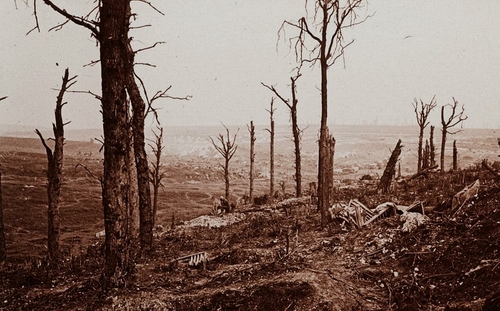
4.09 Landscape > The landscapes of war
4.10 Landscape > Early use of colour in landscape photography
The legacy of Ansel Adams 4.11 Landscape > Ansel Adams: The New Ansel Adams Photography Series About this photographer | Photographs by this photographer
For those that admire high quality landscape photography with black blacks and white whites Ansel Adams stands as the master and his work has influenced generations of large-format photographers. His three books in The New Ansel Adams Photography Series published by the New York Graphic Society were:
The Camera
The Negative
The Print
The books concentrate on the cameras, chemicals and processes and although they do cover subject visualizations the emphasis is on the technical rather than the spiritual side. Thoughts 4.12 Landscape > Thoughts on trends in landscape photography When we look at landscape photography it can be viewed as a series of trends that reflect upon the wider political and social movements of the time.
- The idealism of raw nature (Pioneer spirit)
- The taming of nature by man (Acceptance and control)
- The pretty as a painting approach to landscape (Crafting photographs to appear to be paintings)
- The realization that the taming of nature has detrimental effects (Environmental issues)
- The nostalgic quest for a pristine and more spiritual world (The New Pictorialism)
Each of these has its own adherents and today one can find photographers who have made a conscious or an unconscious choice about the one they've selected.
alan@luminous-lint.com |
General reading 1975, New Topographics: Photographs of a Man-altered Landscape, (Rochester, NY: International Museum of Photography at George Eastman House) [Introduction by William Jenkins] [Δ] Emdur, Alyse, 2012, Prison Landscapes, (London: Four Corners Books) [Δ] Klett, M. et al., 2004, Third Views, Second Sights: A Rephotographic Survey of the American West, (Albuquerque: University of New Mexico Press) [Δ] Klett, Mark et al., 1984, Second View: The Rephotographics Project, (Albuquerque, University of New Mexico Press) [Δ] Vanderbilt, Paul, 1993, Between the Landscape and the Other, (Baltimore: John Hopkins University Press) isbn-10: 0801842581 [Δ] Wall, A[lfred] H., 1896, Artistic Landscape Photography, (London: Percy Lund) [Δ] Wells, Liz, 2011, Land Matters: Landscape Photography, Culture and Identity, (I. B. Tauris) isbn-10: 1845118642 isbn-13: 978-1845118648 [Δ] Readings on, or by, individual photographers Ansel Adams Szarkowski, J., 2001, Adams at 100, (Boston: Bulfinch Press) [Δ] Robert Adams Adams, Robert, 1974, The New West: Landscape Along the Colorado Front Range, (The Colorado Associated University Press) [Δ] Adams, Robert, 2008, The New West: Landscapes Along the Colorado Front Range, (New York: Aperture) [Δ] Thomas Easterly Kilgo, Delores A., 1994, Likeness and Landscape: Thomas M. Easterly and the Art of the Daguerreotype, (University of New Mexico Press) isbn-10: 1883982049 isbn-13: 978-1883982041 [Δ] David Farrell Farrell, David, 2002, Innocent Landscapes: Sites of the Disappeared in Ireland, (Dewi Lewis Publishing) isbn-10: 1899235884 isbn-13: 978-1899235889 [Δ] David Maisel Maisel, David, 2012, Black Maps: American Landscape and the Apocalyptic Sublime, (Steidl) isbn-13: 978-3869305370 [Δ] Joel Meyerowitz Meyerowitz, Joel, 2003, Tuscany: Inside the Light, (Boston: Bulfinch Press) [Text by M. Barrett] [Δ] Beaumont Newhall Newhall, B., 1986, Supreme Instants: The Photography of Edward Weston, (Boston: New York Graphic Society) [Δ] Nancy Newhall Newhall, Nancy (ed.), 1973, The Daybooks of Edward Weston: Volume 1, Mexico, (Millerton, NY: Aperture) [Δ] Newhall, Nancy (ed.), 1973, The Daybooks of Edward Weston: Volume 2, California, (Millerton, NY: Aperture) [Δ] Heinrich Riebesehl Riebesehl, Heinrich, 1979, Agrarlandschaften, (Bremen) [Δ] Joel Sternfeld Sternfeld, Joel, 1997, On this Site: Landscape in Memoriam, (Chronicle Books) isbn-10: 0811814378 isbn-13: 978-0811814379 [Δ] Edward Weston Conger, Amy, 1992, Edward Weston: Photographs, (Tucson: Center for Creative Photography, University of Arizona) [Δ] Maddow, Ben, 1973, Edward Weston: Fifty Years, (Millerton, NY: Aperture) [Δ] Newhall, B., 1986, Supreme Instants: The Photography of Edward Weston, (Boston: New York Graphic Society) [Δ] Newhall, Nancy (ed.), 1973, The Daybooks of Edward Weston: Volume 1, Mexico, (Millerton, NY: Aperture) [Δ] Newhall, Nancy (ed.), 1973, The Daybooks of Edward Weston: Volume 2, California, (Millerton, NY: Aperture) [Δ] Weston, Edward, 1950, My Camera on Point Lobos, (Yosemite National Park, CA: Virginia Adams; Boston: Houghton Mifflin Co.) [Δ] Wilson, Charis & Weston, Edward, 1940, California and the West, (New York: Duell, Sloan and Pearce) [Δ] If you feel this list is missing a significant book or article please let me know - Alan - alan@luminous-lint.com Resources Ansel Adams (1902-1984) • Robert Adams (1937-) • Lewis Baltz (1945-) • Michael Berman (1956-) • John Blakemore (1936-) • Wynn Bullock (1902-1975) • Christopher Burkett (1951-) • Edward Burtynsky (1955-) • Paul Caponigro (1932-) • Linda Connor (1944-) • Robert Dawson (1950-) • Mitch Dobrowner (1957-) • Alfred Ehrhardt (1901-1984) • Elger Esser • Lukas Felzmann • Robbert Flick (1939-) • Franco Fontana (1933-) • Lee Friedlander (1934-) • John B. Ganis (1951-) • Mario Giacomelli (1925-2000) • Fay Godwin (1931-2005) • Frank Gohlke (1942-) • Emmet Gowin (1941-) • Harry Gruyaert (1941-) • Andreas Gursky (1955-) • Rolfe Horn (1971-) • J. Payne Jennings (check) • Michael Kenna (1953-) • Mark Klett (1952-) • Jules Lejeune (1885-1946) • Shinzo Maeda • Dolorès Marat (1944-) • Lawrence McFarland (1942-) • Joel Meyerowitz (1938-) • Courtney Milne (1943-) • Richard Misrach (1949-) • Eadweard Muybridge (1830-1904) • Eliot Porter (1901-1990) • Heinrich Riebesehl (1938-) • Mark Ruwedel (1954-) • Pentti Sammallahti • C.R. Savage (1832-1909) • Nikolaus Schletterer • John Sexton (1953-) • Massimo Vitali (1944-) • Charlie Waite • Carleton E. Watkins (1829-1916) • Brett Weston (1911-1993) • Edward Weston (1886-1958) | Home > Themes > Landscape
|
 | Daguerreotypes - Exterior views (1839-1855) Title | Lightbox | Checklist Released (October 24, 2010) A preliminary reference set. Currently seeking higher quality scans and further examples. |  | Fontainebleau, Barbizon - the relationships between painters and photographers Title | Lightbox | Checklist Released (November 6, 2010) Further examples sought showing direct parallels between individual paintings and photographs. |  | Frank Jay Haynes: Alaska Views Title | Lightbox | Checklist Released (February 19, 2007) |  | Landscape: Cityscapes - A Pictorialist Perspective Title | Lightbox | Checklist Released (April 22, 2012) |  | Landscape: Cityscapes - Urban - Urbanscapes Title | Lightbox | Checklist Released (April 22, 2012) |  | Landscape: Mountains Title | Lightbox | Checklist Released (April 8, 2012) |  | Landscape: Rural pathways, tracks, trails and lanes Title | Lightbox | Checklist Released (April 8, 2012) |  | Landscape: A 19th Century Perspective Title | Lightbox | Checklist Released (April 8, 2012) |  | Landscape: Deserts and Dunes Title | Lightbox | Checklist Released (April 22, 2012) |  | Landscapes: Horizon Title | Lightbox | Checklist Released (April 27, 2012) |  | Landscapes: Ports, harbors - harbours and docks Title | Lightbox | Checklist Released (April 27, 2012) |  | Luca Gilli: The Silences of Photography (Silenzi di forme) Title | Lightbox | Checklist Released (March 9, 2007) |  | Marialba Russo: An evolving retrospective Title | Lightbox | Checklist Released (May 19, 2006) |  | Michael Berman: Under a Dry Moon Title | Lightbox | Checklist Released (January 24, 2007) |  | Mitch Dobrowner Title | Lightbox | Checklist Released (August 31, 2007) |  | Peter Henry Emerson - Marsh Leaves Title | Lightbox | Checklist Released (February 6, 2011) |  | Rick Dingus: An Evolving Retrospective Title | Lightbox | Checklist Released (September 15, 2008) |  | Salt paper prints - Exterior views (1839-1855) Title | Lightbox | Checklist Released (October 24, 2010) A preliminary reference set. Currently seeking higher quality scans and further examples. |  | Stuart Rome Title | Lightbox | Checklist Released (June 19, 2006) | | | Photographer
| | | | | | | | | | | | | | | | | | | | | |  | Rephotographic surveys: Colorado City, Cheyenne Mt.
|
|  | Rephotographic surveys: Crater of the Castle Geyser
|
|  | Rephotographic surveys: Mountain of the Holy Cross
|
| | Connections
 | Albert Renger-Patzsch - Albert Steiner
|
| | Themes
 | Ice and snow: Icebergs
|
|  | Landscape: A 19th century perspective
|
|  | Landscape: A 20th century perspective
|
|  | Landscape: Beaches
|
|  | Landscape: Cityscapes - Urban - Urbanscapes
|
|  | Landscape: Cityscapes - Urban: A Pictorialist perspective
|
|  | Landscape: Cityscapes - Urban: Construction
|
|  | Landscape: Cityscapes - Urban: Strolling the streets
|
|  | Landscape: Cityscapes - Urban: Wartime
|
|  | Landscape: Cliffs
|
|  | Landscape: Deserts and dunes
|
|  | Landscape: Early colour
|
|  | Landscape: Forests
|
|  | Landscape: History
|
|  | Landscape: Horizon
|
|  | Landscape: Ice and snow
|
|  | Landscape: Lakes, ponds, mers, reed beds and lagoons
|
|  | Landscape: Mountains
|
|  | Landscape: New Pictorialism
|
|  | Landscape: New Topographics
|
|  | Landscape: Rainforests
|
|  | Landscape: Rivers and streams
|
|  | Landscape: Rural pathways, tracks, trails and lanes
|
|  | Landscape: Sea
|
|  | Landscape: Water
|
|  | Landscape: Waterfalls
|
|
 | Backgrounds: Landscape
|
| | Techniques
 | Autochromes: Themes: Landscape
|
|  | Cyanotypes: Themes: Landscapes
|
|  | Daguerreotypes: Themes: Landscape
|
|  | Woodburytypes: Themes : Landscapes
|
| Still thinking about these...
 | Figures within the landscape
|
|  | Maps
|
| Refreshed: 14 May 2013, 00:05 |