Contents
| This theme includes example sections and will be revised and added to as we proceed. Suggestions for additions, improvements and the correction of factual errors are always appreciated. Status: Collect > Document > Analyse > Improve | Examples 399.01 Documentary > Nineteenth century post-mortem and memento mori
399.02 Documentary > Post-mortem and memento mori photographs of babies and children
Daguerreotypes 399.03 Documentary > Daguerreotype: Post-mortem portraits
Carte de visites 399.04 Documentary > Carte de visites: Post-mortem portraits
399.05 Documentary > Carte de visites: Memorial portraits
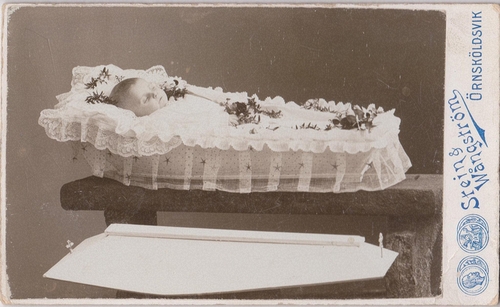
Cabinet cards 399.06 Documentary > Cabinet cards: Post-mortem portraits
399.07 Documentary > Cabinet cards: Memorial portraits
Spirit photography 399.08 Documentary > Abraham Lincoln as a returning spirit
Marketing death 399.09 Documentary > Marketing: Chase's Daguerreotype Rooms, Boston (1846)
Published in The Journal of Health and Monthly Miscellany (Boston), Volume 1, No.2, February 1, 1846, p.60.
Daguerreotype. In our advertising columns may be seen the card of Mr. Chase's Daguerreotype Rooms. We have visited these rooms, and examined his specimens. We were much pleased with every thing connected with this establishment. We advise all our readers, who wish to see themselves in nature's glass, or who have friends desirous of possessing their exact "image and superscription" when they may be absent, or dead, to visit Mr. Chase's rooms and he will do the work for them. He will do it well. 399.10 Documentary > Marketing: John A. Whipple, 96 Washington St., Boston (1848)
Published in The Stranger's Guide in the City of Boston (Boston: Andrews & Co., 1848), p.31.
Daguerreotype Miniatures
John A. Whipple
96 Washington St.
Mr. Whipple stands among the foremost of living Daguerreotype Artists. He receives the patronage of the most distinguished citizens in our community, having established his reputation for accuracy, neatness and vividness of Daguerreotype Portraiture. A visit to his rooms at 96 Washington Street, will satisfy any one as to the amount of his business, as well as to the class of his patrons. He excels particularly in taking groups, and those who visited the last exhibition of the Mechanics' Fair, will remember well those rare specimens in this way, that were executed at the rooms of Mr. Whipple.
Mr. Whipple has a copy of a picture taken by him of the Governor and Council. It embellishes his studio and attracts the admiration of all who visit it. He has much of the patronage of the three learned professions from all parts of New England, and many families are indebted to his unsurpassable skill for the most choice and natural pictures of themselves, joined in a domestic circle. The happy effect of assemblies thus naturally pictured forth, it is impossible to describe. And such memorials are assuredly invaluable, growing more and more so, as absence, or death, or tune, alters or diminishes the domestic circle. We commend the practice of having such pictures taken. How many there are who would pay fifty times the usual price of such pictures, could they but obtain the full likeness of their families, now scattered or thinned by death.
In all the branches of the Daguerreotype profession, Mr. Whipple is prominently distinguished. He performs all that is possible in the art, and his terms are very moderate.
399.11 Documentary > Marketing: J.V.R. Schuyler, Ithaca, NY (1853)
Published in ""Ithaca as it was and Ithaca as it is: with thoughts suggestive of the future" by Hermon Camp Goodwin (Ithaca, N.Y.: Andrus, Gauntlett & Company, 1853), p.40-41.
In the Daguerrean Rooms of Mr. J. V. R. Schuyler, we recently noticed many familiar and well known features true types of the originals- His rooms are large and airy, well furnished, and decorated with splendid pictures Having both sky and side-lights, and all other facilities known to be favorable, to the art, we do not wonder at his furnishing daguerreotypes shadowing forth the smile of beauty and the glance of manhood's " living fire." Mr. Schuyler is an accomplished artist. He keeps a rich assortment of stock, among which may be seen some beautiful pearl cases, fit to hold within their embrace the portrait of the fairest and loveliest in the land
His gallery is well supported, and the affable and courteous proprietor is realizing a handsome compensation for his labor and time. He has had much experience in his profession, and his natural taste and skill will doubtless continue to render his gallery as popular as his pictures are strikingly perfect.
The value of a perfect likeness should not be estimated by dollars and cents. Our father, mother, brother and sister those have all, all departed. What would we not give for a type which would recall every feature of the lost and loved. There sits the mother mourning over the loss of her only child- it was a beautiful little gem of lovelines. But it is now cold; and inanimate. The pulse has ceased to beat, the eyes are closed forever, the lips, though slightly parted, will never again move in uttering words of childish simplicity. There is the marble brow and flaxen Hair, but that brow has been touched by death, and made livid, cold; and that glossy hair will no more hang in tasteful ringlets about that neck of alabaster. The little child is dead. O, what treasure would purchase of the mother the last, the only daguerreotype of her loved, lost-child ? She would not part with it for crowns or golden gems.
399.12 Documentary > Marketing: Root's Daguerrean Gallery (1853)
Root's Daguerrean Gallery, The Christian Parlor Magazine, Volume 10, 1853, p.379.
Root's Daguerrean Gallery. There is no place like this in New York for perfect daguerreotypes. Here is displayed a multitude of the most beautiful speeimens of this art, showing the perfection of Mr. Root's mode of taking them. This gentleman has placed in the Crystal Palace some forty or fifty pieces, which attract great attention, and will probably secure the first prize. Any one who has seen them cannot but admire the sharpness of the figure, the perfection of the drapery, and especially the remarkably clear and natural expression of the eye one of the most difficult attainments in this art. No higher testimony can be given to the exellence of Mr. Root's daguerreotypes than the constant press of business on his hands, his rooms being thronged every day with visitors. He succeeds admirably in taking the likenesses of children. And what mother would not love to preserve the infant features of her children to look upon in after years, especially should they be taken away by death. We have rarely seen a more beautiful illustration of this than in the following:
Sweet child, that angel face must fade,
As years shall come and go.
For time doth ever mar the fair
And bright of all below.
But thy fond mother's jealous care
Hath robbed the yawning tomb,
And by the might of art, hath fixed
For e'er thy youthful bloom.
Within her sacred shrine there hangs
In all its infant grace,
On Root's unequaled, perfect plate,
Her darling's glorious face.
Then, mother of the blooming child,
Trust not the fleeting hours,
But, as this mother did by hers,
Do thou at once by yours.
Then, should the sudden dart of death
Your loved one call away,
You'd bless the hint by which you had
The picture done to day,
By Root, 363 Broadway.
399.13 Documentary > Combining a daguerreotype with a miniature to create a painting (1848)
Extracts from a letter from Daniel Webster to his son Mr. Fletcher Webster (March 12, 1848). This letter is published in George Ticknor Curtis Life of Daniel Webster (New York: D. Appleton and Company, 1870), Volume II, Ch.XXXIV, p.322.
Mr. Healy is painting a portrait from the daguerreotype; I have not seen it, but it is thought to be very good. I have been meditating upon something which I wish should be thought of. Edward was ten years old when I made the Hayne speech in the Senate. Why should not Mr. Healy make a picture of him, as of that age, from the daguerreotype, and from Miss Goodrich's little miniature, and place him at my feet? He was then no older than Daniel is now.
...
See Julia, and tell her what I propose about Edward's picture.
[Major Edward Webster died in the 25th January 1848.] 399.14 Documentary > Elliott and Fry during the First World War - portraits often gain a mournful interest (1917)
Illustrated London News (London, England), Saturday, July 21, 1917; pg. 88; Issue 4083.
In these days, when portraits often gain a mournful interest which makes them priceless to the bereaved friends of the subjects, Messrs. Elliott and Fry, the well-known photographers, of 55-56, Baker Street, W., have issued an illustrated little price list of various forms of their artistic productions, which they will send to applicants. Crayon and pastel drawings are included in the list. Cemeteries 399.15 Documentary > Southworth and Hawes: Mount Auburn Cemetery About this photographer | Photographs by this photographer
Southworth & Hawes photographed the Mount Auburn Cemetery at Cambridge and Watertown in Massachusetts which had been founded in 1831. The rural cemetery has several photographic connections as it is the last resting place for Oliver Wendell Holmes (1809-1894) who was the first person to use the term "stereograph" in an 1859 article, and Harold 'Doc' Edgerton (1903-1990) a pioneer of scientific photography and strobe lighting. Photographs on graves 399.16 Documentary > Photograph of the deceased on a grave at a cemetery in Yokohama, Japan (1881)
Captain S.H. Jones-Parry, My Journey Round the World via Ceylon, New Zealand, Australia, Torres Straits, China, Japan, and the United States, Two Volumes (London: Hurst and Blackett, 1881), Volume II, p.28-29
Next day I took advantage of seeing the gate open to stroll into the cemetery, a sweet, sunny spot, very well looked after. Pretty shrubs are dotted about here and there; and many a sorrowing relative will be cheered by knowing that their dear ones, buried in this distant land, are still cared for, and that their graves are hidden by lovely camellias, cherry and almond trees. The tombs in some cases were very quaint. On the headstone of one I noticed half an orange and a saucer, put, as I afterwards learnt, by some faithful Japanese or Chinese servant, a simple token of love and regard for the little one whose body rested beneath; it was the one touch of nature, and made me feel so sad and choky that I had to turn away. I love that nigger, as they stupidly call these men, for that act. Another had a bouquet with a Christmas card attached, placed reverently on the grassy mound. Another foreign one had a ghastly photograph of the deceased lying surrounded by his sorrowing friends and active servants; it was let into the headstone, and covered with glass, but was much faded by the action of the atmosphere. I confess I liked the bouquet and pretty flowers better. Some English and American tombs were handsome. Altogether I was pleasantly impressed with this spot, and felt that I should not mind being buried there myself. Notable deaths 399.17 Documentary > François Aubert: The execution of Emperor Maximillian About this photographer | Photographs by this photographer
alan@luminous-lint.com |
General reading Brett, Mary, 2006, Fashionable Mourning Jewelry, Clothing & Customs, (Schiffer Publishing) isbn-10: 0764324462 isbn-13: 978-0764324468 [Δ] Burns, Stanley, 1990, Sleeping Beauty: Memorial Photography in America, (Twelvetrees Press) isbn-10: 0942642325 isbn-13: 978-0942642322 [Δ] Burns, Stanley, 2011, Sleeping Beauty III: Memorial Photography: The Children, (Burns Press) isbn-13: 978-1936002047 [Δ] Burns, Stanley B, & Burns, Elizabeth, 2002, Sleeping Beauty II: Grief, Bereavement and the Family in Memorial Photography, American & European Traditions, (New York: Burns Archive Press) [Δ] Meinwald, Dan, 1990, ‘Memento Mori: Death in Nineteenth Century Photography‘, CMP Bulletin, California Museum of Photography, vol.9, no.4 [Δ] Mord, Jack, 2011, Beyond the Dark Veil: Postmortem and Memorial Photography from The Thanatos Archive, (The Thanatos Archive) isbn-10: 0615518141 isbn-13: 978-0615518145 [Δ] Pike, Martha V. & Armstrong, Janice Gray, 1980, A Time to Mourn: Expressions of Grief in Nineteenth Century America, (Stoney Brook, NY: The Museums at Stony Brook) isbn-10: 0295963255 isbn-13: 978-0295963259 [Δ] Ruby, Jay, 1984, July-September, ‘Post-mortem Photography in America‘, History of Photography, vol.8, no.3, pp.201-222 [Δ] Ruby, Jay, 1985, Secure the Shadow: Death and photography in America, (The MIT Press) isbn-10: 0262181649 isbn-13: 978-0262181648 [Δ] Readings on, or by, individual photographers William H. Mumler Kaplan, Louis, 2008, The Strange Case of William Mumler, Spirit Photographer, (University of Minnesota Press) isbn-13: 978-0816651566 [Δ] Nadar Nadar, Félix, 1982, Le Paris Souterrain de Félix Nadar 1861, (Caisse nationale des monuments historiques et des sites) isbn-10: 2858220557 isbn-13: 9782858220557 [Δ] Marcus Aurelius Root 1853, ‘Root's Daguerrean Gallery‘, The Christian Parlor Magazine, vol.10, pp.379 [Δ] If you feel this list is missing a significant book or article please let me know - Alan - alan@luminous-lint.com Freddy Alborta • William H. Mumler (1832-1884) • Leo Touchet (1939-) | Home > Themes > Documentary > Society > Death, post-mortem, memorial portraiture and memento mori
|