Contents
| This theme includes example sections and will be revised and added to as we proceed. Suggestions for additions, improvements and the correction of factual errors are always appreciated. Status: Collect > Document > Analyse > Improve | Introduction 377.01 Pictorialism > Introduction to global trends in Pictorialism Through the 1890's there was a split between those interested in the technical side of photography and those interested in seeing pictorialist photography incorporated into the arts. The pressures within the existing photographic societies that organized the exhibitions were increasing to a point where those seeking change decided to go their own way and found new groups of like-minded people. the founding of the Linked Ring Brotherhood in Great Britain was the first but the high-calibre members it attracted from overseas (Hugo Henneberg, René Le Begue, Paul Martin, Alfred Stieglitz, Sarah Sears, Clarence H. White) demonstrated that change was long overdue. Within the next twenty years photographic clubs that supported the style of photography championed by the Linked Ring Brotherhood were founded around the world and the American influence of Fred Holland Day and the photographers of the Photo-Secession and Camera Work of Alfred Stieglitz would prove to be so important. 377.02 Pictorialism > International connections between the Pictorialist photographic salons
There can be a tendency to see the groups that practiced pictorialism as distinct entities that worked alone in different countries but this is far from the case. The leading individuals knew each other and exhibited widely at different salons and had their works published in contemporary journals.
Taking the image above by Robert Demachy (1859-1936), founder of the Photo-Club de Paris with Constant Puyo, Hachette and De Singly in 1894, as an example it was published multiple times including:
Note that the name is different each time making the job of photo-historians rather more difficult.
The influence of the European salons upon the American and vice versa is complex and requires further research but many see Camera Work as the high point of pictorialist publishing but this is simplistic. Half of the twenty photogravures included in The Photographic Salon - 1895 (London) were later published in Camera Notes which was the magazine Alfred Stieglitz edited prior to Camera Work. In Germany Die Kunst in der Photographie edited by Franz Goerke, published from 1897 until 1908, was also influential and twenty three of the photographers it included were later included in Camera Work.
When studying pictorialism it needs to be seen as a complex international network of personal relationships where the influences were certainly not in a single direction. France 377.03 Pictorialism > Pictorialism in France In 1894 The Photo-Club of Paris (le Photo Club de Paris) with Constant Puyo, Robert Demachy, René Le Begue, Hachette and De Singly held its first exhibition in 1894 Première exposition d'art photographique but its roots went back to 1890. The club published the Bulletin du photo-club de Paris with its Art Nouveau stylistic designs. Robert Demachy (1859-1937) in Paris popularized the pictorialist style through the 1890s. 377.04 Pictorialism > The Photo Club of Paris (Le Photo Club de Paris)
377.05 Pictorialism > Photo-Club de Paris: Première Exposition d'Art Photographique - 1894
The Photo-Club de Paris was created by members who seceded from the Société Francaise de Photographie and it included influential photographers including Robert Demachy and Constant Puyo. In 1894 they hosted one of the most lavish and international of the artistic photographic salons of the late nineteenth century. Precedents to this had been set by the 1888 Vienna salon, followed by the Vienna salons of 1891 and 1892 and the first London (Linked Ring) salon held in 1893. Each of these broke away from the older established photographic societies that were inclusive but frequently interested in technical rather than artistic achievement.
On 20th July 1893 the 10 articles outlining the rules for entry to this first French exposition (Première Exposition d‘Art Photographique) were established by Photo-Club de Paris president Maurice Bucquet and counter-signed by the club‘s secretary Paul Bourgeois. A jury of ten men was established headed by Armand Dayot, the Inspecteur des Beaux-Arts, and it included five painters, a sculptor, an art-critic and two photographers who were members of the committee for the Société Francaise de Photographie. It was seen as important by the founders of the salons that photography was accepted within the broader community of the arts and the composition of the jury reflects this goal.
first exhibition, the "Première Exposition d‘Art Photographique", ran from 10th - 30th January 1894 and was held by the fashionable Galleries Georges Petit at 8 Rue de Seze in Paris. exact number of photographs and entrants is given differently by different sources - Weston Naef in his book Collection of Alfred Stieglitz gives 505 photographs by 156 photographers were accepted and displayed and a contemporary reviewer (G.M.) in La Nature: Revue Des Sciences (1894 -premier semestre) gives 511 accepted photographs from the 2000 submitted. Whatever the exact figure it was a very substantial exhibition.
A contemporary review (La Nature: Revue Des Sciences - 1894 -premier semestre) gives the breakdown of the accepted prints by country:
It is not surprising given the location that sixty nine of the photographers accepted for this first exposition were from France but the material included was highly international. There were thirty photographers from Great Britain including Scotland and the Isle of Wight; Austria had seventeen followed by Belgium and Holland with ten. Nine were from America: including Emilie Clarkson, John Bullock, John Dumont, Rudolph Eickemeyer, Emma Farnsworth, Clarence Moore, William Post, Robert Redfield and Alfred Stieglitz. Works from Germany, Italy, Spain, Russia and Switzerland were hung. Algeria was represented by at least one photograph by the Frenchman Emile Fréchon. work of the deceased, but influential, British photographer Julia Margaret Cameron (1815-1879) was acknowledged by the exposition committee members and she had an unknown number of works accepted for hanging.
Weston Naef in his book Collection of Alfred Stieglitz describes this first French exposition:
"most stunning event, outdoing anything yet seen in the world of photography, was the 1894 Première Exposition d‘Art Photographique held by the Photo-Club de Paris." (1978:30)
but he also makes the observation that
"selection process was not as highly selective as that of the Photographic Salon in London, nor did it reflect the direction Stieglitz would take in organizing American exhibitions." (1978:32)
Naef continues:
"Winner of the sweepstakes for most works exhibited at Paris was J. Craig Annan with fifteen photographs, followed closely by René Le Bègue, with fourteen pictures. Surprisingly high in the running was Emma Justine Farnsworth, whose nine images considerably outdistanced Eickemeyer‘s seven and Stieglitz‘s three. exhibition reflected the tastes of a jury half of which consisted of painters and sculptors, while the selection in the deluxe catalog was made by the photographers." (1978:32)
An Austrian perspective of this first French exposition was included in the March 1894 issue of the Vienna Camera Club journal Wiener Photographische Blätter. Club president Alfred Buschbeck first gave notice of the groundbreaking photographic art exhibition held by his club in 1892 and how the 1893 London salon of the Linked Ring Brotherhood followed suit. He stated that the 1894 Paris exposition was done in the same spirit and acknowledged the fine entries accepted by several members of the Vienna club. Furthermore, he informed interested members that copies of a "werk" with "50 heliogravures" could be purchased for the price of 50 French francs. Further acknowledgment of this exposition catalogue appears on page 164 and lists seven Vienna Camera Club members who participated in the show and the six who had work reproduced in the catalogue.
This online version of the spectacular portfolio of large-plate heliogravures (photogravures), comes from the personal copy of Photo-Club de Paris founder member Constant Puyo. It is example #42 of 470 deluxe copies printed on French hand-made white Marais paper. An additional 30 copies were printed on Imperial Japan paper. All of the heliogravures were printed by the important French lithography firm of LeMercier & Cie. Fifty of the copper plates were made by M. Fillon and the remaining six were by Blechinger, Richard Paulussen of Vienna, Dujardin, James Craig Annan of Scotland and gallery host Georges Petit for the watercolor by artist Guillaume Dubufe that began the catalogue as the first plate.
Photoseed is honored and pleased to let people around the world experience the beauty of this important 1894 exposition by means of the Internet.
Translations from the French have been kindly provided by Frédéric Perrier where necessary and I have done my best to include accents but apologies if some have been missed.
D. Spencer (Photoseed)
Naef, Weston (1978) Collection of Alfred Stiegltiz: Fifty Pioneers of Modern Photography Metropolitan Museum of Art 377.06 Pictorialism > Photo-Club de Paris: Deuxième Exposition d'Art Photographique - 1895
In 1894 the Photo-Club of Paris (Photo-Club de Paris) with Constant Puyo, Robert Demachy, René Le Begue, Hachette and De Singly held its first exhibition the Première exposition d‘art photographique. This section includes all the plates printed as photogravures in the catalogue of the second exhibition that took place in 1895; the Deuxième exposition d‘art photographique.
Within this exhibition there are some well known names such as Alfred Stieglitz from the USA and the founders of the Photo Club, Constant Puyo, Robert Demachy and René Le Begue but the key point is to appreciate the international flavor of the pictorialists in the 1890s. The photographers represented in the catalogue are from France, Germany, Belgium, Holland, England, Scotland, Austria and the USA while others from Italy, Germany and Switzerland were included in the hung exhibition.
Hans Watzek (1848-1903) and Hugo Henneberg (1863-1918) from Austria would go on to found the ‘The Clover Leaf‘ (‘Das Kleeblatt‘ or ‘Trifolium‘) society of pictorialist photographers with Heinrich Kühn in 1896. Although many of the photographers listed are relatively unknown J. Craig Annan (1864-1946) was a masterful Scottish photographer and in the 1890s he printed the photographs of David Octavius Hill and Robert Adamson. Also of note is Baron Adolph de Meyer who became one of the greatest of the early fashion photographers and was the chief photographer at Vogue in the USA for many years.
The history of photography has not been kind to many people and most of the photographers shown here are now forgotten but we should resist using modern viewpoints to judge the talents of these amateurs. They were involved in a movement that fundamentally changed the course of artistic photography. 377.07 Pictorialism > Photo-Club de Paris: Troisième Exposition d'Art Photographique - 1896
The third international photographic art exposition hosted by the Photo-Club de Paris was held at the Galerie Des Champs Elysées at 72 Avenue des Champs Elysées in Paris between May 12th and 31st, 1896. The Photo-Club de Paris was created by members who seceded from the Société Francaise de Photographie and it included influential photographers including Constant Puyo and Robert Demachy.
This was also the third year the Photo-Club de Paris issued a commemorative portfolio for the exposition. This portfolio broke with the tradition of the first two years of the exposition portfolios being bound volumes with printed tissue guards. Instead, the vellum plate large-format photogravures were printed in the ateliers Charles Wittmann (470 deluxe copies printed on paper manufactured by Blanchet and Kléber of Rives, France) blind-stamp numbered which corresponded to a list of plates (Table des Planches) and inserted loosely into an olive cloth portfolio with silk ties. The presence of several loose tissue guards (unprinted) scattered among the plates is also evident in this copy: #128.
This portfolio, along with the successive Photo Club de Paris Exposition d‘Art Photographique portfolios in Photoseed for the years 1894, 1895, and 1897, were the personal copies of Photo-Club de Paris co-founder Constant Puyo.
A three-page "Liste des Exposants" included in the letterpress at the beginning of the portfolio lists a total of 223 distinct photographers who entered their work in this third exposition. The breakdown of the number of photographers from each country was:
Other countries represented include Germany, Sweden, Spain, Russia, and Ireland - represented by a Mr. Alfred Werner from Dublin.
This portfolio contains 42 individual large format photogravures and one lithographic plate-depicting an Art-Nouveau style drawing by the French artist Edme Couty of a woman holding out a flower. Background on individual photographs has been included where appropriate. In addition to containing several important and ground-breaking examples in the history of photography, the portfolio also brings new discoveries of material worthy of further photographic scholarship.
Photoseed is honored and pleased to let people around the world experience the beauty of this important 1896 exposition portfolio by means of the Internet.
David Spencer 377.08 Pictorialism > Photo-Club de Paris: Quatrième Année Salon de Photographie - 1897
This fourth international photographic art exposition (Quatrième Année Salon de Photographie) hosted by the Photo-Club de Paris at the Galerie Des Champs Elysées in Paris was held between 13th and 28th April 1897. The Photo-Club de Paris was created by members who seceded from the Société Francaise de Photographie and it included influential photographers including Constant Puyo and Robert Demachy.
This was also the fourth year that the Photo-Club de Paris issued a commemorative portfolio for the exposition. It seems the decision was made to issue this portfolio in a much smaller edition than the previous three years. This example in this exhibition (#40) was the personal copy of Constant Puyo, and was one of only 200 examples printed on vellum. Another 30 deluxe examples were issued printed in a double suite of plates on Impérial Japan paper and vellum. Each of the large plate photogravures was printed on paper manufactured by Blanchet and Kléber of Rives, France. Several notable things were eliminated in the introductory letterpress for this portfolio. Principally, these were the "Règlement de l‘Exposition", which were basically the rules for entering the exhibition and most notably, the lengthy exhibitors list for all those photographers who had their work accepted for hanging at the exhibition.
We have included an example of the large color lithographic poster used to promote the exhibition. If this was made into a reduced form and included as a plate similar to the Edme Couty lithograph in the third portfolio catalogue of 1896, then it has gone missing from this particular copy. This large poster (34 x 47 2/3") went unsold in a major recent German camera auction.
There are 38 photogravures in this portfolio, also a major reduction considering the first year showcased 64 photographs printed on 56 individual plates. The majority of the copper plates in this portfolio were engraved by the firm of Fillon et Heuse, an atelier based in Paris. All of the plates were printed by Charles Wittmann. The letterpress, along with the poster, were printed at Imprimerie Chaix in Paris - perhaps better known for the fact that it was headed up by artist Jules Cheret - its‘ principal artist and director best known for his series of large lithographs of the Folies-Bergére.
On the judging front however, there was a noticeable difference - and one might even call it "progress" in giving the photographs a stronger voice on the judging panel. This was because unlike the first three years (1894-1896) of the expositions, in which the largely unknown amateur photographers Audra and Saint-Senoch were the only photographic voices among the artists, sculptors and critics acting as judges, the fourth year was a great leap in that three very well known "artistic" photographers: Hector Colard (Belgium: 1851-1923), Paul Bergon (France: 1863-1912) and René Le Beque (France: 1857-1914) were represented on the judging committee.
It is known that there was a fifth year for this international salon sponsored by the Photo-Club de Paris, also held at the Galerie Des Champs Elysées (May 3-29, 1898). However, it is unknown if there was a final portfolio similar to the previous four issued for the 1898 salon.
Photoseed is honored and pleased to let people around the world experience the beauty of this important 1897 exhibition catalog. Belgium 377.09 Pictorialism > Pictorialism in Belgium
The Belgian Photographic Association (l’Association belge de photographie) with its monthly Bulletin de l'Association Belge de Photographie that ran from 1874 until 1935. By the end of the nineteenth century there were several outstanding pictorialists including Léonard Misonne (1870-1943), Gustave Marissiaux (1872-1929) and Maurice Ummels (?-1924). 377.10 Pictorialism > Gustave Marissiaux: Visions d’Artistes (1908)
Germany 377.11 Pictorialism > Pictorialism in Germany
In Germany Gesellschaft zur Förderung der Amateur Photographie de Hambourg was a center of activity. German pictorialists include the brothers Theodor Hofmeister (1863-1943) and Oskar Hofmeister (1871-1937) and their associates Eduard Christian Arning (1855-1936), George Einbeck (1871-1951), Heinrich Wilhelm Müller (1859-1933), Gustav E. B. Trinks (1871-1967) and Bernhard Troch (1867-after 1924) Austria 377.12 Pictorialism > Pictorialism in Austria
In 1896 The Clover Leaf (Das Kleeblatt or Trifolium) in Vienna with Heinrich Kühn (1866 - 1944), Hans Watzek (1848 - 1903) and Hugo Henneberg (1863 - 1918). Sweden 377.13 Pictorialism > Pictorialism in Sweden
Henry B. Goodwin (1878-1931) was born in Munich (Germany) as Heinrich Karl Hugo Goodwin Burgel but settled in Sweden in 1909 and anglicized his name at the start of the First World War. He became a noted pictorialist and his portraits, plant studies and sensual nudes are outstanding. Spain 377.14 Pictorialism > Pictorialism in Spain
José Ortiz-Echagüe (1886-1982) was a Spanish pictorialist who used his own direct-carbon method of the Fresson process to record the traditional Spain set within its religious rituals. 377.15 Pictorialism > José Ortiz-Echagüe (1886-1982) About this photographer | Photographs by this photographer
Greece 377.16 Pictorialism > Nelly's: Greek refugees from Asia Minor About this photographer | Photographs by this photographer
Russia 377.17 Pictorialism > Pictorialism in Russia
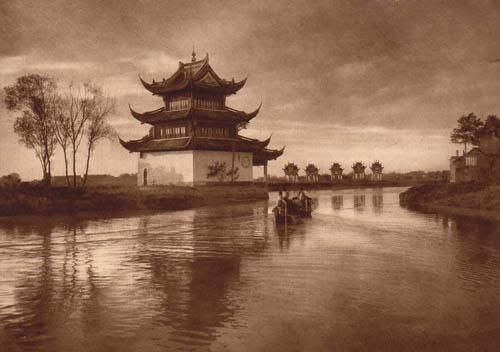
Sergey Lobovikov (1870-1942) in Russia with his bromoil and platinum prints of rural settings. China 377.18 Pictorialism > Donald M. Mennie: Pictorialist China About this photographer | Photographs by this photographer
Donald M. Mennie was a Scottish businessman and amateur photographer who was active in China. Arrived in China in 1899 working first at Mactavish & Lehman & Co. in Peking (now Beijing) and later joined A.S. Watson & Co. in Shanghai. A highly successful entrepreneur of pharmaceuticals, wine, spirits, cigars and photographic chemicals and apparatus he was well-able to support his photographic interests. He was influenced by contemporary pictorialism and his photogravures were well-suited to a slightly romanticised and soft-focus view of China.
His photographs were first published in Elizabeth Cooper's book My Lady of the Chinese Courtyard (1914) and through the 1920s he published under the auspices of the company he worked for, A.S. Watson & Co., a number of photographically-illustrated books on China of which the most notable are The Pageant of Peking (first edition 1920) and the The Grandeur of the Gorges (1926). Japan 377.19 Pictorialism > Pictorialism in Japan
The Aiyu Photography Club was founded in Nagota (Japan) in 1912 and the Tenkyukai group was also influential. Yasuzo Nojima (1889-1964) started as a Pictorial photographer and a patron during this period and can be compared to his American contemporary Alfred Stieglitz. His photographic work made the transition between pictorialism and the New Photography that was embraced by Nakayama Iwata who founded the Ashiya Camera Club in 1930. 377.20 Pictorialism > Japanese pictorialism - Bunka Shashin-shu (1922)
Bunka Shashin-shu was the magazine published by the Tokyo-based photo group Shashin Bunka Kyokai. The publication was influenced by Stieglitz‘s Camera Work}>. The group held regular juried exhibitions that included work by leading Japanese pictorialists of the 1920s. Top selections were published their magazine. There were only three issues: June, August, and September of 1922.
Courtesy of Charles Schwartz Hawaii 377.21 Pictorialism > Caroline Haskins Gurrey: Portraits from Hawaii
Australia 377.22 Pictorialism > Pictorialism in Australia
John Kauffman (1864-1942) was an Australian photographer who spent ten years in Europe (1887-1897) studying photography. His work was influenced by the The Linked Ring Brotherhood, which was founded in Great Britain in 1892, and this clearly showed in the photographs he made after his return to Adelaide in 1897.
Harold Cazneaux (1878-1953) was a New Zealand-born pictorialist photographer who was active in Australia. There is a large collection of his photographs in the National Library of Australia.
alan@luminous-lint.com | Readings on, or by, individual photographers John Kauffmann Newton, Gael, 1996, John Kauffmann, art photographer, (distributed by Thames and Hudson) isbn-10: 0642130442 isbn-13: 978-0642130440 [Δ] Donald M. Mennie Cooper, Elizabeth, 1914, My Lady of the Chinese Courtyard, (New York: Frederick A. Stokes Co.,) [Includes thirty-one duo-tone illustrations from photographs by Donald Mennie] [Δ] Mennie, Donald, 19-?, China by Land and Water, (Shanghai: A.S. Watson) [Δ] Mennie, Donald, 1920 (?), Glimpses of China, (Shanghai: A.S. Watson & Co. Ltd.) [Δ] Mennie, Donald, 1922, China, North and South, (Shanghai: A.S. Watson) [Δ] Mennie, Donald, 1926, The Grandeur of the Gorges. Fifty photographic studies, with descriptive notes, of China's great waterway, the Yangtze Kiang, including twelve hand-coloured prints. From photographs by Donald Mennie, (Shanghai: A.S. Watson & Co.) [Δ] Mennie, Donald & Weale, Putnam, 1922, The Pageant of Peking. Comprising sixty-six Vandyck photogravures of Peking and environs from photographs by Donald Mennie, (Shanghai: A.S. Watson & Co.) [With an introduction by Putnam Weale. Descriptive notes by S. Couling. Third edition. The first edition was published in 1920] [Δ] If you feel this list is missing a significant book or article please let me know - Alan - alan@luminous-lint.com Nikolai Andreev (1882-1947) • Harold Cazneaux (1878-1953) • William Dassonville (1879-1957) • F. Holland Day (1864-1933) • Robert Demachy (1859-1936) • Yuri Eremin (1881-1941) • Henry B. Goodwin (1878-1931) • Alexander Grinberg (1885-1979) • Caroline Haskins Gurrey (check) • Hugo Henneberg (1863-1918) • Hofmeister Brothers • John Kauffmann (1864-1942) • Heinrich Kühn (1866-1944) • Sergey Lobovikov (1870-1942) • Gustave Marissiaux (1872-1929) • Paul Martin (1864-1944) • Donald M. Mennie (check) • Léonard Misonne (1870-1943) • Nojima Yasuzõ (1889-1964) • José Ortiz-Echagüe (1886-1980) • Richard Polak (check) • Emile Joachim Constant Puyo (1857-1933) • Guido Rey (1861-1935) • Sarah Choate Sears (1858-1935) • Alfred Stieglitz (1864-1946) • Nikolai Svishchov-Paola (1874-1964) • Hans Watzek (1848-1903) • Clarence H. White (1871-1925) | Home > Themes > Pictorialism > Global trends in Pictorialism
|