Luminous-Lint - for collectors and connoisseurs of fine photography
HOME  BACKFREE NEWSLETTER
   Make a pledge on Kickstarter to support the next phase of Luminous-Lint
Many thanks, Alan


Getting around


HomeWhat's NewContentsVisual IndexesOnline ExhibitionsPhotographersGalleries and DealersThemes
AbstractEroticaFashionLandscapeNaturePhotojournalismPhotomontagePictorialismPortraitScientificStill lifeStreetWar
TimelinesTechniquesLibraryImages and WordsSupport 
 

Social media

Share |


HomeContentsThemes > Great Depression

Curatorial and planning notes 
  
The Plough that Broke the Plains (1936) is a 25 minute documentary written and directed by Pare Lorentz sponsored by United States government (Resettlement Administration) to raise awareness of the ecological crisis that was leading to the Dust Bowl.
 
  
Contents

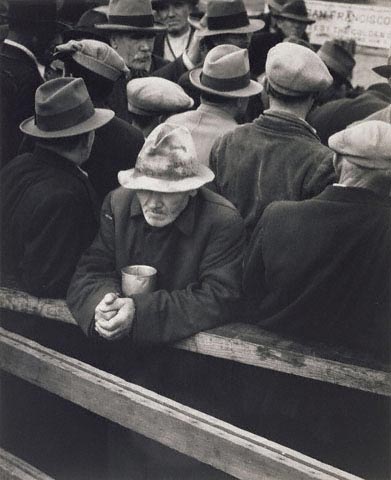
365.01   Dorothea Lange: White Angel Breadline, San Francisco
365.02   Arthur Rothstein: Cow skull in the Badlands
365.03   Arthur Rothstein: Fleeing a dust storm
This theme includes example sections and will be revised and added to as we proceed. Suggestions for additions, improvements and the correction of factual errors are always appreciated.
 
  
365.01   Documentary >  Dorothea Lange: White Angel Breadline, San Francisco 
About this photographer | Photographs by this photographer 
  
Thumbnail Thumbnail Thumbnail  
  
The photograph was taken at the White Angel Jungle, a soup kitchen for San Francisco's jobless during the Depression. From June 1931 until September 1933 Lois Jordan, a wealthy white woman known as the "White Angel", supported the soup kitchen at Abe Reuff's lot, bounded by the Embarcadero and Battery, between Filbert and Greenwich, through charitable donations. There is a small historical marker with photographs on the site near Levi's Plaza Park at 1160 Battery St. next to The Embarcadero road at the end of Pier 23 in San Francisco.
 
Widely reproduced it has become one of the iconic photographs of economic hardship and was used as the cover photograph for Irving Bernstein A Caring Society: The New Deal, the Worker, and the Great Depression (Houghton Mifflin, 1985).
 
There is an a story that this photograph was tacked on the wall up in the studio of Dorothea Lange and on her darkroom door there was a quotation by Francis Bacon:
 
The contemplation of things as they are without error or confusion without substitution or imposture is in itself a nobler thing than a whole harvest of invention.
 
Milton Meltzer "Dorothea Lange: A Photographer's Life" (Syracuse University Press, 2000) p.286
 
Lois Jordan The work of the White Angel Jungle of San Francisco waterfront (Mother Lois Jordan Book Co., 1935) 
  
365.02   Documentary >  Arthur Rothstein: Cow skull in the Badlands 
About this photographer | Photographs by this photographer 
  
Thumbnail Thumbnail  
  
This photograph by Arthur Rothstein taken when he was working for the FSA created a political stir at the time as the skull was moved by the photographer to create what he considered to be a stronger visual image.
In an oral history interview with Arthur Rothstein by Richard Doud (25 May 1964) for the Archives of American Art, Smithsonian Institution the following comment was made.
 
Arthur Rothstein:
Well, I found myself in South Dakota on cracked earth where there was a skull, and I made a lot of photographic exercises using the skull-the texture of the skull, the texture of the earth, the cracks in the soil, the lighting, how the lighting changed from the east to the west as the sun went down. I spent a good part of the day taking pictures of it, near a piece of cactus, on grass-you know-and experimenting with it. I sent all these pictures in to Washington. I was on this long trip, which took many months out through the West. Roy was always permitting picture editors from the Associated Press and other agencies to go through the file and if they saw anything they liked, they were to take it and print it. Unknown to me, and perhaps even unknown to Roy, this picture editor, Max Hill with Associated Press (he dies quite some time ago) extracted the photograph. Since he knew nothing about the West, to him this was a symbol of the drought. The fact is that it had been made in May and the fact that these arroyos are to be found even to this day in any part of the West, and the fact that you can find skulls of steers and cows and jackrabbits and rabbits, and so forth, all over the plains meant nothing to him. He just liked this picture probably because I lavished so much photographic artistry on it, you see. And so he sent it out as an example of the drought. This was months later, months after I'd made the picture. The drought was becoming serious around June and July. Well, there, too, nothing would have happened probably if the editor of the Fargo Forum had not picked up this picture, serviced by the Associated Press, Fargo Forum was a member of the Associated Press, and said, "Now this is a real example of fakery." As far as he was concerned, it was a fake photograph. He didn't know that I had made the picture in May and that the picture had a caption on it that I hadn't contributed, that it was sent out by the Associated Press, not by the government! He didn't know any of these things. As far as he was concerned, here was a government picture that was a fake. Propaganda. And of course the Forum was, like most newspapers of the time, opposed to the Democratic Party and to the New Deal. He wrote a big front-page editorial, just as Roosevelt was coming through Bismark, North Dakota, and printed a special edition of the Fargo Forum with this picture on the front page and called it a fake-New Deal Propaganda-there was a lot of talk about that in those days-and put this on the train for all the correspondents to read. It just happened that I was in Bismark, North Dakota, at the time this came through. One of the correspondents asked me if I had made this picture and I agreed that I had. So he immediately sent a message back to Washington and got somebody to start digging through the files. They found a lot of other pictures that I had made, and this of course became a great joke. Cartoonists drew pictures of me wandering all over the United States with a skull, planting it here and planting it there, but the fact is that this was the farthest thing from my mind. I had not taken the picture in the first place as an example of New Deal propaganda; I had taken a picture of something that existed, and may even exist today. I had not taken the picture with the idea of it being used as a symbol of the drought, although it did show the drought, I mean it was dried earth and a skull. And this thing snowballed to the point there were columns written about it, stories in Time Magazine, and Westbrook Pegler wrote a humorous little satirical piece; some people came to the defense of this picture and other people attacked it. Meantime I evaded everybody and went off for a vacation in Minnesota.

Interviewee: Roy Stryker (Head of the FSA Photographic Unit)
Interviewer: Richard Doud
Date: October 17, 1963; June 13, 1964; January 23, 1965
Oral history interview with Roy Emerson Stryker, 1963-1965, Archives of American Art, Smithsonian Institution.
Roy Stryker: That wasn't exactly controversial. There's not too much to say. Rothstein had moved to his --from --over to --and cactuses and sparse vegetation. It wasn't dishonesty at all because it was complete honesty. It was a political situation. Newspapers picked it up because we were then going over into a political controversy. Which is a perfectly legitimate, worth-while thing. Thank God that's what democracy is -- a difference of opinion. The result was, there was a stampede, everybody take up the thing and damn us for it. I don't think they even looked carefully. In the end, I think they made something more out of it; it wasn't that important.
 
Richard Doud: By itself it was a terrific picture.
 
Roy Stryker: No. Not a terrific picture. An interesting picture but it wasn't a terrific picture. I don't think it began to even come anywhere near the pictures we had the following -- I don't think -- I think they made a great picture out of it because they made all this fuss. I don't think it was a great picture.
 
Richard Doud: You could call it infamous rather than famous?
 
Roy Stryker: No, I just think they made it a well known picture, let's put it that way. I shouldn't use the word "famous." I just think they made it a very well known picture. I don't think it would ever have had that importance if they hadn't given it a flurry all through the papers because they wanted to raise hell with the Administration's being dishonest. Of course it was dishonest. Maybe what I said, I said it -- didn't realize I'd said it but I guess I did say it. Well, there was a drought, and the hell with it! And I've been quoted on that. I wasn't very smart to have said it that way, but I did, and I said it, and it's out now. There was a drought. Sure he was naïve. Sure he was out of the city; he was moving around; he was almost composing. It were better left alone. We'd have been smarter if we hadn't let those pictures get out. It didn't hurt.
 
  
365.03   Documentary >  Arthur Rothstein: Fleeing a dust storm 
About this photographer | Photographs by this photographer 
  
Thumbnail Thumbnail  
  
In an oral history interview with Arthur Rothstein by Richard Doud (25 May 1964) for the Archives of American Art, Smithsonian Institution the following comments were made.
 
Arthur Rothstein:
... one day, wandering around through Cimarron County in Oklahoma, which is in the panhandle of Oklahoma, I photographed this farm and the people who lived on the farm. The farmer and his two children, two little boys, were walking past a shed on their property and I took this photograph with the dust swirling all around them. I had no idea at the time that it was going to become a famous photograph, but it looked like a good picture to me and I took it. And I took a number of other pictures on the same property. And then I went on to some other farms and took those pictures. This particular picture turned out to be the picture that was quite famous. It was a picture that had a very simple kind of composition, but there was something about the swirling dust and the shed behind the farmer. What it did was the kind of thing Roy [Stryker] always talked about-it showed an individual in relation to his environment. Of course this is the sort of thing that painters from time immemorial have been trying to do-to show man in relation to his environment. You know the old axiom that " Art is the expression of man," so here, if this has any art, it's because it's an expression of man.
 
Provenance: US Camera Archive


alan@luminous-lint.com


HomeContents > Further research


Thumbnail Thumbnail Thumbnail Thumbnail Thumbnail Thumbnail Thumbnail Thumbnail Thumbnail  
  
General reading 
  
Hambourg, Maria Morris & Phillips, Christopher, 1994, The New Vision: Photography Between the World Wars: The Ford Motor Company Collection at the Metropolitan Museum of Art, (New York: Metropolitan Museum of Art) [Δ
  
Poos, Françoise (ed.); Back, Jean; Bauret, Gabriel & Lorang, Antoinette, 2012, The Bitter Years: Edward Steichen and the Farm Security Administration Photographs, (D.A.P./Distributed Art Publishers) isbn-10: 1935202863 isbn-13: 978-1935202868 [Δ
  
Stott, William, 1986, Documentary Expression and Thirties America, (Chicago: University of Chicago Press) [Δ
  
Stryker, Roy & Wood, Nancy, 1975, In This Proud Land: America 1935–1943 as Seen in FSA Photographs, (Boston: New York Graphic Society) [Δ
  
Trachtenberg, Alan & Levine, Lawrence W, 1988, Documenting America, 1935–1943, (Berkeley: University of California Press) [Δ


Readings on, or by, individual photographers 
  
Jim Alinder 
  
Alinder, J. (ed.), Wolcott, M. P., & Stein, S., 1983, Marion Post Wolcott: FSA Photographs, (San Francisco: Friends of Photography) [Δ
  
Margaret Bourke-White 
  
Caldwell, Erskine & Bourke-White, Margaret, 1937, You Have Seen Their Faces, (Viking Press) [Δ
  
Esther Bubley 
  
Pastan, Amy (ed.) & Greene, Melissa Fay (introduction), 2010, Fields of Vision: The Photographs of Esther Bubley: The Library of Congress, (Giles in association with the Library of Congress) isbn-10: 1904832482 isbn-13: 978-1904832485 [Δ
  
Yochelson, B. et al., 2005, Esther Bubley on Assignment, (New York: Aperture) [Δ
  
Jack Delano 
  
Delano, Jack, 1997, Photographic Memories, (Washington and London: Smithsonian Institution Press) [Δ
  
Santiago, Esmeralda (introducton), 2010, Fields of Vision: The Photographs of Jack Delano: The Library of Congress, (Giles in association with the Library of Congress) isbn-10: 1904832466 isbn-13: 978-1904832461 [Δ
  
Walker Evans 
  
Agee, James & Evans, Walker, 2001, Let Us Now Praise Famous Men, (Boston: Houghton Mifflin Company) [Δ
  
Dorothea Lange 
  
Borhan, P., 2002, Dorothea Lange: The Heart and Mind of a Photographer, (New York: Bulfinch Press) [Δ
  
Coles, R. & Heyman, T., 1982, Dorothea Lange: Photographs of a Lifetime, (Millerton, NY: Aperture) [Δ
  
Elliott, George P., 1966, Dorothea Lange, (New York: Museum of Modern Art) [Δ
  
Lange, Dorothea, 1994, Dorothea Lange: American Photographs, (San Francisco: San Francisco Museum of Modern Art,) [Δ
  
Lange, Dorothea & Taylor, Paul S., 1999, An American Exodus: A Record of Human Erosion in the Thirties, (Paris: Jean-Michel Place) [Δ
  
Meltzer, Milton, 2000, Dorothea Lange: A Photographer’s Life, (Syracuse, NY: Syracuse University Press) [Δ
  
Partridge, Elizabeth (ed.), 1994, Dorothea Lange: A Visual Life, (Washington, D.C.: Smithsonian Institution Press) [Δ
  
Russell Lee 
  
Hurley, F. Jack, 1978, Russell Lee, Photographer, (Dobbs Ferry, NY: Morgan and Morgan) [Δ
  
Lemann, Nicholas, 2008, Fields of Vision: The Photographs of Russell Lee: The Library of Congress, (Giles in association with the Library of Congress) isbn-10: 1904832393 isbn-13: 978-1904832393 [Δ
  
Carl Mydans 
  
Proulx, Annie & Pastan, Amy (ed.), 2011, Fields of Vision: The Photographs of Carl Mydans: The Library of Congress, (Giles in association with the Library of Congress) isbn-10: 1904832881 isbn-13: 978-1904832881 [Δ
  
Gordon Parks 
  
Parks, Gordon, 1990, Voices in the Mirror, An Autobiography., (New York: Nan A. Talese) [Δ
  
Arthur Rothstein 
  
Packer, George & Pastan, Amy (ed.), 2011, Fields of Vision: Photographs of Arthur Rothstein: The Library of Congress, (Giles in association with the Library of Congress) isbn-10: 190483289X isbn-13: 978-1904832898 [Δ
  
Rothstein, Arthur, 1978, The Depression Years as Photographed by Arthur Rothstein, (New York: Dover Publications) [Δ
  
Rothstein, Arthur, 1984, Arthur Rothstein’s America in Photographs, 1930–1980, (New York: Dover) [Δ
  
Rothstein, Arthur, 1986, Documentary Photography, (Boston: Focal Press) [Δ
  
Ben Shahn 
  
Pastan, Amy (ed.) & Egan, Timothy (introduction), 2008, Fields of Vision: The Photographs of Ben Shahn: The Library of Congress, (Giles in association with the Library of Congress) isbn-10: 1904832407 isbn-13: 978-1904832409 [Δ
  
Pratt, Davis (ed.), 1975, The Photographic Eye of Ben Shahn, (Cambridge: Harvard University Press) [Δ
  
Roy Stryker 
  
Stryker, R. E. & Wood, Nancy, 1973, In This Proud Land, (New York: Galahad Books) [Δ
  
John Vachon 
  
Andersen, Kurt (introduction), 2010, Fields of Vision: The Photographs of John Vachon: The Library of Congress, (Giles in association with the Library of Congress) isbn-10: 1904832474 isbn-13: 978-1904832478 [Δ
  
Marion Post Wolcott 
  
Alinder, J. (ed.), Wolcott, M. P., & Stein, S., 1983, Marion Post Wolcott: FSA Photographs, (San Francisco: Friends of Photography) [Δ
  
Hurley, F. J., 1989, Marion Post Wolcott, A Photographic Journey, (Albuquerque, NM: University of New Mexico Press) [Δ
  
Prose, Francine, 2008, Fields of Vision: The Photographs of Marion Post Wolcott: The Library of Congress, (Giles in association with the Library of Congress) isbn-10: 1904832415 isbn-13: 978-1904832416 [Δ


If you feel this list is missing a significant book or article please let me know - Alan - alan@luminous-lint.com 
  

HomeContentsPhotographers > Photographers worth investigating

 
Esther Bubley  (1921-1998) • Paul Carter • John Collier  (1913-1992) • Marjory Collins • Harold Haliday Costain  (1895-1994) • Jack Delano  (1914-1997) • Sheldon Dick  (1906-1950) • Walker Evans  (1903-1975) • John Gutmann  (1905-1998) • Theodor Jung  (1906-) • Dorothea Lange  (1895-1965) • Russell Lee  (1903-1986) • Hansel Mieth  (1909-1998) • Carl Mydans  (1907-2004) • Gordon Parks  (1912-2006) • Edwin Rosskam  (1903-) • Arthur Rothstein  (1915-1985) • Ben Shahn  (1898-1969) • Arthur Siegel  (1913-1978) • John Vachon  (1914-1975) • Marion Post Wolcott  (1910-1990)
HomeThemesDocumentarySociety > Great Depression 
 
A wider gazeRelated topics 
  
FSA - Farm Security Administration 


HomeContentsOnline exhibitions > Great Depression

Please submit suggestions for Online Exhibitions that will enhance this theme.
Alan - alan@luminous-lint.com


ThumbnailDocumentary: 20th Century The FSA (Farm Security Administration) 
Title | Lightbox | Checklist
Improved (June 9, 2012)
ThumbnailDorothea Lange 
Title | Lightbox | Checklist
Released (September 14, 2006)


HomeVisual indexes > Great Depression

Please submit suggestions for Visual Indexes to enhance this theme.
Alan - alan@luminous-lint.com


   Photographer 
  
ThumbnailArthur Rothstein: Fleeing a dust storm 
About this photographer | Photographs by this photographer 
ThumbnailArthur Rothstein: FSA - Farm Security Administration 
About this photographer | Photographs by this photographer 
ThumbnailBen Shahn: FSA - Farm Security Administration 
About this photographer | Photographs by this photographer 
ThumbnailCarl Mydans: FSA - Farm Security Administration 
About this photographer | Photographs by this photographer 
ThumbnailDorothea Lange: FSA - Farm Security Administration 
About this photographer | Photographs by this photographer 
ThumbnailDorothea Lange: The Migrant Mother 
About this photographer | Photographs by this photographer 
ThumbnailDorothea Lange: White Angel Breadline 
About this photographer | Photographs by this photographer 
ThumbnailEdwin Locke: FSA - Farm Security Administration 
About this photographer | Photographs by this photographer 
ThumbnailEdwin Rosskam: FSA - Farm Security Administration 
About this photographer | Photographs by this photographer 
ThumbnailGordon Parks: FSA - Farm Security Administration 
About this photographer | Photographs by this photographer 
ThumbnailJack Delano: FSA - Farm Security Administration 
About this photographer | Photographs by this photographer 
ThumbnailJohn Vachon: FSA - Farm Security Administration 
About this photographer | Photographs by this photographer 
ThumbnailMarion Post Wolcott: FSA - Farm Security Administration 
About this photographer | Photographs by this photographer 
ThumbnailPaul Carter: FSA - Farm Security Administration 
About this photographer | Photographs by this photographer 
ThumbnailRussell Lee: FSA - Farm Security Administration 
About this photographer | Photographs by this photographer 
ThumbnailSheldon Dick: FSA - Farm Security Administration 
About this photographer | Photographs by this photographer 
ThumbnailWalker Evans: FSA - Farm Security Administration 
About this photographer | Photographs by this photographer 
ThumbnailWalker Evans: The Burroughs family 
About this photographer | Photographs by this photographer 
 
  
   Connections 
  
ThumbnailDorothea Lange - Margaret Bourke-White 


   Themes 
  
ThumbnailDocumentary: Organizations: FSA - Farm Security Administration - OWI: Early colour 
ThumbnailDocumentary: Organizations: FSA - Farm Security Administration: Examples 
ThumbnailDocumentary: Organizations: FSA - Farm Security Administration: Models 
ThumbnailDust Bowl 
 
  
   Still thinking about these... 
  
ThumbnailBlack Blizzards 


Refreshed: 20 May 2013, 19:53


HOME  BACKFREE NEWSLETTER
   Make a pledge on Kickstarter to support the next phase of Luminous-Lint
Many thanks, Alan
