Contents
| This theme includes example sections and will be revised and added to as we proceed. Suggestions for additions, improvements and the correction of factual errors are always appreciated. | Examples 303.01 Appropriation
Photographers 303.02 Andy Warhol: Appropriation About this photographer | Photographs by this photographer
303.03 Richard Prince: Appropriation About this photographer | Photographs by this photographer
303.04 Robert Heinecken: Appropriation About this photographer | Photographs by this photographer
303.05 Sherrie Levine: Appropriation About this photographer | Photographs by this photographer
303.06 Karl Baden: Appropriation About this photographer | Photographs by this photographer
303.07 Robert Silvers: Photomosaics About this photographer | Photographs by this photographer
303.08 Daniele Buetti: Appropriations and manipulations About this photographer | Photographs by this photographer
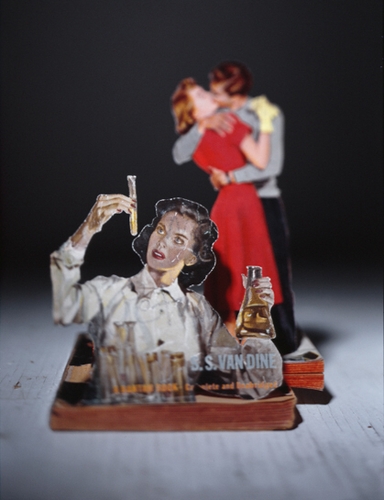
303.09 Thomas Allen: Uncovered About this photographer | Photographs by this photographer
I’ve always been fascinated by pop-up books, dioramas, 3-D glasses and the View Master for they all have the ability to picture false realities. To be believable, the angle for viewing these illusions must be correct, the distance from the subject should be such that it fills the viewer’s entire field of vision and the lighting has to be right. For example, the feeling of standing next to a set of railroad tracks made from toothpicks while a construction-paper train (billowing cotton ball smoke) emerges from a paper mache tunnel will never be fully appreciated if one’s eye is not pressed firmly against the hole cut in the end of the shoebox!
I approach the picture-making process in the much the same way. My subjects are the characters found on the covers of vintage paperbacks whose range of emotions and expressions are altered with a few strokes of an X-acto knife. The act of cutting and folding transforms these flat figures into life-like, multi-dimensional, pop-up book characters. The view camera is the shoebox and the ground glass is the viewing hole. Each book is gently positioned according to what is projected through the lens. If necessary, pins are used to invisibly hold the pieces in place since the slightest movement, in any direction, would reveal (and ruin) the trick Lighting and composition are just as important. They set the (often times humorous) mood of the story being captured. A shallow focus completes the illusion and magnifies the sense of seeing in 3-D. The process can sometimes take hours to complete, but it’s all part of why I choose to make photographs and well worth the effort.
Naming the work is the final step and I use single-word titles to play off the humor in a print while subtly suggesting a deeper meaning. If I have to resort to using long titles to explain what’s going in a photograph, then I’m doing something wrong.
Finally, I’ve been photographing books for quite a long time and I’m constantly thinking about how the work can evolve. My next series of images pictures multiple books. In fact, there is a stack of westerns sitting on the table next to me with cut-out cowboys itching to saddle up for a shoot out! The working title is Posse.
Thomas Allen
alan@luminous-lint.com | General reading Garnet, Joy & Meiselas, Susan, 2007, February, ‘On the rights of the Molotov Man: Appropriation and the art of context‘, Harper's Magazine, pp.53-58 [Δ] Garnet, Joy & Meiselas, Susan, 2007, February, ‘On the rights of the Molotov Man: Appropriation and the art of context‘, Harper's Magazine, pp.53-58 [Δ] Hollein, Max, 2012, Malerei in Fotografie. Strategien der Aneignung / Painting in Photography.
Strategies of Appropriation, (Heidelberg: Kehrer Verlag) isbn-13: 978-3941399167 [Texts by Dr. Martin Engler, Carolin Köchling, and Dr. Christina Leber] [Δ] Hoy, Anne H., 1987, Fabrications: Staged, Altered and Appropriated Photographs, (New York: Abbeville Press) [Δ] Nakamori, Yasufumi & Bader, Graham, 2012, Utopia/Dystopia: Construction and Destruction in Photography and Collage, (Museum Fine Arts Houston) isbn-10: 030017960X isbn-13: 978-0300179606 [Δ] Readings on, or by, individual photographers Robert Heinecken Borger, I. et al., 1999, Robert Heinecken, Photographist: A Thirty-Five Year Retrospective, (Chicago: Museum of Contemporary Art) [Δ] Hannah Höch Lavin, Maud, 1993, Cut with the Kitchen Knife: The Weimar Photomontages of Hannah Höch, (New Haven and London: Yale University Press) [Δ] Barbara Kruger Kruger, B., 1999, Barbara Kruger, (Cambridge: The MIT Press) [Δ] Andy Warhol McShine, K. (ed.), 1989, Andy Warhol, A Retrospective, (New York: Museum of Modern Art) [Δ] Warhol, Andy, 1988, Andy Warhol: Death and Disasters, (Houston, TX: Menil Collection: Houston Fine Art Press) [Δ] Warhol, Andy, 1989, Andy Warhol, Photobooth Pictures, (New York: Robert Miller Gallery) [Δ] Warhol, Andy, 1999, About Face: Andy Warhol Portraits, (Hartford, CT: Wadsworth Atheneum and Pittsburgh: Andy Warhol Museum, Cambridge, MA: Distributed by MIT Press) [Essays by Baume, Nicholas, Crimp, Douglas, Meyer, and Richard] [Δ] If you feel this list is missing a significant book or article please let me know - Alan - alan@luminous-lint.com Thomas Allen • Daniele Buetti (1956-) • Walker Evans (1903-1975) • Hans-Peter Feldman • Robert Heinecken (1931-2006) • Barbara Kruger (1945-) • Nikki S. Lee (1970-) • Sherrie Levine (1947-) • Yasumasa Morimura (1951-) • Vik Muniz (1961-) • Osamu James Nakagawa (1962-) • Richard Prince (1949-) • Robert Rauschenberg (1925-2008) • Gerhard Richter (1932-) • James Rosenquist (1933-) • Thomas Ruff (1958-) • Cindy Sherman (1954-) • Robert Silvers (1968-) • Laurie Simmons (1949-) • Andy Warhol (1928-1987) | Home > Appropriation
|
