Contents
| This theme includes example sections and will be revised and added to as we proceed. Suggestions for additions, improvements and the correction of factual errors are always appreciated. Status: Collect > Document > Analyse > Improve | 3.01 Fashion > Transportation and fashion examples
Introduction 3.02 Fashion > Introduction to fashion By the end of the 19th century studio photographers in Paris, including the Reutlinger studio, Bissonais et Taponnier, were taking photographs for magazines that showed the latest in fashion. The photographic style was neither adventurous nor innovative - very largely the models were posed in a similar way to the carte de visite which came out in 1854. Models were provided with suitable costumes, painted backdrops and props but the shots were largely studio based. It is true that technical limitations of the cameras required artificial lighting and this often necessitated a studio setting. The earliest fashion shots could hardly be differentiated from the portrait shots of the same period. 3.03 Fashion > Early fashion photography
Photo-jewelry 3.04 Fashion > Photo-jewelry: Bracelets
3.05 Fashion > Photo-jewelry: Brooches
3.06 Fashion > Photo-jewelry: Lockets
3.07 Fashion > Photo-jewelry: Pendants
3.08 Fashion > Photo-jewelry: Rings
3.09 Fashion > Photo-jewelry: Stick pins
3.10 Fashion > Photo-jewelry: Political
Items of clothing 3.11 Fashion > Still life: Textiles and lace
Key fashion photographers 3.12 Fashion > Norman Parkinson (1913-1990)
These examples from 1959 and 1960 show both the colour and black & white styles of Norman Parkinson. Magazines 3.13 Fashion > Vanity Fair
The society magazines of the early twentieth century were the arbiters of good taste and the status quo - a land were the monarchies of Europe were a good influence and where tea on lawn was to be accompanied by photographs of people of exquiste taste, power or artistic prowess. During the early years of Vanity Fair it was owned by Condé Naste and the editor from 1914 to 1936 was Frank Crowninshield who said that the target audience was:
"people of means, who cultivate good taste, read good books, buy the best pictures, appreciate good opera, love good music and build distinguished homes.."
Vanity Fair: Portraits of an Age 1914-1936, (Thames and Hudson, 1982), p. xii
There may have been a lack of gravitas in the writing and the political turmoils of the period were largely ignored but this was not the point of the magazine. Where it excelled was in the photography and the ability of the picture editor to obtain the very best portraits of the period. To look at a list of the photographers who provided portraits to Vanity Fair during this period is to see the very best.
Photographers whose work was shown in Vanity Fair (1914-1936) included:
Fashion houses 3.14 Fashion > Fashion houses and photography
The rise of the fashion house linked to a named individual has been a fascinating phenomenon and has its roots in the early 20th century. Although there were named fashion designers long before this the global awareness of individuals really came to the fore with the rise of the great fashion magazines such as Harper's Bazaar and Vogue which were innovative in the way they used photography.
The names from the early 1900's are the names of legend Coco Chanel, Gucci, Fendi, Yves Saint Laurent and Prada.
- Coco Chanel opened her millinery shop in 1912 and rapidly rose to become one of the premier fashion designers in Paris, France.
- Prada, the Italian fashion house, was established in Milan, Italy in 1913.
- Guccio Gucci was born in 1881 and opened his first shop in Florence in 1920.
- Edoardo and Adele Fendi opened a small leather and fur store in 1925 in Via del Plebiscito in the center of Rome.
- Elsa Schiaparelli (1890-1973) was a French designer who established a fashion house in Paris that ran from the late 1920's until 1954, and established a New York showroom in 1949.
The cult of the personality they developed in the 1920's and 30's has led to the glitterati of today where the cult is molded by the designs of Karl Lagerfield, Christian Dior, Calvin Klein, Ralph Lauren, Louis Vuitton and the Versace family. 3.15 Fashion > Fashion houses: Gianni Versace
The major fashion houses have always hired photographers with the ability to show their clothes to the greatest advantage. Advertising and fashion shows are an essential promotional activity and have a higher proportional budgets than in most comparable industries.
The collections of Gianni Versace (1946-1997) for example used Richard Avedon (1923-2004) and Irving Penn to take the photographs and these were published in books of the different seasonal collections. 3.16 Fashion > Parisian couture (ca. 1900-1920)
Fashion photographers by decade 3.17 Fashion > Fashion photographers by decade
To highlight the main trends in fashion photography each decade is discussed within a separate theme and influential magazine such as Vogue have pages to themselves.
- Fashion 1920s
Photographers:
Cecil Beaton,
Adolf Gayne de Meyer,
George Hoyningen-Heune,
Edward Steichen
- Fashion 1930s
Photographers:
Louise Dahl-Wolfe,
Horst Paul Horst,
George Hoyningen-Heune,
Man Ray,
Martin Munkacsi,
Edward Steichen
- Fashion 1940s
Photographers:
Richard Avedon,
Cecil Beaton,
Erwin Blumenfeld,
Toni Frissell,
Horst Paul Horst,
Irving Penn
3.18 Fashion > Fashion 1920s
Following the First World War (1914-1918) there was a strong reaction against the values of the older generation that was held responsible for the carnage. Women were struggling to get political representation and were entering the workplace in larger numbers. The younger generation of the wealthier classes were expressing themselves in their clothing and through the music of the Jazz Age. The stylistic elements of modernism, abstraction and Art Deco were incorporated into architecture, design and clothing styles.
Fashion photography had been firmly rooted in approaches that had come out of Pictorialism - indeed Baron Adolf De Meyer had been appointed as photographer at Vogue based upon his works done in the first decade of the twentieth century that were stylistically reminiscent of portrait painting. By the early twenties this approach was looking dated and out of line with cultural changes that were being driven by youth rather than aging aristocrats. Edward Steichen replaced Baron Adolf De Meyer as Chief Photographer for Condé Nast publications in 1923 and there was a move towards a more modernist and geometric approach to fashion photography.
The striking images of Edward Steichen used props and light to create visual patterns that reflected the optimism of the high society 1920's. The fashion houses of Elsa Schiaparelli, Vionnet and Alix all promoted the new woman - the short haired smoking thin waisted debutante. Pictorialism was rejected and soft focus was replaced by sharp detail - outdoor photography became increasingly common along with the angular designs of Cubism.
In Europe the British edition of Vogue came out in 1916 followed in 1920 by the French edition based in Paris. George Hoyningen-Heune, who was recruited to French Vogue in 1925. The same year that George Hoyningen-Heune joined French Vogue the International Decorative Arts Exhibition (Exposition Internationale des Arts Decoratifs et Industriels) was held in Paris. This showed commercial products where design had been incorporated along with functionality into everyday items - at the time this was called Moderne, Jazz Moderne or Streamline Modern but is now better known as Art Deco. George Hoyningen-Heune used parallels from the clean lines of antiquity to pose models as remote objects of desire. This style of linking back to classical themes had its roots in the pictorialist style of Fred Holland Day - but now there was none of the gentle fuzziness - beauty and elegance was the issue and the backgrounds and props served to give the model a static religious like desire - these were the Vestal virgins for a new age. 3.19 Fashion > Fashion 1930s
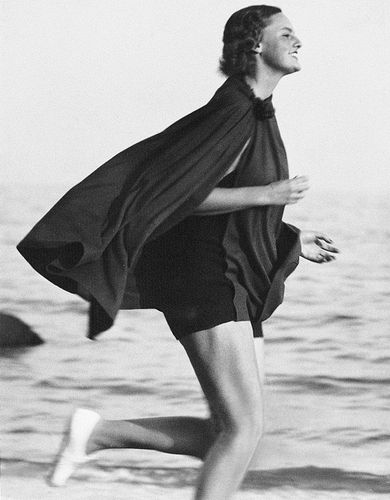
The 1930's were a period of financial instability following the Wall Street Crash of 1929 and the heady extravagance of the 1920's in Western Europe and America came to an abrupt end. Unemployment rose rapidly to devastating levels and in America the situation worsened with the social ravages bought about by the droughts and dust storms in the rural heartland. This was a time when optimism was difficult to justify and the exotic fashions of the 1920's were out of line with what was happening to the working population. 3.20 Fashion > Fashion 1940s
Within Europe and America the 1940's were split into two very distinct parts by the Second World War - firstly there was the restrictive war period with restrictions on fabric availability and a tendency to less flamboyance as more women entered the workforce. Following the war the New Look of Christian Dior brought back high fashion with a swirling flourish. 3.21 Fashion > Fashion 1950s
The 1950s had a freedom from rationing and the austerity that had plagued the fashions of Second World War (1939-1945) and the years that immediately followed it. 3.22 Fashion > Fashion 1960s
3.23 Fashion > Fashion 1970s
3.24 Fashion > Fashion 1980s
3.25 Fashion > Fashion 1990s
Fashion and the use of colour 3.26 Fashion > The rise of colour in fashion photography
Fashion and the military 3.27 Fashion > Fashion: Accessories: Gas masks
Contemporary fashion 3.28 Fashion > Contemporary fashion photography
By the 1980's photographers such as Sarah Moon and Deborah Turbeville were creating images of women that reflected changing social attitudes. Here the women are not in control or at ease with their surroundings - it is a form of fashion photography where the model and subject in the photograph seems to be questioning whether to be there. Fashion photography molds generations but at the same time it is a victim of it's own success - a successful advertizing campaign leads to imitators and years pass where the style is the emmaciated destruction and androgynous look of heroin chique without the context of drug abuse that Larry Clark gave in his seminal book Tulsa. In Terryworld the images of fashion photographer Terry Richardson blends sex and fashion into a world of no taboos - here porn becomes a fashion statement and style. Fashion goes through phases when under-age models are used to sell underwear and cosmetics to increasingly young audiences. It is the sermon of the old to remember and lecture on a golden age when things were not so commercialized - and I'm doing exactly that.
In many ways I agree with the comments made by the curator at MOMA (NY) when the exhibition on Contemporary fashion was mounted, by the late 80's and 90's there was a move from the clothes themselves to two different approaches to marketing them. The first was to make them appear as if the models are actors or props on a film set - rather like the fabricated realities of Cindy Sherman approach, whilst the second is lifestyle. Case studies 3.29 Fashion > Robinson & Roi: The Famous Glass Dress - Royal Robe of Princess Eulalia
In this cabinet card shows a mannequin wearing the glass dress that was ordered by the Spanish Princess Eulalia at the 1893 World's Fair. The back of the card provides the context and serves as a promotion for The Libbey Glass Company.
alan@luminous-lint.com |
General reading 1982, Vanity Fair: Portraits of an Age 1914-1936, (Thames and Hudson) [Δ] Adams, Robert, 1981, Beauty in Photography, (Millerton, NY: Aperture) [Δ] Lansdell, Avril, 1985, Fashion ŕ la Carte 1860-1900, (London: Shire Publications) [Δ] Meinwald, Dan, 1990, ‘Memento Mori: Death in Nineteenth Century Photography‘, CMP Bulletin, California Museum of Photography, vol.9, no.4 [Δ] Setnik, Linda, 2012, Victorian Costume for Ladies 1860-1900, (Schiffer Publishing Ltd) isbn-10: 0764339729 isbn-13: 978-0764339721 [2nd edition] [Δ] Setnik, Linda, 2012, Victorian Fashions for Women and Children: Society's Impact on Dress, (Schiffer Publishing Ltd) isbn-10: 0764341642 isbn-13: 978-0764341649 [Δ] Severa, Joan L., 1997, Dressed for the Photographer: Ordinary Americans and Fashion, 1840-1900, (Kent State Univ Press) isbn-10: 0873385128 isbn-13: 978-0873385121 [Δ] Severa, Joan L., 2006, My Likeness Taken: Daguerreian Portraits In America, (Kent State Univ Press) isbn-10: 0873388372 isbn-13: 978-0873388375 [Δ] West, Larry J. & Abbott, Patricia A., 2005, Antique Photographic Jewelry: Tokens of Affection and Regard, (Larry J. West- Privately printed) isbn-10: 0977710777 [Δ] Readings on, or by, individual photographers G. Agié Roger-Miles, L. & Agié, G., 1910, Les Createurs de la Mode, (Paris: Ch. Eggimann / Edition du Figaro) [175 numbered copies] [Δ] Amy Arbus Arbus, Amy, 2006, On the Street, (Welcome) [Δ] Richard Avedon Arbus, Doon & Avedon, Richard, 1999, The Sixties, (Random House) [Δ] Avedon, Richard, 1976, Portraits, (Farrar Straus & Giroux) [Also published by Noonday Press (1976)] [Δ] Avedon, Richard, 1978, Avedon Photographs: 1947-1977, (Farrar Straus & Giroux) [Essay by Harold Brodkey] [Δ] Avedon, Richard, 1993, An Autobiography, (New York: Random House) [Δ] Avedon, Richard, 1994, Evidence: 1944-1994, (Random House) [Δ] Avedon, Richard, 1998, Versace: The Naked and the Dressed, (Random House) [Δ] Avedon, Richard, 2001, Richard Avedon: Made in France, (Fraenkel Gallery) [Essay by Judith Thurman] [Δ] Avedon, Richard, 2002, Vice et versa: 20 ans de mode de Versace, (Plume) [Δ] Avedon, Richard, 2005, Women in the Mirror: 1945-2004, (Harry N. Abrams, Inc) [Δ] Cecil Beaton Pepper, Terence, 2004, Beaton: Portraits, (Yale University Press) isbn-10: 0300102895 isbn-13: 978-0300102895 [Δ] Ross, Josephine, 2012, Beaton in Vogue, (Thames & Hudson) isbn-10: 0500290245 isbn-13: 978-0500290248 [Δ] Vickers, Hugo, 2003, Beaton in the Sixties, (Weidenfeld & Nicolson) isbn-10: 0297645560 isbn-13: 978-0297645566 [Δ] Erwin Blumenfeld Ewing, William A., 1996, A Fetish For Beauty: Blumenfeld, (Thames & Hudson) isbn-10: 0500542023 isbn-13: 978-0500542026 [Δ] Ewing, William A. & Schinz, Marina, 1996, Blumenfeld: Photographs: A Passion for Beauty, (Harry N Abrams) isbn-10: 0810931451 isbn-13: 978-0810931459 [Δ] Alexey Brodovitch Purcell, K. W., 2002, Alexey Brodovitch, (New York: Phaidon Press) [Δ] Baron Adolph de Meyer Brandau, R. (ed.), 1976, De Meyer, (New York: Knopf) [Δ] Ehrenkranz, Anne et al., 1994, A Singular Elegance: The Photographs of Baron Adolph de Meyer, (San Francisco: Chronicle Books; New York: International Center of Photography) [Δ] Terence Donovan Donovan, Diana & Hillman, David (eds.), 2000, Terence Donovan: The Photographs, (London: Little Brown & Cc) [Δ] George Hoyningen-Huene Ewing, W. A., 1998, The Photographic Art of Hoyningen-Huene, (New York: Thames & Hudson) [Δ] Martin Munkácsi Morgan, Susan, 1992, Martin Munkacsi, (New York: Aperture,) [Δ] White, Nancy & Esten, John, 1979, Style in Motion: Munkacsi Photographs 20s, 30s, 40s, (New York: Clarkson N. Potter, Inc.) [Δ] Herb Ritts Martineau, Paul, 2012, Herb Ritts: L.A. Style, (J. Paul Getty Museum) isbn-10: 1606061003 isbn-13: 978-1606061008 [With an essay by James Crump] [Δ] Bruce Weber Weber, Bruce, 1991, Calvin Klein Jeans Supplement [Δ] Weber, Bruce, 2003, A Letter to true: A Film Journal by Bruce Weber - Supplement to Vogue Italia, (Vogue Italia) [Δ] If you feel this list is missing a significant book or article please let me know - Alan - alan@luminous-lint.com Resources
Richard Avedon http://www.pbs.org ... This is part of the excellent American Masters series of television programs broadcast by PBS in the USA.
| Condé Nast Art http://www.condenastart.com This the official sales arm for the photographic and art work used in the various Condé Nast publications including Vogue, Vanity Fair and the New Yorker. If you wish to purchase a photographic print or discuss rights and permissions this will be a useful starting point.
| G. Agié • Richard Avedon (1923-2004) • Lillian Bassman (1917-2012) • Cecil Beaton (1904-1980) • Gilles Bensimon • Erwin Blumenfeld (1897-1969) • Guy Bourdin (1928-1991) • Louise Dahl-Wolfe (1895-1989) • Corinne Day (1965-) • Baron Adolph de Meyer (1868-1946) • Patrick Demarchelier (1943-) • Brian Duffy (1933-2010) • Felix-Paris • Toni Frissell (1907-1988) • Hiro (1930-) • E.O. Hoppé (1878-1972) • Horst (1906-1999) • George Hoyningen-Huene (1900-1968) • Nick Knight (1958-) • Serge Lutens (1942-) • George Platt Lynes (1907-1955) • Man Ray (1890-1976) • Henri Manuel • Guido Mocafico (1962-) • Sarah Moon (check) • Martin Munkácsi (1896-1963) • Arnold Newman (1918-2006) • Helmut Newton (1920-2004) • Norman Parkinson (1913-1990) • Irving Penn (1917-2009) • Platon (1968-) • John Rawlings (check) • Terry Richardson (1965-) • Herb Ritts (1952-2002) • Paolo Roversi (1947-) • George Saad • Satoshi Saikusa (1959-) • Francesco Scavullo (1921-2004) • David Seidner (1957-1999) • Jeanloup Sieff (1933-2000) • David Sims • Rodney Smith • Melvin Sokolsky (1933-) • Edward Steichen (1879-1973) • Juergen Teller • Mario Testino • Deborah Turbeville (1937-) • Javier Vallhonrat (1953-) • Albert Watson (1942-) • Bruce Weber (1946-) • Joel-Peter Witkin (1939-) | Home > Themes > Fashion
|