Contents
| This theme includes example sections and will be revised and added to as we proceed. Suggestions for additions, improvements and the correction of factual errors are always appreciated. Status: Collect > Document > Analyse > Improve | Introduction 284.01 Landscape > Early examples of using photography to provide a social commentary
Photographic prints have the ability to inform the higher classes of society about the living conditions of the less fortunate poor and homeless. By the 1860s the wretched decaying quarters of cities were revealed and social remedies were required and this became a political objective.
The examples shown have a mixed effect upon a modern audience - they show the cramped alleys and poverty but at the same time there is a misplaced nostalgia for a world that has largely gone in the developed world. 284.02 Landscape > Early street photography
With early photography prior to the 1880s long exposures meant that streets are largely devoid of people or traces of blurred ghost-like figures remain. The physical street was recorded with the surrounding architecture but life on the street was largely absent. In rare cases such as a civic event, a protest or crowd the whole scene is captured but those are about the "event" rather than the everyday. There is a level of detachment from the events taken place on the street rather than an involvement in it. In cases where photographers recorded people on the street it was to document vendors, traders and the "characters" rather than the fluid mix of people that makes up the everyday. Examples 284.03 Landscape > Landscape: Cityscapes
284.04 Landscape > Ports, harbours and docks
Photographers 284.05 Landscape > George Robinson Fardon: San Francisco Album. Photographs of the Most Beautiful Views and Public Buildings of San Francisco (1856-1857) About this photographer | Photographs by this photographer
George Robinson Fardon (1806-1886) with his series of albumenized salt paper prints in San Francisco Album. Photographs of the Most Beautiful Views and Public Buildings of San Francisco (1856-1857) has the distinction of creating the first album of photographs on an American city ever published.
Fardon arrived in San Francisco in 1856 and had a Daguerreian Studio at 203 Clay Street in 1859. The book George Robinson Fardon. San Francisco Album: Photographs of the Most Beautiful Views and Public Buildings (San Francisco: Fraenkel Galleries, Hans P. Kraus, Jr. and Chronicle Books, 1999) includes a catalogue of the 65 known San Francisco views and their variants by Fardon. Although this is a small number of plates and only nine copies of the complete album are known the importance of a photographic series showing the urban development of an American city is difficult to over emphasize.
Fardon later moved to Victoria on Vancouver Island and became one of the earliest photographers on the West Coast of Canada. He first opened a studio at 68 Government Street and in 1864 moved to Langley Street. He died on 20th August 1886 and was buried at Ross Bay Cemetery in Victoria. 284.06 Landscape > Silas A. Holmes (attributed): New York ca. 1855) About this photographer | Photographs by this photographer
284.07 Landscape > Thomas Annan: The Old Closes & Streets of Glasgow About this photographer | Photographs by this photographer
This section covers the portfolio The Old Closes & Streets of Glasgow - engraved by Annan from Photographs taken for the City of Glasgow Improvement Trust. With an Introduction by William Young, R.S.W. that was published in 1900 by James MacLehose & Sons of Glasgow. The importance of this work is that it includes photographs taken by Thomas Annan (1829-1887) in 1868 of the squalid slums and closes of the Scottish city. These photographs are amongst the earliest taken specifically as a record of housing conditions prior to urban renewal and as such they are an important milestone in the history of documentary photography.
In the introduction to a 1977 reprint of this work Anita Ventura Mozley wrote:
"It is likely that Annan regarded the commission from the Trustees of the Improvements Act as just another he received when his success as a commercial photographer of Glasgow was increasingly recognized. However inadvertently, he did give us the first thorough photographic representation available of the dwelling places and the inhabitants of an urban slum." (Mozley 1977:XII).
The importance of the choices made by the photographer was almost totally ignored in the original work and it was only on page 22 of the Introduction by the historian William Young that he is mentioned:
"The City Improvement Trustees acquired, by act of parliament, in 1866, the right to alter and reconstruct several of the more densely built areas of the city, and these operations, it was foreseen, would remove many old and interesting landmarks. Before entering upon their work, the Trustees arranged with the late Mr. Thomas Annan to take photographs of a series of views of the closes and streets more immediately affected, and a few copies were presented to members of the Corporation and others." (Young 1900:22)
When Martin Parr and Gerry Badger describe this work in their The Photobook: A History - Volume 1 they make an important observation about the camera viewpoint choices that Annan was largely forced into by the nature of the architectural spaces he was attempting to record.
"The Scottish ‘close‘ and ‘wynd‘ - the terms are almost interchangeable - were familiar landmarks in any city with a densely packed medieval street pattern: narrow passageways leading either from one street to another, or into the middle of a building block. It is the consistently narrow form of the alley that gives formal coherency to most of Annan‘s imagery- he simply stood the camera in the middle of the passageway and shot down it." (2004:49)
Thomas Annan was not the first to record architectural subjects. There had been the Mission Héliographiques in France which combined the talents of Edouard Baldus, Hippolyte Bayard, Gustave Le Gray, Henri Le Secq and Auguste Mestral. There were also the wet collodion photographs of Charles Marville (1816-1879) capturing in the 1860s a record of the streets of Paris prior to their destruction to make way for Baron Georges-Eugène Haussmann’s urban redesign. The work of Annan pre-dates that of Eugéne Atget (1857-1927) in creating an important record of a 19th century urban slum: a slum that to many Glasgow residents in the 1860s was home all the same.
Thomas Annan was not a purist and improved his printed photographs:
"He added clouds, which brighten the skies over Glasgow‘s slums, and he whitened the wash on the line. He did this for pictorial effect, for nice balance. While his taste for the picturesque, for a tradition inherited from painting, and quite in accord with salon practice of the day, may distort to some extent the immediacy of the mise-en-scene, we must appreciate the fact that he did not tidy up the rest of the picture, as his son, James Craig Annan, did when he made the photogravure plates for the 1900 edition. The photogravures are lighter in tone, and consequently in mood, in the sense of the place, than Annan‘s carbon prints. Moving figures, those ghosts who would not stand still for the photographer, are completely excised in the photogravure edition..." (Mozley 1977:XI- XII).
This brings us to the point that there are multiple versions of the portfolio in carbon prints and photogravures and there are differences between them that are not only a part of the processes involved in reproduction but also in the aesthetics of the printer. When James Craig Annan, the son of Thomas Annan, created the photogravure plates for the 1900 edition he did not remove all of the "ghosts" and though lacking in power compared to their unadulterated carbon print counterparts, the plates shown here do not lack in content or feeling in richness of tone.
Finally it is worth providing a short background to the different versions that exist of these photographs. A very small number of bound sets of Annan‘s albumen photographs from this endeavor are known to exist: examples are in the Mitchell Library in Glasgow and in the Scottish National Portrait Gallery in Edinburgh. Surprisingly, another set of 31 mounted albumen prints with printed caption labels but lacking the title page and enclosed in a contemporary green half morocco portfolio, lettered on upper cover Glasgow Improvements Act. 1866. Photographs of Streets, Closes &c. taken 1868-71 sold at auction for £13,000 (Lyon and Turnbull in Edinburgh - July 11th, 2006).
In the introduction by Anita Ventura Mozley (1977) we also learn of a second edition of this work: "Sometime late in 1878 or early in 1879, an edition comprising 40 carbon prints was published in an edition of 100 quarto-sized copies by Annan‘s Lenzie firm for the Glasgow City Improvements Trust." At the Phillips de Pury auction (New York - April 22, 2004) a complete carbon version of this edition was offered for sale and it realized £66,000.
The present edition comes from the photogravure edition of 100 copies (not numbered) issued in 1900 by James MacLehose & Sons of Glasgow. The portfolio contains 50 fine photogravures from wet-collodion negatives taken between 1868 and 1899 and engraved and printed by James Craig Annan of T. & R. Annan & Sons. The later pictures added to the 1900 edition done after Thomas Annan‘s death in 1885 were most likely done by Thomas Annan‘s eldest son John Annan (1862-1947). According to the National Library of Scotland, John Annan was "a member of the family firm of photographers. John specialized in architectural photography and was known for his photographs of Glasgow slums." The National Galleries of Scotland online collections website states in part "His son John inherited the project and in 1900, the family firm T.&R. Annan produced a photogravure album with new prints by John Annan".
T. & R. Annan & Sons also printed and issued a second 1900 edition of 100 copies under their own imprint. Glasgow historian William Young supplied an introduction (23 pages-dated August of 1900 in portfolio) for both 1900 photogravure editions but only makes a brief reference to the author of these historically important photographs.
© Photoseed & Alan Griffiths (2006) - Used with permission
Bibliography
Mozley, Anita Ventura (1977) Thomas Annan: Photographs of The Old Closes And Streets of Glasgow 1868/1877 (With a supplement of 15 related views) with a new introduction by Anita Ventura Mozley. (New York: Dover Publications, Inc.) Published through the Cooperation of The International Museum of Photography / George Eastman House.
Parr, Martin & Gerry Badger (2004) The Photobook: A History-volume 1 (Phaidon Press Limited).
Young, William (1900) The Old Closes & Streets of Glasgow - engraved by Annan from Photographs taken for the City of Glasgow Improvement Trust. With an Introduction by William Young, R.S.W. (Glasgow: James MacLehose & Sons) 284.08 Landscape > Archibald Burns: Edinburgh About this photographer | Photographs by this photographer
Archibald Burns was active in Edinburgh (Scotland) between 1858 and his death in the early 1880s. He provided photographs for the tourist trade and to illustrate books including Picturesque Bits from Old Edinburgh (1868). In 1871 he was appointed by the Edinburgh Improvement Trust to document an over-crowded slum area of the city after the buildings had been demolished in February 1871.
The National Library of Scotland has a collection of his salted-paper prints. 284.09 Landscape > Charles Marville: Paris About this photographer | Photographs by this photographer
Charles Marville took a series of about 400 images of roads that were to be destroyed by Baron Georges-Eugène Haussmann’s redesign of Paris during the nineteenth century. A decade later he returned to the same localities to photograph the new roads. 284.10 Landscape > Eugène Atget: The streets and buildings of Paris About this photographer | Photographs by this photographer
Eugène Atget is best known for his photographs late nineteenth and early twentieth century Paris that detail the streets, architecture, shops, parks and trees of the city. He sold photographs to archives and museum and to artists who used them to develop their painting skills. He lived very close to Man Ray in Paris who knew his work and purchased prints. In his final years his work was promoted by Berenice Abbott and the New York gallery owner Julian Levy. 284.11 Landscape > Carlo Naya: Venice: Grand Canal About this photographer | Photographs by this photographer
284.12 Landscape > Henri Bechard: Cairo: Streets About this photographer | Photographs by this photographer
284.13 Landscape > Luis Pastorino: Fotografias de Montevideo (1880) About this photographer | Photographs by this photographer
This 1880 album "Fotografias de Montevideo" consists of 24 albumen prints taken by Luis Pastorino, Fotografo, 94A Calle Minas, Montevideo. 284.14 Landscape > Album of cyanotypes of Florence, Italy (1880s or later)
Cyanotypes are rarely found in Italy. Cyanotype views are even rarer, while twelve topographical cyanotypes in a studio album format are virtually unknown, at least in my experience as a collector. Unfortunately, the studio which produced these images is not indicated, though the maker would appear to be a professional photographer who had worked in Florence. He used more than one lens, and he had access to privileged viewpoints, which would not have been available to amateurs or visiting foreigners. The subjects reflect the typical itinerary of the ‘grand tour’ souvenir album of the city, and they were probably derived from glass plates made at an earlier date, probably the early 1880s. The positioning of the camera and the absence of shadows suggests that each view was taken at the most appropriate time of the day, i.e., they are the result of a sustained and costly effort to capture the moment when each subject could be photographed to its best advantage. If albums such as this were intended as a commercial enterprise, however, we can reasonably conclude that the attempt was not a commercial success.
Michael G. Jacob
Spoleto, Italy 284.15 Landscape > Jacob A. Riis: How the Other Half Lives About this photographer | Photographs by this photographer
The Photographic Times and American Photographer, Vol.XVIII, February 3, 1888, No.333, p.58-59.
THE SOCIETY OF AMATEUR PHOTOGRAPHERS OF NEW YORK.
Lantern Exhibition.
The regular monthly lantern exhibition was given at the rooms of the Society. 123 West 30th Street, on Wednesday evening, January 25th, and was very largely attended.
The subject was, "The Other Half How it lives and dies in New York," and was explained in an informal way by Mr. Jacob A. Riis, who for ten years past has been the police reporter of the New York Press. The object of the exhibition was to picture to the audience the exact condition of the lowest phases of life as it at present exists in New York City. Many of the pictures were obtained by the aid of flash magnesium light.
The exhibition opened with a view of a well-known alley in Cherry Street, around which, it was said, 1,000 persons lived.
Other views included the "Bandit's Alley," near Mott and Hester Streets, where murderers and thieves congregate and enjoy life in what is known as the "stale beer dives."
"Bottle Alley," near Baxter Street, contained many children. A capital picture was that of an old tramp and thief in front of his broken-down shanty. About this Mr. Riis said he obtained the consent of the tramp to stand for ten cents, but he put his pipe in his pocket. So the tramp struck for higher pay, and on giving him five cents more he posed with his pipe as Mr. Riis desired. Another excellent picture illustrated how young boys first practice picking pockets.
The object of attack was a drunken man lying down in a stupor. The two boys were on each side overhauling the pockets with decided energy. They term the pickings their winnings, never call it stealing. At a place called "Hell's Kitchen," near Eleventh Avenue on Thirty-ninth Street, they experienced considerable difficulty, were attacked by some of the women with brickbats, which broke one of the plate-holders. The Italian rag-pickers' alley in South Fifth Avenue was shown; the women at work were suddenly dispersed by one word from the Italian proprietor before their pictures could be caught. An Italian tea-kettle was shown, somewhat large in size, stuffed with dirty linen. In the morning the kettle was used as boiler for boiling the clothes; at night it was employed for making tea.
A typical group of New York toughs called "The Growlers," was exhibited, hidden away under one of the dump docks on the East Side. They were factory hands, and got young boys to go after beer which they would drink in these places. A single picture of a young lad eight years old carrying a large pail of beer was quite effective. Other views of the back of tenement-houses showing the multiplicity of clothes-lines; of Baxter Street, crowded with humanity; of Mott and Pell Streets, showing Chinese life; the interior of a Chinese opium den, with the Chinamen laying off in their bunks under its influence: of the Chinese altar in the Joss-house, some of the latter being taken by aid of flash-light, were extremely interesting. Also pictures of the interior of the cheap lodging-houses, the Tombs, the Five Points House of Industry, the Catholic Protectory, with children playing around and Sister Irene in the foreground, who is said to have saved 13,003 children; also the exterior and interior of an uptown branch of the Boys' Lodging House of the Children's Aid Society, established through the beneficence of the late Mrs. Robert L. Stuart. All of the above were exceedingly interesting as showing the beneficent power which these institutions exert in this city.
Portraits of children side by side, of how they looked when taken from their hovels, and cruel and wretched parents, and after they were cleaned and cared for by Mr. E. Gerry's "Society for the Prevention of Cruelty to Children," illustrated more forcibly than any word picture the necessity and usefulness of that institution.
Several interesting portraits of noted thiefs and forgers, both male and female, taken from the Rogues' Gallery, were shown; Ex-Governor Moses, of South Carolina, had the handsomest looking face.
A fine picture, showing four or five detectives holding a refractory thief while he was having his photograph taken, was quite comical.
A good interior of a police office, showing the sergeant recording the facts, with the policeman standing near the rail, holding a foundling wrapped up in a black shawl, and messenger and others looking on, was quite effective and well lighted.
Several views of the Arabs in their hovels in Washington Street were exhibited. The women lay around on the floor without any bedding, and were completely embedded and begrimed with dirt. These were secured by aid of the flash-light. There were also two or three excellent interiors of the School for Blind Children.
The exhibition terminated with several excellent views of the New York Morgue, interior of Bellevue Hospital, exterior and interior of the Penitentiary on Blackwell's Island, of the Lunatic Asylum on Ward's Island, and of the burying ground on Hart's Island.
Mr. Riis related many interesting episodes and facts. It was hard to realize the enormity of the degradation and poverty constantly present in the great city. He remarked that four thousand children were barred out from the public schools, because there was not room enough to accommodate all who could attend.
At 10 o'clock the entertainment terminated.
284.16 Landscape > Jacob A. Riis: How the Other Half Lives - Book covers About this photographer | Photographs by this photographer
Towards the end of the nineteenth century in the United States Jacob Riis (1849-1914) and Lewis Hine (1874-1940) were committed to social change. When Jacob Riis published his first book, How the Other Half Lives on the overcrowded New York slums in 1890 it was a damning statement on societal ills. The book included seventeen halftone illustrations from photographs and a further nineteen hand drawings. The journalist and novelist Stephen Crane (1871-1900) published Maggie: A Girl of the Streets in 1893 and the following year he wrote the article Experiment in Misery when he dressed as a bum and spent a night in a flophouse. 284.17 Landscape > Alvin Langdon Coburn: London (1909) About this photographer | Photographs by this photographer
284.18 Landscape > Alvin Langdon Coburn: New York (1910) About this photographer | Photographs by this photographer
There were 20 photogravures by Alvin Langdon Coburn (1882-1966) included in the 1910 book "New York" (London: Duckworth and New York: Brentano‘s). The photographs were introduced by an essay written by H.G. Wells "the famous novelist".
An advertisement for this book was published in Camera Work (1910, No, XXXII 284.19 Landscape > Edward Steichen: The Flatiron About this photographer | Photographs by this photographer
284.20 Landscape > Berenice Abbott: Changing New York About this photographer | Photographs by this photographer
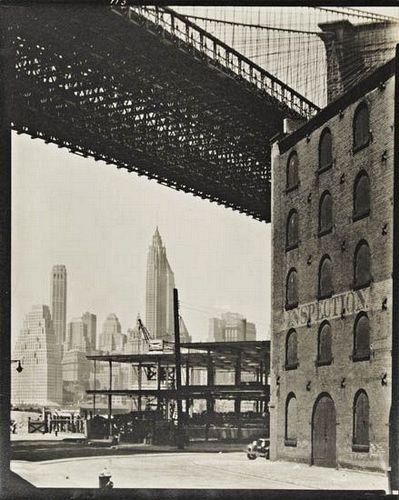
Berenice Abbott had known Eugène Atget in Paris and admired and promoted his work after his death in 1927. She saw the significance of detailed documentary projects that preserved the architectural heritage of changing urban centers. In 1935 she proposed her project "Changing New York" to the Federal Art Project (FAP) which was to support unemployed artists and those with related skills during the Great Depression. Berenice Abbott's work resulted in the book Changing New York (1939) with an introduction by art critic Elizabeth McCausland. The book included 97 illustrations by Berenice Abbott and larger sets of 302 photographs were distributed by FAP to High schools, libraries and public institutions. 284.21 Landscape > Morrison & Burdekin: London Night (1934) About this photographer | Photographs by this photographer
John Morrison and Harold Burdekin collaborated together on the book of night photography London Night (Collins, 1934). Pictorialism 284.22 Landscape > Landscape: Pictorialist Cityscapes
Construction 284.23 Landscape > Landscape: Construction within cityscapes
Wartime 284.24 Landscape > Cityscapes in wartime
People within the city 284.25 Landscape > Strolling the city streets
alan@luminous-lint.com |
General reading Edwards, Elizabeth, 2012, The Camera as Historian: Amateur Photographers and Historical Imagination, 1885–1918, (Duke University Press) isbn-10: 0822351048 isbn-13: 978-0822351047 [Δ] George, Alice Rose (ed.), Peress, Gilles et. al., 2002, Here is New York: A Democracy of Photographs, (New York: Scalo) isbn-10: 3908247667 isbn-13: 978-3908247661 [Δ] Golden, Reuel, 2012, London: Portrait of a City, (Taschen) isbn-13: 978-3836528771 [Δ] Hales, Peter Bacon, 2005, Silver Cities: Photographing American Urbanization, 1839–1939, (Albuquerque: University of New Mexico Press) [Δ] Pinkney, David H., 1972, Napoleon III and the Rebuilding of Paris, (Princeton University Press) isbn-10: 0691007683 isbn-13: 978-0691007687 [Δ] Rice, Shelley, 1999, Parisian Views, (The MIT Press) isbn-10: 0262681072 isbn-13: 978-0262681070 [Δ] Robinson, Percy, 1896, Relics of Old Leeds, (Leeds: Percy Robinson; London: B. T. Batsford) [Δ] Spring, Ian, 1990, Phantom Village: The Myth of the New Glasgow, (Edinburgh: Polygon) [Δ] Stamp, Gavin, 1984, The Changing Metropolis: Earliest Photographs of London, 1839-79, (Hammondsworth: Penguin) [Δ] Werner, Alex & Williams, Tony, 2012, Dickens's Victorian London: 1839-1901, (Edbury Press) isbn-10: 0091943736 isbn-13: 978-0091943738 [Δ] Readings on, or by, individual photographers Berenice Abbott McCausland, Elizabeth & Abbott, Berenice, 1939, Changing New York, (New York: E. P. Dutton) [Δ] Van Haaften, Julia (ed.), 1989, Berenice Abbott, Photographer: A Modern Vision, (New York: New York Public Library) [Δ] Yochelson, Bonnie, 1997, Berenice Abbott: Changing New York, (New York: The New Press; New York: Museum of the City of New York) [Δ] Thomas Annan Annan, Thomas, 1977, Photographs of the Old Closes and Streets of Glasgow, 1868–1877, (New York: Dover Publications) [Introduction by Anita Ventura Mozeley. Reprint] [Δ] McKenzie, Roy, 1992, ‘Thomas Annan and the Scottish Landscape: Among the Gray Edifices‘, History of Photography, vol.16, no.1, pp.40 [Δ] Spring, Ian, 1996, ‘Midnight Scenes and Social Photographs: Thomas Annan's Glasgow‘, in Mancoff, Debra N. & Trela, DJ (eds.), Victorian Urban Settings: Essays on the Nineteenth-Century City and Its Contexts, pp.195-213 [Δ] Stevenson, Sara, 1990, Thomas Annan 1829-1887, (Edinburgh: National Galleries of Scotland) [Δ] Eugène Atget Atget & Proust, 2012, Paris du temps perdu, (Paris: Editions Hoëbeke) [Δ] Szarkowski, John & Hambourg, Maria Morris, 1981, The Work of Atget. Vol. 1: Old France, (New York: Museum of Modern Art) [Δ] Archibald Burns Burns, Archibald & Henderson, Thomas, 1868, Picturesque Bits from Old Edinburgh: A Series of Photographs, (Edomonston and Douglas, publishers to the Society of Antiquaries of Scotland, London: Simpkin, Marshall, and Company) [Δ] Alvin Langdon Coburn Chesterton, G.K. & Coburn, Alvin Langdon, 1914, London With ten photographs by Alvin Langdon Coburn, (London: Privately printed for Alvin Langdon Coburn & Edmund D. Brooks and their friends) [Δ] Coburn, Alvin Langdon, 1909, London, (London: Duckworth & Co.) [Δ] Coburn, Alvin Langdon, 1910, New York, (London: Duckworth and New York: Brentano‘s) [Introductory essay by H.G. Wells] [Δ] George Robinson Fardon Fardon, George Robinson, 1856, Photographs of the Most Beautiful Views and Public Buildings of San Francisco [Δ] Fardon, George Robinson & Fraenkel, Jeffrey, 1999, George Robinson Fardon. San Francisco Album: Photographs of the Most Beautiful Views and Public Buildings, (San Francisco: Fraenkel Galleries, Hans P. Kraus, Jr. and Chronicle Books) isbn-10: 0811826309 isbn-13: 978-0811826303 [Δ] Marcel Gautherot Gautherot, Marcel, 1956, Modern Architecture in Brazil, (Amsterdam/Rio de Janeiro: Colibri) [Δ] Gautherot, Marcel, 1965, Rio de Janeiro, (Munique: W. Anderman) [Δ] Gautherot, Marcel, 2001, O Brasil de Marcel Gautherot, (São Paulo: Instituto Moreira Salles (IMS)) isbn-10: 8586707058 [Δ] Gautherot, Marcel, 2010, Building Brasilia: Photographs by Marcel Gautherot, (Thames & Hudson) isbn-10: 0500515425 isbn-13: 978-0500515426 [Δ] György Lorinczy Lorinczy, György, 1972, New York, New York, (Budapest, Magyar Helikon) [Δ] David Maisel Maisel, David, 2006, Oblivion, (Nazraeli Press) [Essay by William L. Fox and poem by Mark Strand] [Δ] Charles Marville Chambord, Jacqueline (ed.), 1981, Charles Marville: Photographs of Paris, 1852-1878, (French Inst/Alliance Francaise) isbn-10: 0933444397 isbn-13: 978-0933444393 [Δ] Marville, Charles, 1994, Marville Paris, (Hazan) [Δ] Marville, Charles, 1997, Charles Marville, (Centre National de Photo) isbn-10: 286754100X isbn-13: 978-2867541001 [French] [Δ] Morrison & Burdekin Morrison, John & Burdekin, Harold, 1934, London Night, (London: Collins) [Δ] Jacob A. Riis Alland Sr, Alexander, 1993, Jacob A. Riis: Photographer and Citizen, (New York: Aperture) [Δ] Riis, Jacob A., 1890, How the Other Half Lives: Studies Among the Tenements of New York, (New York: Charles Scribner’s Sons) [Δ] Yochelson, Bonnie & Czitrom, Daniel, 2007, Rediscovering Jacob Riis: Exposure Journalism and Photography in Turn-of-the-Century New York, (New York: New Press) [Δ] If you feel this list is missing a significant book or article please let me know - Alan - alan@luminous-lint.com Berenice Abbott (1898-1991) • Alinari • Thomas Annan (1829-1887) • Eugène Atget (1857-1927) • Archibald Burns • Alvin Langdon Coburn (1882-1966) • George Robinson Fardon (1807-1886) • Marcel Gautherot (1910-1996) • David Maisel • Charles Marville (1813-1879) • William Notman (1826-1891) • Victor Prevost (1820-1881) • Jacob A. Riis (1849-1914) • Camilo José Vergara (1944-) | Home > Themes > Landscape > Landscape types > Cityscapes - Urban
|