Contents
| This theme includes example sections and will be revised and added to as we proceed. Suggestions for additions, improvements and the correction of factual errors are always appreciated. Status: Collect > Document > Analyse > Improve | Introduction 247.01 War > Second World War (1939-1945): Introduction
In the Second World War many photographers with distinguished pre-war careers chose to use their skills to switch to war photography. Some such as
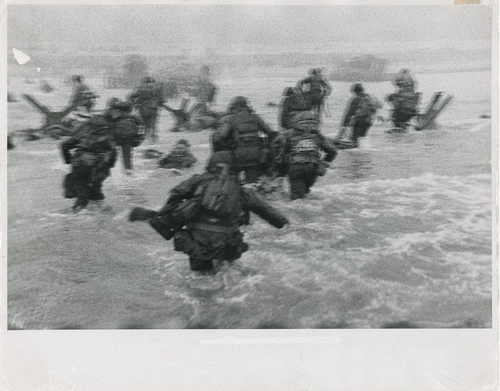
Robert Capa (1913-1954) were well versed in war but others such as
W. Eugene Smith,
Cecil Beaton,
Lee Miller,
Margaret Bourke-White and the surrealist French photographer
Roger Parry, who became a war correspondent for Agence France Presse, had to adapt to it. Each of these had shot different types of images before the war but each of them produced major bodies of work and in some cases books.
Propaganda and public information 247.02 War > Heinrich Hoffman: Portraits of Adolf Hitler About this photographer | Photographs by this photographer
247.03 War > Heinrich Hoffmann (Editor) & Josef Bürckel (Foreword): Hitler holt die Saar heim (1938) About this photographer | Photographs by this photographer
Heinrich Hoffmann (Editor) & Josef Bürckel (Foreword) Hitler holt die Saar heim (Berlin: Zeitgeschichte-Verlag, 1938), First edition (1. bis 25. Tausend). Quarto. Unpaginated [64pp]. Original pictorial wrappers over softcover. Stunning photographic work by Hitler's personal photographer on the return of the Saar region to Germany. With 88 spectacular full-page and half-page photos, this book tells the story of this important event which was highlighted as a tremendous victory for Hitler by his efficient and powerful propaganda machine.
About the Saar plebiscite: In 1933, a considerable number of political opponents of National Socialism moved to the Saar, as it was the only part of Germany that remained under foreign occupation following the First World War. As a result, anti-Nazi groups agitated for the Saarland to remain under British and French occupation under a League of Nations mandate. However, with most of the population being German, the mandate was unpopular. A plebiscite was held in the territory on 13 January 1935. With Adolf Hitler anxious for the propaganda advantages of the return of the Saar to Germany, Joseph Goebbels designed a concerted campaign to sway voters. The support of the local Catholic authorities for a return also helped, as did concerns about Bolshevism, against which Hitler was seen as a bulwark. With a voter participation of 98%, the result of the plebiscite was that the overwhelming majority, 90.73%, voted to re-join the German Reich, with only 8.86% wanting to retain the status quo. A third option of joining France received 0.41% of the vote. Following the vote, Hitler announced that Germany "had no further territorial demands to make of France." 247.04 War > A question of emotional interpretation: People of Cheb salute the German troops entering the town in the Anschluss of the Sudetenland (October 1938)
Additional information (Wikipedia - Accessed April 2011):
This iconic picture of the Anschluss of the Sudetenland has been captioned and interpreted differently, depending on who published it. The Nazis, who first published it in autumn 1938 shortly after the Anschluss in their newspaper Völkischer Beobachter, claimed the woman cried tears of joy. See for instance this history of the Sudetenland, which uses such a caption:
A Sudeten woman, overcome with emotion, pays homage as the Wehrmacht enters the Sudeten border town of Cheb.
Also see the letter Lieutenant Earle A. Cleveland wrote to the Time Magazine (printed November 12, 1945). He wrote:
The Nazi explanation was that here were portrayed the intense emotions of joy which swept the Sudeten Germans as Hitler crossed the Czech border at Asch and drove through the streets of the nearby ancient city of Eger, 99% of whose inhabitants were ardently pro-Nazi Sudeten Germans at the time...
to which the Time editors commented
...sauce for the Nazi goose is sometimes sauce for Allied propaganda.
The U.S. National Archives and Records Administration (NARA) provides this image (as #78) with the caption:
The tragedy of this Sudeten woman, unable to conceal her misery as she dutifully salutes the triumphant Hitler, is the tragedy of the silent millions who have been 'won over' to Hitlerism by the 'everlasting use' of ruthless force.
which is similar in spirit to the ADN/Zentralbild (a GDR news agency) German caption preserved by the German Federal Archive. Translation:
With her arm raised to the Hitler salute, this woman stood at the roadside when the troops of fascist Germany entered this town [Cheb] after the Munich Agreement (Sep. 29/30, 1938). The salute was not convincing; it was forced. She expresses it in her tears. Tears of misery, of deprivation, of human suffering. What has she gone through because of the fascists; what will she experience after this day?
247.05 War > Winston Churchill - Wanted for incitement to Murder
247.06 War > American posters from the Second World War (1939-1945):
The majority of the public information posters produced in America during the Second World War (1939-1945) used graphic art rather than photographs as the imagery. Here are some examples that either use photographs or the case of the hoisting the flag on Iwo Jima is based on a famous photograph. The home front 247.07 War > Second World War (1939-1945): The home front
The war in Europe 247.08 War > Second World War (1939-1945): Russian photographers
On 22 June 1941 The Russian forces were caught totally off guard when 'Operation Barbarossa' began with over 3 million German soldiers and 3,300 tanks crossing the Russian border. In these days of sophisticated surveillance it seems extraordinary that a military build up of this scale could take place without the full threat being appreciated. The German Luftwaffe annihilated the Russian air force in the first few days of the campaign - but this initial victory led into a sequence of interminable battles and terrible winters with bewilderingly high casualty rates. Throughout the The Great Patriotic War, as the Russians call it, a group of talented Russian photojournalists covered the brutal campaigns that took place on what the Western powers called 'The Eastern Front'.
Second World War (1939-1945) 247.09 War > Nazi suicides in Leipzig, Germany (1945)
Towards the end of the Second World War (1939-1945) when it became apparent that Germany would lose the war and the Third Reich would fall there were a series of mass suicides in Leipzig. The motivations for the suicides were the collapse of the Nazi Party and its ideology and the fear of retribution from the Allied forces that were entering the homeland.
On the 18th April 1945 a number of officials of Leizig commited suicide in the New Town Hall (Neues Rathaus). It is the photographs of the office of the Deputy Mayor Dr. jur. Ernst Kurt Lisso with his wife Renate Stephanie and daughter Regina Lisso photographed on or around 20th April 1945 by Lee Miller, Margaret Bourke-White, Robert Capa and J Malan Heslop who was a U.S Army Signal Corps photographer that show the scene.
The daughter is wearing a nurses cap. 247.10 War > Margaret Bourke-White: Purple Heart Valley About this photographer | Photographs by this photographer
247.11 War > Second World War (1939-1945): Resistance in lands under Nazi occupation
In France...
- Julia Pirotte - Most notable for her brave work in Marseille during the Second World War when she documented the work of the resistance.
- Henri Cartier-Bresson - after escaping from a Prisoner of War camp he photographed for the French Resistance.
Cas Oorthuys and Charles Breijer (1914-) photographed the German Occupation of The Netherlands using hidden cameras.
The Czech photographer Zdenek Tmej was conscripted under the Nazi Totaleinsatz policy (the mobilization of the workforce) to forced labour from 1942-1944 at Breslau in Prussia. The most remarkable point about this was that he was able to take photographs of life during this period. 247.12 War > Yevgeny Khaldei: Soldiers raising the flag of Soviet Union on the roof of Reichstag building in Berlin (2 May 1945) About this photographer | Photographs by this photographer
The Holocaust 247.13 War > The Holocaust: The Pre-Second World War setting
- Roman Vishniac travelled through the Jewish communities of Poland and Eastern Europe in the 1930's and recorded life in the ghettoes with the poverty, joy and variety that makes up a rich tradition. The significance of Roman Vishniac is that because of the destruction of all aspects of Jewish culture by the Nazis that so little remains.
- Margaret Michaelis-Sachs (1902-1985) - Austrian who fled the rise of Fascism in 1933 and travelled widely. She was involved in the Spanish Civil War and in 1938 she visited her parents and photographed in the Jewish ghetto at Cracow.
247.14 War > The Holocaust: Photographing inside the ghettos
- Henryk Ross (1913-1991) was a Polish press photographer who was arrested in 1940 and sent to the Jewish Ghetto of Lodz where he took photographs for the Germans. When the Germans started destroying the ghetto he hid 3,000 negatives in barrels and retrieved them after the war. The images were used as evidence at the trial of Adolf Eichmann at which he gave evidence.
- Heinrich Jöst (1898-1983) was a sergeant in the German Army (Wehrmacht) stationed near Warsaw (Poland) in 1941. On 19 September 1941, which was his birthday, he visited the Jewish Ghetto in Warsaw with his Rolleiflex camera. The photographs that he took that day are amongst the few surviving shots of the Ghetto taken before the uprising that started on 19 April 1943 and the final clearing and destruction of the ghetto on 16 May 1943. The photographer did not show the photographs to anybody until 1982 the year before his death and his motivations remain unclear.
- Joe Heydecker was a journalist and photographer. During the Second World War In 1941 he was ordered to Warsaw to join a propaganda unit (Propogandakompanie) and he took over a thousand photographs of military life including an important series of 42 photographs taken between 11 November 1941 and 14 April 1942 in the Warsaw Ghetto. After the war he covered the Nuremberg Trials before moving to South America where the photographs he had taken in Warsaw were exhibited for the first time in São Paulo in 1981.
- Willy Georg in the summer of 1941 spent a day photographing in the Warsaw Ghetto. He was stopped when taking his fifth roll of film and it was confiscated but the four rolls he had already taken survived. These photographs were published in In the Warsaw Ghetto Summer 1941: Photographs by Willy Georg with Passages from the Warsaw Ghetto Diaries (Aperture, 1993).
247.15 War > The Holocaust: Death camps
The opening of the death camps was documented by multiple photographers:
- Lee Miller walked into the newly liberated Buchenwald death camp - her photographs were run in Vogue with the headline Believe It!. She later went to Dachau.
- Margaret Bourke-White - the opening of the death camps - particularly Buchenwald in April 1945.
- Walter Rosenblum had landed in Normandy on D-Day and took the first motion picture footage of the Dachau concentration camp.
- Henri Cartier-Bresson photographed the interrogations at the Dessau death camps.
247.16 War > The Holocaust: Children
The magnitude of the deaths means that one of the ways we relate to it is through the lifes of individuals - the diaries and letters of children such as Anne Frank (1929-1945) or Georges Halpern (1935-44) bring home both the courage and terrors of that period. The book by Serge Klarsfeld (2001) Remembering Georgy: Letters from the House of Izieu (Aperture) includes the illustrations and letters of Georges Halpern from the childrens home in Izieu (France) for the two years before he was exterminated at the age of 8 in Auschwitz. 247.17 War > The Holocaust: Photographers who died Photographers who died in the Holocaust:
- Erich Salomon - In 1932 Salomon fled to The Netherlands with his wife and son to escape Jewish persecution, but they were arrested in Scheveningen and deported first to Theresienstadt and then to Auschwitz, where they died.
- Imre Kinszki (1901-1943/44?) - Hungarian photographer who dissappeared during the |Holocaust (1943/44).
- Dr. Emil Mayer, one of the great bromoilists, committed suicide with his wife when the Nazis annexed Austria in 1938.
247.18 War > The legacy of the Holocaust in contemporary photography
Contemporary photographers who try to record some of the issues:
Internment camps 247.19 War > Internment camps in the USA during the Second World War
Under pressure from public outcry following the Pearl Harbour attack on 7 December 1941 on February 19th 1942 President Roosevelt signed Executive Order 9066 by which 120,000 people of Japanese descent living in the US were interned in camps. The controversy over this action still continues as more than two thirds of those interned were US citizens and had never shown any signs of disloyalty.
- Hansel Mieth and her husband Otto Hagel were working for LIFE magazine when they were assigned to photograph the Heart Mountain Relocation Center in Wyoming during the Second World War where more than 10,000 Japanese and Japanese Americans were being unconstitutionally incarcerated. Bill Manbo (1908-1992) documented the Heart Mountain camp in colour using Kodachrome.
- Ansel Adams photographed Japanese internment camp at Manzanar (California).
- Dorothea Lange photographed an Japanese internment camp and her photographs were censored by the U.S. Army and not published until many years later.
In December 1944 Public Proclamation number 21 allowed internees to return to their homes from January 1945 onwards. The photographs of the camps were not published during the war and it was not until the 1990s that it became politically acceptable to publish them. The war in the Pacific 247.20 War > Second World War (1939-1945): The War in the Pacific
The photographers in the Pacific theatre of war are generally less well known than those in Europe though the war was just as brutal.
- Louis Stettner (1922-) A rich career that has included, combat photography in the Pacific (1941-1945), advertizing, documentary, landscapes, nudes and still lives.
- Edward Steichen (1879-1973) was with the US Navy.
- W. Eugene Smith Okinawa - finding the baby.
- Carl Mydans of LIFE took the dramatic photograph of General Douglas MacArthur with his staff coming ashore at Lingayen Gulf, Luzon, in the Philippines on January 9, 1945.
- Flag Raising at Iwo Jima - by Joe Rosenthal, February 1945
- Nagasaki Journey: The Photographs of Yosuke Yamahata August 10, 1945 - The photographs Shomei Tomatsu took in 1960 of Nagasaki - with the scarred flesh, decimated cemeteries and twisted glass bottle such a poignent reminder of burnt and twisted flesh.
- The celebrations in Time Square (New York) when VJ was announced. - Alfred Eisenstaedt, V-J Day, 15 August 1945, the war had actually ended the day before.
- The photographs of the Japanese surrender USS Missouri - Sept. 2, 1945 at the end of the war.
http://www.acepilots.com/ww2/pictures.html
- Werner Bischof's studies of post-war Japan. The suicide of the writer Yukio Mishima and the cult of ultra strong nationalism mixed with militarism.
247.21 War > Naval Aviation Photographic Unit
Although officially Edward Steichen was too old to serve during the Second World War he reenlisted after several attempts as a commissioned Lieutenant Commander in 1942. His considerable photographic skills werre recognised he and joined the US Navy founding the Naval Aviation Photographic Unit. The group he led covered the carrier battles and amphibious landings of the US Navy in the Pacific theatre. Over 14,000 photographs are preserved in the American National archives. Photographers included:
Edward Steichen also made the documentary The Fighting Lady (1944) which chronicled the lifes and battles of the Aircraft Carrier U.S.S. Yorktown which won the Academy Award for Best Documentary Feature in 1945 and the New York Film Critics Circle Special Award in 1946. He was 67 when he was discharged in 1945 and he was awarded the Distinguished Service Medal. He was also awarded the Presidential Medal of Freedom by President John F. Kennedy and President Lyndon B. Johnson presented it to him in December 1963. 247.22 War > Joe Rosenthal: Flag raising at Iwo Jima (23 February 1945) About this photographer | Photographs by this photographer
247.23 War > War: Atomic explosions: Nagasaki
247.24 War > War: Atomic explosions: Hiroshima
Aerial photography 247.25 War > Second World War (1939-1945): Aerial reconnaissance and bombing photography
247.26 War > Harold E. Edgerton: Night experiments at Stonehenge About this photographer | Photographs by this photographer
alan@luminous-lint.com |
General reading Citroen, Hans & Starzynska, Barbara, 2012, Auschwitz-Oswiecim, Oswiecim-Auschwitz, (Post Editions) isbn-13: 978-9460830501 [There are editions in Dutch, English and German] [Δ] Fowler, Will, 2000, Their War: German Combat Photographs From the Archives Of Signal Magazine, (Da Capo Press) isbn-10: 1580970400 isbn-13: 978-1580970402 [Δ] Fox, Frank, 1999, God's Eye: Aerial Photography and the Katyn Forest Massacre, (West Chester, PA: West Chester University Press) [Δ] Georg, Willy, 1993, In the Warsaw Ghetto Summer 1941: Photographs by Willy Georg with Passages from the Warsaw Ghetto Diaries, (Aperture) isbn-10: 0893815268 isbn-13: 978-0893815264 [Δ] Jones, Ed & Pus, Timothy (eds.), 2007, Nein, Onkel: Snapshots from Another Front 1938-1945, (Archive of Modern Conflict) isbn-10: 095470911X isbn-13: 978-0954709112 [Δ] Klarsfeld, Serge, 2001, Remembering Georgy: Letters from the House of Izieu, (Aperture) isbn-10: 0893819549 [Δ] Lewinski, Jorge, 1978, The Camera at War, A History of War Photography, (New York: Simon & Schuster) [Δ] Lindstrom, Lamont & White, Geoffrey M., 1990, Island Encounters: Black and White Memories of the Pacific War, (Smithsonian) isbn-10: 0874744571 isbn-13: 978-0874744576 [Δ] Livingston, Jane, 1985, The Indelible Image, Photographs of War, (New York: Harry Abrams) [Δ] Manbo, Bill & Muller, Eric L. (ed.), 2012, Colors of Confinement: Rare Kodachrome Photographs of Japanese American Incarceration in World War II, (The University of North Carolina Press) isbn-10: 0807835730 isbn-13: 978-0807835739 [Δ] Piórkowska, Krystyna, 2012, English-speaking Witnesses to Katyn: Recent Research, (MK, Muzeum Katyn´skie) [Δ] Poirer, Robert G., 1981, Spring, ‘The Katyn Enigma: New Evidence in a 40-year-old Riddle‘, Studies in Intelligence, vol.25, pp.53-63 [Δ] Shneer, David, 2010, Through Soviet Jewish Eyes: Photography, War, and the Holocaust, (Rutgers University Press) isbn-10: 0813548845 isbn-13: 978-0813548845 [Δ] Readings on, or by, individual photographers Ansel Adams Adams, Ansel, 1944, Born free and equal, photographs of the loyal Japanese-Americans at Manzanar Relocation Center, Inyo County, California, (New York: U.S. Camera) [Δ] Margaret Bourke-White Bourke-White, Margaret, 1942, Shooting the Russian War, (New York, Simon and Schuster) [Δ] Bourke-White, Margaret, 1944, They called it "Purple Heart Valley": A Combat Chronicle of the War in Italy, (New York: Simon and Schuster) [Δ] Bourke-White, Margaret, 1946, "Dear fatherland, rest quietly": A Report on the Collapse of Hitler's "Thousand years", (New York, Simon and Schuster) [Δ] Rubio, Oliva María & Quimby, Sean, 2013, Margaret Bourke-White: Moments in History, (Madrid: La Fábrica) isbn-13: 978-8415303961 [Δ] Horace Bristol Faram, Mark, 2009, Faces of War: The Untold Story of Edward Steichen's WWII Photographers, (Berkley Hardcover) isbn-10: 0425221407 [Δ] Robert Capa Capa, Robert, 1947, Slightly Out of Focus, (New York: Henry Holt) [Δ] Capa, Robert, 1964, Images of War, (NY: Paragraphic Books) [Δ] Capa, Robert, 1989, Robert Capa, (Paris: Centre National de la Photographie) [Δ] Forbes-Robertson, Diana & Capa, Robert, 1941, The battle of Waterloo road, (New York: Random House) [Δ] Kershaw, Alex, 2002, Blood and Champagne: The Life and Times of Robert Capa, (Macmillan) [Δ] Wertenbake, Charles & Capa, Robert, 1944, Invasion!, (New York: D. Appleton Century) [Includes 16 photographs by Robert Capa] [Δ] Whelan, R., 2001, Robert Capa: The Definitive Collection, (New York: Phaidon Press) [Δ] Whelan, Richard, 1994, Robert Capa: A Biography, (Lincoln, NE: University of Nebraska Press) [Δ] Brigitte Carnochan Carnochan, Brigitte, 2012, Imagining Then: A Family Story, 1941-47, (hp MagCloud) [Introduction by Brooks Jensen & Afterword by David Bayles. Exhibition catalog. MagCloud id: 374656] [Δ] Chim Naggar, Carole & Seymour, David [Chim], 2013, Chim: Children of War, (Umbrage Editions) isbn-10: 1884167837 isbn-13: 978-1884167836 [Δ] Young, Cynthia; Naggar, Carole & Cohen, Roger, 2013, We Went Back: Photographs from Europe 1933-1956 by Chim, (Prestel) isbn-10: 3791352814 isbn-13: 978-3791352817 [Δ] Alfred Eisenstaedt Verria, Lawrence & Galdorisi, George, 2012, The Kissing Sailor: The Mystery Behind the Photo that Ended World War II, (Naval Institute Press) isbn-10: 1612510787 isbn-13: 978-1612510781 [Foreword by David Hartman] [Δ] Joe Heydecker Heydecker, Joe J., 1983, Das Warschauer Ghetto: Foto-Dokumente eines deutschen Soldaten aus dem Jahr 1941, (Muenchen: Deutscher Taschenbuch Verlag) isbn-10: 3423102470 isbn-13: 978-3423102476 [Δ] Heydecker, Joe J., 1991, The Warsaw Ghetto: A Photographic Record, 1941-1944, (London: St Martins Press) isbn-10: 1850431558 isbn-13: 978-1850431558 [Δ] Heinrich Hoffmann Hoffmann, Heinrich (ed.) & Bürckel, Josef (Foreword), 1938, Hitler holt die Saar heim, (Berlin: Zeitgeschichte-Verlag) [Δ] Yevgeny Khaldei Volland, Ernst & Krimmer, Heinz (eds.), 1999, Von Moskau nach Berlin. Bilder des russischen Fotografen Jewgeni Chaldej, (Berlin) [Δ] Franz Krieger Kramml, Peter F. & Straßl, Roman, 2008, Der Salzburger Pressefotograf Franz Krieger (1914–1993): Bildberichterstattung im Schatten von NS-Propaganda und Krieg, (Salzburg Stadtarchiv und Statistik) isbn-13: 978-3900213084 [German. English translation of title: The Salzburg Press Photographer Franz Krieger (1914-1993): Photojournalism in the Shadow of Nazi Propaganda and War] [Δ] Dorothea Lange Gordon, Lina & Okihiro, Gary Y. (eds.), 2006, Impounded: Dorothea Lange and the Censored Images of Japanese American Internment, (W. W. Norton & Company) isbn-10: 039306073X isbn-13: 978-0393060737 [Δ] Lee Miller Allmer, Patricia, 2012, ‘Lee Miller's Revenge on Fascist Culture‘, History of Photography, vol.36, no.4, pp.397-413 [Δ] Penrose, Antony, 1985, The Lives of Lee Miller, (New York: Holt, Rinehart & Winston) [Δ] Penrose, Antony (ed.), 2005, Lee Miller’s War, (New York: Thames and Hudson) isbn-10: 0500285586 isbn-13: 978-0500285589 [Foreword by David E. Scherman] [Δ] Wayne Miller Daiter, Stephen (ed.), 2008, Wayne F. Miller: Photographs 1942-1958, (powerHouse Books) isbn-10: 1576874621 isbn-13: 978-1576874622 [Essay by Kerry Tremain. Introduction by Fred Ritchin.] [Δ] Faram, Mark, 2009, Faces of War: The Untold Story of Edward Steichen's WWII Photographers, (Berkley Hardcover) isbn-10: 0425221407 [Δ] John Phillips Phillips, John, 1986, Testimone del secolo - John Phillips Fotografie 1936-1982, (Olivetti) [Italian] [Δ] W.G. Sebald Patt, Lise (ed.), 2007, Searching for Sebald: Photography After W. G. Sebald, (Los Angeles: The Institute of Cultural Inquiry) [Δ] Edward Steichen Faram, Mark, 2009, Faces of War: The Untold Story of Edward Steichen's WWII Photographers, (Berkley Hardcover) isbn-10: 0425221407 [Δ] Phillips, Christopher, 1983, Steichen at War: The Navy's Pacific Air Battles, (Harry N Abrams) isbn-10: 0810916398 isbn-13: 978-0810916395 [Δ] Steichen, Edward, 1945, Power In the Pacific, (New York: US Camera Publishing Corp.) [Δ] Steichen, Edward, 1987, U.S. Navy War Photographs Pearl Harbor to Tokyo Bay, (Bonanza Books) isbn-10: 0517455498 isbn-13: 978-0517455494 [Δ] Steichen, Edward (ed.), 1947, The Blue Ghost, (New York: Harcourt, Brace, and Co.) [Δ] Shõmei Tõmatsu Tomatsu, Shomei, 1966, 11 ji 02 fun Nagasaki (<11?02?>Nagasaki, "11:02" Nagasaki), (Tokyo: Shashin Dojinsha) [Δ] Roman Vishniac Vishniac, Roman, 1986, A Vanished World - Roman Vishniac, (Douglas & McIntyre) isbn-10: 0374520232 isbn-13: 978-0374520236 [Foreword by Elie Wiesel] [Δ] If you feel this list is missing a significant book or article please let me know - Alan - alan@luminous-lint.com Resources Max Alpert (1899-1980) • Emmy Andriesse (1914-1953) • Dmitri Baltermants (1912-1990) • Cecil Beaton (1904-1980) • Thérèse Bonney (1894-1978) • Margaret Bourke-White (1904-1971) • Wilhelm Brasse (1917-2012) • Horace Bristol • Robert Capa (1913-1954) • Henri Cartier-Bresson (1908-2004) • Anatoli Egorov • Emmanuel Evzerikhin (1911-1984) • James Fee (1949-2006) • Andrew Freeman • Toni Frissell (1907-1988) • Joe Heydecker (1916-1997) • Heinrich Hoffmann (1885-1957) • Dmitri Kessel (1902-1995) • Yevgeny Khaldei (1917-1997) • Andreas Magdanz • Mark Markov-Grinberg (1907-) • Yoshito Matsushige (1913-2005) • Lee Miller (1907-1977) • Wayne Miller (1918-) • Carl Mydans (1907-2004) • Cas Oorthuys (1908-1975) • Roger M. Parry (1905-1977) • Georgii Petrusov (1903-1971) • John Phillips (1914-1996) • Julia Pirotte (1911-) • Arthur Rickerby • George Rodger (1908-1995) • Walter Rosenblum (1919-2006) • Joe Rosenthal (1911-2006) • Henryk Ross (1910-1991) • Paul Senn (1901-1953) • George Silk (1916-) • W. Eugene Smith (1918-1978) • Humphrey Spender (1910-2005) • Edward Steichen (1879-1973) • Louis Stettner (1922-) • John Swope (1908-1979) • Zdenek Tmej (1920-2004) • Tony Vaccaro (1922-) • Alexander Zhitomirsky (1907-1993) | Home > Themes > War > Second World War (1939-1945)
|