This theme includes example sections and will be revised and added to as we proceed. Suggestions for additions, improvements and the correction of factual errors are always appreciated.
In the American Civil War (1861-1865) the photographers of Mathew Brady (1823-1896),
Alexander Gardner (1821-1882), Timothy O’Sullivan (1840-1882) and others took many plates of the dead as they did not move and could, if current prevailing opinion suggests, be moved to appropriate locations. They brought home to the public the real chaos of war and the fact that it is rarely glorious. When the 10 volume Photographic History of the Civil War edited by Robert S. Lanier came out there was a vast range of images to select from and this is still evident from the number of original Civil War photographs, both original and fraudulent, that can still be purchased on Ebay.
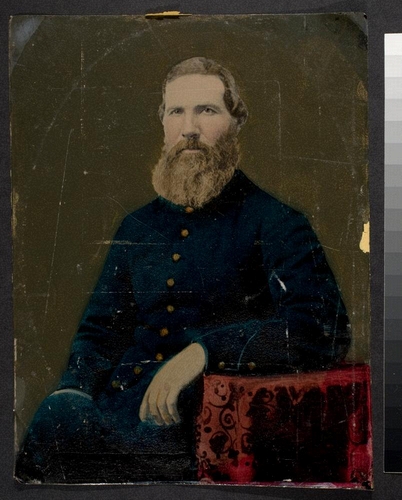
There had been a rapid growth in photographic studios in the 1850's and the introduction of the tintype / ferrotype in 1853 meant that photographs could be on cheap metal sheets rather than on the more fragile glass plates used by ambrotypes. The late Robert Leggat on his website on the History of Photography gave five reasons for this:
The process is a single stage requiring no negative.
They were cheap to create making them ideal for the military and their relatives.
The metal base meant they could be placed in albums or mailed.
They could be cut with scissors or pincers making them perfect for photo-jewelry.
The relatively low cost of portraits and the abundance of photographers led to the American Civil War being the first major conflict in which common soldiers had their portraits taken in large numbers.
For the officers during the American Civil War (1861-1865) the carte de visite had been patented in 1854 and higher quality glass plates were also available. The plethora of techniques and the ways they could be displayed ensured that there was something appropriate for every pocket.
During and after the American Civil War (1861-1865) there was a commercial opportunity for marketing series of stereoviews of the personalities, battlefields, equipment and camp life. The study of these is complex as the photographer is frequently not recorded, the studio or studio owner claimed rights over the photographs they had financed or purchased without giving credit to the photographer, publishers obtained photographs from multiple sources, studios went out of business, negatives were sold from one studio to another, the captions and attributions on occasion were not accurate.
Includes photographs by George N. Barnard, Thomas C. Roche and others by The War Photograph & Exhibition Company (Hartford), and Taylor & Huntington (Hartford).
In the James Wadsworth Family Papers archive at The Library of Congress there is a particularly fine photograph album of two hundred individuals thought to have been collected by John Hay (1838-1905) who was the personal secretary to President Abraham Lincoln.
The collecting and exchange of carte de visite was a craze during the American Civil War (1861-1865) and it was common place to have them autographed by the sitter.
Civil War Cameras - George Eastman House Curator of Technology Todd Gustavson discusses two examples of Civil War-era cameras - a stereo camera and the Lewis wet-plate camera.
During the American Civil War (1861-1865) vast numbers of photographs were taken but there are few illustrated works as well known as highly regarded as Gardner‘s Photographic Sketchbook of the War compiled by Alexander Gardner. The two volume album contained 100 albumen prints in total with 50 tipped in plates in each volume accompanied by a descriptive text possibly by Alexander Gardner. The book was published by Philp & Solomons (Washington) in two editions, one thought to have been published in 1865 and the other in 1866. More recent research by Anne E. Peterson (Curator of Photographs, DeGolyer Library, Southern Methodist University) now indicates that both editions came out in 1866.
Within public collections the same plate can have different photographers assigned to it and a level of confusion can occur. This is partly because of the way the work was created with the negative being taken by one photographer, the print made by another and the copyright registered by a third. The text printed on the first plate "Marshall House, Alexandria, Virginia" highlights this:
"Negative by Wm. R. Pyrell. August 1862. Entered according to Act of Congress in the year 1865, by A. Gardner, in the Clerk’s Office of the District Court of the District of Columbia. Incidents of the War. Marshall House, Alexandria, VA. Published by Philp & Solomons, Washington. Positive by A. Gardner, 511 7th St., Washington"
These original records are not always accurate and to find the actual photographer who took the negative it is advisable to check with:
The solid introduction by E.F. Bleiler and reproductions of all the plates makes this the most authoritative source on this series. Where there are discrepancies between different sources I have attempted to highlight them but I always welcome additional research to ensure accuracy and completeness.
The exact number of copies of the Photographic Sketchbook of the War sold is not known but is thought to be between 125 and 200 copies and there are complete sets at George Eastman House and Cornell University Library both of which have copies on the Internet. Because there was no way of printing the photographs directly onto the pages the 100 photographs for each set were made individually and then affixed to the pages. This was both laborious and expensive and the two volume sold for $150 a set when they were published in the 1860s a vast sum of money at the time.
With wet collodion negatives the light sensitivity of the chemicals was such that one could get the correct exposure for the sky or for the landscape but rarely both. The French master of seascapes, Gustave Le Gray (1820-1884), got around this by taking two plates each exposed correctly for a part of the shot and then creating a final image that was a composite of the two.
With George N. Barnard (1819-1902) during the American Civil War (1861-1865) these examples show both the original negative (presumably from a plate) and the retouched version where the clouds are both dramatic and visible. If you look at the skyline on the retouched version of the Potter House image and examine the trees on the right hand side you can clearly see where the two images have been joined.
An examination of the skyline and the edges of the tree branches in the photograph Rebel Works in front of Atlanta, No. 1 by American Civil War (1861-1865) photographer George N. Barnard shows that this is a composite made from multiple distinct negatives.
An examination of the clouds in versions of George N. Barnard's dramatic photograph of Destruction of Hood's Ordnance Train indicates that these are composite prints using one negative for the landscape and another for the sky.
On 30th June 1864 Congress passed the Internal Revenue Act of 1864 (13 Stat. 223) to raise additional revenue to finance the American Civil War. This included a provision to tax "photographs, ambrotypes, daguerreotypes or any other sun-pictures" by affixing a tax revenue stamp proportionate to the cost of the photograph to the reverse of each photograph.
Up to 25 cents - 2 cent revenue stamp
26-50 cents - 3 cent revenue stamp
51 cents - $1 - 5 cent revenue stamp
Over $1 a further 5 cent stamp for each $1 or fraction thereof.
Sherman's neckties - otherwise known at Sherman's hairpins or Sherman's bow ties - where named after Maj. Gen. William Tecumseh Sherman of the Union Army and were a method employed for destroying Confederate railroad infrastructure as a part of his scorched earth policy during the American Civil War.
Gerneral Sherman, Special Field Orders No.37, (July 18, 1864)
"...Keep every man of his command at work in destroying the railroad by tearing up track, burning the ties and iron, and twisting the bars when hot. Officers should be instructed that bars simply bent may be used again, but if when red hot they are twisted out of line they cannot be used again. Pile the ties into shape for a bonfire, put the rails across and when red hot in the middle, let a man at each end twist the bar so that its surface becomes spiral.”
Other devices for wrecking track employed large levers and A.J. Russell photographed the use of these in his series Photographs illustrative of operations in construction and transportation, as used to facilitate the movements of the Armies of the Rappahannock, of Virginia, and of the Potomac ... (1863)
During the American Civil War (1861-1865) the cameras were not able to photograph movement with any fidelity and therefore more static subjects were selected. The dead were a natural if macabre choice but there has been considerable discussion about the placement of the dead so that they provided the best visual composition. Analysis by William Frassanito in his pioneering book on photo-forensics Gettysburg: A Journey in Time indicated that some bodies had been moved and the captions provided within Gardner's Sketchbook of the War were not always accurate.
On 2 January 1864 Frank Leslie's Illustrated Newspaper published the article "An incident at Gettysburg" which included an illustration of Amos Humiston dies holding an ambrotype of his three children. Within the American population during the American Civil War there was generally held belief that the family would join together after death. This acceptance of a heavenly order is shown in letters of the time:
"I have often thought if I have to die on the battlefield, if some kind friend would just lay my Bible under my head and your likeness on my breast with the golden curls of hair in it, that it would be enough."
Letter from William Stilwell to his wife, Molly, in Georgia.
[Secondary source: Drew Gilpin Faust, 2008, This Republic of Suffering: Death and the American Civil War (Knopf), p.12
William H. Mummler (1832-1884) was one of American's great spirit photographers and also a considerable fraud. At the time of national grieving for the terrible losses of the American Civil War (1861-1865) he took photographs of people with departed relatives. The most famous of these is his portrait of Mary Todd Lincoln, the wife of Abraham Lincoln, sitting with the departed President standing behind her with his hand affectionately resting on her shoulder. In April 1869 he was tried for fraud and P.T. Barnum testified against him and had the noted New York photographer Abraham Bogardus created a fake to show how it could be done.
"Spiritual Photography", 1869, The Living Age, vol. 102, p. 314-315 gives an account of the trial of Mummler taken from The Saturday Review:
The celebrated Barnum was called among other witnesses for the prosecution, and he stated that he had devoted a portion of his life to the detection of humbugs. About seven years ago Mr. Barnum was composing a book on humbugs, and he wrote to Mr. Mumler that he wished to purchase specimens of his so-called spirit photographs for the Museum of humbugs established by him, Barnum. Spirit photographs were accordingly supplied by Mr. Mumler at two dollars apiece, and they were hung by Mr. Barnum on the walls of the Museum for three or four years. Among them were spirit photographs of Napoleon Bonaparte and Henry Clay, and the positions of the figures were exactly like the well-known engravings of these personages. The title of Mr. Barnum's book was The Humbugs of the World. All the chapter relating to spirit photographs, referred to Mr. Mumler, who does not seem to have objected to the celebrity thus bestowed upon him. The spirit photographs which were hung upon the walls of Mr. Barnum's Museum were labelled " humbug," and the compliment thus conveyed was not repudiated by Mr. Mumler. (p. 315)
This carte de visite by Wenderoth, Taylor and Brow was published in 1864 during the American Civil War (1861-1865) and is entitled on the front "Frank, Frederick & Alice"> The front shows three children and at it is a family portrait. The carte de visite is a copy of an ambrotype and the back of the card explains.
"The Children of the Battle Field"
is a copy of the Ambrotype found in the hands of of Sargeant Humiston of the 154th N.Y. Volunteers as he lay dead on the Battlefield of Gettysburg.
The proceeds of the sale of the copies are approportioned to the support and education of the Orphan Children.
Picture is private property, and can not be copied without wronging the Orphans for whom it is published.
(Philadelphia, Dec. 3d 1864.
J. Francis Bourns.
Curational comment from "Dawn's Early Light: The First 50 Years of American Photography" (October 20, 2011 - May 4, 2012, Hirshland Exhibition Gallery in Carl A. Kroch Library, Cornell University) on this carte de visite explains that a Philadelphia physician sold them to raise funds for the children.
The number of professional and amateur historians who have written on American Civil War (1861-1865) is enormous but few have had the influence on the analysis of the photographic evidence that William Frassanito had with his 1975 book Gettysburg: A Journey in Time. Frassinato's background in intelligence analysis with the U.S. Army provided a new perspective on the visual material. His analysis of the over 230 surviving photographs of the battlefield at Gettysburg known at that time saw them not as mere illustrations but as historical documents worthy of a thorough forensic analysis to provide evidence and insights into the events of July 1863. Many of the captions on the photographs were misleading, imprecise or incorrect and the same images were being used repeatedly embedding the mistakes within subsequent histories.
Frassanito (1975:p.15) clearly articulated the six questions he wanted to address:
Who, in fact were the early photographers of the battlefield and from where did they come? How long after the battle were the various views taken - several days, several weeks, or several years? What portions of the field were covered by the different cameramen? What portions were neglected and why? How did each photographer interpret his subject matter? Has each photograph been properly credited with the scenes he recorded? If the currently accepted captions on the better-known Gettysburg views are incorrect, how did they come to be misidentified?
The analysis of the scene revealed that the photographs taken in the vicinity of the Rose Farm and Rose Woods had confusing labels and the motivations for the mislabeling are unclear - it could have been memory failings or a conscious desire to improve sales by associating the scenes with significant moments in the battle. The fact that the same group of bodies was photographed with cameras at an angle of 135o and yet each group was given different captions presents a problem. The original captions say that the fallen were Union soldiers and in another case Confederate, on another the caption refers to "Field Where General Reynolds Fell, Gettysburg" which is not accurate. The photographs have been on occasion credited to Alexander Gardner as some of them were published in the Gardner's Photographic Sketch Book of the War. Incidents of the War but it was Timothy H. O'Sullivan who took some of them.
During the American Civil War (1861-1864) at about noon on 21st May 1864 the Army of the Potomac with Generals U.S. Grant and George Mead arrived at Massaponax Church, on Telegraph Road (Virginia, in Spotsylvania County). During a brief stay a Council of War was held and photographed by Timothy O'Sullivan through a window from the gallery in the nearby Massaponax Church.
The people included in the photographs are:
General U.S. Grant
General George Meade
Secretary of War Charles Dana
Chief of Staff John A. Rawlins
In these photographs of injuries to Private George Lemon that required the amputation of his leg during the American Civil War (1861-1865) in the version on the left he is shown naked from the waist down to highlight the injury. The same negative has been used for the photograph on the right but here a leaf has been painted over his genitals.
In the 1915 silent film Birth of a Nation, (dir. D.W. Griffith) part of this story of the American Civil War (1861-1865) and its aftermath hangs on Ben Cameron, a Southerner seeing a cased photograph showing Elsie Stoneman a Northener and falling in love during a period of social and political upheaval.
1870-88, Medical and Surgical History of the War of the Rebellion (1865-65), (Washington, Gov’t print. off.) [Three volumes. Includes work by Joseph Janvier Woodward] [Δ]
Burns, Stanley, 1980, Civil War Medical Photography, (Burns Press) [Δ]
Coddington, Ronald S., 2004, Faces of the Civil War: An Album of Union Soldiers and Their Stories, (Johns Hopkins University Press) isbn-10: 0801878764 isbn-13: 978-0801878763 [Δ]
Coddington, Ronald S., 2008, Faces of the Confederacy: An Album of Southern Soldiers and Their Stories, (Johns Hopkins University Press) isbn-10: 0801890195 isbn-13: 978-0801890192 [Δ]
Coddington, Ronald S., 2012, African American Faces of the Civil War: An Album, (The Johns Hopkins University Press) isbn-10: 142140625X isbn-13: 978-1421406251 [Forward by J. Matthew Gallman] [Δ]
Connor, J.T.H. & Rhode, Michael G., 2003, ‘Shooting Soldiers: Civil War Medical Images, Memory, and Identity in America‘, Invisible Culture: An Electronic Journal for Visual Culture, vol.5 [Δ]
DK Publishing, 2011, The Civil War: A Visual History, (DK Publishing) isbn-10: 075667185X isbn-13: 978-0756671853 [Δ]
Faust, Drew Gilpin, 2008, This Republic of Suffering: Death and the American Civil War, (Knopf) isbn-10: 037540404X isbn-13: 978-0375404047 [Δ]
Frassanito, William A., 1975, Gettysburg: A Journey in Time, (Scribner) isbn-10: 0684139243 isbn-13: 978-0684139241 [Δ]
Frassanito, William A., 1978, Antietam: The Photographic Legacy of America's Bloodiest Day, (Scribner) isbn-10: 0684156598 isbn-13: 978-0684156590 [Δ]
Frassanito, William A., 1995, Early Photography at Gettysburg, (Thomas Publications) isbn-10: 0939631865 isbn-13: 978-0939631865 [Δ]
Harvey, Eleanor Jones, 2012, The Civil War and American Art, (Yale University Press) isbn-10: 0300187335 isbn-13: 978-0300187335 [Δ]
Hopkins, Donald A., 2012, Robert E. Lee in War and Peace: Photographs of a Confederate and American Icon, (El Dorado Hills, CA: Savas Beatie) isbn-13: 978-1611211207 [Δ]
Hyslop, Steve, 2006, Eyewitness to the Civil War, (National Geographic) isbn-10: 0792262069 isbn-13: 978-0792262060 [Δ]
Knauer, Kelly, 2011, TIME The Civil War: An Illustrated History, (Time) isbn-10: 1603201718 isbn-13: 978-1603201711 [Δ]
Lanier, Robert S. (ed.), 1911, Photographic History of the Civil War, (New York: Review of Reviews Co.) [10 volumes] [Δ]
Lewinski, Jorge, 1978, The Camera at War, A History of War Photography, (New York: Simon & Schuster) [Δ]
Livingston, Jane, 1985, The Indelible Image, Photographs of War, (New York: Harry Abrams) [Δ]
Peterson, Anne E., 2013, The Civil War in Photographs: New Perspectives from the Robin Stanford Collection, (De Golyer Library, South Methodist University) [Exhibition catalogue, January 15 - March 15, 2013, De Golyer Library, South Methodist University] [Δ]
Piston, William Garrett & Sweeney, Thomas P., 2009, Portraits of Conflict: A Photographic History of Missouri in the Civil War, (University of Arkansas Press) isbn-10: 1557289131 isbn-13: 978-1557289131 [Δ]
Recker, Stephen, 2012, Rare Images of Antietam: And the Photographers Who Took Them, (Another Software Miracle) isbn-10: 0971548617 isbn-13: 978-0971548619 [Δ]
Rogers, B.O., 1995, May-June, ‘The first Civil War photographs of soldiers with facial wounds‘, Aesthetic Plastic Surgery, vol.19, no.3, pp.269-83 [Δ]
Rosenheim, Jeff L., 2013, Photography and the American Civil War, (Metropolitan Museum of Art) isbn-10: 0300191804 isbn-13: 978-0300191806 [Exhibition catalogue] [Δ]
Tucker, Anne Wilkes; Michels, Will & Zelt, Natalie, 2012, War/Photography: Images of Armed Conflict and Its Aftermath, (The Museum of Fine Arts Houston) isbn-10: 0300177380 isbn-13: 978-0300177381 [Δ]
Willis, Deborah & Krauthamer, Barbara, 2012, Envisioning Emancipation: Black Americans and the End of Slavery, (Temple University Press) isbn-10: 1439909857 isbn-13: 978-1439909850 [Δ]
Barnard, George N., 1866 (ca), Photographic Views of Sherman's Campaign, Embracing Scenes of the Occupation of Nashville, the
Great Battles around Chattanooga and Lookout Mountain, the Campaign of Atlanta, March to the Sea, and the Great Raid through the Carolinas, (New York: Press of Wynkoop & Hallenbeck) [Δ]
Barnard, George N., 1977, Photographic Views of Sherman’s Campaign, (New York: Dover Publications) [Preface by Beaumont Newhall] [Δ]
Davis, Keith F (ed.), 1990, George N. Barnard: Photographer of Sherman’s Campaign, (Kansas City, MO: Hallmark Cards) [Δ]
Bontecou, Reed B., 1888, What class of gunshot wounds and injuries justify resection or excision in modern warfare? : with a description of an antiseptic provisional wound dressing for the field, devised for the military service, (Troy, N.Y. : [s.n.], (Phila., Pa. : Press of Wm. F. Fell & Co.)) [Δ]
Burns, Stanley, 2011, Shooting Soldiers: Civil War Medical Photography By R.B. Bontecou, (Burns Press) isbn-13: 978-1936002054 [Δ]
Rogers, B.O., 2000, March, ‘Reed B. Bontecou, M.D. - his role in Civil War surgery and medical photography.‘, Aesthetic Plastic Surgery, vol.24, no.2, pp.114-29 [Δ]
Horan, James D., 1955, Mathew Brady: Historian With a Camera, (Bonanza) [Δ]
Meredith, Roy, 1976, The World of Mathew Brady: Portraits of the Civil War Period, (Brooke House Publishers) isbn-10: 0912588055 isbn-13: 978-0912588056 [Δ]
Meredith, Roy, 1982, Mathew Brady’s Portrait of an Era, (New York and London: W. W. Norton) [Δ]
Edwards III, Conley L., 1974, June, ‘The Photographer of the Confederacy on George S. Cook‘, Civil War Times, vol.XIII, no.5, pp.27-33 [Δ]
Kocher, A. Lawrence & Dearstyne, Howard, 1954, Shadows in Silver: A Record of Virginia, 1850-1900, In Contemporary Photographs Taken by George and Huestis Cook, with Additions from the Cook Collection, (New York: Scribner) [Δ]
Peach, Thomas J., 1982, George Smith Cook: South Carolina's Premier Civil War Photojournalist, (Master's thesis, University of South Carolina) [Δ]
Ramsey, Jr., Jack C., 1994, Photographer ... Under Fire: the Story of George S. Cook (1819-1902), (Green Bay: Historical Resources Press) [Δ]
Gardner, Alexander, 2003, Gardner’s Photographic Sketchbook of the American Civil War, (New York: Delano Greenidge) [Δ]
Gardner, Alexander & Bleiler, E.F., 1959, Gardner‘s Photographic Sketch Book of the Civil War, (New York, Dover Publications) isbn-10: 0486227316 isbn-13: 978-0486227313 [Introduction by E.F. Bleiler] [Δ]
Johnson, Brooks, 1991, An Enduring Interest: The Photographs of Alexander Gardner, (Norfolk, VA: Chrysler Museum) [Δ]
Savas, Theodore P., 2008, Brady's Civil WarJournal: Photographing the War, 1861-65, (New York: Skyhorse Publications) [Δ]
Davis, King F. & Aspinwall, Jane L., 2011, Timothy H. O'Sullivan: The King Survey Photographs, (Nelson Atkins Museum) isbn-10: 0300179847 isbn-13: 978-0300179842 [Δ]
Gardner, Alexander, 2003, Gardner’s Photographic Sketchbook of the American Civil War, (New York: Delano Greenidge) [Δ]
Savas, Theodore P., 2008, Brady's Civil WarJournal: Photographing the War, 1861-65, (New York: Skyhorse Publications) [Δ]
Gardner, Alexander, 2003, Gardner’s Photographic Sketchbook of the American Civil War, (New York: Delano Greenidge) [Δ]
If you feel this list is missing a significant book or article please let me know - Alan - alan@luminous-lint.com
Resources
Military Images magazine http://www.civilwar-photos.com ... For those interested in the photography of the American military upto the First World War then this is a useful resource. They can be contacted at: Military Images, PO Box B, Export, PA 15632 (milimage04@yahoo.com)
Civil War Photography http://www.civilwarphotography.com An essential resource for those interested in the photography of the American Civil War (1861-1865). They can be contacted at: The Center for Civil War Photography, P.O. Box 1740, Oldsmar, Florida 34677 (813) 951-4962 info@civilwarphotography.org
Gardner's Photographic Sketch Book of the War http://rmc.library.cornell.edu ... An excellent resource by Cornell University Library on an important record of the American Civil War.
Taylor & Huntington: Chattanooga, Tenn. In the foreground is the Railroad Depot of Chattanooga; a group of Rebel prisoners waiting for a train to take them North
The War Photograph & Exhibition Company: Federal Camp at Johnsonville, Tenn. This view taken at Johnsonville the day before the evacuation…. In the foreground is the depot platform and just back of that is the 1st Tennessee Colored Battery