Contents
| This theme includes example sections and will be revised and added to as we proceed. Suggestions for additions, improvements and the correction of factual errors are always appreciated. | Daguerreotypes 192.01 Europe > Daguerreotypes: Paris
192.02 Europe > Daguerreotypes: Paris: Notre-Dame
Daguerreotypomania 192.03 Europe > Daguerreotypomania
Henry Fox Talbot in Paris 192.04 Europe > William Henry Fox Talbot: France: Paris About this photographer | Photographs by this photographer
Notre Dame 192.05 Europe > France: Paris - Notre Dame
192.06 Europe > France: Paris - Notre Dame, Facade
192.07 Europe > France: Paris - Notre Dame, La Porte Rouge
Each architectural feature of a significant building such as the Porte Rouge at Notre Dame in Paris has a temporal sequence of photographs that show not only how the feature has changed but how photographic techniques have changed along with stylistic approaches. The daguerreotype by Joseph-Philibert Girault de Prangey (1841) is the same subject as the salt print by Charles Marville taken a decade later and that is different from the albumen prints by Bisson frères (ca. 1856) and Auguste Rosalie Bisson (ca. 1865).
"Why do we like Paris?", 1878, May, Lippincott's Magazine of Popular Literature and Science, vol. 23, p. 528
One of the most beautiful bits of Notre Dame is the Porte Rouge on the north side, which may be translated the "Door of Blood," and which was built by John the Fearless, duke of Burgundy, in expiation of the murder of the duke of Orleans in 1407. The valor and other princely qualities of Jean sans Peur and the odious character of his victim, who was the very curse of France, bias us in favor of the former notwithstanding the treachery of his deed. Their enmity had been bitter and of long standing, but they met for formal and public reconciliation, attended mass and received the sacrament together, and ended the day by a banquet. On his way home the duke of Orleans was surrounded and assassinated: the story goes that one wrapped in a mantle and scarlet hood, so as to conceal his face and figure, suddenly came out of a house and struck the final, fatal blow, and that this was the duke of Burgundy. The duke of Orleans had offered him an unpardonable insult by placing the likeness of the duchess of Burgundy among the portraits of his mistresses. It is further said that the duke of Burgundy had received intelligence of a plot to assassinate himself, and merely got the start of his foe. His atonement was splendid, according to the notions of those times. About ten years afterward he paid the natural penalty of his great crime, and was slain in his turn on the bridge of Montereau during a parley with the dauphin, afterward Charles VII. His tomb is at Dijon, the place of his birth, beside that of his father, Philippe le Hardi; his duchess Margaret lies by his side coroneted and in daisy-sprinkled robe; around the base of the monument troops of little monks mourn the death of their prince with every demonstration of grief. But under the rich Gothic canopy which forms the porch of the Porte Rouge the duke and duchess of Burgundy kneel in perpetual repentance amid a crowd of divine and sacred figures.
The Year of Revolutions (1848) 192.08 Europe > Year of Revolutions (1848): France - Paris
In 1848 Paris was in a state of revolution and this was the period described by Victor Hugo (1802-1885) in his novel Les Miserables:
"In less than an hour twenty-seven barricades rose from the ground in the single quartier of the markets...The narrow, uneven, sinuous streets full of turns and corners, were admirably chosen; the environs of the markets in particular, a network of streets more intricate than a forest..."
Victor Hugo Les Miserables
There are surviving photographs by Hippolyte Bayard (1801-1887) of the remains of barricades in Rue Royale and two daguerreotypes by M. Thibault of those on Rue Saint-Maur-Popincourt set up during the 1848 revolution in Paris. The Thibault photograph secured it's place in history as being the first daguerrotype that was copied as an engraving and published in L'Illustration on 1 July 1848 (nos 279-280, 1er-8 juillet 1848, p. 276.) with the title La barricade de la rue Saint-Maur-Popincourt le lundi après l'attaque, d'après une planche daguerréotypée par M. Thibault. When the Thibault daguerreotypes were sold at Sotheby's in London (Thursday, 9 May 2002) they were claimed to be the first examples of photoreportage. Charles Marville 192.09 Europe > Charles Marville: Paris About this photographer | Photographs by this photographer
Charles Marville took a series of about 400 images of roads that were to be destroyed by Baron Georges-Eugène Haussmann’s redesign of Paris during the nineteenth century. A decade later he returned to the same localities to photograph the new roads. Nadar - Above and below Paris 192.10 Europe > Nadar: Balloon flights About this photographer | Photographs by this photographer
The Photographic Journal being the Journal of the Photographic Society, 15 October 1863, No.138, p.383
M. Nadar, a celebrated Parisian photographer, has distinguished himself as an aeronaut, and recently made an ascent, with about a dozen friends, in the largest balloon ever made. His balloon, called 'Le Géant,' is thus described in a daily contemporary: "The design of M. Nadar is to render aerial voyaging not only instructive, but pleasant; so he has constructed reading- and billiard-rooms, and a photographic studio, in addition to the usual living apartments. The car which contains these is two-storied, the upper floor being a terrace, surrounded by a strong railing, or garde-fous (absit omen !), from which, I presume, our travellers are to fish for birds, for M. Nadar is amply supplied with fishing tackle, which must either be intended for aerial sport, else as provision against their ' falling in the sea.'"
In the "Foreign Notes" section of Mi>Every Saturday, Vol.I, No.23, June 9, 1866, p.643.
The various balloon experiments of M. Nader, the famous Parisian photographer, have resulted in a small volume, which the English translator styles, "The Right to Fly." M. Nader considers that all existing styles of locomotion will be deemed obsolete in a few years, when a more perfect system of aerostation shall have been discovered.
192.11 Europe > Nadar: Catacombs and subterranean Paris About this photographer | Photographs by this photographer
The construction of the Paris Opera 192.12 Europe > Louis-Emile Durandelle: The Paris Opera (1861-1875) About this photographer | Photographs by this photographer
The construction of the new Opera House in Paris in the nineteenth century was a statement in quarried stone of civic and national pride. On 29 December 1860 a resolution was passed that commenced a competition for suitable designs and plans. The unanimously chosen winner was Charles Garnier and by July 1861 the site had been selected and the following month the excavation of the foundations commenced. This was far from an ideal time for new public works with both the Franco-Prussian War and the following dark times of the Paris Commune coinciding with the construction. Despite this Garnier completed the project by December 1874 and in January 1875 it opened:
The opening of the New Opera House at Paris took place on Tuesday last. The Government had engaged the entire house for the opening night, which was, therefore, a state festivity, to which the diplomatic corps, the deputies, &c, were invited. The regular performances were to commence last evening with Hamlet.
The Academy, Issue 7, Jan 9, 1875, p.51
This vast undertaking was described in a contemporary account as follows:
The historian of the new temple of song rounds off his record with an array of not uninteresting figures, and with a few of these I too shall close. The gas-pipes, if connected, would form a pipe twenty-five kilometres in length; fourteen furnaces and four hundred and fifty grates heat the house; a battery of seventy cups generates electricity for the scenic effects; nine reservoirs and two tanks hold a hundred thousand litres of water, and distribute their contents through six thousand nine hundred and eighteen metres of piping, and there are twenty-five hundred and thirty-one doors, and seven thousand five hundred and ninety-three keys, which latter M. Gamier delivered formally, but figuratively, I imagine, to M. Halanzier when the manager took possession of the premises.
Frederick A. Schwab, "A Temple of Song", Scribners Monthly, May, 1875, Volume X, No.1, p.20
During the process Louis-Emile Durandelle photographed both the construction and the ornamental sculptures that decorated the immense building. His photographs were published in Le Nouvel Opera de Paris par Charles Garnier, (Paris: Ducher et Cie, 1875-81), and in Charles Nuitter, Le Nouvel Opera (Paris: Libraire Hachette et Cie, 1875) and remain as one of the key documentations of a nineteenth century architectural project. Durandelle recorded many other key projects in Paris including the construction of Sacre Coeur, the Hotel de Ville, and the Eiffel Tower. The Paris Commune (1871) 192.13 Europe > Paris Commune (1871): Introduction
Following the Franco-Prussian War (1870-1871) the head of the French National Government, Adolph Thiers, had negotiated the terms of peace but the inhabitants of Paris, who had undergone a long siege, did not accept the German victory. A catalyst for widespread unrest was a planned triumphal entry into the city by the German army - the citizens rebelled and the Paris Commune began on 18 March 1871.
There remains a photographic record of the barricades, devastated streets and buildings and the dead communards. Most of the photographs are uninteresting albumen prints but within the collections at Northwestern University Library there are some gems. Photographs also survive of the destruction of the Colonne Vendôme on 16 May 1871 in Place Vendôme.
In the week beginning 21 May 1871 there was brutal street fighting an an estimated 20,000-30,000 communards were killed or executed with many more being arrested. French newspapers, such as Le Monde illustré and L'Illustration, used photographs as the basis for their engravings. 192.14 Europe > Paris Commune (1871): Photographs of wanted and dead communards
Following the Paris Commune (1871) photographs of wanted communards were supplied to the Frontier police so they could be captured - this use of photographs to support political objectives where photojournalists are torn between taking images at demonstrations and the knowledge that their images will be used as a tool of oppression. 192.15 Europe > Paris Commune (1871): Destruction of the Vendome Column
192.16 Europe > Paris Comme Album (1871)
This exhibition contains the title page and all the plates for the:
Album Photographique
des
Ruines de Paris
collection
de tous les monuments et édifices incendiés et détruits
par
La Commune de Paris
Accompagnee de Notices historique de descriptives sur chaque sujet
The album with 20 glued in albumen prints was published in Paris by Librairie rue Visconti, 22 with the price of 28 francs. The author who wrote the notes was Justin Lallier, septembre 1871. Railways of Paris 192.17 Europe > Construction du Chemin de Fer Metropolitan Municipal de Paris (1905-1910)
Eugène Atget 192.18 Europe > Eugène Atget: The streets and buildings of Paris About this photographer | Photographs by this photographer
Eugène Atget is best known for his photographs late nineteenth and early twentieth century Paris that detail the streets, architecture, shops, parks and trees of the city. He sold photographs to archives and museum and to artists who used them to develop their painting skills. He lived very close to Man Ray in Paris who knew his work and purchased prints. In his final years his work was promoted by Berenice Abbott and the New York gallery owner Julian Levy. 192.19 Europe > Eugène Atget: Street photography About this photographer | Photographs by this photographer
No matter how well-respected Eugène Atget is as a recorder of the streets and architecture of Paris his street photography of people does not stand up well. In most cases it is distant with the backs of a group or crowd where their attention is drawn away from the photographer. The distance between the subject and the camera might be a part of the equipment he used but is more likely to be about personal reserve and a level of comfort he had with the subject. Where individuals such as Joueur de Guitare [Guitar Player] (1900), a street vendor Marchard d'abat-jour, rue Lepic (1899-1900) or the Facteur [Postman] (ca. 1900) were taken they are posed rather than having the informality that was emerging with 1890s snapshots. Just as Atget's camera and technique was outdated so was his approach to street photography. 192.20 Europe > Eugène Atget: Window displays About this photographer | Photographs by this photographer
Snapshots 192.21 Europe > Photograph album - An Unknown Street Photographer in Paris (1896)
These photographs come from a small, olive green Kodak album with the handwritten inscription on the inside cover, "Paris, 1896". The size of the prints, 1½ x 2 inches, indicates they were taken with a Pocket Kodak Camera, first released the year before. There are 92 photographs in all.
So much for the technical information; the real value of this album is that it represents the work of an amateur street photographer during the very earliest years of snapshot photography. More than that, the composition of a lot of the images is enigmatic. It anticipates an aesthetic that didn’t become popular until the introduction of the SLR camera some thirty years later and it leads us to wonder whether some of the photographs are the accidents they first appear to be.
The photographer has left a few, spare clues about his identity. The shadow cast in one photograph indicates it is a man and from two images it appears he may have been wandering the streets in the company of a friend. The inscriptions written in faint pencil on the album pages are in French although we can’t assume that was his native language. Tourists often give the local names for landmarks. One thing seems certain; though he may have been an amateur by inclination, his eye for photography is sophisticated, suggesting previous experience, a background in visual arts or at the least, a natural affinity.
A sizeable number of photographs in the album have to do with motion; bicyclists, horse drawn buggies and pedestrians hurrying through the streets. In December the previous year the Lumiére brothers had given the first public exhibition of their cinematograph and Etienne Jules Marey was still perfecting chronophotographic cameras. Capturing motion was constantly discussed in photographic journals and in newspapers and though no capable high speed cameras were commercially available in 1896, they were an inevitability. The new Pocket Kodak had a shutter speed of 1 1/25 of a second, still not fast enough to eliminate blur but it was small and light enough to exert some control over the image. As the photographer strolled through the Bois de Boulogne and snapped at bicyclists, he was as interested in experimenting with the possibilities of his new camera as he was in documenting city life.
Most amateur photo albums contain at least one image with an exact and revelatory composition that holds our attention. Generally we put that down to coincidence, but with this album the composition in so many images is carefully considered. Take, for example No. 14, a woman pushing a pram. The balance and pattern of the image, with the baby’s head placed under the dome and the woman at the centre is very neat. It appears as though the photographer saw the image materializing, perhaps as she was a few metres away, and positioned himself, steadying the camera against his chest and watching for the moment through the viewfinder.
With other images he intrudes, pushing his camera as close as possible without attracting obvious attention. In one of the most mysterious images (No. 19), a woman’s face is cropped neatly in half, the Pont Royal in the background. We could accept this as a lucky accident but the same apparent haphazardness is found in other images and on closer view they all reveal a harmony in the composition that begins to look deliberate. In the photograph of several men sitting on park benches (No. 25), the man in the right foreground is cropped, again, in half. The whole shape of the photograph leads towards the top hatted figure at the rear but it’s the hand on the silver topped cane that draws us back. In No. 24, another photographer (his friend?) is shot adjusting his camera. His head is cut off. Had a photographer like Andre Kertesz taken this in the 1930s we’d get the pun immediately and talk about it in terms of vision and identity. Only the date and this photographer’s anonymity prevent us from thinking he may have been making the same point.
Other photographs evoke Walker Evans’ streetscapes and (not surprisingly) J. H Lartigue’s juvenile snapshots. Looking at the album in its entirety, it’s clear that although he has photographed many landmarks, the photographer is less interested in Paris as a subject than in the possibilities it offers for exploring something more intangible. If not an artist by profession, he was by disposition.
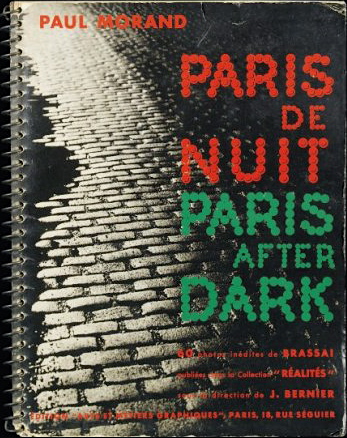
John Toohey (August 2009) Social life 192.22 Europe > Brassaï: Paris de nuit: Book covers About this photographer | Photographs by this photographer
192.23 Europe > The social life of Paris
Streets of Paris 192.24 Europe > André Kertész: Street photography in Paris About this photographer | Photographs by this photographer
192.25 Europe > Harold Chapman: Paris About this photographer | Photographs by this photographer
alan@luminous-lint.com |
General reading Janis, Eugenia Parry, 1986, ‘Demolition Picturesque: Photographs of Paris in 1852 and 1853 by Henri Le Secq‘, in Welch, Peter & Barrow, Thomas F (eds), Perspectives on Photography: Essays in Honor of Beaumont Newhall, pp.53 [Δ] McCauley, Elizabeth Anne, 1994, Industrial Madness: Commercial Photography in Paris 1848-1871, (New Haven: Yale University Press) [Δ] Pinkney, David H., 1972, Napoleon III and the Rebuilding of Paris, (Princeton University Press) isbn-10: 0691007683 isbn-13: 978-0691007687 [Δ] Readings on, or by, individual photographers Eugène Atget Abbott, Berenice, 1963, Eugène Atget, (Prague: S.N.K.L.U.) [Δ] Abbott, Berenice, 1964, The World of Atget, (New York: Horizon Press) [Δ] Atget & Proust, 2012, Paris du temps perdu, (Paris: Editions Hoëbeke) [Δ] Atget, Eugène, 1930, Atget: Photographe de Paris, (New York: E. Weyhe) [Δ] Atget, Eugène, 1930, E. Atget: Lichtbilder, (Paris and Leipzig: Verlag Henri Jonquithres) [Δ] Atget, Eugène, 1963, A Vision of Paris, (New York: MacMillan) [Δ] Atget, Eugène, 1975, Atget: Lichtbilder, (Munich: Rogner and Bernhard) [Δ] Atget, Eugène, 1979, Atget: Voyages en Ville, (Paris: Chêne/ Hachette) [Δ] Atget, Eugène, 1979, Eugène Atget, (Milan: Electa Editrice) [Δ] Atget, Eugène, 1981, Atget's Vision, (Chicago: Edwynn Houk Gallery) [Δ] Atget, Eugène, 1982, Eugène Atget 1857-1927: Intérieurs Parisiens, Photographies, (Paris: Musée Carnavalet) [Δ] Atget, Eugène, 1983, Eugene Atget, I Grandi Fotografi Serie Aergento, (Gruppo Editoriale Fabri) [Δ] Atget, Eugène, 1984, Atget, Géniaux, Vert: Petits Métiers et Types Parisiens, vers 1900, (Paris: Musée Carnavalet) [Δ] Atget, Eugène, 2001, Eugène Atget: Miroirs: Daniel Quesney: Reconstitution Photographique, (Brussels: ARP Editions) [Δ] Atget, Eugène, 2002, Atget: L'art décoratif, (Paris: Flammarion) [Δ] Atget, Eugène, 2004, Eugène Atget: The Art of Old Paris, (Seoul: Kim Young Seob Photo Gallery) [Δ] Atget, Eugène, 2008, Atget à Sceaux: Inventaire avant disparitions, (Paris: Somogy Editions d'Art) [Δ] Atget, Eugène, 2011, Eugène Atget: Old Paris, (Madrid: Fundación MAPFRE/TF Editores) [Δ] Atget, Eugène & Friedlander, Lee, 2008, Parks and Trees: Eugene Atget & Lee Friedlander, (Cologne: Galerie thomas Zander) [Δ] Aubenas, Sylvie, 2010, Eugène Atget, (Paris: Télérama Album) [Δ] Aubenas, Sylvie & Le Gall, Guillaume, 2003, Eugène Atget's Trees, (New York: D.A.P., Distributed Art Publishers) [Δ] Aubenas, Sylvie & Le Gall, Guillaume, 2007, Atget: Une rétrospective, (Paris: Bibliotheque Nationale de France/Editions Hazan) [Δ] Badger, Gerry, 2001, Eugene Atget 55, (London: Phaidon Press) [Δ] Baldwin, Gordon, 2000, In Focus: Eugène Atget, (Los Angeles: The J. Paul Getty Museum) [Δ] Borcoman, James, 1984, Eugène Atget, 1857-1927, (Ottawa: Galerie Nationale du Canada) [Δ] Christ, Yvan, 1951, Saint Germain des pres 1900, Vu par Atget [Δ] Fourquier, Alain, 2007, Atget: Un photographe déjà célebre de son vivant, (Paris: Au bibliophile parisien, Stanislas Fourquier) [Δ] Harris, David, 1999, Eugène Atget: Itinéraires parisiens, (Paris: Musée Carnavalet/ Paris Musées) [Δ] Harris, David, 2003, Eugène Atget: Unknown Paris, (New York: The New Press) [Δ] Krase, Andreas & Adam, Hans Christian, 2001, Eugène Atget's Paris, (Cologne: Taschen) [Δ] Laxton, Susan, 2002, Paris as Gameboard: Man Ray's Atgets, (New York: Miriam and Ira D. Wallach Art Gallery, Columbia University) [Δ] Le Gall, Guillaume, 1998, Atget, Paris pittoresque, (Paris: Editions Hazan) [Δ] Lemagny, Jean-Claude et al., 2000, Atget, le Pionnier, (Paris: Marval) [Δ] Leroy, Jean, 1975, Atget: Magicien du vieux Paris, (Joinville-le-Pont: Pierre-Jean Balbo Editeur) [Δ] Puttnies, Hans Georg, 1980, Atget, (Cologne: Galerie Rudolf Kicken) [Δ] Rauschenberg, Christopher, 2007, Paris Changing: Revisiting Eugène Atget's Paris, (New York: Princeton Architectural Press) [Δ] Reynaud, Françoise, 1984, Eugene Atget, (Paris: Centre National de la Photographie) [Δ] Szarkowski, John, 2000, Atget, (New York: the Museum of Modern Art/ Callaway) [Δ] Szarkowski, John & Hambourg, Maria Morris, 1981, The Work of Atget. Vol. 1: Old France, (New York: Museum of Modern Art) [Δ] Szarkowski, John & Hambourg, Maria Morris, 1982, The Work of Atget. Vol. II: The Art of Old Paris, (New York: Museum of Modern Art) [Δ] Szarkowski, John & Hambourg, Maria Morris, 1983, The Work of Atget. Vol. III: The Ancien Regime, (New York: Museum of Modern Art) [Δ] Szarkowski, John & Hambourg, Maria Morris, 1985, The Work of Atget. Vol. IV: Modern Times, (New York: Museum of Modern Art) [Δ] Wiegand, Wilfried, 1998, Eugène Atget: Paris, (New York: Te Neues Publishing Company) [Δ] Worswick, Clark, 2002, Berenice Abbott & Eugene Atget, (Santa Fe: Arena Editions) [Δ] Yokoe, Fuminori & Ogura, Kosei, 1998, Eugene Atget: A Retrospective: An Intimate View of Paris at the Turn of the Century, (Tokyo: Tokyo Metropolitan Museum of Photography) [Δ] Édouard Baldus Daniel, Malcolm R., 1994, The Photographs of Édouard Baldus, (New York: Metropolitan Museum of Art; Montreal: Canadian Centre for Architecture) [Δ] Brassaï 2003, Resonancias: Brassaï > Paris / Colom < Barcelona, (Barcelona: Fundacio Foto Colectania) [Δ] Brassaï, 1933, Paul Morand: Paris de Nuit, (Paris: Arts et Métiers Graphiques) [Δ] Brassaï, 1968, Brassaï, (New York: Museum of Modern Art) [Introduction by Lawrence Durrell] [Δ] Brassaï, 2001, The Secret Paris of the 1930s, (New York: Thames and Hudson) [Δ] Warehime, Marja, 1996, Brassaï. Images of Culture and the Surrealist Observer, (Baton Rouge: Louisiana State University Press) [Δ] Henri Cartier-Bresson Cartier-Bresson, Henri, 1998, Henri Cartier-Bresson: Henri Cartier-Bresson: À Propos de Paris, (Bulfinch) isbn-10: 0821224964 isbn-13: 978-0821224960 [Reprint edition] [Δ] Joan Colom 2003, Resonancias: Brassaï > Paris / Colom < Barcelona, (Barcelona: Fundacio Foto Colectania) [Δ] Robert Doisneau Doisneau, Robert, 2012, Robert Doisneau: Paris Les Halles Market, (Flammarion) isbn-10: 2080201085 isbn-13: 978-2080201089 [Δ] Louis-Emile Durandelle Baillargeon, C., 2011, ‘Construction Photography and the Rhetoric of Fundraising: The Maison Durandelle Sacre-Coeur Commission‘, Visual resources: an international journal of documentation, vol.27, no.2, pp.113-128 [Δ] Garnier, Charles, 1878, Le Nouvel Opera de Paris par Charles Garnier, (Paris: Ducher et Cie) [Illustrations are based on photographs by Louis-Emile Durandelle] [Δ] Nuitter, Charles, 1875, Le Nouvel Opera, (Paris: Libraire Hachette et Cie) [Illustrations are based on photographs by Louis-Emile Durandelle] [Δ] Robert Frank Eskildsen, Ute, 2008, Robert Frank: Paris, (Steidl) isbn-10: 3865215246 isbn-13: 978-3865215246 [Δ] Lee Friedlander Atget, Eugène & Friedlander, Lee, 2008, Parks and Trees: Eugene Atget & Lee Friedlander, (Cologne: Galerie thomas Zander) [Δ] Izis Izis, 1950, Paris des Rêves, (Lausanne: Charmes de Londres Editions La Guilde du Livre) [Δ] André Kertész Ducrot, Nicholas (ed.), 1972, André Kertész: Sixty Years of Photography, 1912–1972, (New York: Grossman Publishers) [Δ] Kertész, André, 1974, J’aime Paris: Photographs Since the Twenties, (New York: Grossman Publishers) [Δ] Phillips, Sandra S et al., 1985, André Kertész: Of Paris and New York, (Chicago: Art Institute of Chicago) [Δ] Man Ray Garcia, Erin C., 2011, Man Ray in Paris, (J. Paul Getty Museum) isbn-10: 1606060600 isbn-13: 978-1606060605 [Δ] Charles Marville Marville, Charles, 1994, Marville Paris, (Hazan) [Δ] Marville, Charles, 1997, Charles Marville, (Centre National de Photo) isbn-10: 286754100X isbn-13: 978-2867541001 [French] [Δ] Nadar Nadar, Félix, 1982, Le Paris Souterrain de Félix Nadar 1861, (Caisse nationale des monuments historiques et des sites) isbn-10: 2858220557 isbn-13: 9782858220557 [Δ] Christopher Rauschenberg Rauschenberg, Christopher, 2007, Paris Changing: Revisiting Eugène Atget's Paris, (New York: Princeton Architectural Press) [Δ] Todd Webb Davis, Keith F, & Webb, Todd, 1986, Todd Webb: Photographs of New York and Paris, (Hallmark Cards, Inc.) [Δ] If you feel this list is missing a significant book or article please let me know - Alan - alan@luminous-lint.com Jules Aarons (1921-) • Lucien Aigner (1901-1999) • Eugène Atget (1857-1927) • Édouard Boubat (1923-1999) • Marcel Bovis • Bruno Braquehais (1823-1875) • Brassaï (1899-1984) • Henri Cartier-Bresson (1908-2004) • François Adolphe Certes • Harold Chapman (1927-) • Choiselat & Ratel • Barnaby Conrad • François-Joseph Delintraz • Delmaet & Durandelle • André Adolphe-Eugène Disdéri (1819-1889) • Robert Doisneau (1912-1994) • Louis-Emile Durandelle (check) • Hans Eijkelboom (1949-) • William England (1830-1896) • André Kertész (1894-1985) • William Klein (1928-) • Jacques-Henri Lartigue (1894-1986) • Charles Marville (1813-1879) • Willy Maywald (1907-1985) • Achille Quinet (1831-1900) • Christopher Rauschenberg • Willy Ronis (1910-2009) • Charles Soulier (check) • Philip Trager (1935-) • Raoul Ubac (1910-1985) • Ed Van der Elsken (1925-1990) • Frederick von Martens (1885-) • Vicky Wetherill • Émile Zola (1840-1902) | Home > Geographical regions > Europe > France > Paris
|