Contents
| Early examples | | 17.01 | A world of roofs | | 17.02 | Calvert Richard Jones: Daguerreotype: Margam Castle, Wales | | 17.03 | Mission Héliographique | | 17.04 | Achille Quinet: Restoration of the Royal Chaalis Abbey | | Scotland | | 17.05 | Thomas Annan: The Old Closes & Streets of Glasgow | | 17.06 | Archibald Burns: Edinburgh | | France, Paris | | 17.07 | France: Paris - Notre Dame | | 17.08 | France: Paris - Notre Dame, Facade | | 17.09 | France: Paris - Notre Dame, La Porte Rouge | | 17.10 | Charles Marville: Paris | | 17.11 | Louis-Emile Durandelle: The Paris Opera (1861-1875) | | 17.12 | Eugène Atget: The streets and buildings of Paris | | Canada, Montreal | | 17.13 | William Notman: The construction of Victoria Bridge, Montreal, Canada (1854-1859) | | India, Gaur | | 17.14 | John Henry Ravenshaw: Gaur; its Ruins and Inscriptions (1878) | | Italy, Venice | | 17.15 | Carlo Naya: Venice: Palaces | | 17.16 | Carlo Naya: Venice: Grand Canal | | England, London | | 17.17 | Philip Henry Delamotte: The Crystal Palace (1854-1855) | | 17.18 | The Society for photographing relics of old London | | 17.19 | Roger Mayne: Wapping | | Australia, Sydney | | 17.20 | Album of Sydney, N.S.W., Australia (1870) | | USA, New York | | 17.21 | Jacob A. Riis: How the Other Half Lives - Book covers | | 17.22 | Jacob A. Riis: How the Other Half Lives | | 17.23 | Lewis W. Hine: Empire State Building (1929-1931) | | 17.24 | Berenice Abbott: Changing New York | | Building types | | 17.25 | Skyscrapers | | Survey projects | | 17.26 | Historic American Buildings Survey - HABS | | USA, California | | 17.27 | William A. Garnett: Aerial views of Californian suburbia | | 17.28 | Robert Adams: The construction of suburbia | | Cities in decay | | 17.29 | Roger Mayne: Leeds, slum clearance |
| This theme includes example sections and will be revised and added to as we proceed. Suggestions for additions, improvements and the correction of factual errors are always appreciated. | Early examples 17.01 Architecture > A world of roofs
Early photographic methods required light, a place to work and test chemicals and optics. Prior to the preparation of specially designed photographic studios upper floors of buildings particularly in congested urban settings made sense and that is why a number of early photographs show roof details. These photographs are unlikely to have been to show architectural details but rather to test daguerreotype and other techniques. The 1843 daguerreotype by Armand Hippolyte Fizeau of a roof with a chimney in Paris (Toiture et cheminée, rue du Cherche-Midi à Paris and the 1851-53 salt paper print by lawyer Eduard Isaac Asser View from the roof of the photographer's house, Amsterdam are both examples of this. But the most famous is the earliest surviving photograph View from the Window at Le Gras taken in around 1826 by Joseph Nicéphore Niépce. 17.02 Architecture > Calvert Richard Jones: Daguerreotype: Margam Castle, Wales About this photographer | Photographs by this photographer
17.03 Architecture > Mission Héliographique
Mission Héliographiques was a project initiated by writer Prosper Mérimée in 1851 to document with photography the state of architecturally significant monuments in France so they could be preserved and restored. The photographers were Édouard Baldus, Hippolyte Bayard, Gustave Le Gray, Henri Le Secq and Auguste Mestral. On occasion Le Gray & Mestral travelled and worked together and it is unclear which one took the photographers or if they were taken together. Henri Courmont (1813-1855) was a commissioner for Mission Héliographiques but did not contribute photographs.
The photographers normally worked independently with the exception of Le Gray & Mestral who on occassion both signed the same photograph. The regions surrounding Paris were assigned to the photographers:
North and east (Including the cathedrals of Reims, Laon, Troyes, and Strasbourg) - Henri Le Secq
South and east (Palace of Fontainebleau, Lyon and the Roman in Orange, Nîmes and Arles) - Édouard Baldus
Southwest (The Loire chateaux of Blois, Chambord, Amboise, and Chenonceaux and the towns of Carcassonne, Albi, Perpignan, Le Puy and Clermont-Ferrand - Le Gray & Mestral consisting of Gustave Le Gray and Auguste Mestral
West (Brittany and Normandy including the towns of Caen, Bayeux, and Rouen) - Henri Le Secq
Prints from the 258 photographs they made are exceedingly rare as they were locked away and not published after they were delivered in the fall of 1851. Of the group works by Gustave Le Gray and Auguste Mestral are more common and this might indicate that they had a second set of negatives but this is not certain. 17.04 Architecture > Achille Quinet: Restoration of the Royal Chaalis Abbey About this photographer | Photographs by this photographer
Chaalis Abbey (Abbaye royale de Chaalis) was a Cistercian abbey to the north of Paris in France. This hand-coloured albumen print from the 1850s or later by Achille Quinet was prepared to assist in the restoration of the building. Scotland 17.05 Architecture > Thomas Annan: The Old Closes & Streets of Glasgow About this photographer | Photographs by this photographer
This section covers the portfolio The Old Closes & Streets of Glasgow - engraved by Annan from Photographs taken for the City of Glasgow Improvement Trust. With an Introduction by William Young, R.S.W. that was published in 1900 by James MacLehose & Sons of Glasgow. The importance of this work is that it includes photographs taken by Thomas Annan (1829-1887) in 1868 of the squalid slums and closes of the Scottish city. These photographs are amongst the earliest taken specifically as a record of housing conditions prior to urban renewal and as such they are an important milestone in the history of documentary photography.
In the introduction to a 1977 reprint of this work Anita Ventura Mozley wrote:
"It is likely that Annan regarded the commission from the Trustees of the Improvements Act as just another he received when his success as a commercial photographer of Glasgow was increasingly recognized. However inadvertently, he did give us the first thorough photographic representation available of the dwelling places and the inhabitants of an urban slum." (Mozley 1977:XII).
The importance of the choices made by the photographer was almost totally ignored in the original work and it was only on page 22 of the Introduction by the historian William Young that he is mentioned:
"The City Improvement Trustees acquired, by act of parliament, in 1866, the right to alter and reconstruct several of the more densely built areas of the city, and these operations, it was foreseen, would remove many old and interesting landmarks. Before entering upon their work, the Trustees arranged with the late Mr. Thomas Annan to take photographs of a series of views of the closes and streets more immediately affected, and a few copies were presented to members of the Corporation and others." (Young 1900:22)
When Martin Parr and Gerry Badger describe this work in their The Photobook: A History - Volume 1 they make an important observation about the camera viewpoint choices that Annan was largely forced into by the nature of the architectural spaces he was attempting to record.
"The Scottish ‘close‘ and ‘wynd‘ - the terms are almost interchangeable - were familiar landmarks in any city with a densely packed medieval street pattern: narrow passageways leading either from one street to another, or into the middle of a building block. It is the consistently narrow form of the alley that gives formal coherency to most of Annan‘s imagery- he simply stood the camera in the middle of the passageway and shot down it." (2004:49)
Thomas Annan was not the first to record architectural subjects. There had been the Mission Héliographiques in France which combined the talents of Edouard Baldus, Hippolyte Bayard, Gustave Le Gray, Henri Le Secq and Auguste Mestral. There were also the wet collodion photographs of Charles Marville (1816-1879) capturing in the 1860s a record of the streets of Paris prior to their destruction to make way for Baron Georges-Eugène Haussmann’s urban redesign. The work of Annan pre-dates that of Eugéne Atget (1857-1927) in creating an important record of a 19th century urban slum: a slum that to many Glasgow residents in the 1860s was home all the same.
Thomas Annan was not a purist and improved his printed photographs:
"He added clouds, which brighten the skies over Glasgow‘s slums, and he whitened the wash on the line. He did this for pictorial effect, for nice balance. While his taste for the picturesque, for a tradition inherited from painting, and quite in accord with salon practice of the day, may distort to some extent the immediacy of the mise-en-scene, we must appreciate the fact that he did not tidy up the rest of the picture, as his son, James Craig Annan, did when he made the photogravure plates for the 1900 edition. The photogravures are lighter in tone, and consequently in mood, in the sense of the place, than Annan‘s carbon prints. Moving figures, those ghosts who would not stand still for the photographer, are completely excised in the photogravure edition..." (Mozley 1977:XI- XII).
This brings us to the point that there are multiple versions of the portfolio in carbon prints and photogravures and there are differences between them that are not only a part of the processes involved in reproduction but also in the aesthetics of the printer. When James Craig Annan, the son of Thomas Annan, created the photogravure plates for the 1900 edition he did not remove all of the "ghosts" and though lacking in power compared to their unadulterated carbon print counterparts, the plates shown here do not lack in content or feeling in richness of tone.
Finally it is worth providing a short background to the different versions that exist of these photographs. A very small number of bound sets of Annan‘s albumen photographs from this endeavor are known to exist: examples are in the Mitchell Library in Glasgow and in the Scottish National Portrait Gallery in Edinburgh. Surprisingly, another set of 31 mounted albumen prints with printed caption labels but lacking the title page and enclosed in a contemporary green half morocco portfolio, lettered on upper cover Glasgow Improvements Act. 1866. Photographs of Streets, Closes &c. taken 1868-71 sold at auction for £13,000 (Lyon and Turnbull in Edinburgh - July 11th, 2006).
In the introduction by Anita Ventura Mozley (1977) we also learn of a second edition of this work: "Sometime late in 1878 or early in 1879, an edition comprising 40 carbon prints was published in an edition of 100 quarto-sized copies by Annan‘s Lenzie firm for the Glasgow City Improvements Trust." At the Phillips de Pury auction (New York - April 22, 2004) a complete carbon version of this edition was offered for sale and it realized £66,000.
The present edition comes from the photogravure edition of 100 copies (not numbered) issued in 1900 by James MacLehose & Sons of Glasgow. The portfolio contains 50 fine photogravures from wet-collodion negatives taken between 1868 and 1899 and engraved and printed by James Craig Annan of T. & R. Annan & Sons. The later pictures added to the 1900 edition done after Thomas Annan‘s death in 1885 were most likely done by Thomas Annan‘s eldest son John Annan (1862-1947). According to the National Library of Scotland, John Annan was "a member of the family firm of photographers. John specialized in architectural photography and was known for his photographs of Glasgow slums." The National Galleries of Scotland online collections website states in part "His son John inherited the project and in 1900, the family firm T.&R. Annan produced a photogravure album with new prints by John Annan".
T. & R. Annan & Sons also printed and issued a second 1900 edition of 100 copies under their own imprint. Glasgow historian William Young supplied an introduction (23 pages-dated August of 1900 in portfolio) for both 1900 photogravure editions but only makes a brief reference to the author of these historically important photographs.
© Photoseed & Alan Griffiths (2006) - Used with permission
Bibliography
Mozley, Anita Ventura (1977) Thomas Annan: Photographs of The Old Closes And Streets of Glasgow 1868/1877 (With a supplement of 15 related views) with a new introduction by Anita Ventura Mozley. (New York: Dover Publications, Inc.) Published through the Cooperation of The International Museum of Photography / George Eastman House.
Parr, Martin & Gerry Badger (2004) The Photobook: A History-volume 1 (Phaidon Press Limited).
Young, William (1900) The Old Closes & Streets of Glasgow - engraved by Annan from Photographs taken for the City of Glasgow Improvement Trust. With an Introduction by William Young, R.S.W. (Glasgow: James MacLehose & Sons) 17.06 Architecture > Archibald Burns: Edinburgh About this photographer | Photographs by this photographer
Archibald Burns was active in Edinburgh (Scotland) between 1858 and his death in the early 1880s. He provided photographs for the tourist trade and to illustrate books including Picturesque Bits from Old Edinburgh (1868). In 1871 he was appointed by the Edinburgh Improvement Trust to document an over-crowded slum area of the city after the buildings had been demolished in February 1871.
The National Library of Scotland has a collection of his salted-paper prints. France, Paris 17.07 Architecture > France: Paris - Notre Dame
17.08 Architecture > France: Paris - Notre Dame, Facade
17.09 Architecture > France: Paris - Notre Dame, La Porte Rouge
Each architectural feature of a significant building such as the Porte Rouge at Notre Dame in Paris has a temporal sequence of photographs that show not only how the feature has changed but how photographic techniques have changed along with stylistic approaches. The daguerreotype by Joseph-Philibert Girault de Prangey (1841) is the same subject as the salt print by Charles Marville taken a decade later and that is different from the albumen prints by Bisson frères (ca. 1856) and Auguste Rosalie Bisson (ca. 1865).
"Why do we like Paris?", 1878, May, Lippincott's Magazine of Popular Literature and Science, vol. 23, p. 528
One of the most beautiful bits of Notre Dame is the Porte Rouge on the north side, which may be translated the "Door of Blood," and which was built by John the Fearless, duke of Burgundy, in expiation of the murder of the duke of Orleans in 1407. The valor and other princely qualities of Jean sans Peur and the odious character of his victim, who was the very curse of France, bias us in favor of the former notwithstanding the treachery of his deed. Their enmity had been bitter and of long standing, but they met for formal and public reconciliation, attended mass and received the sacrament together, and ended the day by a banquet. On his way home the duke of Orleans was surrounded and assassinated: the story goes that one wrapped in a mantle and scarlet hood, so as to conceal his face and figure, suddenly came out of a house and struck the final, fatal blow, and that this was the duke of Burgundy. The duke of Orleans had offered him an unpardonable insult by placing the likeness of the duchess of Burgundy among the portraits of his mistresses. It is further said that the duke of Burgundy had received intelligence of a plot to assassinate himself, and merely got the start of his foe. His atonement was splendid, according to the notions of those times. About ten years afterward he paid the natural penalty of his great crime, and was slain in his turn on the bridge of Montereau during a parley with the dauphin, afterward Charles VII. His tomb is at Dijon, the place of his birth, beside that of his father, Philippe le Hardi; his duchess Margaret lies by his side coroneted and in daisy-sprinkled robe; around the base of the monument troops of little monks mourn the death of their prince with every demonstration of grief. But under the rich Gothic canopy which forms the porch of the Porte Rouge the duke and duchess of Burgundy kneel in perpetual repentance amid a crowd of divine and sacred figures.
17.10 Architecture > Charles Marville: Paris About this photographer | Photographs by this photographer
Charles Marville took a series of about 400 images of roads that were to be destroyed by Baron Georges-Eugène Haussmann’s redesign of Paris during the nineteenth century. A decade later he returned to the same localities to photograph the new roads. 17.11 Architecture > Louis-Emile Durandelle: The Paris Opera (1861-1875) About this photographer | Photographs by this photographer
The construction of the new Opera House in Paris in the nineteenth century was a statement in quarried stone of civic and national pride. On 29 December 1860 a resolution was passed that commenced a competition for suitable designs and plans. The unanimously chosen winner was Charles Garnier and by July 1861 the site had been selected and the following month the excavation of the foundations commenced. This was far from an ideal time for new public works with both the Franco-Prussian War and the following dark times of the Paris Commune coinciding with the construction. Despite this Garnier completed the project by December 1874 and in January 1875 it opened:
The opening of the New Opera House at Paris took place on Tuesday last. The Government had engaged the entire house for the opening night, which was, therefore, a state festivity, to which the diplomatic corps, the deputies, &c, were invited. The regular performances were to commence last evening with Hamlet.
The Academy, Issue 7, Jan 9, 1875, p.51
This vast undertaking was described in a contemporary account as follows:
The historian of the new temple of song rounds off his record with an array of not uninteresting figures, and with a few of these I too shall close. The gas-pipes, if connected, would form a pipe twenty-five kilometres in length; fourteen furnaces and four hundred and fifty grates heat the house; a battery of seventy cups generates electricity for the scenic effects; nine reservoirs and two tanks hold a hundred thousand litres of water, and distribute their contents through six thousand nine hundred and eighteen metres of piping, and there are twenty-five hundred and thirty-one doors, and seven thousand five hundred and ninety-three keys, which latter M. Gamier delivered formally, but figuratively, I imagine, to M. Halanzier when the manager took possession of the premises.
Frederick A. Schwab, "A Temple of Song", Scribners Monthly, May, 1875, Volume X, No.1, p.20
During the process Louis-Emile Durandelle photographed both the construction and the ornamental sculptures that decorated the immense building. His photographs were published in Le Nouvel Opera de Paris par Charles Garnier, (Paris: Ducher et Cie, 1875-81), and in Charles Nuitter, Le Nouvel Opera (Paris: Libraire Hachette et Cie, 1875) and remain as one of the key documentations of a nineteenth century architectural project. Durandelle recorded many other key projects in Paris including the construction of Sacre Coeur, the Hotel de Ville, and the Eiffel Tower. 17.12 Architecture > Eugène Atget: The streets and buildings of Paris About this photographer | Photographs by this photographer
Eugène Atget is best known for his photographs late nineteenth and early twentieth century Paris that detail the streets, architecture, shops, parks and trees of the city. He sold photographs to archives and museum and to artists who used them to develop their painting skills. He lived very close to Man Ray in Paris who knew his work and purchased prints. In his final years his work was promoted by Berenice Abbott and the New York gallery owner Julian Levy. Canada, Montreal 17.13 Architecture > William Notman: The construction of Victoria Bridge, Montreal, Canada (1854-1859) About this photographer | Photographs by this photographer
The New World in 1859 being the United States and Canada, Illustrated and Described (London: H. Bailliere, ca. 1859), Part Third, Upper and Lower Canada
THE VICTORIA BRIDGE.
This gigantic undertaking forms one of the most interesting and wonderful features connected with the city, at Point St. Charles.
It is being built for the purpose of enabling the Grand Trunk Railway to form a continuous railroad communication with the railroads of the United States, instead of passengers being obliged to cross the river in steamers, as at present
The width of the river where the bridge is being built is very nearly 2 miles.
The current of the river is very rapid—with a depth of from 4 to 10 feet, excepting in the main channel, where it is from 30 to 35 feet deep.
In the winter, the ice is formed into a great thickness, and frequently immense piles accumulate—as high as 80 to 40 feet Thus piled up in huge boulders, the water rushes through them at a fearful rate, driving the blocks of ice along, and crushing all before them.
The bridge will consist of 24 strong piers, standing 242 feet apart, excepting the entire span, which is 339 feet wide. They are all perpendicular on three sides, and slope down to the water-edge against the current, so as to withstand the force and action of the floating masses of ice, on its breaking up. Each pier is estimated to withstand the force of 70,000 tons of ice at one time.
Resting on these piers, and running from abutment to abutment, is the bridge, which consists of a hollow iron tube, 22 feet high, and 16 feet wide.
The entire span is to be 60 feet above the average level of the water, thence sinking towards each end 1 foot in 130, thus making the height of the abutments about 37 feet
The estimated cost is about £1,250,000 stg. The weight of the iron in the tubes will be 8,000 tons, and the contents of the masonry will be about 3,000,000 cubic feet The whole will be completed in the autumn of 1859 or spring of 1860. As is well known, the engineer of this greatest bridge in the world is Mr. Robert Stephenson of Newcastle-upon-Tyne.
The whole of the views of Montreal, as given in the accompanying pages, were taken for this work by Mr. Notman, photographer, Montreal, and the clear and sharp photographs supplied by him for the purpose of engraving from, affords the best evidence of his being a first-class artist.
India, Gaur 17.14 Architecture > John Henry Ravenshaw: Gaur; its Ruins and Inscriptions (1878) About this photographer | Photographs by this photographer
John Henry Ravenshaw had a brother in the East India Company, his father had been as was his grandfather John Goldsworth Ravenshaw. Posthumously his widow edited and altered his work on the archaeological remains at Gaur in India and it was published as Gaur; its Ruins and Inscriptions. By the late John Henry Ravenshaw, B.C.S. (C. Kegan, Paul & Co.) Italy, Venice 17.15 Architecture > Carlo Naya: Venice: Palaces About this photographer | Photographs by this photographer
17.16 Architecture > Carlo Naya: Venice: Grand Canal About this photographer | Photographs by this photographer
England, London 17.17 Architecture > Philip Henry Delamotte: The Crystal Palace (1854-1855) About this photographer | Photographs by this photographer
Elizabeth Creveling
P. H. Delamotte Photograph of the Interior of the Crystal Palace
Courtesy of the University of Maryland, Digital Collections
A Treasury of World's Fair Art & Architecture
After a successful year of housing the Great Exposition, the Crystal Palace by Joseph Paxton was disassembled and moved to Sydenham, where it stood for the next 85 years (Hobhouse, 32). The Palace, built for the 1851 World's Fair in London, was an architectural and engineering wonder modeled after the bridge and train shed construction of the mid-nineteenth century. The structure had been designed to be quickly assembled out of prefabricated members and easily rebuilt elsewhere. Its light construction was made possible to use of thin cast iron prefabricated elements combined with wood and a glazed outer shell.
The Crystal Palace housed the most spectacular collection of artistic and industrial wonders ever assembled in one place thus far. Visitors came from all over the world to see this display of power at the "Exhibition of the Works of All Nations" which was organized by Prince Albert and Henry Cole (Beaver, 12). The success of the Crystal Palace that cost "a penny per cubic foot" (Hobhouse, 39) brought Joseph Paxton much praise as well as a knighthood. The structure at Hyde Park was designed as a temporary building, able to be constructed and disassembled easily. During the Great Exposition the Crystal Palace housed the works of craftsmen, engineers and artists. The most popular of these exhibits was a crystal fountain made especially for the exhibition (Beaver, 47). The full 33,000,000 cubic feet of Crystal Palace was filled with displays and people crowding the aisles examining these wonders (Hobhouse, 39).
When the Fair closed the fate of the Crystal Palace was a topic of extreme importance. Its popularity was obvious and Paxton suggested transforming it into a "Winter Park and Garden Under Glass" where visitors could see displays of botany, ornithology, and geology and at the same time enjoy the building as an indoor park (Beaver, 69). This proposal was opposed by Colonel Sibthorpe, a member of the Metropolitan Police Force who vehemently disapproved of the nature of the Exposition and the preservation of the building as a cultural icon. Knowing it would take some work to save his masterpiece, Paxton began raising money and eventually came up with over 500,000 pounds. He formed a company to purchase the building from its initial builders, the engineering firm of Fox and Henderson. The site selected to re-erect the Palace was 200 acres of wooded parkland on the summit of Sydenham Hill. Rebuilding began in August 1852.
By rebuilding the famous Crystal Palace and making it a permanent symbol of England's success and role in the Industrial Revolution, the government created a cultural icon that would forever stand in testament to the grand nature of the first International World's Fair. A decision was made to alter the original plans and enlarge the structure, making the Sydenham Palace more massive than its predecessor. The most characteristic portion of the Hyde Park structure, the arched transept, was emulated throughout when the whole structure was rebuilt, creating an entirely arched nave and transept system (Hitchcock, 27). These same arched transepts were considered awe-inspiring by the Victorians, who were deep in the Romantic Age and well versed in the eighteenth-century notion of the Sublime. The lunettes with the familiar spoke pattern provided a terminus for the long nave and served as an element of continuity between the Hyde Park building and the one rebuilt in Sydenham.
The new Crystal Palace became a museum of world cultures, with "style courts" such as the Nineveh, Roman and Egyptian courts depicting ancient and modern civilizations for visitors. Matthew Digby Wyatt and architect Owen Jones were "sent abroad to ransack the world's great art collections" and find ideas for the courts (Beaver, 79). Aside from the great courts, Joseph Paxton also "envisioned a system of fountains that would rival Versailles" (Beaver, 79). To accommodate this great waterworks two large towers were erected further distancing the Sydenham structure from its predecessor in Hyde Park.
Photography had been invented thirteen years before the erection of the Crystal Palace. By 1851 this new medium had gone through many improvements, and quickly became a documentary and artistic tool for all people. Photographs were used for artistic endeavors, documentation, and souvenirs. Many photographers flocked to the Great Exposition to record the feats in architecture and engineering. William Henry Fox Talbot (1820-1877) recorded the interior of the Crystal Palace while it was still in Hyde Park and did so on Sundays while the Exhibition was closed (Beaver, 37). Another photographer, Philip Henry Delamotte (1820-1889) recorded the building after its move to the Sydenham location (Newhall, 110). He also photographed many English landmarks such as Yorkshire abbeys and Strawberry Hill.
Delamotte produced several sets of prints documenting the Crystal Palace, which he sold at a profit. A set of nine original albumen reprints is housed in the Special Collections room of the University of Maryland Architecture Library. One print titled "View up Nave from Gallery at North End" displays the vast interior of the new structure. It is approximately eight by ten inches mounted professionally for the set published by Crystal Palace Art Union. Printed on the paper surrounding the photograph are captions including Delamotte's name and documentation attributing the printing to "Negretti and Zambra."
The print on the screen [Referring to a photograph in the University of Maryland Collection] exhibits the deep purple hues achieved through the albumen process and gold chloride solution. The characteristic color was protected from fading on the edges by mounting the prints and keeping them in a darkened collectible box. There is little tonal separation, due to the nature of albumen printing. The geometric complexity of the structure is clearly shown, as well as its numerous galleries and the roof structure displaying the beautiful arched nave. Delamotte positioned his tripod along a side of the nave to achieve a perspective view that would capture the great depth of the building and convey the grand nature of the space. In the foreground Delamotte captured a large amount of detail in the vegetation and supports. The photograph reflects the impression that the exhibits "inhabit" the building, allowing the viewer to see how replete the Palace was with displays. Delamotte did not need to use supplementary lighting; the building itself was perfect for photographs, a virtual skylight. All that was needed was a sunny day. Patches of sun can be seen on the floor. Delamotte could clearly sense the architectural beauty in his subject and captured it artfully. The hustle and bustle of the original building is not conveyed in this print, which possesses a serene quality due to the lack of human presence.
Delamotte was able to capture the character of the Crystal Palace, and provided the public a peek into the famous structure. The Crystal Palace will live forever in his beautiful prints helping to influence artists and architects into the future. During its 85 years standing, the Crystal Palace appeared in millions of photographs, establishing it as a symbol of English power from both a political and architectural standpoint.
Works Cited
Arts Council of Great Britain, Sir Joseph Paxton, 1803-1865: a centenary exhibition organized in association with the Victorian Society [by the] Arts Council of Great Britain, (London: The Arts Council, 1965)
Patrick Beaver, The Crystal Palace, 1851-1936: a portrait of Victorian enterprise, (London: Hugh Evelyn Ltd., 1970)
Asa Briggs, Iron Bridge to Crystal Palace: impact and images of the Industrial Revolution. (London: Thames and Hudson in collaboration with the Ironbridge Gorge Museum Trust, ca. 1979)
Henry Russell Hitchcock, The Crystal Palace: the structure, its antecedents and its immediate progeny: and exhibition, (Northampton, Massachusetts: Smith College Museum of Art, 1952)
Christopher Hobhouse, 1851 and the Crystal Palace; being an account of the Great Exhibition and its contents; of Sir Joseph Paxton; and the erection, the subsequent history and the destruction of his masterpiece, (London: Murray, 1950)
Beaumont Newhall, The History of Photography: from 1839 to the present, (New York: Museum of Modern Art. 1982)
This text is freely available for the purpose of academic teaching and research provided the text is distributed with the header information provided. Courtesy of the University of Maryland, Digital Collections, A Treasury of World's Fair Art & Architecture 17.18 Architecture > The Society for photographing relics of old London
The Society for Photographing Relics of Old London was established in 1875 and photographers Henry Dixon, William Strudwick and A[lfred]. & J[ohn]. Bool documented the buildings that were at risk of demolition in >|theme|655|London. project was published in annual parts over twelve years from 1875 onwards and included a total of 120 photographs.
May 16, 1879, Publisher's Circular, vol. 42, p. 366
Society for Photographing Relics of Old London is about to issue a fresh selection of views in permanent photography, carrying on the series of publications which illustrate many of the fast-vanishing historical and picturesque buildings of the metropolis. Canonbury Tower, Barnard's Inn, old houses in Aldersgate-street, Christ's Hospital, the churchyard of St. Laurence Pountney, and a house in Great Queen-street supply subjects for this issue.
July-December, 1886, Walford's Antiquarian, Vol. X, p.47-48
OLD LONDON RELICS.
Sir,—Some of the newspapers have been calling attention to the Society for Photographing Relics of Old London, deploring the necessity of its collapse, and attributing the same to a want of interest on the part of the general public, and of its necessary support in the form of subscriptions. This is scarcely a correct statement of the actual facts, although one which might very justly be deduced from the notice of this last issue being the final one of the "Society." In one sense, a society it never has been ; for its management, the choice of subjects, the excellent letterpress accompanying each issue, and the various details and complicated work and trouble attached to it, have been the labour of love of one man only, Mr. Alfred Marks, the originator, director, and manager from the first, the funds derived from subscriptions having been expended entirely upon its publications; and the fortunate subscribers have received their photographs, not mere sun pictures, as evanescent and as fleeting as the very sunshine itself, but permanent memorials of an "Old London" fast disappearing from our view in our own times, here preserved to those that come after by the taste, energy, and forethought of one man, to whom others like myself will be for ever indebted. These labours have ended from lack not of support, but of material; 120 pictures of Old London practically exhaust the subject. But there is a moral attached. first issue of these photographs was in 1875, and in the decade just elapsed nearly one-half have disappeared or are threatened with probable demolition. In the next decade to come how many of the remainder will be left? subject is "too dismal to contemplate "—a wealthy city, not altogether without taste, and with such lovely memorials of the past, thus deliberately to denude itself of every atom, of every spark of its antiquity.
Devereux Chambers, Temple. GEORGE H. BIRCH, F.S.A.
17.19 Architecture > Roger Mayne: Wapping About this photographer | Photographs by this photographer
Australia, Sydney 17.20 Architecture > Album of Sydney, N.S.W., Australia (1870)
USA, New York 17.21 Architecture > Jacob A. Riis: How the Other Half Lives - Book covers About this photographer | Photographs by this photographer
Towards the end of the nineteenth century in the United States Jacob Riis (1849-1914) and Lewis Hine (1874-1940) were committed to social change. When Jacob Riis published his first book, How the Other Half Lives on the overcrowded New York slums in 1890 it was a damning statement on societal ills. The book included seventeen halftone illustrations from photographs and a further nineteen hand drawings. The journalist and novelist Stephen Crane (1871-1900) published Maggie: A Girl of the Streets in 1893 and the following year he wrote the article Experiment in Misery when he dressed as a bum and spent a night in a flophouse. 17.22 Architecture > Jacob A. Riis: How the Other Half Lives About this photographer | Photographs by this photographer
The Photographic Times and American Photographer, Vol.XVIII, February 3, 1888, No.333, p.58-59.
THE SOCIETY OF AMATEUR PHOTOGRAPHERS OF NEW YORK.
Lantern Exhibition.
The regular monthly lantern exhibition was given at the rooms of the Society. 123 West 30th Street, on Wednesday evening, January 25th, and was very largely attended.
The subject was, "The Other Half How it lives and dies in New York," and was explained in an informal way by Mr. Jacob A. Riis, who for ten years past has been the police reporter of the New York Press. The object of the exhibition was to picture to the audience the exact condition of the lowest phases of life as it at present exists in New York City. Many of the pictures were obtained by the aid of flash magnesium light.
The exhibition opened with a view of a well-known alley in Cherry Street, around which, it was said, 1,000 persons lived.
Other views included the "Bandit's Alley," near Mott and Hester Streets, where murderers and thieves congregate and enjoy life in what is known as the "stale beer dives."
"Bottle Alley," near Baxter Street, contained many children. A capital picture was that of an old tramp and thief in front of his broken-down shanty. About this Mr. Riis said he obtained the consent of the tramp to stand for ten cents, but he put his pipe in his pocket. So the tramp struck for higher pay, and on giving him five cents more he posed with his pipe as Mr. Riis desired. Another excellent picture illustrated how young boys first practice picking pockets.
The object of attack was a drunken man lying down in a stupor. The two boys were on each side overhauling the pockets with decided energy. They term the pickings their winnings, never call it stealing. At a place called "Hell's Kitchen," near Eleventh Avenue on Thirty-ninth Street, they experienced considerable difficulty, were attacked by some of the women with brickbats, which broke one of the plate-holders. The Italian rag-pickers' alley in South Fifth Avenue was shown; the women at work were suddenly dispersed by one word from the Italian proprietor before their pictures could be caught. An Italian tea-kettle was shown, somewhat large in size, stuffed with dirty linen. In the morning the kettle was used as boiler for boiling the clothes; at night it was employed for making tea.
A typical group of New York toughs called "The Growlers," was exhibited, hidden away under one of the dump docks on the East Side. They were factory hands, and got young boys to go after beer which they would drink in these places. A single picture of a young lad eight years old carrying a large pail of beer was quite effective. Other views of the back of tenement-houses showing the multiplicity of clothes-lines; of Baxter Street, crowded with humanity; of Mott and Pell Streets, showing Chinese life; the interior of a Chinese opium den, with the Chinamen laying off in their bunks under its influence: of the Chinese altar in the Joss-house, some of the latter being taken by aid of flash-light, were extremely interesting. Also pictures of the interior of the cheap lodging-houses, the Tombs, the Five Points House of Industry, the Catholic Protectory, with children playing around and Sister Irene in the foreground, who is said to have saved 13,003 children; also the exterior and interior of an uptown branch of the Boys' Lodging House of the Children's Aid Society, established through the beneficence of the late Mrs. Robert L. Stuart. All of the above were exceedingly interesting as showing the beneficent power which these institutions exert in this city.
Portraits of children side by side, of how they looked when taken from their hovels, and cruel and wretched parents, and after they were cleaned and cared for by Mr. E. Gerry's "Society for the Prevention of Cruelty to Children," illustrated more forcibly than any word picture the necessity and usefulness of that institution.
Several interesting portraits of noted thiefs and forgers, both male and female, taken from the Rogues' Gallery, were shown; Ex-Governor Moses, of South Carolina, had the handsomest looking face.
A fine picture, showing four or five detectives holding a refractory thief while he was having his photograph taken, was quite comical.
A good interior of a police office, showing the sergeant recording the facts, with the policeman standing near the rail, holding a foundling wrapped up in a black shawl, and messenger and others looking on, was quite effective and well lighted.
Several views of the Arabs in their hovels in Washington Street were exhibited. The women lay around on the floor without any bedding, and were completely embedded and begrimed with dirt. These were secured by aid of the flash-light. There were also two or three excellent interiors of the School for Blind Children.
The exhibition terminated with several excellent views of the New York Morgue, interior of Bellevue Hospital, exterior and interior of the Penitentiary on Blackwell's Island, of the Lunatic Asylum on Ward's Island, and of the burying ground on Hart's Island.
Mr. Riis related many interesting episodes and facts. It was hard to realize the enormity of the degradation and poverty constantly present in the great city. He remarked that four thousand children were barred out from the public schools, because there was not room enough to accommodate all who could attend.
At 10 o'clock the entertainment terminated.
17.23 Architecture > Lewis W. Hine: Empire State Building (1929-1931) About this photographer | Photographs by this photographer
17.24 Architecture > Berenice Abbott: Changing New York About this photographer | Photographs by this photographer
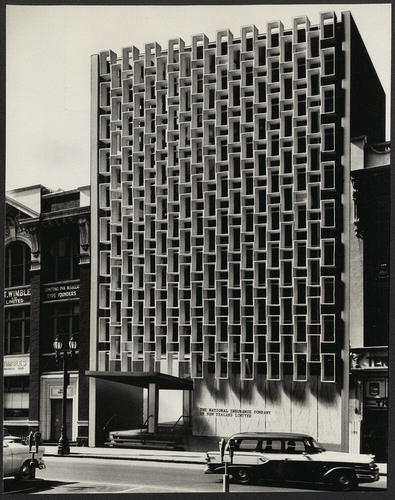
Berenice Abbott had known Eugène Atget in Paris and admired and promoted his work after his death in 1927. She saw the significance of detailed documentary projects that preserved the architectural heritage of changing urban centers. In 1935 she proposed her project "Changing New York" to the Federal Art Project (FAP) which was to support unemployed artists and those with related skills during the Great Depression. Berenice Abbott's work resulted in the book Changing New York (1939) with an introduction by art critic Elizabeth McCausland. The book included 97 illustrations by Berenice Abbott and larger sets of 302 photographs were distributed by FAP to High schools, libraries and public institutions. Building types 17.25 Architecture > Skyscrapers
Survey projects 17.26 Architecture > Historic American Buildings Survey - HABS
During the Great Depression the Historic American Buildings Survey (HABS) was established in December 1933 as a make-work project for photographers, draftsmen and architects. It started with a proposal by Charles E. Peterson of the National Parks Service to hire a thousand out-of-work architects to research and document buildings of historic significance. In his original November 1933 proposal Peterson was clear about the cultural value of his plan:
The plan I propose is to enlist a qualified group of architects and draftsmen to study, measure and draw up the plans, elevations and details of the important antique buildings of the United States. Our architectural heritage of buildings from the last four centuries diminishes daily at an alarming rate. The ravages of fire and the natural elements together with the demolition and alterations caused by real estate 'improvements' form an inexorable tide of destruction destined to wipe out the great majority of the buildings which knew the beginning and first flourish of the nation. The comparatively few structures which can be saved by extraordinary effort and presented as exhibition houses and museums or altered and used for residences or minor commercial uses comprise only a minor percentage of the interesting and important architectural specimens which remain from the old days. It is the responsibility of the American people that if the great number of our antique buildings must disappear through economic causes, they should not pass into unrecorded oblivion.
The list of building types . . . should include public buildings, churches, residences, bridges, forts, barns, mills, shops, rural outbuildings, and any other kind of structure of which there are good specimens extant . . . . Other structures which would not engage the especial interest of an architectural connoisseur are the great number of plain structures which by fate or accident are identified with historic events.
Peterson, Charles E., to the Director, United States Department of the Interior, Office of National Parks, Buildings, and Reservations, Washington, D.C., November 13, 1933. Reprinted in the Journal of the Society of Architectural Historians 16, no. 3 (October 1957): 29-31.
The staff involved were sent out to document historic architecture throughout the USA to establish an archive of representative buildings. The project gained a level of stability when it was authorized by Congress as part of the Historic Sites Act of 1935.
The photographic collection of HABS is housed in the Library of Congress. USA, California 17.27 Architecture > William A. Garnett: Aerial views of Californian suburbia About this photographer | Photographs by this photographer
17.28 Architecture > Robert Adams: The construction of suburbia About this photographer | Photographs by this photographer
Cities in decay 17.29 Architecture > Roger Mayne: Leeds, slum clearance About this photographer | Photographs by this photographer
alan@luminous-lint.com |
General reading 1875, Les Chateau Historiques - Chambord - Photographie by Mieusement, (Paris: Ducher & Co) [Avec un Texte Descriptif et Historique par Auguste Millot] [Δ] Bramsen, H.; Brøns M. & Ochsner, B., 1957, Early Photographs Of Architecture And Views In Two Copenhagen Libraries, (Copenhagen: Thaning & Appel) [Δ] Bush, Graham, 1975, Old London: Photographed by Henry Dixon and Alfred & John Bool for the Society for Photographing Relics of Old London, (Academy Editions Ltd) isbn-10: 0856701505 isbn-13: 978-0856701504 [Δ] De Mondenard, A., 1994, Photographier L'Architecture 1851-1920, (Paris: Éditions de la Réunion des Musées Nationaux) [Δ] Edwards, Elizabeth, 2012, The Camera as Historian: Amateur Photographers and Historical Imagination, 1885–1918, (Duke University Press) isbn-10: 0822351048 isbn-13: 978-0822351047 [Δ] Foote, Kenneth E., 1987, ‘Relics of Old London: Photographs of a Changing City‘, History of Photography, vol.11, no.2, pp.133-153 [Δ] Herschdorfer, Nathalie & Umstatter, Lada (ed.), 2013, Le Corbusier And The Power Of Photography, (Thames and Hudson) isbn-10: 0500544220 isbn-13: 978-0500544228 [Δ] Howitt, William, 1865, The Ruined Abbeys of Yorkshire [6 photo illustrations by Sedgfield and Ogle] [Δ] Meyer, Rudolf, 1985, Albrecht Meydenbauer: Baukunst in historischen Fotografien, (Leipzig: VEB Fotokinoverlag) [Δ] Mondenard, Anne de, 2002, La Mission Héliographique: Cinq photographes parcourent la France en 1851, (Paris: Centre des Monuments Nationaux) [Δ] Néagu, Philippe, et al., 1980, La Mission Héliographique: Photographies de 1851. Exhibition catalogue, (Paris: Inspection Générale des Musées Classés et Contrôlés) [Δ] Nilsen, Micheline, 2011, Architecture in Nineteenth-Century Photographs: Essays on Reading a Collection, (Ashgate) isbn-10: 140940904X isbn-13: 978-1409409045 [Δ] Pare, R., 1982, Photography And Architecture: 1839-1939, (Montreal: Callaway Editions) [Δ] Rice, Shelley, 1999, Parisian Views, (The MIT Press) isbn-10: 0262681072 isbn-13: 978-0262681070 [Δ] Robinson, Percy, 1896, Relics of Old Leeds, (Leeds: Percy Robinson; London: B. T. Batsford) [Δ] Spring, Ian, 1990, Phantom Village: The Myth of the New Glasgow, (Edinburgh: Polygon) [Δ] Stamp, Gavin, 1984, The Changing Metropolis: Earliest Photographs of London, 1839-79, (Hammondsworth: Penguin) [Δ] Readings on, or by, individual photographers Berenice Abbott McCausland, Elizabeth & Abbott, Berenice, 1939, Changing New York, (New York: E. P. Dutton) [Δ] Van Haaften, Julia (ed.), 1989, Berenice Abbott, Photographer: A Modern Vision, (New York: New York Public Library) [Δ] Yochelson, Bonnie, 1997, Berenice Abbott: Changing New York, (New York: The New Press; New York: Museum of the City of New York) [Δ] Thomas Annan Annan, Thomas, 1870, Old Country Houses of the Old Glasgow Gentry [Δ] Annan, Thomas, 1977, Photographs of the Old Closes and Streets of Glasgow, 1868–1877, (New York: Dover Publications) [Introduction by Anita Ventura Mozeley. Reprint] [Δ] Mozley, Anita Ventura, 1977, Thomas Annan: Photographs of The Old Closes And Streets of Glasgow 1868/1877, (New York: Dover Publications, Inc.) [With a supplement of 15 related views) with a new introduction by Anita Ventura Mozley. Published through the Cooperation of The International Museum of Photography / George Eastman House] [Δ] Spring, Ian, 1996, ‘Midnight Scenes and Social Photographs: Thomas Annan's Glasgow‘, in Mancoff, Debra N. & Trela, DJ (eds.), Victorian Urban Settings: Essays on the Nineteenth-Century City and Its Contexts, pp.195-213 [Δ] Stevenson, Sara, 1990, Thomas Annan 1829-1887, (Edinburgh: National Galleries of Scotland) [Δ] Young, William (introduction), 1900, The Old Closes & Streets of Glasgow - engraved by Annan from Photographs taken for the City of Glasgow Improvement Trust, (Glasgow: James Maclehose and Sons) [Δ] Amy Arbus Arbus, Amy, 1999, The Inconvenience of Being Born, (Fotofolio) [Δ] Eugène Atget Atget & Proust, 2012, Paris du temps perdu, (Paris: Editions Hoëbeke) [Δ] Szarkowski, John & Hambourg, Maria Morris, 1981, The Work of Atget. Vol. 1: Old France, (New York: Museum of Modern Art) [Δ] Édouard Baldus Daniel, Malcolm R., 1994, The Photographs of Édouard Baldus, (New York: Metropolitan Museum of Art; Montreal: Canadian Centre for Architecture) [Δ] Lewis Baltz Baltz, Lewis, 1974, The New Industrial Parks near Irvine, California, ([New York]: [Leo Castelli/Castelli Graphics]) [Δ] Rian, J., 2001, Lewis Baltz, (New York: Phaidon Press) [Δ] Bernd & Hilla Becher Becher, B. & Hilla, 2002, Industrial Landscapes, (Cambridge, MA: MIT Press) [Δ] Becher, B. & Hilla, 2004, Typologies of Industrial Buildings, (Cambridge, MA: MIT Press) isbn-10: 0262025655 isbn-13: 978-0262025652 [Edited by Armin Zweite] [Δ] Becher, Bernd & Becher, Hilla, 1988, Water Towers, (The MIT Press) isbn-10: 026202277X isbn-13: 978-0262022774 [Δ] Becher, Bernd & Becher, Hilla, 1991, Bernd & Hilla Becher: Pennsylvania Coal Mine Tipples, (Dia Art Foundation) isbn-10: 0944521231 isbn-13: 978-0944521236 [Δ] Becher, Bernd & Becher, Hilla, 1997, Fördertürme, (Munich: Schirmer) [Δ] Becher, Bernd & Becher, Hilla, 2001, Framework Houses, (The MIT Press) isbn-10: 0262024993 isbn-13: 978-0262024990 [Δ] Becher, Bernd & Becher, Hilla, 2006, Cooling Towers, (The MIT Press) isbn-10: 0262025981 isbn-13: 978-0262025980 [Δ] Becher, Bernhard & Becher, Hilla, 1970, Anonyme Skulpturen - Eine Typologie technischer Bauten, (Düsseldorf: ART-PRESS Verlag) [Exhibition catalogue of the gallery Konrad Fischer, Düsseldorf] [Δ] Becher, Bernhard & Becher, Hilla, 1970, Anonyme Skulpturen, A Typology of Technical Constructions, (New York: Wittenborn and Co.) [Δ] Heckert, Virginia Ann, 1987, May, A Photographic Archive of Industrial Architecture: The Work of Bernd and Hilla Becher, (M.A. thesis, University of California, Santa Barbara) [Δ] Lange, Susanne, 2006, Bernd and Hilla Becher: Life and Work, (The MIT Press) isbn-10: 0262122863 isbn-13: 978-0262122863 [Δ] Bisson frères Bisson frères, 1853-1862, Reproductions photographiques des Plus Beaux Types d'Architecture [Published in installments] [Δ] Archibald Burns Burns, Archibald & Henderson, Thomas, 1868, Picturesque Bits from Old Edinburgh: A Series of Photographs, (Edomonston and Douglas, publishers to the Society of Antiquaries of Scotland, London: Simpkin, Marshall, and Company) [Δ] Louis-Emile Durandelle Baillargeon, C., 2011, ‘Construction Photography and the Rhetoric of Fundraising: The Maison Durandelle Sacre-Coeur Commission‘, Visual resources: an international journal of documentation, vol.27, no.2, pp.113-128 [Δ] Garnier, Charles, 1878, Le Nouvel Opera de Paris par Charles Garnier, (Paris: Ducher et Cie) [Illustrations are based on photographs by Louis-Emile Durandelle] [Δ] Nuitter, Charles, 1875, Le Nouvel Opera, (Paris: Libraire Hachette et Cie) [Illustrations are based on photographs by Louis-Emile Durandelle] [Δ] Frederick H. Evans Hammond, Anne (ed.), 1992, Frederick H. Evans: Selected Texts and Bibliography, (Boston: G. K. Hall) [World Photographers Reference Series, vol. 1] [Δ] Marcel Gautherot Gautherot, Marcel, 1956, Modern Architecture in Brazil, (Amsterdam/Rio de Janeiro: Colibri) [Δ] Gautherot, Marcel, 1965, Rio de Janeiro, (Munique: W. Anderman) [Δ] Gautherot, Marcel, 2001, O Brasil de Marcel Gautherot, (São Paulo: Instituto Moreira Salles (IMS)) isbn-10: 8586707058 [Δ] Gautherot, Marcel, 2010, Building Brasilia: Photographs by Marcel Gautherot, (Thames & Hudson) isbn-10: 0500515425 isbn-13: 978-0500515426 [Δ] Lewis W. Hine Hine, Lewis W., 1932, Men at Work, (New York: The Macmillan Company) [Δ] Clarence John Laughlin Brady, P. & Lawrence, J. H. (eds.), 1997, Haunter of Ruins: The Photography of Clarence John Laughlin, (Boston: Bulfinch Press) [Δ] Laughlin, Clarence J, 1987, Ghosts Along the Mississippi, (New York: American Legacy Press) [Δ] Juan Laurent Gil-Díez Usandizaga, Ignacio (ed.), 2011, Las fotografias de J. Laurent (1816–1886) y La Rioja, (Logroño) [Δ] Rodríguez, Francisco Javier & José María Coronado (eds.), 2003, Obras públicas de España: Fotografías de J. Laurent, 1858–1870, (Ciudad Real) [Teixidor, Carlos, Carlos Nárdiz, José Ramón Navarro, Ignacio González, José Aguilar, Dora Nicolás, and José María de Ureña] [Δ] Tuda, Isabel (ed.), 2005, Jean Laurent en el Museo Municipal de Madrid, vol. 1., (Madrid) [Teixidor, Carlos, Carlos Nárdiz, José Ramón Navarro, Ignacio González, José Aguilar, Dora Nicolás, and José María de Ureña] [Δ] Frederick Anthony Stansfield Marshall Marshall, Frederick Anthony Stansfield, 1855, Photography: The Importance of Its Application in Preserving Pictorial Records of the National Monuments of History and Art, (London: Hering and Remington) [Δ] Charles Marville Marville, Charles, 1994, Marville Paris, (Hazan) [Δ] Marville, Charles, 1997, Charles Marville, (Centre National de Photo) isbn-10: 286754100X isbn-13: 978-2867541001 [French] [Δ] Richard Banner Oakely Oakeley, Richard Banner, 1859, The Pagoda of Hallibeed, illustrated by fifty-six photographic views, with descriptive letter-press, (London: Thomas M'Lean) [Δ] Edward Ruscha Ruscha, Edward, 1965, Some Los Angeles Apartments, (Los Angeles: Anderson, Ritchie & Simon) [Δ] Ruscha, Edward, 1966, Every Building on the Sunset Strip, (Los Angeles: Edward Ruscha) [Δ] Charles Sheeler Millard III, Charles W., 1967, ‘Charles Sheeler, American Photographer‘, Contemporary Photographer, vol.6, no.1 [Entire issue on Charles Sheeler] [Δ] Stebbins Jr, Theodore E. & Keyes Jr, Norman, 1987, Charles Sheeler: The Photographs, (Boston: Little, Brown and Company) [Δ] Stebbins Jr, Theodore E. et al., 2002, The Photography of Charles Sheeler: American Modernist, (Boston: Bulfinch Press) [Δ] Ezra Stoller Rappaport, Nina & Stoller, Erica, 2012, Ezra Stoller, Photographer, (Yale University Press) isbn-13: 978-0300172379 [Introduction by Andy Grundberg; With contributions by Akiko Busch and John Morris Dixon] [Δ] William Strudwick Strudwick, William, 1860 (ca), Old London - views by W. Strudwick [Δ] Hiroshi Sugimoto Bonami, Francesco et al., 2003, Sugimoto: Architecture, (Chicago: Museum of Contemporary Art) [Δ] If you feel this list is missing a significant book or article please let me know - Alan - alan@luminous-lint.com Resources
Architecture and Interior Design for 20th Century America: Photographs by Samuel Gottscho and William Schleisner, 1935-1955 http://memory.loc.gov ...
| Photographs of Dogon, Niger, and Lobi (including sculpture and architecture) by Huib Blom http://www.dogon-lobi.ch ...
| Man Ray http://www.pbs.org ... This is part of the excellent American Masters series of television programs broadcast by PBS in the USA.
| Andy Warhol http://www.pbs.org ... This is part of the excellent American Masters series of television programs broadcast by PBS in the USA.
| Andrew White - Architectural Photographs Collection http://cidc.library.cornell.edu ... The Andrew Dickson White Architectural Photographs Collection at Cornell University includes approximately 13,000 nineteenth- and early twentieth-century photographs of architecture, decorative arts and sculpture.
| The Hill Collection: Architectural Photography in the 19th Century http://www.hillcollection.com
| Berenice Abbott (1898-1991) • James Anderson (1813-1877) • Amy Arbus (1954-) • Eugène Atget (1857-1927) • Lewis Baltz (1945-) • Bernd & Hilla Becher • Peter Bialobrzeski • Bisson frères • A. & J. Bool • Bill Burke (1943-) • Delmaet & Durandelle • Lucinda Devlin (1947-) • Götz Diergarten (1972-) • Henry Dixon (1820-1893) • Dixon & Son • Louis-Emile Durandelle (check) • Frederick H. Evans (1853-1943) • Walker Evans (1903-1975) • Andrew Freeman • Lee Friedlander (1934-) • William W. Fuller (1948-) • Marcel Gautherot (1910-1996) • Pedro E. Guerrero (1917-2012) • Antje Hanebeck • Lucien Hervé (1910-2007) • Candida Höfer (1944-) • Francis Benjamin Johnston (1864-1952) • Thomas Kellner (1966-) • Nikolay Khomoutetski (1905-1973) • Shinchiro Kobayashi • Juan Laurent (1816-1886) • Albert Levy (check) • Andreas Magdanz • Werner Mantz (1901-1983) • Michael Massaia (1978-) • Gordon Matta-Clark (1943-1978) • Merchand & Meffre • Albrecht Meydenbauer (1834-1921) • Séraphin Médéric Mieusement (1840-1905) • Grant Mudford (1944-) • Richard Nickel (1928-1972) • Sean Perry (1968-) • Robert Polidori (1951-) • Albert Renger-Patzsch (1897-1966) • Martin Rosswog (1950-) • John Ruskin (1819-1900) • Charles Shepherd • Julius Shulman (1910-2009) • William Strudwick (1834-1910) • Thomas Struth (1954-) • Roger Sturtevant • Hiroshi Sugimoto (1948-) • Adolphe Terris (1820-1900) • Terris & Vitigliano • Philip Trager (1935-) • Camilo José Vergara (1944-) | Home > Themes > Architecture
|