Luminous-Lint - for collectors and connoisseurs of fine photography
HOME  BACKFREE NEWSLETTER
   Make a pledge on Kickstarter to support the next phase of Luminous-Lint
Many thanks, Alan


Getting around


HomeWhat's NewContentsVisual IndexesOnline ExhibitionsPhotographersGalleries and DealersThemes
AbstractEroticaFashionLandscapeNaturePhotojournalismPhotomontagePictorialismPortraitScientificStill lifeStreetWar
TimelinesTechniquesLibraryImages and WordsSupport 
 

Social media

Share |


HomeContentsThemes > War

Contents

Introduction
13.01   Introduction to war photography
Military acceptance of photography
13.02   Ordnance Survey Building, Southampton
13.03   Photography and the British Army
Journalists at war
13.04   Journalists at war
Problematic issues
13.05   Photographs of war dead
13.06   American Civil War (1861-1865): The dead
13.07   Willoughby Wallace Hooper: The scandal of delaying a firing squad
13.08   American fatalities: The debate continues over whether the casualties of war should be shown
13.09   Censorship of war photography
13.10   Faking war photographs
13.11   Humanity in terrible times
13.12   The landscapes of war
13.13   The civilian impact of War
13.14   Wars and the lack of photographic evidence
13.15   Boer War (1899-1902): Fabrications
13.16   National and ethnic perspectives of war
Rephotographic studies
13.17   Rephotographic studies of conflicts and wars
The impact of changing technologies
13.18   The changing technologies of war photography
13.19   Fashion: Accessories: Gas masks
13.20   Night vision imagery
13.21   Iraq War (2003-2011): Abu Ghraib
13.22   Satellite Sentinel and the Enough Project
13.23   Balazs Gardi: Basetrack One-Eight, Afghanistan (2010-2011)
Thoughts
13.24   War conclusions
This theme includes example sections and will be revised and added to as we proceed. Suggestions for additions, improvements and the correction of factual errors are always appreciated. 
  
Status: Collect > Document > Analyse > Improve
 
  
Introduction 
  
13.01   War >  Introduction to war photography 
  
Thumbnail Thumbnail Thumbnail Thumbnail Thumbnail  
  
The photographs taken during each war show us the popular concerns of the day and reflect the morays of society at large. The American Civil War (1861-1865) can be seen through works of fiction such as Stephen Crane's The Red Badge of Courage or Charles Frazier's Cold Mountain or the writings of Shelby Foote. The Vietnam War (1961-1975) can be viewed through the contemporary diaries of Michael Herr in Dispatches. Research and interviews of what actually happened during a mission in Somalia that went terribly wrong as in Mark Bowden's Black Hawk Down: A Story of Modern War gives us insights. Both fictional and non-fictional works help us to understand a conflict and the attitudes that go with it - photographs take us there to show us the brutal reality of experience. They place us amid circumstances that nobody should ever see and yet a single shutter click of a 1000th of a second amidst the chaos of years can sum up an entire war and arouse public indignation.
 
In the sections on the different wars these issues are dealt with in detail and examples of the key images and the people who took them are provided. Here before we go into those we need to highlight the broader trends so that they can be better understood. 
  
Military acceptance of photography 
  
13.02   War >  Ordnance Survey Building, Southampton 
  
Thumbnail Thumbnail Thumbnail  
  
The utilization of photography by the military expanded through the nineteenth century and the construction of a photography building for the Ordnance Survey of the British Army in the 1850s at Southampton in England was a physical manifestation of this 
  
13.03   War >  Photography and the British Army 
  
Thumbnail Thumbnail Thumbnail  


Journalists at war 
  
13.04   War >  Journalists at war 
  
Thumbnail Thumbnail Thumbnail  


Problematic issues 
  
13.05   War >  Photographs of war dead 
  
Thumbnail Thumbnail Thumbnail Thumbnail Thumbnail  
  
During the Boer War (1899-1902) that was a conflict in Southern Africa between the British Empire and the Dutch Boers who were seeking independence at the battle of Spion Kop in the Natal a Boer photographer took photographs of the British dead as a propaganda tool. These photographs were double edged as they showed that the British army could be defeated and at the same time they raised morale amongst the Boers. Images of the dead had been shown during the American Civil War (1861-1865) but they were not consciously used for propaganda rather as a record of what had occurred.
 
National newspapers in uncensored countries walk a tight path during times of war and have to question whether it is right to include photographs of their fallen. At the height of the First World War (1914-1918) the front page of the French newspaper Le Miroir published a photograph of the bodies of a German and a Frenchman propped up against each other. It was a devastating indictment on the futility of war.
 
Sensitivities about the heroic dead raise emotions in a time of war and it was not until 1943 that the USA published photographs of dead American soldiers. On 20 September 1943 LIFE magazine included a stark 1942 photograph of three dead marines on Buna Beach in Papua New Guinea taken by George Strock during the Second World War (1939-1946), the power of the image meant that the magazine felt compelled to explain why it had been included in an adjacent full-page editorial. Opinions were divided on whether it was appropriate but the influential Washington Post said that the pictures "can help us to understand something of what has been sacrificed for the victories we have won."
 
The symbolism of the dead to create a political backlash is well appreciated by governments and during the Second Gulf War (2003-) attempts were made by the US government to prevent the publication of any arrivals of flag draped coffins or military funerals. When a cargo worker, Tami Silicio, took photographs of the flag draped coffins at Dover Airforce Base she said she did it to show the respect that was paid to the dead - the government did everything it could to prevent any other images being distributed. 
  
13.06   War >  American Civil War (1861-1865): The dead 
  
Thumbnail Thumbnail Thumbnail Thumbnail Thumbnail Thumbnail Thumbnail Thumbnail Thumbnail Thumbnail Thumbnail Thumbnail Thumbnail Thumbnail Thumbnail Thumbnail Thumbnail Thumbnail Thumbnail Thumbnail Thumbnail  
  
During the American Civil War (1861-1865) the cameras were not able to photograph movement with any fidelity and therefore more static subjects were selected. The dead were a natural if macabre choice but there has been considerable discussion about the placement of the dead so that they provided the best visual composition. Analysis by William Frassanito in his pioneering book on photo-forensics Gettysburg: A Journey in Time indicated that some bodies had been moved and the captions provided within Gardner's Sketchbook of the War were not always accurate.
 
A contemporary account reveals that Felice Beato (ca.1825-ca.1908) did the same in some of his photographs of the Second Chinese Opium War (1856-1860)
  
13.07   War >  Willoughby Wallace Hooper: The scandal of delaying a firing squad 
About this photographer | Photographs by this photographer 
  
For an account of the scandal of Colonel Hooper photographing the execution of the dacoits in Mandalay.
 
Geary, Grattan, 1886, Burma, after the conquest: viewed in its political, social, and commercial aspects, from Mandalay (London: Sampson Low, Marston, Searle & Rivington), p.241-243
The second instance which may be adduced is that in which the too curious use of the photographic camera added an unseemly element to military executions in Mandalay. Being desirous of getting photographs of the prisoners' attitudes and expressions at the moment the bullets struck them, the Provost-Marshal set up a photographic camera in a convenient position when the dread words of command, "Ready! Present" were given. The discharge was then delayed for a few minutes while the camera was brought to bear on the doomed men; the focus attained, the signal was given, the bullets struck the waiting men; the negatives were secured. This procedure probably did not add perceptibly to the suffering of the men expecting momentarily the fatal bullets; but there is something unpleasant and almost sinister at the coolness and deliberation with which the action of the tragedy was suspended in order that a scientific record might be taken of the effect, physical and moral, of the shock of bullets, on the persons of defenceless and despairing men. Lord Dufferin at Calcutta and the Ministers in England shared the indignation of Mr. Bernard, when they came to know what had been done. The then Secretary of State, Lord Randolph Churchill, at once telegraphed instructions that grave and immediate action should be taken with regard to the officer concerned. His successor ordered that the Provost Marshal should be tried by Court-martial. But no one supposes that statesmen and administrators, accustomed to recognise and respect the rights of humanity, would fail to reprobate acts of the kind. The fatal thing is that such acts under certain circumstances become inevitable under a natural law, which ordains that the practice of cruelty makes even merciful men cruel, dulling the moral sense until it is impossible to draw the line with any precision between what is legitimate and what is not.
 
It is fair to say that Colonel Hooper has the reputation of being a very good officer, and that the desire to photograph the Burmese when struck by bullets is attributed, not to any inhumanity, but to what may almost be regarded as a passion for securing an indelible record of human expression at the supreme moment. It is related of him that on one occasion when a sepoy went shooting at large at his officers and comrades, he ran out with a photographic apparatus and brought it to bear upon the sepoy, who was in the act of taking aim at him. The homicidal soldier was struck at the instant by a bullet from another sepoy, and Colonel Hooper obtained his negative. At the battle of Minelah the gallant officer carried his camera under fire, so that it might be available for the record of any exceptional incident.
 
The photographing of the men shot at Mandalay under the circumstances mentioned was undoubtedly reprehensible. It created a bad impression, from which Colonel Hooper must be prepared to suffer in public opinion. But it is open to doubt whether there is not something very pharasaical in the spirit which revolts at the operation of photographing a batch of men at the moment of their execution, when their execution in batches is accepted as an ordinary incident in the subjugation of a conquered people. If all the men who were shot were dacoits, or had committed any moral offence other than that of hazarding their life in a lost cause, the shooting would be righteous as well as necessary, but, speaking generally, the executions in such cases are exemplary, and not punitive. It is the custom to close the eyes and the ears to the real nature of the "salutary severities" which are sparingly alluded to in the narratives of military operations in a vanquished country. It would be a great gain to the cause of humanity if there were more Colonel Hoopers, who would focus and fix and make widely known, every horror which it is the custom to slur over in referring to incidents of the kind. If people at large realised with anything like exactitude, the real nature of the price which subjugated populations pay for the blessings of civilisation, sounder views on such subjects would perhaps become more prevalent. As has been said above, if the severities produced always and everywhere the tranquillising effects which are generally expected from them, it might be a duty to acquiesce, as it is the duty of a surgeon to inflict pain as the price of an ultimate good.
 
  
13.08   War >  American fatalities: The debate continues over whether the casualties of war should be shown 
  
Thumbnail Thumbnail  


13.09   War >  Censorship of war photography 
  
The attitude to censorship has varied over time and space. During the Second World War the American President Franklin Delano Roosevelt lifted censorship because he wanted the public to appreciate the hardship and the losses made on their behalf. In the Vietnam War the open access to the battlefields meant that haunting images were shown and this may have been a contributing factor to sapping the will of the public to continue the war. All was not open in Vietnam and the bombing of Cambodia was not widely reported to the American public. The images of the Vietnam War weighed heavily upon political and military strategists and resulted in making the battlefields off limits to non-combat personnel in the British-Argentinean Falklands War and the First Gulf War - leaving history largely bereft of images that were not taken for official purposes. This changed again in the Second Gulf War with pretty liberal rules for embedded journalists who were with the frontline troops and could witness war as it actually is. 
  
13.10   War >  Faking war photographs 
  
Thumbnail Thumbnail  
  
From the American Civil War (1861-1865) there is a particularly well known case of a faked battlefield photograph and the Spanish-American War (1898) was a media created war that was initiated by Randolph Hearst as part of a newspaper circulation battle. During this appalling misuse of the power of the media engravings showing the sinking of the American battleship U.S.S. Maine by the Spaniards were issued as fact and films of the battles were made in America rather than on the actual battlefields. The real highlight of the faked photograph came in Soviet Russia when personalities who were out of favor with Stalin simply disappeared from the historical record by being erased from photographs in an Orwellian manner. 
  
13.11   War >  Humanity in terrible times 
  
Thumbnail Thumbnail  
  
Each side during a conflict seeks to justify their actions by demonstrating that their side has moral superiority and therefore a 'god-given' right to win. It does this by promoting images that degrade the enemy or demonstrate seemingly super-human heroic actions by individuals that show by examine why right is on our side rather than theirs.
 
In reviewing images of the First World War amongst all the pictures of devastation one will find images of a soldier carrying another wounded or gassed soldier back to a medical unit.
 
The photograph of the soldier carrying the wounded baby in the Pacific War during Second World War by W. Eugene Smith shows a fleeting attempt to do something humane in a time that rarely allows it. The fact that the circumstances are only partially known and the child died does little to take away from the power of an image that transcends the time and place to reveal a sanctity to the action.
 
In all wars there will be acts of humanity that demonstrate that people have the ability to rise above their baser instincts to be truly noble. 
  
13.12   War >  The landscapes of war 
  
Thumbnail Thumbnail Thumbnail Thumbnail Thumbnail Thumbnail Thumbnail  


13.13   War >  The civilian impact of War 
  
Thumbnail Thumbnail Thumbnail Thumbnail Thumbnail Thumbnail Thumbnail Thumbnail Thumbnail Thumbnail Thumbnail  
  
When we examine the photographs that reveal the civilian costs of war these can be organized into a series of distinct piles. This may seem a brutal way to deal with images of material and social destruction but follow my argument for a moment. The basic piles can be divided up into:
  • Remote impact
     
    Here during the American Civil War (1861-1865) we can see the burnt out warehouses and ruined cities. The cities are largely without people and show the remaining chimney stacks and unsupported blackened walls of disintegrating buildings. The casual observer would find little to distinguish the cities of the Confederacy from the photographs of 1870 Strasbourg taken during the Franco-Prussian War (1870-71). Indeed moving forward during the First World War large numbers of picture postcards of towns such as Ypres and Arras were sold showing similar cities. The only real difference is in the explosive power of the weapons used to create the devastation. By the Second World War with the blanket bombing of civilian centers such as Coventry, Dresden, Tokyo and innumerable others - the aerial photographs of the ruins somehow remove us from what actually happened. We see bricks, tiles and splintered wood rather than the bodies beneath them.
     
  • Near distance impact
     
    We better comprehend what actually happens during war when confronted by images of those that have directly suffered its consequences. They are not the fighters but the civilians whose lives are dragged into turmoil by the battles that surround them. When Adrian J. Ebell photographed the refugees from the Indian attacks on the Northern Plains that led to the First Indian War he understood their meaning. Illustrations based on the photographs were published in 1863 in Harper's New Monthly Magazine and forced political action. Single images such as the young naked girl running from exploding napalm in the Vietnam War bring home real events in the way words rarely can. We are surrounded by images of the bus bomb victims in Israel and the reactive collateral damage on civilians of the targeted assassinations of Palestinians by the IDF.
     
  • Full impact
     
    Alongside the fates of individuals there are the fates of entire peoples and ethnic groups who have been persecuted and massacred because of race hatred, jealousy and bigotry. The genocide of Armenian Massacres (1915-23) left little photographic evidence whereas the Holocaust of the Second World War left so much that one would have to be unbalanced or prejudiced to question its veracity. Through our lives genocides continue - the 1994 Rwandan genocide with its hatreds that continue with massacres in Burundi, Congo and Rwanda, the Killing Fields of Cambodia, the 1982 Lebanese Christian Phalangist militia massacres in the Beirut refugee camps of Sabra and Shatila (Chatila), the massacres during the Balkan wars carried out by Serbian forces at Vukovar in 1991 and Srebrenica in 1995.
     
    Whole massacres have been blamed on others for political expediency. The execution of the 4,443 Polish officers whose bodies were disinterred from the Katyn Forest by the Germans in 1943 and Radio Berlin broadcast "a most horrific discovery" on 13 April 1943 claiming the Russian forces had done it - it was over 45 years later on 7 March 1989 that the Polish Government finally revealed that the Soviet NKVD under Stalin's orders had killed them whereas previously it was claimed that the German Army was responsible.
Photojournalists bring the civilian causalities of war and the displaced people into our secure homes and pose uncomfortable questions about our humanity. The truly great photographs leave scars upon our memories that never heal. 
  
13.14   War >  Wars and the lack of photographic evidence 
  
Thumbnail Thumbnail Thumbnail  
  
The Native Americans at the Battle of the Little Big Horn did not take photographers with them and so history records the event from the photographs of the battlefield taken later or from historical accounts. Those that have the best technologies and communication methods preserve history and the myths that go along with it. We have hardly any photographic evidence of the Armenian Massacres (1915-23) because there were few photographers to record it. same is true of Falklands War and the vast armored battle of VII Corps (under Lt. Gen. Frederick M. Franks, Jr.) in late February 1991 during the First Gulf War because of restricted access to the war zone. Other wars and genocides such as the Killing Fields of Cambodia and the Rwandan Massacre took place in oppressive regimes where images needed to be taken covertly or after the event as it is too dangerous at the time. In Chechnya photojournalists are seen as fair game by all sides and the bravery of those that try to get the images out is extraordinary. When Michael von Graffenried took covert photographs during the Algerian Civil War of the 1990's he risked his life with every shot he took. 
  
13.15   War >  Boer War (1899-1902): Fabrications 
  
Thumbnail Thumbnail Thumbnail Thumbnail Thumbnail Thumbnail Thumbnail Thumbnail Thumbnail Thumbnail Thumbnail Thumbnail Thumbnail Thumbnail Thumbnail Thumbnail  
  
This series examines questions of veracity in war photography and includes three distinct types of fabricated realities that were used to portray the events of the Boer War (1899-1902) in South Africa. The three types are:
  • Recreations of contemporary news events: The stereocards marketed by the Universal View Co. (Philadelphia Pa, Lawrence Kan) and E.W. Kelley (Chicago : Dallas, Tex : Augusta, Ga) come from different stereoview series but all appear to have been taken on the same day with the same cast of extras even though they purport to be real events. Some of the cards have titles that relate to real events Boer Artillery, Battle of Spion Kop. South Africa but the landscapes, trees, uniforms have no relationship to the contemporary photographs of the real battle. Some of the cards bear the mark of William H. Rau Publishers (Philadelphia, U.S.A.) and his life dates (1855-1920) mean that he could have taken them but this is not certain.
     
  • Recreations for industrial exhibitions: The industrial exhibitions included a wide range of entertainment including staged events. Some of the stereoviews shown here come from the "Louisiana Purchase Exposition" held in St. Louis (USA) in 1904. The photographs by H.C. White (The Perfec Stereograph) show recreations of scenes from the Boer War that have far more activity in them than the actual war photographs.
     
  • Patriotic scenes: Other images created scenes that showed the heroic troops in a romantic vein. These resemble theatrical stock shots and were to entertain rather than deceive.
During the Boer War film footage was taken by a variety of companies but there were also frauds including the Norden Films who shot scenes from the war in the countryside outside Blackburn in Great Britain. With profits to be made it is not surprising that fabricated events show up in both photographs and films. 
  
   War Boer Fabrications 
View exhibition 
Title | Lightbox | Checklist
 
  
13.16   War >  National and ethnic perspectives of war 
  
Thumbnail Thumbnail Thumbnail  
  
The historical and linguistic associations between countries lead to different media coverage and access. The Falklands War was of great interest in Britain and Argentina but of far less interest elsewhere, the Algerian War of Independence in the 1950s was a liberation struggle against French colonialism and the legacy of that meant that the brutal internal struggles in Algerian Civil War (1991-) were of more interest in France because it was a former colony and there are strong ties because of the large Algerian population in France. The newspapers and magazines with the strongest ties of interest will send more of their own photographers and will use more images from the photo agencies that have the best access.
 
Ongoing repression and independence struggles continue in many parts of the world but are a background hum in news stories - rarely do the images from these wars get published or appear in the news outside of their local region. 
  
Rephotographic studies 
  
13.17   War >  Rephotographic studies of conflicts and wars 
  
Given the intense interest in historical issues related to conflict and wars it is not surprising that significant locations have been repeatedly revisited and rephotographed to provide evidence that would improve understanding of what occurred. Information boards at the sights include historical and contemporary images to improve understanding and changes in the landscape.
 
William Frassinato used his military intelligence forensic skills to examine the photographic evidence of the battlefields of Gettysburg and Antietam from the American Civil War (1861-1865).
 
Dr. David Jones returned in the summers of 2011 and 2012 to the significant locations of the Crimean War (1854-1856). He rephotographed the locations photographed by Roger Fenton and also the sights from the 1904 album by Colonel Vladislav Klembovsky
  
The impact of changing technologies 
  
13.18   War >  The changing technologies of war photography 
  
Thumbnail Thumbnail Thumbnail Thumbnail Thumbnail Thumbnail  
  
Until the development of better lenses and improved chemicals the plates used were incapable of showing clearly the immediacy of war and so the cannon ball strewn fields of the Crimean War, the barricaded streets of the Paris Commune, the stiff portraits of military commanders having a meeting in the American Civil War (1861-1865) show facets of multi-faceted events. As technology improves so more facets are shown only to be obscured at times by restricted access or censorship. Sometimes an additional facet is falsely revealed by a faked photograph.
 
By the Spanish Civil War and the Second World War large numbers of active participants and civilians had cameras and filled albums with personal histories - there were also increasing numbers of official photographers assigned to military units on all sides alongside the accredited photojournalists. Cameras were now highly portable and this allowed photographers to blend in with the troops. The lack of control of images is becoming a major concern to armies because of the potential for uncontrolled information leakage - frankly this is of far more concern to democratic countries with relatively free media because of the political fallout.
 
When army photographer Ronald Haeberle took the photographs at My Lai in Vietnam did he fully appreciate the effect it would have later on the war as a whole? When Tami Silicio, a Maytag Aircraft cargo worker, during the Iraq War (2003-2011) took photos of flag draped coffins aboard a cargo plane she did it to show the respect that the fallen were given - the fact that she lost her job and all further photographs were restricted was to prevent political damage in direct contrast to Franklin Delano Roosevelt who held during the Second World War that the country needed to see the human cost of what it was fighting for. The new generations of camera phones will become a nightmare as they are increasingly integrated into the internet allowing anybody to upload photographs immediately. A photograph taken to humiliate a prisoner in the Iraqi jail at Abu Ghraib during the Iraq War (2003-2011) has become an iconic image of religious potency. 
  
13.19   War >  Fashion: Accessories: Gas masks 
  
Thumbnail Thumbnail Thumbnail Thumbnail Thumbnail Thumbnail Thumbnail Thumbnail Thumbnail Thumbnail Thumbnail  


13.20   War >  Night vision imagery 
  
Thumbnail Thumbnail Thumbnail Thumbnail  
  
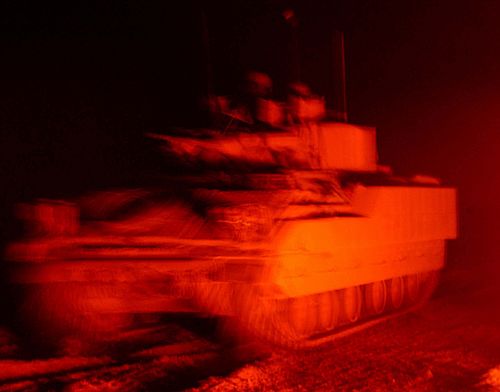
Technologies to improve night vision capabilities have existed since the end of the Second World War where they were used by the German, American and British forces for enhancing the vision of snipers. The early systems used a near-infrared (NIR) light source that reflected the target back to the scope where an image tube enhanced the image. By the 1950's the US Army had established the 'Army Night Vision Laboratory', at Fort Belvoir (Virginia), which was instrumental in developing new technologies under the leadership of Robert Wiseman. Through the Vietnam War (1961-1975) and the First Gulf War (1991) there were tremendous leaps in the effectiveness in equipment as new technological approaches were tested and improved. Current night vision equipment can amplify the image brightness up to 100,000 times but to improve the resolution and contrast this is normally reduced to two or three thousand times. 
  
13.21   War >  Iraq War (2003-2011): Abu Ghraib 
  
Thumbnail Thumbnail Thumbnail Thumbnail Thumbnail Thumbnail Thumbnail Thumbnail Thumbnail  


13.22   War >  Satellite Sentinel and the Enough Project 
  
Thumbnail Thumbnail Thumbnail Thumbnail  


13.23   War >  Balazs Gardi: Basetrack One-Eight, Afghanistan (2010-2011) 
  
Thumbnail Thumbnail Thumbnail Thumbnail Thumbnail Thumbnail Thumbnail Thumbnail Thumbnail Thumbnail Thumbnail Thumbnail Thumbnail Thumbnail Thumbnail Thumbnail Thumbnail Thumbnail Thumbnail  
  
Basetrack One-Eight was an independent, civilian media project, funded by a 2010 News Challenge Grant from the John S. and James L. Knight Foundation. It embedded journalists, including Balasz Gardi, with the 1st Battalion, 8th Marines, in the southern deserts of Afghanistan during 2010 and 2011. The project used iPhones and other devices to record photographs, audio and video that was posted on Facebook, Flickr and other social media websites. The project was closed down by the Marines when some of the postings made on the social media sites were inappropriate and potentially harmful. 
  
Thoughts 
  
13.24   War >  War conclusions 
  
War is largely seen through the eyes and archives of the victors but increasingly with Internet access and global communications images from both sides are now appearing almost instantly on the monitors of picture editors. Digital cameras linked with mobile phones are changing the nature of photojournalism and the selection of which images to print (or display) and which to censor out is becoming increasingly political.
 
When the great contemporary war photographers such as Luc Delahaye, Stanley Greene, Gilles Peress, Tom Stoddart and James Nachtwey take shots they are driven by a strong desire to show the world as it is - these images are passed on the mayor photo agencies but often not published by the media as they are deemed too horrific for the public to see.
 
We are fortunate that there are photojournalists who have been motivated by strong personal convictions that what they are seeing is not right to record little known wars to ensure that there is evidence of what has occurred. We do not like the images they take but by preserving reality they are trying to right wrongs. We may never understand the motivations of why some photographs were taken, for example those of the German Officer Heinrich Jösts in the Warsaw ghetto, but the images remain as a testimony to lives lost. 
  

alan@luminous-lint.com


HomeContents > Further research


Thumbnail Thumbnail Thumbnail Thumbnail Thumbnail Thumbnail Thumbnail Thumbnail Thumbnail Thumbnail Thumbnail Thumbnail Thumbnail Thumbnail Thumbnail Thumbnail  
  
General reading 
  
Batchen, Geoffrey; Gidley, Mick; Miller, Nancy K. & Prosser, Jay (eds.), 2012, Picturing Atrocity: Photography in Crisis, (Reaktion Books) isbn-10: 186189872X isbn-13: 978-1861898722 [Δ
  
Burns, Stanley, 1980, Civil War Medical Photography, (Burns Press) [Δ
  
Eisenman, Stephen F., 2010, The Abu Ghraib Effect, (Reaktion Books) isbn-10: 1861896468 isbn-13: 978-1861896469 [Δ
  
Ernst, Friedrich, 1924, Krieg dem Kriege! Guerre a la guerre! War against war! Oorlog aan den oorlog!, (Berlin: Freie Jugend) [Δ
  
Faas, Horst, 1997, Requiem By the Photographers who Died in Vietnam and Indochina, (New York: Random House) [Δ
  
Feinstein, Anthony, 2006, Journalists Under Fire: The Psychological Hazards of Covering War, (The Johns Hopkins University Press) isbn-10: 0801884411 isbn-13: 978-0801884412 [Δ
  
Finnegan, Terrence J., 2011, Shooting the Front: Allied Aerial Reconnaisance in the First World War, (The History Press) isbn-10: 0752460528 isbn-13: 978-0752460529 [Δ
  
Fowler, Will, 2000, Their War: German Combat Photographs From the Archives Of Signal Magazine, (Da Capo Press) isbn-10: 1580970400 isbn-13: 978-1580970402 [Δ
  
Goldberg, Vicki, 1993, The Power of Photography: How Photographs Changed Our Lives, (London and New York: Abbeville Press) [Δ
  
Halberstam, David; Pyle, Richard & Faaas, Horst, 2003, Lost over Laos: A True Story of Tragedy, Mystery, and Friendship, (Da Capo Press) isbn-10: 0306812517 [Δ
  
Hannavy, John, 1974, The Camera Goes to War: Photographs from the Crimean War, 1854-1856, (Edinburgh: Scottish Arts Council) [Δ
  
Kamber, Michael, 2013, Photojournalists on War: The Untold Stories from Iraq, (University of Texas Press) isbn-10: 0292744080 isbn-13: 978-0292744080 [Introduction by Dexter Filkins] [Δ
  
Kamber, Michael, 2013, Photojournalists on War: The Untold Stories from Iraq, (University of Texas Press) isbn-13: 978-0292744080 [Foreword by Dexter Filkins] [Δ
  
Leroy, Catherine & McCain, John (foreword), 2005, Under Fire: Great Photographers and Writers in Vietnam, (Random House) isbn-10: 1400063582 isbn-13: 978-1400063581 [Δ
  
Lewinski, Jorge, 1978, The Camera at War, A History of War Photography, (New York: Simon & Schuster) [Δ
  
Livingston, Jane, 1985, The Indelible Image, Photographs of War, (New York: Harry Abrams) [Δ
  
Moeller, Susan D., 1989, Shooting War, (New York: Basic Books) [Δ
  
Moorehead, Caroline, 2009, Humanity in War: Frontline Photography since 1860, (New Internationalist) isbn-10: 1906523150 isbn-13: 978-1906523152 [Introduction by James Nachtwey] [Δ
  
Naythons, Matthew, 1993, Face of Mercy: A Photographic History of Medicine at War, (Burns Press) isbn-10: 0976449552 [Δ
  
Norback, Craig & Melvin, Gray (eds.), 1980, The World's Great News Photos 1840-1940, (New York: Crown) [Δ
  
Piston, William Garrett & Sweeney, Thomas P., 2009, Portraits of Conflict: A Photographic History of Missouri in the Civil War, (University of Arkansas Press) isbn-10: 1557289131 isbn-13: 978-1557289131 [Δ
  
Roberts, Hilary, 2013, The Great War: A Photographic Narrative, (Jonathan Cape Ltd) isbn-10: 0224096559 isbn-13: 978-0224096553 [Δ
  
Rogers, B.O., 1995, May-June, ‘The first Civil War photographs of soldiers with facial wounds‘, Aesthetic Plastic Surgery, vol.19, no.3, pp.269-83 [Δ
  
Sandweiss, Martha; Stewart, Rick & Huseman, Ben, 1989, Eyewitness to War: Prints and Daguerreotypes of the Mexican War, 1846-1848, (Fort Worth & Washington: Amon Carter & Smithsonian) [Δ
  
Shaw, Irwin (ed.), 1981, Paris, Magnum Photographs 1835-1981, (Millerton, NY: Aperture) [Δ
  
Stichelbaut, Birger et al., 2009, Images of Conflict: Military Aerial Photography and Archaeology, (Cambridge Scholars Publishing) isbn-10: 1443801712 isbn-13: 978-1443801713 [Δ
  
Strachan, Hew (ed.), 2003, The Oxford Illustrated History of the First World War, (Oxford Paperbacks) isbn-10: 0192893254 isbn-13: 978-0192893253 [Δ
  
Sullivan, Constance, 1978, Great Photographic Essays from Life, (Boston: New York Graphic Society) [Δ
  
Szarkowski, John, 1973, From The Picture Press, (New York: Museum of Modern Art) [Δ
  
Taylor, A.J.P., 1963, The First World War: An Illustrated History, (Hamish Hamilton) [Δ
  
Tucker, Anne Wilkes; Michels, Will & Zelt, Natalie, 2012, War/Photography: Images of Armed Conflict and Its Aftermath, (The Museum of Fine Arts Houston) isbn-10: 0300177380 isbn-13: 978-0300177381 [Δ


Readings on, or by, individual photographers 
  
Eddie Adams 
  
Adams, Eddie, 2008, Eddie Adams: Vietnam, (Umbrage Editions) isbn-10: 1884167969 isbn-13: 978-1884167966 [Δ
  
George N. Barnard 
  
Barnard, George N., 1866 (ca), Photographic Views of Sherman's Campaign, Embracing Scenes of the Occupation of Nashville, the Great Battles around Chattanooga and Lookout Mountain, the Campaign of Atlanta, March to the Sea, and the Great Raid through the Carolinas, (New York: Press of Wynkoop & Hallenbeck) [Δ
  
Barnard, George N., 1977, Photographic Views of Sherman’s Campaign, (New York: Dover Publications) [Preface by Beaumont Newhall] [Δ
  
Davis, Keith F (ed.), 1990, George N. Barnard: Photographer of Sherman’s Campaign, (Kansas City, MO: Hallmark Cards) [Δ
  
Barnard & Gibson 
  
Gardner, Alexander, 2003, Gardner’s Photographic Sketchbook of the American Civil War, (New York: Delano Greenidge) [Δ
  
Felice Beato 
  
Bowen, Claire, 2007, ‘Memorising the Mutiny: Felice Beato's Lucknow Photographs‘, Cahiers victoriens & édouardiens, no.66, pp.195-209 [Δ
  
Chappell, Walter, 1958, Feb., ‘Robertson, Beato & Co. Camera vision at Lucknow‘, Image, no.7, pp.36-40 [Δ
  
Clark, John; Fraser, John & Osman, Colin, 1989, A Chronology of Felix (Felice) Beato, (Privately printed by the authors) [Δ
  
Fraser, John, 1981, ‘Beato's photograph of the interior of the Sikansar-Bagh at Lucknow‘, Journal of the Society for Army Historical Research, vol.59, pp.51-55 [Δ
  
Harris, John, 2000, ‘Topography and Memory: Felice Beato's Photographs of India, 1858-1859‘, in Dehejia, Vidya (ed.), India through the lens: photography 1840-1911, pp.118-147 [Δ
  
Masselos, Jim & Gupta, Narayani, 1997, Beato's Delhi, 1858, 1887, (Delhi) [Δ
  
White, Stephen, 1982, ‘Felix Beato and the First Korean War, 1871‘, The Photographic Collector, vol.3, no.1 [Δ
  
R.B. Bontecou 
  
Bontecou, Reed B., 1888, What class of gunshot wounds and injuries justify resection or excision in modern warfare? : with a description of an antiseptic provisional wound dressing for the field, devised for the military service, (Troy, N.Y. : [s.n.], (Phila., Pa. : Press of Wm. F. Fell & Co.)) [Δ
  
Burns, Stanley, 2011, Shooting Soldiers: Civil War Medical Photography By R.B. Bontecou, (Burns Press) isbn-13: 978-1936002054 [Δ
  
Rogers, B.O., 2000, March, ‘Reed B. Bontecou, M.D. - his role in Civil War surgery and medical photography.‘, Aesthetic Plastic Surgery, vol.24, no.2, pp.114-29 [Δ
  
Margaret Bourke-White 
  
Bourke-White, Margaret, 1944, They called it "Purple Heart Valley": A Combat Chronicle of the War in Italy, (New York: Simon and Schuster) [Δ
  
Mathew B. Brady 
  
Meredith, Roy, 1976, The World of Mathew Brady: Portraits of the Civil War Period, (Brooke House Publishers) isbn-10: 0912588055 isbn-13: 978-0912588056 [Δ
  
Sullivan, George, 1994, Mathew Brady: His Life and Photographs, (New York, Cobblehill/Dutton) isbn-10: 0525651861 isbn-13: 978-0525651864 [Δ
  
Larry Burrows 
  
Halberstam, D., 2002, Larry Burrows Vietnam, (New York: Alfred A. Knopf) [Δ
  
Robert Capa 
  
Capa, Robert, 1947, Slightly Out of Focus, (New York: Henry Holt) [Δ
  
Capa, Robert, 1964, Images of War, (NY: Paragraphic Books) [Δ
  
Capa, Robert, 1989, Robert Capa, (Paris: Centre National de la Photographie) [Δ
  
Whelan, R., 2001, Robert Capa: The Definitive Collection, (New York: Phaidon Press) [Δ
  
Whelan, Richard, 1994, Robert Capa: A Biography, (Lincoln, NE: University of Nebraska Press) [Δ
  
Young, Cynthia (ed.), 2010, The Mexican Suitcase, (Steidl / ICP Publications) isbn-10: 3869301414 isbn-13: 978-3869301419 [2 volumes, slipcase] [Δ
  
Chim 
  
Young, Cynthia (ed.), 2010, The Mexican Suitcase, (Steidl / ICP Publications) isbn-10: 3869301414 isbn-13: 978-3869301419 [2 volumes, slipcase] [Δ
  
Alexander Gardner 
  
Gardner, Alexander, 2003, Gardner’s Photographic Sketchbook of the American Civil War, (New York: Delano Greenidge) [Δ
  
Johnson, Brooks, 1991, An Enduring Interest: The Photographs of Alexander Gardner, (Norfolk, VA: Chrysler Museum) [Δ
  
James Gardner 
  
Gardner, Alexander, 2003, Gardner’s Photographic Sketchbook of the American Civil War, (New York: Delano Greenidge) [Δ
  
Ashley Gilbertson 
  
Gilberston, Ashley & Filkins, Dexter (introduction), 2007, Whiskey Tango Foxtrot: A Photographer's Chronicle of the Iraq War, (University Of Chicago Press) isbn-10: 0226293254 isbn-13: 978-0226293257 [Δ
  
Philip Jones Griffiths 
  
Griffiths, Philip Jones, 1971, Vietnam Inc., (New York: Collier Books) isbn-13: 978-0020804000 [First edition] [Δ
  
Griffiths, Philip Jones, 2004, Agent Orange: Collateral Damage in Vietnam, (Trolley Books) isbn-10: 1904563058 isbn-13: 978-1904563051 [Δ
  
Griffiths, Philip Jones & Sayle, Murray, 1996, Dark Odyssey, (Aperture Foundation) isbn-10: 0893816450 isbn-13: 978-0893816452 [Δ
  
Tim Hetherington 
  
Hetherington, Tim, 2009, Long Story Bit by Bit: Liberia Retold, (Umbrage Editions) isbn-10: 188416773X isbn-13: 978-1884167737 [Δ
  
Hetherington, Tim, 2010, Infidel, (Chris Boot) isbn-10: 1905712189 isbn-13: 978-1905712182 [Δ
  
Willoughby Wallace Hooper 
  
Geary, Grattan, 1886, Burma, after the conquest: viewed in its political, social, and commercial aspects, from Mandalay, (London: Sampson Low, Marston, Searle & Rivington) [For an account of Colonel Hooper photographing the execution of the dacoits in Mandalay] [Δ
  
Hooper, Willoughby Wallace, 1887, Burmah. A series of one hundred photographs, illustrating incidents connected with the British Expeditionary Force to that country, (London, Bangalore and Calcutta: J.A. Lugard, C.G. Brown and Thacker, Spink & Co.) [Δ
  
Kenneth Jarecke 
  
Cervenka, Exene & Jarecke, Kenneth, 1992, Just Another War, (Montana, Joliet: Bedrock Press) isbn-10: 0963478400 isbn-13: 978-0963478405 [Δ
  
David Knox 
  
Gardner, Alexander, 2003, Gardner’s Photographic Sketchbook of the American Civil War, (New York: Delano Greenidge) [Δ
  
Josef Koudelka 
  
Koudelka, J., 1999, Chaos, (New York: Phaidon Press) [Δ
  
John McCosh 
  
Russell-Jones, Peter R., 1968, January, ‘John MacCosh’s Photographs of the 2nd Sikh War, 1848-49, and the 2nd Burma War, 1852-53‘, Photographic Journal, vol.108, pp.25-27 [Δ
  
Don McCullin 
  
McCullin, Don, 1971, Destruction Business, (Macmillan) [Δ
  
McCullin, Don, 1981, Hearts of Darkness, (Random House Inc) [Δ
  
McCullin, Don, 1981, Hearts of Darkness: Photographs by Don McCullin, (New York: Alfred A. Knopf) [Introduction by John Le Carré] [Δ
  
McCullin, Don, 1992, Unreasonable Behaviour: An Autobiography, (Knopf) [1st American edition] [Δ
  
McCullin, Don, 1996, Sleeping With Ghosts: A Life's Work in Photography, (Aperture) [Introduction by Mark Haworth-Booth] [Δ
  
McCullin, Don, 2005, Don McCullin in Africa, (London: Jonathan Cape) [Δ
  
McCullin, Don, 2010, Shaped By War, (Jonathan Cape) [Δ
  
Susan Meiselas 
  
Meiselas, Susan, 1981, Nicaragua From June 1978–July 1979, (New York: Pantheon) [Δ
  
Meiselas, Susan, 2008, Nicaragua, (Aperture/ICP) isbn-10: 159711071X isbn-13: 978-1597110716 [New edition - Claire Rosenberg (ed.).] [Δ
  
Joel Meyerowitz 
  
Meyerowitz, Joel, 2006, Aftermath, (New York: Phaidon) [Δ
  
Lee Miller 
  
Penrose, Antony (ed.), 1992, Lee Miller’s War: Photographer and Correspondent with the Allies in Europe 1944–1945, (Boston: Bulfinch Press) [Δ
  
Penrose, Antony (ed.), 2005, Lee Miller’s War, (New York: Thames and Hudson) isbn-10: 0500285586 isbn-13: 978-0500285589 [Foreword by David E. Scherman] [Δ
  
James Nachtwey 
  
Nachtwey, James, 1989, Deeds of War, (New York: Random House) [Δ
  
Nachtwey, James, 1999, Inferno, (London: Phaidon) [Δ
  
Timothy H. O'Sullivan 
  
Gardner, Alexander, 2003, Gardner’s Photographic Sketchbook of the American Civil War, (New York: Delano Greenidge) [Δ
  
Tim Page 
  
Page, Tim & Shawcross, William (introduction), 1995, Tim Page's Nam, (Thames and Hudson, Inc.) isbn-10: 0500272808 isbn-13: 978-0500272800 [Δ
  
William Pywell 
  
Gardner, Alexander, 2003, Gardner’s Photographic Sketchbook of the American Civil War, (New York: Delano Greenidge) [Δ
  
John Reekie 
  
Gardner, Alexander, 2003, Gardner’s Photographic Sketchbook of the American Civil War, (New York: Delano Greenidge) [Δ
  
Gerda Taro 
  
Taro, Gerda, 2008, Gerda Taro, (Steidl) isbn-10: 3865215327 isbn-13: 978-3865215321 [Δ
  
Young, Cynthia (ed.), 2010, The Mexican Suitcase, (Steidl / ICP Publications) isbn-10: 3869301414 isbn-13: 978-3869301419 [2 volumes, slipcase] [Δ
  
Wood & Gibson 
  
Gardner, Alexander, 2003, Gardner’s Photographic Sketchbook of the American Civil War, (New York: Delano Greenidge) [Δ


If you feel this list is missing a significant book or article please let me know - Alan - alan@luminous-lint.com 


Resources 
  
Civil War Collections 
http://www.geh.org ... 
  
Magnum Photos 
http://www.magnumphotos.com ... 
Probably the world‘s most famous photo agency for photojournalists. Use this site to access the portfolios, biographies of the many notable Magnum photographers. Where there are books by the photographers the website frequently includes the photographs used. 


HomeContentsPhotographers > Photographers worth investigating

 
Max Alpert  (1899-1980) • Dmitri Baltermants  (1912-1990) • Micha Bar-Am  (1930-) • Felice Beato  (1832-1909) • Cecil Beaton  (1904-1980) • Werner Bischof  (1916-1954) • R.B. Bontecou  (1824-1907) • Margaret Bourke-White  (1904-1971) • Mathew B. Brady  (1823-1896) • Larry Burrows  (1926-1971) • Robert Capa  (1913-1954) • Agustin Victor Casasola  (1874-1938) • Dean Chapman • Luc Delahaye  (1962-) • Raymond Depardon  (1942-) • David Douglas Duncan  (1916-) • Emmanuel Evzerikhin  (1911-1984) • Horst Faas  (1933-2012) • Enrique Fazio • Roger Fenton  (1819-1869) • L. Fiorillo • Leonard Freed  (1929-2006) • Alexander Gardner  (1821-1882) • Ashley Gilbertson  (1978-) • Burt Glinn  (1925-2008) • Philip Jones Griffiths  (1936-2008) • Bert Hardy  (1913-1995) • Tim Hetherington  (1970-2011) • Chris Hondros  (1070-2011) • Frank Hurley  (1885-1962) • Yevgeny Khaldei  (1917-1997) • Don McCullin  (1935-) • Susan Meiselas  (1948-) • Chester Michalik • Lee Miller  (1907-1977) • Christopher Morris  (1958-) • James Nachtwey  (1948-) • Timothy H. O'Sullivan  (1840-1882) • Tim Page • Alessandro Pavia  (1824-1889) • Gilles Peress  (1946-) • Georgii Petrusov  (1903-1971) • James Robertson  (1813-1888) • George Rodger  (1908-1995) • Walter Rosenblum  (1919-2006) • Paul Senn  (1901-1953) • Paul Shambroom  (1956-) • W. Eugene Smith  (1918-1978) • Humphrey Spender  (1910-2005) • Edward Steichen  (1879-1973) • Lou Stoumen  (1917-1991) • Ellen Susan • David Wilkie Wynfield  (1837-1887) • Georgi Zelma  (1906-1984)
HomeThemes > War 
 
A wider gazeA closer lookRelated topics 
  
Aerial reconnaissance and bombing photography 
Agent Orange 
Documentary 
Evidence 
Military 
Naval Aviation Photographic Unit 
Patriotism 
Photojournalism 
Propaganda 
The Holocaust (1933-1945) 
 
Key dates 
  
The Holocaust (1933-1945) 


HomeContentsOnline exhibitions > War

Please submit suggestions for Online Exhibitions that will enhance this theme.
Alan - alan@luminous-lint.com


ThumbnailAdolphe Braun - The Paris Commune and the Aftermath of the Franco-Prussian War (1870-1871) 
Title | Lightbox | Checklist
Released (February 20, 2007)
ThumbnailAmerican Civil War (1861-1865) 
Title | Lightbox | Checklist
Released (February 28, 2011)
ThumbnailAmerican Civil War (1861-1865: Robin Stanford Civil War Photography Collection 
Title | Lightbox | Checklist
Released (April 3, 2013)
ThumbnailAutochromes and Autochromists of WWI 
Title | Lightbox | Checklist
Released (May 1, 2006)
ThumbnailBoer War (1899-1902) - Fabrications 
Title | Lightbox | Checklist
Released (July 25, 2006) The veracity of war.
ThumbnailCrimean War (1854-1856) 
Title | Lightbox | Checklist
Released (August 28, 2006)
ThumbnailEarliest War Photographs 
Title | Lightbox | Checklist
Improved (October 28, 2010) The section on the Mexican-American War has been updated to include the Daguerreotypes from the Amon Carter Museum, Fort Worth, Texas. Many thanks (14 July 2010).
ThumbnailEdward Grazda: Afghanistan, 1992-2004 
Title | Lightbox | Checklist
Released (February 1, 2007)
ThumbnailEdward Grazda: With the Mujahideen, Afghanistan, 1982-1989 
Title | Lightbox | Checklist
Released (January 25, 2007)
ThumbnailEllen Susan: Soldier Portraits 
Title | Lightbox | Checklist
Released (August 6, 2008)
ThumbnailFirst World War (1914-1918) - Prisoners of War 
Title | Lightbox | Checklist
Released (January 28, 2007)
ThumbnailGardner's Photographic Sketch Book of the War (1866) 
Title | Lightbox | Checklist
Improved (September 19, 2006)
ThumbnailGustave Le Gray: Camp de Châlons (1857) 
Title | Lightbox | Checklist
Released (November 13, 2011)
ThumbnailIndian Mutiny (1858) 
Title | Lightbox | Checklist
Released (November 9, 2010)
ThumbnailMexican-American War (1846-1848) 
Title | Lightbox | Checklist
Released (March 25, 2011)
ThumbnailMichael Rockefeller: In the Highlands of West Papua 
Title | Lightbox | Checklist
Released (January 5, 2008)
ThumbnailParis Commune Album (1871) 
Title | Lightbox | Checklist
Released (May 1, 2006)
ThumbnailPortrait: The Guinea Pig Club 
Title | Lightbox | Checklist
Released (July 18, 2010) Warning: These images may be considered disturbing as this exhibition remembers the pioneering plastic surgery of Archibald McIndoe. Thanks to Nicola Kurtz who photographed the 65th reunion of The Guinea Pig Club in September 2006.
ThumbnailSecond Chinese Opium War (1856-1860) 
Title | Lightbox | Checklist
Released (November 9, 2010)
ThumbnailShaped by War: Photographs by Don McCullin 
Title | Lightbox | Checklist
Released (February 17, 2010)
ThumbnailUnification of Italy (1849-1871) 
Title | Lightbox | Checklist
Released (December 4, 2010)
ThumbnailWilliam Laven: War Models 
Title | Lightbox | Checklist
Released (November 16, 2006)


HomeVisual indexes > War

Please submit suggestions for Visual Indexes to enhance this theme.
Alan - alan@luminous-lint.com


   Photographer 
  
ThumbnailAdolphe Braun: The Paris Commune and the Aftermath of the Franco-Prussian War 
About this photographer | Photographs by this photographer 
ThumbnailAdolphe Braun: Théâtre de la Guerre, 1870-1871 
About this photographer | Photographs by this photographer 
ThumbnailChris Steele-Perkins: Northern Ireland: The Troubles (1960s-1998) 
About this photographer | Photographs by this photographer 
ThumbnailDmitri Baltermants: Second World War (1935-1945) 
About this photographer | Photographs by this photographer 
ThumbnailE. & H.T. Anthony & Co.: War Views 
About this photographer | Photographs by this photographer 
ThumbnailEddie Adams: Street execution of a Viet Cong prisoner, Saigon 
About this photographer | Photographs by this photographer 
ThumbnailFernand Cuville: Autochromes of the First World War 
About this photographer | Photographs by this photographer 
ThumbnailFrank Hurley: Paget plates of the First World War 
About this photographer | Photographs by this photographer 
ThumbnailG. Papot: Sicile, Palerme, Barricade de la Portal di Castro 
ThumbnailGeorge Hubert Wilkins: Paget plates for the Australian Historical Mission on the First World War (1919) 
ThumbnailJames Robertson: Interior of the Malakoff Fortress 
About this photographer | Photographs by this photographer 
ThumbnailJames Robertson: Interior of the Redan, Sevastopol 
About this photographer | Photographs by this photographer 
ThumbnailJohn Burke: General Roberts and staff inspecting captured guns 
About this photographer | Photographs by this photographer 
ThumbnailJohn Burke: Khyber Pass 
About this photographer | Photographs by this photographer 
ThumbnailJohn Burke: Portraits 
About this photographer | Photographs by this photographer 
ThumbnailJohn McCosh: Burma 
About this photographer | Photographs by this photographer 
ThumbnailJules Gervais-Courtellemont: Les Champs de Bataille de la Marne 
About this photographer | Photographs by this photographer 
ThumbnailL. Fiorillo: Anglo-Egyptian War (1882) 
About this photographer | Photographs by this photographer 
ThumbnailLéon Eugène Méhédin: Campagne d'Italie en 1859 - Voyages en Italie 
About this photographer | Photographs by this photographer 
ThumbnailManuel Ramos: Mexican Revolution 
About this photographer | Photographs by this photographer 
ThumbnailMike Abrahams: Northern Ireland: The Troubles (1960s-1998) 
About this photographer | Photographs by this photographer 
ThumbnailOlive Edis: British women's services at the battlefields of France and Flanders (1918-1919) 
About this photographer | Photographs by this photographer 
ThumbnailPhilip Jones Griffiths: Vietnam Inc. 
About this photographer | Photographs by this photographer 
ThumbnailPhilip Jones Griffiths: Vietnamese Children file past a Dead Child 
About this photographer | Photographs by this photographer 
ThumbnailR.B. Bontecou: Surgical injuries and their treatment during the American Civil War: 
About this photographer | Photographs by this photographer 
ThumbnailRaphaël Dallaporta: Antipersonnel 
About this photographer | Photographs by this photographer 
ThumbnailRobert F. Sargent: Taxi to Hell 
ThumbnailRoger Fenton: Balaclava - Balaklava 
About this photographer | Photographs by this photographer 
ThumbnailRoger Fenton: Cooking House 
About this photographer | Photographs by this photographer 
ThumbnailRoger Fenton: Portraits from the Crimea 
About this photographer | Photographs by this photographer 
ThumbnailRoger Fenton: The artist's van 
About this photographer | Photographs by this photographer 
ThumbnailRoger Fenton: Valley of the Shadow of Death 
About this photographer | Photographs by this photographer 
ThumbnailSAFARA: Fabrication des casques de soldats 
ThumbnailStefano Lecchi: The Defence of Rome (la difesa di Roma) 
About this photographer | Photographs by this photographer 
ThumbnailTim Hetherington: Afghanistan 
About this photographer | Photographs by this photographer 
ThumbnailUnderwood & Underwood: 8109 A Russian earth mine exploding near base of Antzushan 
About this photographer | Photographs by this photographer 
ThumbnailUnderwood & Underwood: Christmas Presents from home 
About this photographer | Photographs by this photographer 
ThumbnailUnderwood and Underwood: Cost of Patriotism - Remington Scouts enjoying lunch 
About this photographer | Photographs by this photographer 
ThumbnailUnderwood & Underwood: The horrors of modern war! 
About this photographer | Photographs by this photographer 
ThumbnailWenderoth, Taylor and Brown: The Children of the Battle Field 
ThumbnailWilliam Laven: War Models 
About this photographer | Photographs by this photographer 


   Connections 
  
ThumbnailGeorge Hubert Wilkins - Arthur Rothstein 
ThumbnailGeorge N. Barnard - Adolphe Braun - Robert Capa - Peter Keetman 
ThumbnailJean-Baptiste Tournassoud - Dmitri Baltermants 
ThumbnailJohn Heartfield - Alexander Zhitomirsky 
ThumbnailRobert Capa - Mike Stimpson 
ThumbnailRoger Fenton - Timothy H. O'Sullivan - H. Ferdinand Gros 
ThumbnailTibor Honty - Josef Koudelka - Alberto Korda 


   Thematic Connections 
  
ThumbnailAbu Ghraib 
ThumbnailPasschendale 
 
  
   Themes 
  
ThumbnailFashion: Accessories: Gas masks 
ThumbnailLandscape: Cityscapes - Urban: Wartime 
ThumbnailNorthern Ireland: The Troubles (1960s-1998) 
ThumbnailSpanish Civil War (1936-1939): Aerial reconnaissance and bombing photography 
ThumbnailWar of the Triple Alliance (1865-1870) 
ThumbnailWar: Afghanistan Wars (1979-?) 
ThumbnailWar: American Civil War (1861-1865) 
ThumbnailWar: American Civil War (1861-1865): Birth of a Nation (1915) 
ThumbnailWar: American Civil War (1861-1865): Prisons and prisoners 
ThumbnailWar: American Civil War (1861-1865): Private George Lemon, ex-prisoner of war of the Confederates 
ThumbnailWar: American Civil War (1861-1865): Propaganda 
ThumbnailWar: American Civil War (1861-1865): Revenue stamps 
ThumbnailWar: American Civil War (1861-1865): The breastworks and fortifications 
ThumbnailWar: American Civil War (1861-1865): The commanders and officer class 
ThumbnailWar: American Civil War (1861-1865): The dead 
ThumbnailWar: American Civil War (1861-1865): The families 
ThumbnailWar: American Civil War (1861-1865): The hospitals 
ThumbnailWar: American Civil War (1861-1865): The injuries 
ThumbnailWar: American Civil War (1861-1865): The photographers 
ThumbnailWar: American Civil War (1861-1865): The press 
ThumbnailWar: American Civil War (1861-1865): The railways 
ThumbnailWar: American Civil War (1861-1865): The soldiers 
ThumbnailWar: American Civil War (1861-1865): The spies 
ThumbnailWar: American Civil War (1861-1865): The weapons 
ThumbnailWar: Anglo-Zulu War (1879) 
ThumbnailWar: Atomic explosions: Destruction of test house 
ThumbnailWar: Atomic explosions: Examples 
ThumbnailWar: Atomic explosions: Hiroshima (6 August 1945) 
ThumbnailWar: Atomic explosions: Nagasaki (9 August 1945) 
ThumbnailWar: Atomic explosions: New Mexico, at the Alamogordo Test Range, first ever nuclear explosion 
ThumbnailWar: Boer War (1899-1902) 
ThumbnailWar: Boxer Rebellion (1898-1901) 
ThumbnailWar: Cold War (ca. 1945-1991) 
ThumbnailWar: Crimean War (1854-1856) 
ThumbnailWar: Crimean War (1854-1856) : Portrait of a Soldier 
ThumbnailWar: Falklands - Malvinas War (1982) 
ThumbnailWar: First Gulf War (1991) 
ThumbnailWar: First Sino-Japanese (1894-1895) 
ThumbnailWar: First World War (1914-1918) 
ThumbnailWar: First World War (1914-1918): Aerial reconnaissance and bombing photography 
ThumbnailWar: First World War (1914-1918): American Commission for Devastated France 
ThumbnailWar: First World War (1914-1918): Autochromes and Paget plates 
ThumbnailWar: First World War (1914-1918): Gallipoli 
ThumbnailWar: First World War (1914-1918): Photographic competitions 
ThumbnailWar: First World War (1914-1918): Prisoners of war 
ThumbnailWar: First World War (1914-1918): Propaganda 
ThumbnailWar: First World War (1914-1918): Your Country Needs You 
ThumbnailWar: Franco-Prussian War (1871) 
ThumbnailWar: Indian Mutiny (1856) 
ThumbnailWar: Iraq War (2003-2011): Books 
ThumbnailWar: Iraq War (2003-2011): Justification 
ThumbnailWar: Italian Risorgimento (1849-1871) 
ThumbnailWar: Korean War (1950-1953) 
ThumbnailWar: Libya (2011) 
ThumbnailWar: Mexican Revolution (1910-1920) 
ThumbnailWar: Mexican-American War (1846-1848) 
ThumbnailWar: Mexican-American War (1846-1848): Lieutenant Colonel Henry Clay, Jr. 
ThumbnailWar: Modoc War (1872-1873) 
ThumbnailWar: Napoleonic Wars 
ThumbnailWar: New Zealand Wars (1860-1872) 
ThumbnailWar: North American Indian Wars 
ThumbnailWar: Northern Ireland - The Troubles (1960s - 1998) 
ThumbnailWar: Paris Commune (1871) 
ThumbnailWar: Prussian-Danish War (1864) 
ThumbnailWar: Revolution in Asuncion (ca 1890) 
ThumbnailWar: Russian Revolution and the aftermath (1917) 
ThumbnailWar: Russo-Japanese War (1904-1905) 
ThumbnailWar: Second Anglo-Afghan War (1878-1880) 
ThumbnailWar: Second Chinese Opium War (1856-1860) 
ThumbnailWar: Second World War (1939-1945) 
ThumbnailWar: Second World War (1939-1945): Aerial reconnaissance and bombing photography 
ThumbnailWar: Second World War (1939-1945): Internment camps 
ThumbnailWar: Second World War (1939-1945): Justice and revenge 
ThumbnailWar: Second World War (1939-1945): The Holocaust 
ThumbnailWar: Spanish Civil War (1936-1939) 
ThumbnailWar: Terrorism: Examples 
ThumbnailWar: Terrorism: World Trade Center (2001) 
ThumbnailWar: Typologies 
ThumbnailWar: Vietnam War (1961-1975) 


   Events 
  
ThumbnailYear of Revolutions (1848) 


   Techniques 
  
ThumbnailAutochromes: Themes: Military 
ThumbnailCarte de visites: Themes: Military 
 
  
   Still thinking about these... 
  
ThumbnailAircraft recognition training - U.S. Navy (ca. 1947-1951) 
ThumbnailExplosions 
ThumbnailIrish nationalism, the Easter Rising and Partition 
ThumbnailNight vision 
ThumbnailSatellite Sentinel and the Enough Project - Southern Sudan 


Refreshed: 17 May 2013, 23:03


HOME  BACKFREE NEWSLETTER
   Make a pledge on Kickstarter to support the next phase of Luminous-Lint
Many thanks, Alan