Luminous-Lint - for collectors and connoisseurs of fine photography
HOME  BACKFREE NEWSLETTER

Getting around


HomeWhat's NewContentsVisual IndexesOnline ExhibitionsPhotographersGalleries and DealersThemes
AbstractEroticaFashionLandscapeNaturePhotojournalismPhotomontagePictorialismPortraitScientificStill lifeStreetWar
TimelinesTechniquesLibraryImages and WordsSupport 
 

Social media

Share |


HomeContentsThemes > Street

Contents

Introduction
12.01   Street photography
12.02   Adolphe Duperly: Daguerian Excursions in Jamaica (1840)
12.03   Early street photography
12.04   Different perspectives on nineteenth century street photography
Changes in cameras
12.05   Camera developments and street photography
12.06   European Street photography of the 1920‘s and 1930‘s
Photographers
12.07   Richard Beard: Illustrations for Henry Mayhew - London Labour and the London Poor
12.08   Silas A. Holmes (attributed): New York ca. 1855)
12.09   Charles Piazzi Smyth: Early street photography in Russia
12.10   John Thomson: Physic Street, Canton, China
12.11   John Thomson: China, a travelling chiropodist
12.12   John Thomson: Street Life in London
12.13   John Thomson: The Crawlers
12.14   Eugène Atget: Street photography
12.15   Paul Martin: Street photography
12.16   Victor Angerer: Instantaneous photography on the street (1888)
12.17   Emil Mayer: Street photography
12.18   Arnold Genthe: Chinatown
12.19   Walker Evans: Street photography
12.20   Walker Evans: The subway portraits
12.21   Helen Levitt: Children of New York
12.22   Weegee: Street photography
12.23   Vivian Maier: Street photography
12.24   Robert Frank: The Americans: Book covers
12.25   Stephen Shore: Uncommon Places
12.26   Joel Meyerowitz: Street photography
12.27   Ed Van der Elsken: Sweet Life (1966)
12.28   Gabriele and Helmut Nothhelfer: The first exhibition "Bali-Kino" Berlin (October 1974)
12.29   Gabriele and Helmut Nothhelfer: What‘s our Concern with Strangers?
12.30   Philip-Lorca diCorcia: Street hustlers
Voyeurism
12.31   Voyeurism
Working on the street
12.32   Joseph Selle's Fox Movie Flash: Mid-Century Street Vendor Photography
12.33   Backgrounds: Street photographers
12.34   Afghan Box Camera Project
This theme includes example sections and will be revised and added to as we proceed. Suggestions for additions, improvements and the correction of factual errors are always appreciated. 
  
Status: Collect > Document > Analyse > Improve
 
  
Introduction 
  
12.01   Street >  Street photography 
  
Beaumont Newhall in The History of Photography has a chapter entitled 'Instant vision' that examines the technological changes and the personal visions of the photographers that led them to be interested in capturing the immediacy of life. The street theme examines how the advent of smaller cameras, improved optics and higher speed plates and films have allowed images to be captured with increasing veracity and as the size of the camera decreased so the photographer could blend into the background like Arnold Genthe for his work in San Francisco's Chinatown, Paul Martin with his photographs of streets and beaches or Walker Evans on the subway with concealed cameras. 
  
12.02   Street >  Adolphe Duperly: Daguerian Excursions in Jamaica (1840) 
About this photographer | Photographs by this photographer 
  
Thumbnail Thumbnail Thumbnail Thumbnail Thumbnail Thumbnail Thumbnail  


12.03   Street >  Early street photography 
  
Thumbnail Thumbnail Thumbnail Thumbnail Thumbnail Thumbnail Thumbnail Thumbnail Thumbnail Thumbnail  
  
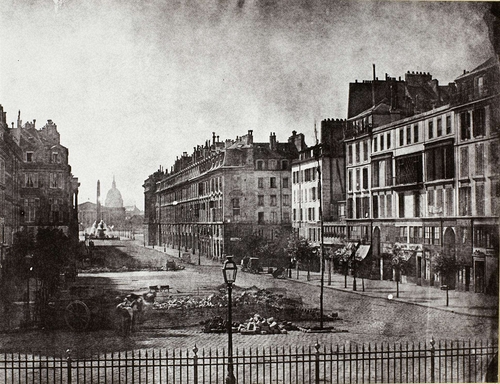
With early photography prior to the 1880s long exposures meant that streets are largely devoid of people or traces of blurred ghost-like figures remain. The physical street was recorded with the surrounding architecture but life on the street was largely absent. In rare cases such as a civic event, a protest or crowd the whole scene is captured but those are about the "event" rather than the everyday. There is a level of detachment from the events taken place on the street rather than an involvement in it. In cases where photographers recorded people on the street it was to document vendors, traders and the "characters" rather than the fluid mix of people that makes up the everyday. 
  
12.04   Street >  Different perspectives on nineteenth century street photography 
  
Thumbnail Thumbnail Thumbnail Thumbnail Thumbnail Thumbnail Thumbnail  
  
Through the nineteenth century there were a series of photographers with different viewpoints taking images for different purposes and with different social agendas. With the works of Richard Beard and John Thomson their photographs, or engravings based on them, had a overt or covert agenda of highlighting class differences and the ills of fast urbanization - in many ways these were the visual equivalent of what Charles Dickens was doing in his literature. At the same time other photographers such as Thomas Annan was recording the older buildings of Glasgow, Scotland or Charles Marville who recorded the roads of Paris that were going to be destroyed by Baron Georges-Eugène Haussmann's urban transformations and Eugéne Atget who preserved the architecture and changing streets. These photographers were preservationists seeking to record the immense changes taking place in the increasingly industrial cities - the people who inhabited the cities were rather like bit players in a far grander drama.
 
The photography with a social message that was seeking to record and hopefully improve the lot of the working classes and the poor was carried out by Waldemar Franz Herman Titzenthaler in Germany, John Galt (1863-1942) in his lantern slides for the London City Mission taken in the early 1900s, the street vendors of Paris taken by Eugéne Atget, and Jacob Riis in the squalid slums of New York.
 
Jacob Riis was born at Ribe in Denmark and became a reporter for The New York Herald on the poverty ridden and squalid slums of New York. There was such a disparity of wealth and understanding that the prosperous had little contact with the lower classes other than servants and vendors and this meant that readers were largely unaware of the issues and the photographs he took were proof of the overcrowded conditions and grinding poverty. New York was jolted into action and social reform when the book How the Other Half Lives: Studies Among the Tenements of New York was published in 1890 - here the barriers of distance and illustrative style were removed and the power of photography to further a social cause was ensured. 
  
Changes in cameras 
  
12.05   Street >  Camera developments and street photography 
  
Thumbnail Thumbnail Thumbnail Thumbnail Thumbnail Thumbnail Thumbnail Thumbnail Thumbnail Thumbnail Thumbnail  
  
A real step forward in camera size came at the end of the 19th century with the Block-Notes camera by L. Gaumont & Cie. a French camera maker. The camera was very small being only 1 1/4 x 2 1/3 x 3 1/2 when folded closed but it took a 4.5 x 6 cm glass plate. This was quite revolutionary as it allowed hobbyists such as Jacques-Henri Lartique (1894-1986) to carry the camera anywhere and that immediacy allowed for a totally different intimacy with the subject.
 
By the 1920s a number of portable cameras came out with fast lenses that were able to use lower level of available light. These allowed interiors to be taken without flash powder or the necessity of a tripod.
  • 1924: Ernox / Ermanox - Ernemann-Werke E.G.
  • 1924: Lunar - Hugo Meyer
  • 1924: Leica (film and different lenses)
  • 1932: Contax - Zeiss-Ikon (rangefinder and slit-image focusing)
The smaller camera with convenient rolls of film allowed photojournalists to capture non-posed views of events and famous people and Erich Salomon, Felix H. Man and Alfred Eisenstaedt excelled at this. But another effect was that it allowed photographers freedom to explore their personal visions of the world. It was this that allowed a continuing stream of remarkable individuals to preserve their own insights of the changing world about them. They did not concentrate on the pictorial aspects of the image but rather the strangeness of the everyday and this is a theme that is as vigorous today as it was in the 1920s.  
  
12.06   Street >  European Street photography of the 1920‘s and 1930‘s 
  
Thumbnail Thumbnail Thumbnail Thumbnail  
  
There was a movement of artists and intellectuals throughout Europe following the First World War (1914-1918) and this led to a spread of ideas and photographic styles. André Kertész (Hungarian) and Brassai (Hungarian) moved to Paris and Bill Brandt (German) moved to London. This is significant as they saw their adopted countries with the enquiring eyes of outsiders. They all took night photographs in the cities they had moved to and they seem to be outside observers rather than participants in the activities that take place. In 1933 Brassai's photographs were published in the book Paris by Night a project that Kertész had already turned down.
 
The 1928 photograph of Meudon by André Kertész is an extraordinary combination of activities, the train moving from right to left on the viaduct, the man with wrapped parcel crossing to the right, all happening seemingly at random. Hans-Michael Koetzle in his 2002 book Photo Icons: The Story Behind the Pictures - Volume 2 (Koln: Taschen) argues that all is not as it would first appear and the person with the parcel could be the German artist Willi Baumeister. Was part of this street photograph staged as with The Kiss (Le Basier de L'Hotel de Ville, 1950) by Robert Doisneau or was it a fortuitous accident? 
  
Photographers 
  
12.07   Street >  Richard Beard: Illustrations for Henry Mayhew - London Labour and the London Poor 
About this photographer | Photographs by this photographer 
  
Thumbnail Thumbnail Thumbnail Thumbnail Thumbnail Thumbnail Thumbnail Thumbnail Thumbnail Thumbnail Thumbnail Thumbnail  
  
In 1851 Henry Mayhew's book London Labour and London Poor was published in three volumes collecting together his well researched articles published in the Morning Chronicle. The book was an attempt at educating the middle and upper classes in Victorian England to the appalling social conditions of London. The illustrations for the book were based on daguerreotypes that were taken under the supervision of Richard Beard that were converted to wood engravings for publication because of the inability to print photographs within books at the time. As Naomi Rosenblaum pointed out in her A World History of Photography the result of using wood engraving is that the characters are removed from their original surroundings by the use of 'sketchily indicated' backgrounds and this separates the viewer from the subject.
 
Illustrations based on Beard daguerreotypes included:
The Coster-Girl
The Oyster Stall
The Irish Street-Seller
The Wallflower Girl
The Groundsel Man
The Baked Potato Man
The London Coffee-Stall
Orange Mart, Dukes Place

The Atheneum, No.1407, Oct. 14, 1854, p.1223.
RARE WORK. A few Copies just ready of HENRY MATHEWS Celebrated and very Extraordinary Work, 'LONDON LABOUR AND THE LONDON POOR : a CycIopedia of Those that Work, Those that cannot Work, and Those that will not Work,' with Engravings of the Scenes and People described, copied from Daguerreotypes taken expressly for this Book by Beard. Prices [unclear on scan]. Each bound copy has at end the whole of the valuable "Answers to Correspondents arranged to be read uninterruptedly." EITHER DIVISION OF THE WORK SOLD SEPARATELY.
 
A quantity of Odd Numbers for completion of sets to 63rd number -(pages -432 of Vol. II. and 199 of Vol. III.}. The Answers to Correspondents prepared for binding, all Advertisements, &c. attached on publication being excluded. Copies bound in manner rendering them more complete than any ever supplied, except by
G. Newbold, 8, Regent-street. Westminster.
N.B. Numbers bought - full price given - lists requested by post.
 
  
12.08   Street >  Silas A. Holmes (attributed): New York ca. 1855) 
About this photographer | Photographs by this photographer 
  
Thumbnail Thumbnail Thumbnail Thumbnail  


12.09   Street >  Charles Piazzi Smyth: Early street photography in Russia 
About this photographer | Photographs by this photographer 
  
Thumbnail Thumbnail  
  
In 1859 Charles Piazzi Smyth (1819-1900) made a trip to Russia and took one inch square plates - including one of a street scene in Novogorod. Based upon this there was an early split in photographers between those who saw the need for the highest possible quality print and that necessitated bulky equipment and those that wanted to 'capture the moment' in a candid manner and that required portability and the need to be unobtrusive. 
  
12.10   Street >  John Thomson: Physic Street, Canton, China 
About this photographer | Photographs by this photographer 
  
Thumbnail Thumbnail  
  
The albumen print "Physic Street, Canton, China" by John Thomson was converted into an illustration, "A street in Canton", for his book reference|395|Straits of Malacca, Indo-China, and China; or Ten Years' Travels, Adventures and Residence Abroad (London: Sampson Low, Marston, Low & Searle, 1875), between p. 248 and 249. 
  
12.11   Street >  John Thomson: China, a travelling chiropodist 
About this photographer | Photographs by this photographer 
  
Thumbnail Thumbnail  


12.12   Street >  John Thomson: Street Life in London 
About this photographer | Photographs by this photographer 
  
Thumbnail Thumbnail Thumbnail Thumbnail Thumbnail Thumbnail Thumbnail Thumbnail Thumbnail Thumbnail Thumbnail Thumbnail Thumbnail Thumbnail Thumbnail Thumbnail Thumbnail Thumbnail Thumbnail Thumbnail Thumbnail Thumbnail Thumbnail Thumbnail Thumbnail Thumbnail Thumbnail Thumbnail Thumbnail Thumbnail Thumbnail Thumbnail Thumbnail Thumbnail Thumbnail Thumbnail Thumbnail Thumbnail Thumbnail Thumbnail Thumbnail Thumbnail Thumbnail Thumbnail Thumbnail Thumbnail  
  
When in 1877 the book Street Life in London was published it included 36 Woodburytypes, an early photographic process, by John Thomson to accompany the texts by Adolphe Smith. In some of the photographs the person seems to have been carefully selected and their clothing and paraphernalia laid out to create a visually agreeable picture. They are posed portraits of street life rather than the unguarded captured moment.
London Nomades
London Cabmen
Covent Garden Flower Women
Recruiting Sergeants At Westminster
Street Floods In Lambeth
Public Disinfectors
Street Doctors
Street Advertising
Clapham Common Industries
"Caney" The Clown
Dealer In Fancy Ware
The Temperance Sweep
The Dramatic Shoe Black
"Tickets," The Card Dealer
The Old Clothes Of St. Giles
A Convicts' Home
The "Wall Worker"
Covent Garden Labourers
Halpenny Ices
Black Jack
The Cheap Fish Of St. Giles's
Cast Iron Billy
Workers On The "Silent Highway"
The Street Fruit Trade
The London Boardmen
The Water Cart
"Mush Fakers" And Ginger Beer Makers
November Effigies
"Hookey Alf," Of Whitechapel
The "Crawlers"
Italian Street Musicians
The Street Locksmith
The Seller Of Shell Fish
Flying Dustmen
Old Furniture
The Independent Shoe Black
 
  
   John  Thomson Street Life In London 
View exhibition 
Title | Lightbox | Checklist
 
  
12.13   Street >  John Thomson: The Crawlers 
About this photographer | Photographs by this photographer 
  
Thumbnail Thumbnail Thumbnail Thumbnail  
  
John Thomson & Adolphe Smith, [1877], Street Life in London, (London: Sampson Low, Marston, Searle and Rivington).
"Some of these crawlers are not, however, so devoid of energy as we might at first be led to infer. A few days' good lodging and good food might operate a marvellous transformation. The abject misery into which they are plunged is not always self sought and merited; but is, as often, the result of unfortunate circumstances and accident. The crawler, for instance, whose portrait is now before the reader, is the widow of a tailor who died some ten years ago. She had been living with her son-in-law, a marble stone-polisher by trade, who is now in difficulties through ill-health. It appears, however, that, at best, "he never cared much for his work," and innumerable quarrels ensued between him, his wife, his mother-in-law, and his brother-in-law, a youth of fifteen. At last, after many years of wrangling, the mother, finding that her presence aggravated her daughter's troubles, left this uncomfortable home, and with her young son descended penniless into the street. From that day she fell lower and lower, and now takes her seat among the crawlers of the district."
 
  
12.14   Street >  Eugène Atget: Street photography 
About this photographer | Photographs by this photographer 
  
Thumbnail Thumbnail Thumbnail Thumbnail Thumbnail Thumbnail Thumbnail Thumbnail Thumbnail Thumbnail Thumbnail Thumbnail Thumbnail Thumbnail  
  
No matter how well-respected Eugène Atget is as a recorder of the streets and architecture of Paris his street photography of people does not stand up well. In most cases it is distant with the backs of a group or crowd where their attention is drawn away from the photographer. The distance between the subject and the camera might be a part of the equipment he used but is more likely to be about personal reserve and a level of comfort he had with the subject. Where individuals such as Joueur de Guitare [Guitar Player] (1900), a street vendor Marchard d'abat-jour, rue Lepic (1899-1900) or the Facteur [Postman] (ca. 1900) were taken they are posed rather than having the informality that was emerging with 1890s snapshots. Just as Atget's camera and technique was outdated so was his approach to street photography
  
12.15   Street >  Paul Martin: Street photography 
About this photographer | Photographs by this photographer 
  
Thumbnail Thumbnail Thumbnail Thumbnail Thumbnail  
  
Paul Martin used a Fallowfield Facile detective camera, sometimes disguised as a parcel, to record the informal side of life on the streets and people at play on beaches at the English seaside towns of Yarmouth, Ilfracombe and the island of Jersey during the 1890s. 
  
12.16   Street >  Victor Angerer: Instantaneous photography on the street (1888) 
About this photographer | Photographs by this photographer 
  
Thumbnail Thumbnail Thumbnail  
  
Victor Angerer was an Austrian photographer who marketed dry-plates and was a practitioner of instantaneous photography for street photography. 
  
12.17   Street >  Emil Mayer: Street photography 
About this photographer | Photographs by this photographer 
  
Thumbnail Thumbnail Thumbnail Thumbnail Thumbnail Thumbnail Thumbnail Thumbnail  
  
Dr. Emil Mayer was a Viennese street photographer in the early 20th century. He was almost certainly the greatest of the European bromoilists in the 1920s and 30s. He and his wife committed suicide in 1938 when the Nazis annexed Austria and much of his work was destroyed. 
  
12.18   Street >  Arnold Genthe: Chinatown 
About this photographer | Photographs by this photographer 
  
Thumbnail Thumbnail Thumbnail Thumbnail Thumbnail Thumbnail Thumbnail Thumbnail Thumbnail Thumbnail Thumbnail  
  
Arnold Genthe was an immigrant from Germany who took up residency in San Francisco in California from 1895 and photographed the streets of Chinatown while trying to remain as inobtrusive as possible.
Like all good tourists I had a Baedeker. A sentence saying, "It is not advisable to visit the Chinese quarter unless one is accompanied by a guide," intrigued me. There is a vagabond streak in me which balks at caution. As soon as I could make myself free, I was on my way to Chinatown, where I was to go again and again, for it was this bit of the Orient set down in the heart of a western metropolis that was to swing my destiny into new and unforeseen channels.

Genthe, Arnold, 1936, As I remember, (Reynal & Hitchcock), p. 32

"The smell of the place—it was a mixture of the scent of sandalwood and exotic herbs from the drugstores, the sickly sweetness of opium smoke, the fumes of incense and roast pork , and the pungent odors from the sausages and raw meats hanging in the "Street of the Butchers." And in the air there was always the sound of temple gongs, the clashing of cymbals and the shrill notes of an orchestra. It was something for me to write home about."

Genthe, Arnold, 1936, As I remember, (Reynal & Hitchcock), p. 33

Arnold Genthe lost most of his early work in the San Francisco Fire of 1906. 
  
12.19   Street >  Walker Evans: Street photography 
About this photographer | Photographs by this photographer 
  
Thumbnail Thumbnail Thumbnail Thumbnail Thumbnail Thumbnail Thumbnail Thumbnail Thumbnail Thumbnail Thumbnail  


12.20   Street >  Walker Evans: The subway portraits 
About this photographer | Photographs by this photographer 
  
Thumbnail Thumbnail Thumbnail Thumbnail Thumbnail Thumbnail Thumbnail Thumbnail Thumbnail Thumbnail  


12.21   Street >  Helen Levitt: Children of New York 
About this photographer | Photographs by this photographer 
  
Thumbnail Thumbnail Thumbnail Thumbnail Thumbnail Thumbnail Thumbnail Thumbnail Thumbnail Thumbnail  


12.22   Street >  Weegee: Street photography 
About this photographer | Photographs by this photographer 
  
Thumbnail Thumbnail Thumbnail Thumbnail Thumbnail Thumbnail Thumbnail Thumbnail Thumbnail Thumbnail Thumbnail Thumbnail Thumbnail Thumbnail Thumbnail Thumbnail Thumbnail  


12.23   Street >  Vivian Maier: Street photography 
About this photographer | Photographs by this photographer 
  
Thumbnail Thumbnail Thumbnail Thumbnail Thumbnail Thumbnail Thumbnail Thumbnail  
  
In 2007 a real estate agent John Maloof purchased 30,000 negatives taken by the then anonymous photographer Vivian Maier, a reclusive nanny from Chicago. Bought on a hunch, he had inadvertently stumbled upon an undiscovered pot of gold.
 
Born in New York in 1926, Maier spent her youth in France before returning home to The States in 1951. There she spent the next five decades looking after various families and their children. As well as following in the footsteps of Mary Poppins this eccentric, highly intellectual and heavily opinionated lady was also a serious street photographer.
 
With her Rolleiflex camera firmly around her neck Maier strolled through the streets of Chicago and New York casting her gaze over the everyday characters and scenes she saw. Fashionable fur stoles, boys playing on the beach and journeys on the Staten Island ferry are just some of the subjects that caught her untrained, yet brilliant eye.
 
When Maloof, acquired these negatives in 2007 Maier was a complete unknown, and there was no knowledge of her talent or the breadth of her archive. The storage locker, which contained Maloof's acquisition, was only auctioned off to help settle a number of payments, which had built up before Maier’s death in 2009.
 
After Maloof's initial discovery he went on to recover over 2,000 rolls of undeveloped film, 3,000 prints and 150,000 negatives. This incredible archive is now highly regarded in the photography field and Maier has since been likened to the great 20th Century documentary photographers Diane Arbus, Brassai, Walker Evans and Weegee.
 
[Courtesy of Chris Beetles Fine Photographs] 
  
12.24   Street >  Robert Frank: The Americans: Book covers 
About this photographer | Photographs by this photographer 
  
Thumbnail Thumbnail Thumbnail Thumbnail Thumbnail Thumbnail Thumbnail Thumbnail Thumbnail Thumbnail Thumbnail Thumbnail Thumbnail Thumbnail Thumbnail Thumbnail Thumbnail Thumbnail Thumbnail Thumbnail Thumbnail  
  
Swiss-born photographer Robert Frank secured a grant from the John Simon Guggenheim Memorial Foundation in 1955. Over the next two years he took 800 rolls of film as he traveled the roads of the USA. From this vast number of photographs he selected 83 for his 1958 book Les Américains which was published by the legendary book designer Robert Delpire in Paris. An American edition of The Americans came out in 1959 with an introduction by Jack Kerouac. The book was not an initial success with a review in Popular Photography (May 1960) criticizing it for "meaningless blur, grain, muddy exposures, drunken horizons and general sloppiness." The criticism missed the point and over time, and no doubt assisted by the writing of Jack Kerouac who had a cult-like following, the book started to become a seminal work of American street photography. The energy of the images so different from the street photography of the time and yet attuned to the disruptive forces that were present in American society and which would be questioned by the counter culture of the 1960s.
"When people look at my pictures I want them to feel the way they do when they want to read a line of a poem twice."
 
Robert Frank, Life (26 November 1951), p. 21
 
  
12.25   Street >  Stephen Shore: Uncommon Places 
About this photographer | Photographs by this photographer 
  
Thumbnail Thumbnail Thumbnail Thumbnail Thumbnail Thumbnail Thumbnail Thumbnail Thumbnail  
  
Until I was twenty-three, I lived mostly in a few square miles in Manhattan. In 1972, I set out with a friend for Amarillo, Texas. I didn't drive, so my first view of America was framed by the passenger's window. It was a shock."
 
Stephen Shore, 1982
 
  
12.26   Street >  Joel Meyerowitz: Street photography 
About this photographer | Photographs by this photographer 
  
Thumbnail Thumbnail Thumbnail Thumbnail  


12.27   Street >  Ed Van der Elsken: Sweet Life (1966) 
About this photographer | Photographs by this photographer 
  
Thumbnail Thumbnail Thumbnail  
  
Ed Van der Elsken Sweet Life (Köln: M. DuMont Schauberg, 1966). First German edition. Large square quarto. [26],179pp. Black cloth with signature of artist stamped in white on front cover in original photographic dust jacket. Photographic endpapers. Fascinating pictorial account of Dutch photographer Ed Van der Elsken's 1960 trip to Asia and North America. The work is profusely illustrated with b/w reproductions of photographs focusing on the daily life of people in these countries. The artist succeeds in capturing the joy, as well as the hardship of its inhabitants. The work was published worldwide in 7 editions. "Van der Elsken hat weder sogenannte Sehenswürdigkeiten noch Landschaften fotografiert; das überläßt er anderen. Sie tauchen zwar in seinen Fotos auch auf, aber das Hauptaugenmerk des Fotografen wie seiner Kamera galt immer dem Menschen, seinem Leiden und Glück, der Vielfalt des Lebens, das er voll Verständnis und Teilnahme und gerade deshalb aufrichtig und ehrlich bis zur Brutalität notierte." Text in German.
"Sweet Life is a sprawling, exuberant cornucopia, a preview of the pure stream-of-consciousness, machine-gun approach that would soon come with the Japanese Provoke photographers. And like the Provoke aesthetic, Van der Elsken's work has its dark and pessimistic undertones, although in Sweet Life bold, frantic energies predominate."
 
Parr, Martin & Badger, Gerry, 2004, The Photobook: A History. Vol. I, (New York: Phaidon), p.255.
 
  
12.28   Street >  Gabriele and Helmut Nothhelfer: The first exhibition "Bali-Kino" Berlin (October 1974) 
About this photographer | Photographs by this photographer 
  
Thumbnail Thumbnail Thumbnail Thumbnail Thumbnail Thumbnail Thumbnail Thumbnail Thumbnail Thumbnail Thumbnail Thumbnail Thumbnail Thumbnail Thumbnail  
  
This exhibition includes the fifteen photographs shown at the first show by Gabriele and Helmut Nothhelfer that was held at "Bali-Kino" in West Berlin, Germany in October 1974. The following comments prepared by the photographers for this online exhibition provide the context.
 
For the first exhibition of our photographs 1974 in West-Berlin we wrote:
"We show festive events, moments where a person rises above his everyday life, such as to elevate himself by joining a well-meaning circle in the certainty about the indivisibility of the nation, or to bask in the radiance from a trophy for his dog; or even to make sure to be among the redeemed by taking part in the procession on Corpus Christi Day. Should anybody nevertheless feel signs of sadness in our pictures, the blame should not be laid on us. Perhaps it is the paltriness of our everyday life, the insufficient conditions of production and working, which even in these festive moments show discernibly through."
Today, rereading these lines, we are astonished at our self-assuredness then: The precisely formulated concept of "alienated leisure time" had been our guideline in finding and selecting motifs; however, dragged along by the passage of history we now find that our pictures may not be locked up within such boundaries.
 
Since then our endeavor has developed further, unpredictable and difficult to explain. Nevertheless, we believe strongly that we are still in pursuit of the same task. Now we are especially led by the magical space provided by the glance and posture of the photographed, by their aura: the tension between being repelled and attracted, which includes us as well as the viewer and which at the same time expels us and shows us our place.
 
Inevitably, political and social climate shows up in these pictures. We as anyone have our opinion about that. But we trust it’s better to leave the viewer on his own and let him enter unguided so that he may find his own self.
 
Gabriele and Helmut Nothhelfer (December 2006) 
  
   1 Nothhelfer Nothhelfer 
View exhibition 
Title | Lightbox | Checklist
 
  
12.29   Street >  Gabriele and Helmut Nothhelfer: What‘s our Concern with Strangers? 
About this photographer | Photographs by this photographer 
  
Thumbnail Thumbnail Thumbnail Thumbnail Thumbnail Thumbnail Thumbnail Thumbnail Thumbnail Thumbnail Thumbnail Thumbnail Thumbnail Thumbnail Thumbnail Thumbnail Thumbnail Thumbnail Thumbnail Thumbnail  
  
In the beginning, we were interested in the documentary force of photography. We wanted to illustrate and criticize social manifestations like the alienation of leisure. But this documentary intention faded in the face of the impact of the individual pictures: if successful, it gave us an impulse, and we were moved by its particular points, which could be brought onto a socially critical denominator. We realized that the preliminary theoretical decisions cannot be a substitute for the spontaneous grasping of a moment. We moved closer to the anarchic element of photography — where chance is often given more credit than the photographer did. And since there is no point in being jealous of chance, it didn‘t bother us being limited in our impact. For it was only within these limits that our intentions could be realized. The way from reality to a photograph is not a technical process. The photographic process is determined by thought and sense and leads from the conspicuous situation through the taking, discussing and selecting of the picture into the rational eye of the public.
 
All of the photographs were taken in Berlin. They show people with which we share the experience of living in the same city. The anonymity of a city is not a magic cap, which makes the social roles invisible. What is our concern with these strangers? In passing they give us inducement to think, to experience emotions of attraction or disgust. Our photography also finds itself in this conflict.
 
Gabriele and Helmut Nothhelfer (May 2007) 
  
   1 Nothhelfer Nothhelfer 
View exhibition 
Title | Lightbox | Checklist
 
  
12.30   Street >  Philip-Lorca diCorcia: Street hustlers 
About this photographer | Photographs by this photographer 
  
Thumbnail Thumbnail Thumbnail Thumbnail Thumbnail  
  
Some series from the work of Philip-Lorca diCorcia blur the boundaries between different genre including street photography, documentary, staged photography and fabricated realities. The use of sophisticated lighting systems such as those used by Gregory Crewdson mean that there is intentionality as the location was selected, lighting set up and the shot framed before the subject arrived. In one series the location was prepared and then street hustlers from Santa Monica Boulevard in Los Angeles were picked up and paid their normal rate for a sexual act. No sexual act took place but the hustler was taken to the prepared location and photographed - the photographs having a title made up of three parts - the name of the person, where they came from and the amount paid. The resulting photograph is therefore partly documentary with portraits of social outsiders but it breaks the rules by changing location and it is not a street photography even though it takes place on the street. Reality has been twisted by the use of additional lighting and so what are we seeing? The resulting staged tableaux can be considered exploitative but they make the viewer question their pre-conceptions of reality and genre. 
  
Voyeurism 
  
12.31   Street >  Voyeurism 
  
Thumbnail  
  
The use of hidden cameras within street photography has been well established by photographers such as Paul Martin with his captured moments in British seaside towns and beaches or with the subway portraits of Walker Evans. These are well accepted within the history of photography even though there is concern about the lack of consent of those photographed. This can be justified to a certain extent by the knowledge that when a camera is present it changes the dynamic and some degree of posing will take place removing the naturalism of a scene.
 
When the photographer and those being photographed are of different genders or there is a disparity in age such as an older person photographing a young child our sensitivities become more acute and laws are increasingly being made and enforced to outlaw the activity. These laws are increasingly flouted as ever-smaller cameras are embedded into mobile devices and have become almost invisible.
 
So how should the work of photographers like Miroslav Tichý be viewed?
 
Miroslav Tichý (1926-2011) was a Czech photographer with a somewhat eccentric style recording with homemade cameras the women of his home town of Kyjov. His use of strange cameras made out of cardboard tubes and old tin cans along with his poorly printed voyeuristic works has made him highly regarded by a certain section of the fine photography community. His work has been collected and preserved by a neighbour, Roman Buxbaum, and since 2004 has gained reputation through international exhibitions as a subversive rebellion against communist repression. The question of voyeurism still remains.
 
The same unease occurs with the voyeuristic surveillance-like night photographs of groping heterosexual and homosexual lovers in three Tokyo parks (Shinjuku, Yoyogi, and Aoyama) by Kohei Yoshiyuki.
 
In 2013 photographer Arne Svenson had an exhibition at the Julie Saul Gallery in New York which showed his series Neighbors which used a telephoto lens to photograph the daily life of unaware participants in apartments opposite his own in Tribeca. Whilst faces are not shown the series provoked an outcry for privacy from some of those viewed. Reading comments on the websites where these have been posted ranges from they are good art right through to voyeurism with all shades inbetween. Legal judgements will do little to provide clear boundaries of what is "acceptable" within society. 
  
Working on the street 
  
12.32   Street >  Joseph Selle's Fox Movie Flash: Mid-Century Street Vendor Photography 
About this photographer | Photographs by this photographer 
  
Thumbnail Thumbnail Thumbnail Thumbnail Thumbnail Thumbnail Thumbnail Thumbnail Thumbnail Thumbnail Thumbnail Thumbnail Thumbnail Thumbnail Thumbnail Thumbnail Thumbnail Thumbnail Thumbnail Thumbnail Thumbnail Thumbnail Thumbnail Thumbnail Thumbnail Thumbnail Thumbnail Thumbnail Thumbnail Thumbnail Thumbnail Thumbnail Thumbnail Thumbnail Thumbnail Thumbnail Thumbnail Thumbnail Thumbnail Thumbnail Thumbnail Thumbnail Thumbnail Thumbnail Thumbnail Thumbnail  
  
Joseph Selle was a commercial photographer in the Union Square area of San Francisco for forty years, from the 30s to the 70s. He took candid snapshots of pedestrians and then sold the portraits by mail for fifty cents each. When he retired his entire archive - totaling some one million images - went to Visual Studies Workshop in Rochester, New York. Now, due to digital technology, a small selection of this vast body of work is available. It is an enormously moving experience of time travel to "walk" the streets along with Selle and see our parents and grandparents or younger selves on display. Curated with the cooperation of VSW archivist Andrew Eskind, this preliminary exhibition will include video projection of thousands of images.
 
Joseph Selle: Curatorial Reflections
 
I distinctly remember a tall older man haunting Union Square in the early 70s, offering to sell pedestrians their photographic portraits. After more than three decades I still remember him for some reason: perhaps it was his height, his odd outfit of a taxi driver’s hat and long duster. It is a supreme coincidence that after all this time I have come to work with Joseph Selle’s lifetime accumulated archive.
 
Viewing these images is an overwhelming emotional experience. After a session editing the photographs, one is unlikely to ever walk the city streets in quite the same way, because an awareness of the lives that once occupied these same sidewalks becomes unshakable. The Selle archive is as close as we will ever come to the experience of time travel, experiencing the streets of San Francisco half a century ago. Truly a memento mori, we encounter vibrantly alive people in the midst of their quotidian lives, people whom we infer are now long dead, while the children displayed are themselves entering late middle age. I don’t believe I have ever understood both the tragedy and dignity of life as viscerally as I have while immersed in this project.
 
It is fascinating and moving to see how people organize themselves, create structure, within such a simple act as walking down the street. Mothers and grandmothers hold children’s hands. Adult children support their aged parents. Women friends walk side by side, talking, touching. Couples and families align themselves with each other, to other pedestrians, and to the architecture. Vehicle traffic and crowding causes odd behavior and balletic moves.
 
This is to some extent an anthropological experience, as we see that a trip downtown to Union Square, even well into the 1960s, was an occasion for wearing one’s best clothing. Women inevitably wear white gloves and hats, and almost never wear slacks. Fox stoles and mink coats abound. Men wear suits and ties, and hats. Everyone smokes. Everyone shops. Everyone’s clean. Just blocks away on Market Street, we discover more people of color and more casually dressed people, especially as the 50s move along into the 60s. Taken at the end of the baby boom, the pictures include many more pregnant women than we are used to seeing on the streets today. Men smoke pipes.
 
People are faced with a behavioral choice if they see someone like Selle about to approach them on the street. Most ignore him if they notice him at all, but once they realize what he is up to, and that he’s harmless, often give themselves away by touching their hair or putting their best foot forward. Quite a few put their hands up to signal stop; many others laugh at being caught unaware.
 
History is lurking in the shadows of every photograph. In the 50s material one can detect the impact of Mamie Eisenhower’s conservative style on the women, and then suddenly just a few months later, Jackie Kennedy’s more chic approach is seen everywhere. We see an elderly man wearing a Kennedy straw hat during the election campaign. Then one evening on Market Street we see people carrying newspapers under their arms with the enormous banner headline: "….SLAIN!" and we can painfully infer that it marks the assassination of the President. Among the well-dressed people streaming by the photographer’s lens are a great number African American and Asian American people, and even a significant number of mixed-race couples; more occasionally we see Latinos, or a hipster in jeans or leather, or out gay people. San Francisco’s particular character was already apparently well on its way to being established.
 
Organizing the archive places the curator into several vexing dilemmas. These images have been captured for four decades like genies in a bottle, waiting to be released. Selecting a few of them for this catalogue feels like a betrayal to all the other lives glimpsed and not included that will now recede back into obscurity forever. Selecting a tiny number of these works to represent the whole is a daunting curatorial task. Arguably, to be most true to the archive one should allow chance to determine the selection: the richness of this work is the profound beauty of its ordinariness. As curator I am drawn to the most artfully or quirkily framed shots. I am tempted to disregard the great majority of the pictures that are out of focus. As historian one could cull the 18,000 images for important moments. As anthropologist there is the opportunity to represent the entire population: the wealthy, the middle class, the working class, all the racial backgrounds, the clothing, lifestyles and eccentricities of the culture. I have tried to represent all these approaches as best I can; a book many times the size of this catalogue is called for.
 
The territory of museums has widened over the past decade to include more and more consideration of visual materials made by non-artists that nonetheless reflect skill, style, meaning and power. The street vendor work of Joseph Selle is just at the brink of being appreciated in that same way and it is a thrill and a privilege to participate in that rediscovery. This project could not have happened without the energy and dedication of Andrew Eskind of Visual Studies Workshop in Rochester, New York. Eskind has taken on the pursuit of information about Selle with the precision of a private eye and the dedicated professionalism of the historian he truly is. I offer my humble thanks to him for bringing this project to me, enabling the Nelson Gallery to share it with the UC Davis community.
 
© Renny Pritikin
Davis, California
February 2005
 
How long does it take to look at a million photographs? Is it even possible? It‘s said that in today‘s media saturated society, we‘re each exposed to 1500 images daily. If that‘s an average (and not counting TV and movies), what are the high and low extremes? Can one look at, say, even 10,000 in a day and still make any sense out of them?
 
This conceptual conundrum is perhaps what delayed archivists and students from exploring and exhibiting the more than one million surviving negatives made between the 1950s and 1970s by the San Francisco street vendor photographic firm, Fox Movie Flash.
 
Fox Movie Flash was owned by Joseph Selle (1906-1988) and operated out of 942 Market Street from the 1930s until the 1970s. Selle ventured out onto Market Street often framing his photographs under the marquee of the neighboring Pix Theatre at 946 Market. He also worked all of the corners and side streets around Union Square during peak periods of pedestrian traffic. He and associate photographers wearing the Fox Movie Flash cap carried rather heavy, modified DeVry movie cameras (marketed by Burke & James, Inc as "Street Vending Cameras"). They were pre focused at 10 ft and loaded with sufficient film to snap up to 1500 images of shoppers and tourists with the hope of selling some percentage of them souvenir portraits of their visit to San Francisco‘s prime retail shopping district. Charlie Rester, the last living Fox Movie Flash associate photographer recalls that on good days photographers could earn $100/day - a respectable living at the time.
 
This photographic genre - street vendor photography - has yet to attract much attention from museums, collectors, or historians. Yet there is anecdotal evidence that similar cameras and the same business model were used in many other American cities as well as abroad. Selle and fellow practitioners were not at all interested in the esthetics of their photographs. In fact, it is unlikely they even looked at every frame among the 1500 on the 100-foot rolls of negatives. The one-out-of-10 (or more likely one-out-of-100) pedestrians who actually paid the 50 cents ($1 by the 1970s) for the postcard-size souvenirs made their purchase decisions sight-unseen. Neither creator nor purchaser was making decisions on the basis of visual interest, or qualitative judgment. Only those frames matched by ticket number to individual purchasers were even printed. Among the many permutations of the speculative commercial practice now called street vendor photography, this one has also been aptly referred to as ‘surprise photography‘. (cf Mapping Sitting: On Portraiture and Photography; Walid Raad, Karl Bassil, Zeina Maasri, Akram Zaatari; 2002)
 
The term "surprise" is fitting in more ways than one. The purchaser received the souvenir within a few weeks in the mail. Having no opportunity for a preview, the end-product may have been a pleasant surprise, or a dud. Not every frame is sharp, well composed, or properly exposed. San Franciscan Jack Tillmany recalls his mother making 2 purchases from Fox Movie Flash operators when he was a kid going downtown with her in the 1950s. The first is a cherished memento; the second a disappointment. The photographers, too, should have experienced surprises - both while on the streets encountering sailors, shoppers, tourists, lovers, families - as well as in the darkroom where surely they looked at, and, perhaps laughed at frames which hadn‘t sold as well as those which were printed for buyers. The best surprise of all, however, are the many reactions we can experience today whether selecting previously unseen images for publication, or viewing original shooting sequences as if they were movies - complete with bad frames, changing weather, newspaper headlines, movie theatre marquees, dress, kids, smokers, relationships.
 
US Davis American Studies professor Jay Mechling refers to the psychological term "intermittant reward" to explain why many viewers become so captivated watching the original unedited shooting sequences that they‘ll continue watching without knowing when - or if - there will soon be an end. If every once in a while, we‘re rewarded by a surprise - by an image striking to us for its accidental composition, for its recollection of someone we knew or loved, for its goofiness - we‘ll happily continue watching expecting a new surprise at any moment.
 
Thus, beyond the sheer logistical challenge of exploring over a million undifferentiated images, the archivist today needs to consider the multitude of potential unimagined points of interest represented in this vast documentary record. For curators, such as Renny Pritikin, there‘s the irresistible temptation to do what Selle and his co-hort photographers never found time or motivation to do. He has applied the criteria of visual interest we‘d otherwise associate with non-commercial street photographers such as Walker Evans, Lee Friedlander, Garry Winogrand, Harry Callahan, or even Weegee. His selections reproduced here from the 18,000 frames digitally scanned to date (only 1% of the extant total) could easily be matched by totally different sets selected from the perspective of social historians, movie buffs (theatre marquees are a recurring theme), architecture historians, urbanologists, or those of us who are plain and simple sentimental old picture junkies.
 
© Andrew Eskind
Rochester, NY
March 2005
 
[These texts accompanied the exhibition Joseph Selle‘s Fox Movie Flash - Mid-Century Street Vendor Photography that was held at the Nelson Gallery at UC Davis, January 13th - March 13th, 2005. This exhibition used projected images.] 
  
   Portrait SF Street Vendor 
View exhibition 
Title | Lightbox | Checklist
 
  
12.33   Street >  Backgrounds: Street photographers 
  
Thumbnail Thumbnail Thumbnail Thumbnail Thumbnail Thumbnail Thumbnail Thumbnail Thumbnail Thumbnail Thumbnail  


12.34   Street >  Afghan Box Camera Project 
  
Thumbnail Thumbnail Thumbnail Thumbnail Thumbnail Thumbnail Thumbnail Thumbnail Thumbnail Thumbnail Thumbnail Thumbnail Thumbnail Thumbnail Thumbnail Thumbnail Thumbnail Thumbnail Thumbnail Thumbnail Thumbnail Thumbnail Thumbnail Thumbnail Thumbnail Thumbnail Thumbnail Thumbnail Thumbnail Thumbnail Thumbnail Thumbnail Thumbnail Thumbnail Thumbnail Thumbnail Thumbnail Thumbnail Thumbnail Thumbnail  


   Afghan Box Camera Project 
View exhibition 
Title | Lightbox | Checklist


alan@luminous-lint.com


HomeContents > Further research


Thumbnail Thumbnail Thumbnail Thumbnail Thumbnail Thumbnail Thumbnail Thumbnail Thumbnail Thumbnail Thumbnail Thumbnail Thumbnail Thumbnail Thumbnail Thumbnail Thumbnail Thumbnail Thumbnail  
  
General reading 
  
Eskildsen, Ute, 2008, Street & Studio: An Urban History of Photograph, (Tate Publishing) isbn-10: 1854377787 isbn-13: 978-1854377784 [Δ
  
Papageorge, Tod, 1981, Walker Evans & Robert Frank: An Essay on Influence, (New Haven, CT.: Yale University Art Gallery) [Δ
  
Westerbeck, Colin & Meyerowitz, Joel, 2001, Bystander: A History of Street Photography, (Boston: Little, Brown and Company) [Δ


Readings on, or by, individual photographers 
  
Amy Arbus 
  
Arbus, Amy, 2006, On the Street, (Welcome) [Δ
  
Henri Cartier-Bresson 
  
Arbaizar, P. et al., 2003, Henri Cartier-Bresson: The Man, the Image and the World: A Retrospective, (New York: Thames & Hudson) [Δ
  
Cartier-Bresson, Henri, 1952, The Decisive Moment, (New York: Simon and Schuster) [Δ
  
Cartier-Bresson, Henri, 1992, Henri Cartier-Bresson: Photographer, (Boston: Little, Brown and Company) [Δ
  
Galassi, Peter, 1993, Henri Cartier-Bresson: The Early Work, (New York: Museum of Modern Art) [Δ
  
Bruce Davidson 
  
Davidson, Bruce, 1970, East 100th Street, (Cambridge, MA: Harvard University Press) [Δ
  
Philip-Lorca diCorcia 
  
diCorcia, P.-L., 2003, A Storybook Life, (Santa Fe, NM: Twin Palms Publishers) [Δ
  
diCorcia, P.-L. & Galassi, P., 1995, Philip-Lorca diCorcia, (New York: Museum of Modern Art; distributed by Abrams) [Δ
  
diCorcia, Philip-Lorca, 2013, Hustlers, (Steidl) isbn-10: 3869306173 isbn-13: 978-3869306179 [Δ
  
Freedman, Dennis (ed.) & diCorcia, Philip-Lorca, 2011, Philip-Lorca diCorcia: Eleven, (Freedman Damiani) isbn-10: 8862081677 isbn-13: 978-8862081672 [Δ
  
Robert Doisneau 
  
Doisneau, R., 1980, Three Seconds from Eternity, (Boston: New York Graphic Society) [Δ
  
Doisneau, Robert, 1997, Three Seconds from Eternity: Photographs by Robert Doisneau, (New York: te Neues Publishing Co) [Δ
  
Hamilton, Peter, 1995, Robert Doisneau: A Photographer’s Life, (New York: Abbeville Press) [Δ
  
Adolphe Duperly 
  
Adolphe Duperly, 1840, Daguerian Excursions in Jamaica being A Collection of Views of the most Striking Scenery, public Buildings and other interesting objects, (A. Duperly) [Δ
  
Walker Evans 
  
Evans, Walker, 1938, Walker Evans: American Photographs, (New York: Museum of Modern Art) [Δ
  
Evans, Walker, 2012, Walker Evans: American Photographs. Seventy-Fifth Anniversary Edition, (New York: MOMA Publications) isbn-13: 978-0870708350 [Essay by Lincoln Kirstein. Introduction by Sarah Meister] [Δ
  
Greenough, Sarah, 1991, Walker Evans: Subways and Streets, (Washington, D.C.: National Gallery of Art) [Δ
  
Robert Frank 
  
Eskildsen, Ute, 2008, Robert Frank: Paris, (Steidl) isbn-10: 3865215246 isbn-13: 978-3865215246 [Δ
  
Frank, Robert, 1958, Les Américains, (Paris: Delpire) [Δ
  
Frank, Robert, 1959, The Americans, (New York: Grove Press) [Δ
  
Lee Friedlander 
  
Galassi, Peter & Benson, Richard, 2005, Friedlander, (New York: Museum of Modern Art) [Δ
  
Bill Jay 
  
Jay, Bill, 1973, Victorian Candid Camera: Paul Martin 1864-1944, (Newton Abbot: David and Charles) [Δ
  
André Kertész 
  
Ducrot, Nicholas (ed.), 1972, André Kertész: Sixty Years of Photography, 1912–1972, (New York: Grossman Publishers) [Δ
  
Greenough, Sarah et al., 2005, André Kertész, (Washington, D.C.: National Gallery of Art; Princeton, N.J.: Princeton University Press) [Δ
  
Kertész, André, 1974, J’aime Paris: Photographs Since the Twenties, (New York: Grossman Publishers) [Δ
  
Phillips, Sandra S et al., 1985, André Kertész: Of Paris and New York, (Chicago: Art Institute of Chicago) [Δ
  
William Klein 
  
Klein, William, 1956, William Klein: New York, 1954–1955, (Paris: Editions de Seuil) [Δ
  
Klein, William, 1958-1959, Rome: The City and its People, (The Viking Press) [Also published by Seuil, Paris (1959) and Feltrinelli, Milan (1960). Republished by Aperture (2009) with texts by Alberto Moravia, Pier Paolo Pasolini, Ennio Flaiano, Federico Fellini.] [Δ
  
Klein, William, 1964, Mockba - Moscow, (New York: Crown) [Δ
  
Klein, William, 1964, Tokyo, (New York: Crown Publishers) [Δ
  
Klein, William, 1964, Tokyo, (Tokyo, Japan: Zokeisha Publications) [Δ
  
Klein, William, 1981, William Klein: Photographs, (New York: Aperture) [Pro?le by John Heilpern] [Δ
  
Klein, William, 1989, Close-up: Photographs and Texts by William Klein, (London: Thames and Hudson) [Δ
  
Klein, William, 2008, William Klein: Contacts, (Rome: Contrasto Due) [Δ
  
Klein, William, 2010, William Klein: Life is Good & Good for You in New York, (Errata Editions) isbn-10: 1935004085 isbn-13: 978-1935004080 [Republished version with texts by Max Kozloff and Jeffrey Ladd] [Δ
  
Helen Levitt 
  
Levitt, Helen, 1989, A Way of Seeing, (Durham, NC: Duke University Press) [3rd edition, with additional photographs. Original edition published in 1965] [Δ
  
Phillips, Sandra S. & Hambourg, Maria Morris, 1991, Helen Levitt, (San Francisco: San Francisco Museum of Modern Art) [Δ
  
Danny Lyon 
  
Eskildsen, U. & Pitts, T., 1991, Danny Lyon: Photo-Film, (Heidelberg, Germany: Edition Braus) [Exhibition catalogue] [Δ
  
Lyon, Danny, 1971, Conversations with the Dead - Photographs of Prison Life with the Letters and Drawings of Billy McCune, (New York: Holt, Rinehart and Winston) [Δ
  
Vivian Maier 
  
Cahan, Richard & Williams, Michael, 2012, Vivian Maier: Out of the Shadows, (CityFiles Press) isbn-10: 0978545095 isbn-13: 978-0978545093 [Δ
  
Maloof, John (ed.), 2011, Vivian Maier: Street Photographer, (powerHouse Books) isbn-10: 1576875776 isbn-13: 978-1576875773 [Contribution by Geoff Dyer] [Δ
  
Mary Ellen Mark 
  
Fulton, Marianne, 1991, Mary Ellen Mark: 25 Years, (Boston: Little, Brown and Company) [Δ
  
Paul Martin 
  
Flukinger, Roy & Schaaf, Aaron, 1977, ‘Paul Martin: A Critical Biography‘, in Flukinger, Roy , Schaaf, Aaron & Meacham, Standish Paul Martin: Victorian Photographer [Δ
  
Jay, Bill, 1973, Victorian Candid Camera: Paul Martin 1864-1944, (Newton Abbot: David and Charles) [Δ
  
Homer Page 
  
Davis, Keith F., 2009, The Photographs of Homer Page - The Guggenheim Year: New York, 1949-50, (The Nelson-Atkins Museum of Art) isbn-13: 978-0300154436 [Δ
  
John Thomson 
  
Thomson, John & Smith, Adolphe, 1881, Street Incidents, (London, Sampson Low, Marston, Searle & Rivington) [Δ
  
Thomson, John & Smith, Adolphe, 1969, Street Life in London, (New York: Bernard Blom) [Facsimile edition] [Δ
  
Thomson, John & Smith, Adolphe, [1877], Street Life in London, (London: Sampson Low, Marston, Searle and Rivington) [Δ
  
Ed Van der Elsken 
  
Van der Elsken, Ed, 1966, Sweet Life, (Köln: M. DuMont Schauberg) [First German edition] [Δ
  
Roman Vishniac 
  
Vishniac, Roman, 1986, A Vanished World - Roman Vishniac, (Douglas & McIntyre) isbn-10: 0374520232 isbn-13: 978-0374520236 [Foreword by Elie Wiesel] [Δ
  
Garry Winogrand 
  
Friedlander, L. & Harris, A. (eds.), 2002, Arrivals & Departures: The Airport Pictures of Garry Winogrand, (New York: Distributed Art Publishers) [Δ
  
Rexer, Lyle, 2013, February, ‘An Obsessive Embrace: Garry Winogrand's late sprint‘, Harper's Magazine, pp.55-63 [Δ
  
Stack, T.W., 2002, Winogrand 1964, (Arena Editions) isbn-10: 1892041626 isbn-13: 978-1892041623 [Δ
  
Stack, Trudy Wilner, 2002, Winogrand: 1964, (Santa Fe: Arena Editions) [Δ
  
Szarkowski, John, 2003, Winogrand: Figments from the Real World, (New York: Museum of Modern Art) [Δ
  
Winogrand, Garry, 1969, The Animals, (New York: Museum of Modern Art) [Republished Museum of Modern Art (2004)] [Δ
  
Winogrand, Garry, 1975, Women Are Beautiful, (New York: Light Gallery & Farrar, Straus & Giroux) [Δ
  
Winogrand, Garry, 1977, Public Relations, (New York: Museum of Modern Art) [Republished by The Museum of Modern Art, New York (2004)] [Δ
  
Winogrand, Garry, 1999, The Man in the Crowd: The Uneasy Streets of Garry Winogrand, (San Francisco: Fraenkel Gallery and DAP) [Introduction by Fran Lebowitz. Essay by Ben Lifson] [Δ


If you feel this list is missing a significant book or article please let me know - Alan - alan@luminous-lint.com 


Resources 
  
Alan Babbitt - Fine Art Photography 
http://www.abproductions.com ... 
The site has a quirky charm but make sure you check out the New York street photography exhibits. 
  
Jeffrey Ladd 
http://www.jeffreyladd.com 
  
Frank Rodick: Liquid city series of black and white motion studies. 
http://www.frankrodick.com ... 
  
Joseph Selle - Fox Movie Flash 
http://host321.ipowerweb.com ... 
Street photography. 


HomeContentsPhotographers > Photographers worth investigating

 
Berenice Abbott  (1898-1991) • Manuel Álvarez Bravo  (1902-2002) • Victor Angerer • J. Craig Annan  (1864-1946) • Thomas Annan  (1829-1887) • Amy Arbus  (1954-) • Diane Arbus  (1923-1971) • Eugène Atget  (1857-1927) • Bill Brandt  (1904-1983) • Brassaï  (1899-1984) • Henri Cartier-Bresson  (1908-2004) • Harold Chapman  (1927-) • Mark Cohen  (1943-) • Marjory Collins • Tošo Dabac  (1907-1970) • Bill Dane  (1938-) • Bruce Davidson  (1933-) • Robert Doisneau  (1912-1994) • Morris Engel  (1918-2005) • Elliott Erwitt  (1928-) • Walker Evans  (1903-1975) • Huger Foote  (1961-) • Robert Frank  (1924-) • Lee Friedlander  (1934-) • Sid Grossman  (1913-1955) • John Gutmann  (1905-1998) • Frank Horvat  (1928-) • Kenneth Josephson  (1932-) • André Kertész  (1894-1985) • William Klein  (1928-) • Josef Koudelka  (1938-) • Dorothea Lange  (1895-1965) • Jacques-Henri Lartigue  (1894-1986) • Russell Lee  (1903-1986) • Helen Levitt  (1913-2009) • Vivian Maier  (1926-2009) • Charles Marville  (1813-1879) • Emil Mayer  (1871-1938) • Roger Mayne  (1929-) • Ray K. Metzker  (1931-) • Joel Meyerowitz  (1938-) • Lisette Model  (1901-1983) • Homer Page  (1918-1985) • Tod Papageorge  (1940-) • Jacob A. Riis  (1849-1914) • Angelo Rizzuto  (1906-1967) • Walter Rosenblum  (1919-2006) • Sebastião Salgado  (1944-) • Roger Scott  (1944-) • Joseph Selle  (1906-1988) • Ben Shahn  (1898-1969) • Raghubir Singh  (1941-1999) • Aaron Siskind  (1903-1991) • Paul Strand  (1890-1976) • Frank Meadow Sutcliffe  (1853-1941) • John Thomson  (1837-1921) • John Vachon  (1914-1975) • Ed Van der Elsken  (1925-1990) • Roman Vishniac  (1897-1990) • Weegee  (1899-1968) • Dan Weiner  (1919-1959) • Garry Winogrand  (1928-1984) • Marion Post Wolcott  (1910-1990) • Max Yavno  (1911-1985)
HomeThemes > Street 
 
A wider gazeA closer lookRelated topics 
  
Characters and occupational types 
Street photographers 
Urban life 


HomeContentsOnline exhibitions > Street

Please submit suggestions for Online Exhibitions that will enhance this theme.
Alan - alan@luminous-lint.com


ThumbnailAfghan Box Camera Project 
Title | Lightbox | Checklist
Released (February 1, 2012)
ThumbnailDouglas Ethridge: Urban Observations 
Title | Lightbox | Checklist
Released (January 5, 2008)
ThumbnailGabriele and Helmut Nothhelfer: The first exhibition "Bali-Kino" Berlin (October 1974) 
Title | Lightbox | Checklist
Released (December 30, 2006)
ThumbnailHarold Chapman: A Retrospective 1947-2007 
Title | Lightbox | Checklist
Released (January 12, 2007)
ThumbnailJohn Thomson - Street Life in London (1877) 
Title | Lightbox | Checklist
Released (March 4, 2013)
ThumbnailJoseph Selle's Fox Movie Flash: Mid-Century Street Vendor Photography 
Title | Lightbox | Checklist
Released (November 14, 2006)
ThumbnailRoger Mayne 
Title | Lightbox | Checklist
Released (October 8, 2007)
ThumbnailStreet photography 
Title | Lightbox | Checklist
Improved (April 11, 2010)


HomeVisual indexes > Street

Please submit suggestions for Visual Indexes to enhance this theme.
Alan - alan@luminous-lint.com


   Photographer 
  
ThumbnailAdolphe Duperly: Daguerian Excursions in Jamaica (1840) 
About this photographer | Photographs by this photographer 
ThumbnailAlfred Stieglitz: Winter on Fifth Avenue 
About this photographer | Photographs by this photographer 
ThumbnailAndré Kertész: Street photography in Paris 
About this photographer | Photographs by this photographer 
ThumbnailArnold Genthe: Chinatown 
About this photographer | Photographs by this photographer 
ThumbnailArnold Genthe: San Francisco: Earthquake and fire (1906) 
About this photographer | Photographs by this photographer 
ThumbnailCharles Gatewood: Wall Street 
About this photographer | Photographs by this photographer 
ThumbnailEmil Mayer: Street photography 
About this photographer | Photographs by this photographer 
ThumbnailEugène Atget: Street photography 
About this photographer | Photographs by this photographer 
ThumbnailEustace Calland: The Mall 
ThumbnailGeorge Davison: Oxford Street - A Wet Day 
About this photographer | Photographs by this photographer 
ThumbnailHarold Chapman: London 
About this photographer | Photographs by this photographer 
ThumbnailHarold Chapman: Paris 
About this photographer | Photographs by this photographer 
ThumbnailHelen Levitt: Children of New York 
About this photographer | Photographs by this photographer 
ThumbnailJoel Meyerowitz: Street photography 
About this photographer | Photographs by this photographer 
ThumbnailJohn Thomson: Physic Street, Canton, China 
About this photographer | Photographs by this photographer 
ThumbnailJohn Thomson: Street Life in London 
About this photographer | Photographs by this photographer 
ThumbnailLisette Model: Portraits 
About this photographer | Photographs by this photographer 
ThumbnailPaul Martin: Ilfracomb 
About this photographer | Photographs by this photographer 
ThumbnailPaul Martin: Jersey 
About this photographer | Photographs by this photographer 
ThumbnailPaul Martin: Street photography 
About this photographer | Photographs by this photographer 
ThumbnailPaul Martin: Yarmouth 
About this photographer | Photographs by this photographer 
ThumbnailRichard Beard: Illustrations for Henry Mayhew - London Labour and the London Poor 
About this photographer | Photographs by this photographer 
ThumbnailRobert Doisneau: Humanistic photography 
About this photographer | Photographs by this photographer 
ThumbnailRobert Frank: The Americans 
About this photographer | Photographs by this photographer 
ThumbnailRoger Mayne: Youth 
About this photographer | Photographs by this photographer 
ThumbnailRoman Vishniac: Street photography 
About this photographer | Photographs by this photographer 
ThumbnailSilas A. Holmes (attributed): New York ca. 1855) 
About this photographer | Photographs by this photographer 
ThumbnailThurston Hopkins: London 
About this photographer | Photographs by this photographer 
ThumbnailTony Ray-Jones: England 
About this photographer | Photographs by this photographer 
ThumbnailVictor Angerer: Instantaneous photography on the street (1888) 
About this photographer | Photographs by this photographer 
ThumbnailVivian Maier: Street photography 
About this photographer | Photographs by this photographer 
ThumbnailWalker Evans: Street photography 
About this photographer | Photographs by this photographer 
ThumbnailWalker Evans: Subway portraits 
About this photographer | Photographs by this photographer 
ThumbnailWeegee: Street photography 
About this photographer | Photographs by this photographer 
 
  
   Connections 
  
ThumbnailFred Church - Paul Burty Haviland - Alfred Stieglitz 
ThumbnailKarl Struss - E.O. Hoppé - Drahomir Ruzicka 
ThumbnailPaul Martin - Eugène Atget 
ThumbnailRoger Mayne - Milton Rogovin 
 
  
   Occupationals 
  
ThumbnailBootblacks and shoeshines 


   Themes 
  
ThumbnailStreet: 1920s-1940s 
ThumbnailStreet: 1950s-1970s 
ThumbnailStreet: Early examples 
ThumbnailStreet: Juxtapositions with posters and signage 
 
  
   Geography 
  
ThumbnailUK: England: Bristol 


   Techniques 
  
ThumbnailCalotypes: Themes: Streets 


   Still thinking about these... 
  
ThumbnailSnapshot aesthetic 


Refreshed: 18 June 2013, 10:32


HOME  BACKFREE NEWSLETTER
 Facebook LuminousLint 
 Twitter @LuminousLint