Contents
| This theme includes example sections and will be revised and added to as we proceed. Suggestions for additions, improvements and the correction of factual errors are always appreciated. | Daguerreotypes 10049.01 Europe > Daguerreotypes: Italy
The Roman Photographic School 10049.02 Europe > The Roman Photographic School - Circolo del Caffé Greco (1847-1855)
In Rome from around 1847 until the middle of the 1850s there was a small and highly cultured group of passionate enthusiasts for the new science and art of photography. This group included Count Frédéric Flachéron, Eugène Constant, Giacomo Caneva, James Anderson and the architect Alfred-Nicolas Normand. It also included the many artists that came to stay in the Academy of France in the Villa Medici. This notable group of painter-photographers have taken their name from their meeting place at the famous Caffé Greco in Rome. The name of this loose group being the Circolo del Caffé Greco (the Greek Coffee Circle) also known as the Roman Photographic School. The key source on the group comes from an article by the chemist and English photographer Richard W. Thomas, who made a trip to Rome in 1852 where he spent time with the Roman artists. On his return to England he wrote the article "Photography in Rome" (The Art Journal, May 1852) on the activity of the Circle and besides the people already mentioned he gives the names of other two people, the Prince Giron des Anglonnes and the Englishman Robinson of whom nothing else is known.
Around the Circolo del Caffé Greco there were a number of other prominent Roman calotypists including Borrioni, Castracane, Matteo Bondini and the Abbot della Rovere. There were also Richard W. Thomas and Robert Eaton from England along with a diverse group of individuals - artists, photographers, professionals and amateurs - that visited Rome and came into contact with the members of the Roman Photographic School. These include the husband and wife couple Guilloz-Saguez (in Rome in 1846-47), Firmin-Eugène Le Dien (some months between 1852 and 1853), Louis-Alphonse Davanne, Henry de La Baume, Andrè Giroux, Thomas Sutton, Stefano Lecchi, Luigi Sacchi, etc. Among these, the Scottish physician Robert Macpherson stayed and took up photography professionally in Rome and became one of the foremost interpreters of ancient and modern Rome.
The stylistic spirit of Roman Photographic School was born from the artistic and pictorial culture of the individuals within the group: Frederic Flachéron was an engraver who specialized in designing medals, Eugène Constant and Giacomo Caneva were both painters, the first was described as an "artist peintre à Rome", and of the second some of his paintings of Roman views are known. Alfred-Nicolas Normand was also a "pensionnaire" at the Villa Medici, he was an architect and saw photography as a documentary tool and his rare photographs clearly show this.
Their photographic language was dictated therefore from their individual artistic perspectives and was inspired from the ancient landscape school of painting that had developed in Rome. They were influenced by this to photograph the illuminated and shaded romantic grandeurs using the characteristic Roman light that for centuries had influenced the painters and draftsmen of Europe.
Flachéron and his friends were also experimenters, they exchanged suggestions, discussed techniques and variations of their formulas and were united by a true spirit of shared pursuits. They loved to go together on their photographic excursions and later to share their results.
By the mid-1850s the group started to dissolve - possibly for personal reasons or it may have been because the period of "pensionnaire" at the Villa Medici, center of the Academy of France, had ended. Giacomo Caneva and James Anderson remained as two true photographic professionals and they started to widen their repertoires. Giacomo Caneva concentrated more on genre and country scenes as studies for painters while James Anderson systematically photographed the ancient monuments, baroque buildings and works of art bringing them together in a professional sales catalogue.
At the same time as they took photographs of Rome there were many other photographers active - both Italian and foreigners - including Pietro Dovizielli, Carlo Baldassarre Simelli, the phantasmal A. de Bonis and the already mentioned Robert Macpherson. Frequently the photographers of this period had their background and training in painting.
The members of the Roman Photographic School normally used the calotype which was simpler to use than the daguerreotype but was also more appropriate for the landscape scenes they were interested in. The warm tones and particularly the Roman light were best captured with a variation of the wet-calotype system, called the "Roman method" that they had perhaps learnt from Guilloz-Saguez. Eugène Constant used the albumen-on-glass procedure that he learnt directly from the inventor Niepce de St. Victor in 1848. This procedure seems to have been used for a limited period by James Anderson and then by Pietro Dovizielli. The very fine detail and particular tonal separation of the albumen-on-glass process puts it in contrast with the softness and grainy pictorial appearance of the calotype. The positive prints were always printed on salt paper and from around 1852 they are also found slightly albuminated or as coated albumen prints to increase the tonal depth.
The photographers used the same equipment as employed for daguerreotypes and Caneva began as a daguerreotypist. Over the years the photographers increased the size of their works, initially modifying the hold-plate of the photographic equipment and then having larger cameras made. Caneva and Constant preferred whole plate transformed for the calotype while Flachéron, who himself had begun using this format, changed in around 1848 to a new larger camera that was made expressly for him by Charles Chevalier. Normand always made his calotypes with a simple whole plate daguerreotype size camera equipped with a simple lens. The lenses were normally simple achromatic but these replaced from around 1850 by double achromatic or by special lenses adapted both for portraits and landscapes through the movement of the lenses.
Marco Antonetto Robert Macpherson 10049.03 Europe > Robert Macpherson: The monuments of Rome About this photographer | Photographs by this photographer
10049.04 Europe > Robert Macpherson: The statues of Rome About this photographer | Photographs by this photographer
James Anderson 10049.05 Europe > James Anderson: The Roman Forum About this photographer | Photographs by this photographer
10049.06 Europe > James Anderson: The Colosseum About this photographer | Photographs by this photographer
Fratelli Alinari 10049.07 Europe > Alinari: Italy: Florence About this photographer | Photographs by this photographer
10049.08 Europe > Alinari: Italy: Pisa: Leaning Tower About this photographer | Photographs by this photographer
10049.09 Europe > Alinari: Italy: Rome: Colosseum About this photographer | Photographs by this photographer
Robert Rive 10049.10 Europe > Robert Rive: Pompeii About this photographer | Photographs by this photographer
10049.11 Europe > Robert Rive: Rome About this photographer | Photographs by this photographer
10049.12 Europe > Robert Rive: Naples About this photographer | Photographs by this photographer
Carlo Naya 10049.13 Europe > Carlo Naya: Venice: Grand Canal About this photographer | Photographs by this photographer
10049.14 Europe > Carlo Naya: Venice: Palaces About this photographer | Photographs by this photographer
Italian Risorgimento (1849-1871) 10049.15 Europe > Giuseppe Garibaldi
The Photographic News, June 29, 1866, p.311-312.
Photography And Garibaldi. Mr. G. A. Sala, in a recent letter in the Telegraph, has a graphic word-photograph on Garibaldi, in commenting on the sun-pictures of the Italian hero. He says: "Photography has not done him justice. The sun, like calumny and the calumniator's favourite weapon, the frying-pan, blackens all with whom his rays, through the medium of the camera, come in contact. In the cartes de visite Garibaldi looks sombre, meagre, and worn. I was surprised to see a hearty, jovial man, with a great blonde beard. But for the eyeglass he used, and the stick he carried, there were no traces visible of the waves of time which have dashed against him, or of the cruel bullet which struck him at Aspromonte. He gave me his hand, and a hearty, sailor-like grip into the bargain; and if it be snobbish to have wished to kiss that horny paw, I am glad to have been, for once in my life at all events, a snob most egregious. A thousand times must it have been remarked in print that the aspect of Garibaldi is as that of a Lion. But no other simile will serve. ' Sorriso di madre, riguardo di leone,' the Italians say of him. His port and mien are, of a truth, thoroughly leonine ; but the ' sorriso di madre,' the ' mother's smile,' comes ever him when he converses familiarly, when he calls to some member of his staff, or, best of all, when he sees the boy volunteers, the hope and promise of Italy, passing before him. And there surely was never a countenance so thoroughly translucent, and from whose eyes there beamed so strongly the light of tho soul within the soul of a just and upright man, quietly striving to do his duty."
10049.16 Europe > Eugène Sevaistre: Italian Risorgimento - Gaeta About this photographer | Photographs by this photographer
10049.17 Europe > Eugène Sevaistre: Italian Risorgimento - Palermo About this photographer | Photographs by this photographer
Vesuvius and Pompeii 10049.18 Europe > Giorgio Sommer: Eruption of Vesuvius (1872) About this photographer | Photographs by this photographer
David Forbes, "The Eruption of Vesuvius in 1872" Nature, Vol.7, 259-261, 6 February, 1873
THAT, in these days of rapid intercourse, the re-appearance of volcanic phenomena on the large scale in any part of the earth’s surface should awaken a far more than mere local interest, was well illustrated in the case of the late great outbreak of Mount Vesuvius, during the continuance of which the telegraphic bulletins received from the fiery mountain became the subject of general inquiry and discussion in all parts of the civilised world; and even now that the eruption has entirely subsided, the publication of a translation by Mr. Mallet, of the report of the well-known Italian savant, Professor Palmieri, entitled “Incendio Vesuviano del 26 Aprile, 1872,” will be welcomed as a valuable contribution to English scientific literature quite independently of its being a book likely to secure numerous readers amongst the non-scientific public also.
Charles Montagu Doughty was a witness to the 1872 eruption and described it in his 1888 book Travels in Arabia Deserta (Cambridge University Press, vol.1, p.420-421) 10049.19 Europe > Giorgio Sommer: Pompeii About this photographer | Photographs by this photographer
10049.20 Europe > Giorgio Sommer: The ash-covered remains from Pompeii About this photographer | Photographs by this photographer
Travel guides and photography 10049.21 Europe > Karl Baedeker's Handbooks for Travellers - Italy
The travel handbooks of Karl Baedeker provided tips on where to purchase the finest photographs whlst traveling.
- Florence
Karl Baedeker (firm) Italy. handbook for travellers. First part: Northern Italy (Leipsic: Karl Baedeker, 1886), p.376.
On the Cafes of Florence: Visitors to the cafe's are frequently importuned by hawkers of photographs, etc., who often sell their wares at one-third or one-half of the price at first demanded, and by the well-known Fioraje, or flower-girls.
- Venice
Karl Baedeker (firm) Italy. handbook for travellers. First part: Northern Italy (Leipsic: Karl Baedeker, 1886), p.234
Photographs: Naya, in the Piazza of St. Mark, views of Venice, from the smallest at about 50 c. to the large and expensive size (28 by 36 inches), copies from drawings I 1/2, from original pictures 4 fr
Albums for travelers 10049.22 Europe > Souvenir albums for travelers in Italy
10049.23 Europe > Enrico Van Lint: Ricordo di Pisa (ca 1875-1880)
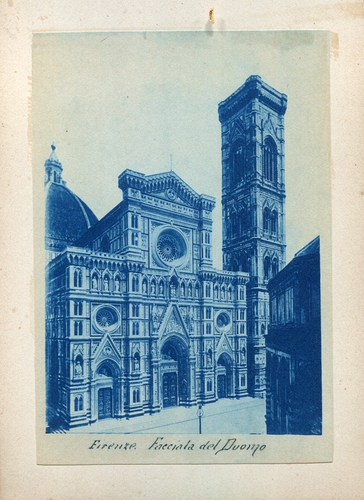
10049.24 Europe > Album of cyanotypes of Florence, Italy (1880s or later)
Cyanotypes are rarely found in Italy. Cyanotype views are even rarer, while twelve topographical cyanotypes in a studio album format are virtually unknown, at least in my experience as a collector. Unfortunately, the studio which produced these images is not indicated, though the maker would appear to be a professional photographer who had worked in Florence. He used more than one lens, and he had access to privileged viewpoints, which would not have been available to amateurs or visiting foreigners. The subjects reflect the typical itinerary of the ‘grand tour’ souvenir album of the city, and they were probably derived from glass plates made at an earlier date, probably the early 1880s. The positioning of the camera and the absence of shadows suggests that each view was taken at the most appropriate time of the day, i.e., they are the result of a sustained and costly effort to capture the moment when each subject could be photographed to its best advantage. If albums such as this were intended as a commercial enterprise, however, we can reasonably conclude that the attempt was not a commercial success.
Michael G. Jacob
Spoleto, Italy Stereotypes 10049.25 Europe > Stereotypical portraits in nineteenth century Italy
When portraits for tourists were taken in nineteenth century Italy local photographers such as Giorgio Sommer, Carlo Naya and Giacomo Brogi all took stereotypes of people being robbed while having their shoes cleaned and eating pasta in a dramatic manner. These photographs were often staged and some were taken inside photographic studios. Futurism 10049.26 Europe > Futurism
10049.27 Europe > Anton Giulio Bragaglia (1890-1960) and Arturo Bragaglia (1893-1962) About this photographer | Photographs by this photographer
Anton Giulio Bragaglia (1890-1960) and his brother Arturo Bragaglia (1893-1962) began in 1911 to take photographs against a black background that were intended to capture continuous movement. This was consciously the opposite of the objective and scientific approaches of Etienne Jules Marey and Eadweard Muybridge and was an attempt to capture the fluid and continuous dynamic flow of movement - hence the Italian name Fotodinamismo ('photodynamism'). A few years later the brothers came into contact with the Italian Futurist painters (Giacomo Balla, Boccioni and Russolo) who were experimenting with how to represent movement in painting at the same time. Anton Giulio Bragaglia published Fotodinamismo Futurista in 1913 and it was a plea to capturing the dynamism of movement rather than a single moment - whilst a fascinating argument it was difficult to capture in a painting that requires form. Having said this it is worth examining Giacomo Balla's 1912 painting Dynamism of a Dog on a Leash (also called Leash in Motion) now at the Albright-Knox Art Gallery, Buffalo, USA to see the same concept expertly carried out. Second World War (1939-1945) 10049.28 Europe > Margaret Bourke-White: Purple Heart Valley About this photographer | Photographs by this photographer
Contemporary colour 10049.29 Europe > Joel Meyerowitz: Tuscany About this photographer | Photographs by this photographer
alan@luminous-lint.com |
General reading 1988, Italy: One Hundred Years of Photography, (Florence: Alinari) [Texts by Cesare Colombo and Susan Sontag] [Δ] Becchetti, P., 1978, Fotografi e Fotografia In Italia 1839-1880, (Rome: Edizioni Quasar) [Δ] Becchetti, Pietro, 1983, La fotografia a Roma dale origini al 1915, (Editore Colombo) [1st edition] [Δ] Bonetti, Maria Francesca & Maffioli, Monica, 2003, L'Italia d'Argento 1839/1859: Storia del dagherrotipo in Italia, (Fratelli Alinari spa) isbn-10: 8872924405 isbn-13: 978-8872924402 [Δ] Bouqueret, C. & Livi, F., 1989, Le Voyage En Italie. Les Photographes Français En Italie 1840-1920, (Lyon: La Manufacture) [Δ] Cartier-Bresson, Anne & Margiotta, Anita et al., 2004, Rome 1850, Le cercle des artistes photographes du Caffè Greco, (Paris: Maison Européenne de la Photographie) [Δ] Constantini, P. & Zannier, I., 1986, Itinerario Fiorentino, (Florence: Alinari) [Δ] Dewitz, B.V.; Siegert, D. & Schuller-Procopovici, K., 1994, Italien Sehen Und Sterben. Photographien Der Zeit Des Risorgimento (1845-1870), (Köln: Braus) [Δ] Fanelli, G., 2001, L’anima dei luoghi. La Toscana nella fotografia stereoscopica, (Firenze: Mandragora) [Δ] Helsted, D.; Pers, H.; Pietrangeli, C. & Becchetti, P., 1977, Rome in Early Photographs: The Age of Pius IX. Photographs 1846-1878 from Roman and Danish Collections, (Copenhagen: The Thorvaldsen Musuem) [Δ] Lundberg, W. Bruce & Pinto, John A. (eds.), 2008, Steps Off the Beaten Path: Nineteenth-Century Photographs of Rome and Its Environs / Sentieri smarriti e ritrovati: Roma e dintorni nelle fotografie del secondo Ottocento, (Charta/American Academy in Rome) isbn-10: 8881586673 isbn-13: 978-8881586677 [English / Italian] [Δ] Lundberg, W.B. & Pinto, J.A., 2007, Steps off the Beaten Path. Nineteenth-Century Photographs of Rome and its Environs. Images from the Collection of Delaney and W. Bruce Lundberg, (Milan: Charta) [Δ] Lyons, Claire et al., 2005, Antiquity and Photography: Early Views of Ancient Mediterranean Sites, (Los Angeles: J. Paul Getty Museum) [Δ] Maffioli, M., Marchioni, S. & Marchioni, N. (eds.), 2008, I Macchiaioli e la fotografia, (Florence: Alinari) isbn-13: 978-8895849041 [Exhibition catalogue] [Δ] Paoli, Silvia (ed.), 2010, Lo sguardo della Fotografia sulla città ottocentesca: Milano 1839-1899, (Torino [Turin]: Umberto Allemandi & C.) isbn-10: 8842218952 isbn-13: 978-8842218951 [Italian] [Δ] Pelizzari, Maria Antonella, 2011, Photography and Italy, (London: Reaktion) [Δ] Pohlmann, U.; Bolloch, J.; Heilbrun, F.; Jacobson, K.; Maffioli, M.; Miraglia, M.; Ritter, D.; Saunier, P. & Zimmerman, M.F., 2009, Voir l'Italie et Mourir, (Paris: Musée d'Orsay & Skira Flammarion) [Δ] Russo, Antonella, 2011, Storia culturale fotografia. Dal neorealismo al postmoderno, (Einaudi) isbn-10: 8806203177 isbn-13: 978-8806203177 [Δ] Saunier, Philippe, Heilbrun, Françoise, Pohlmann, Ulrich, Ritter, Dorothea, Maffioli, Monica, Zimmermann,Michaël F. & Bolloch, Joëlle, 2009, Voir l'Italie et mourir. Photographie et peinture dans l'Italie du XIXe siècle, (Paris: musée d'Orsay / Skira-Flammarion) isbn-13: 978-2081224254 [Exhibition catalogue] [Δ] Vigano, Enrika, 2007, Neorealismo: New Photography in Italy 1932-1960, (Christoph Merian Verlag) isbn-10: 385616331X isbn-13: 978-3856163310 [Exhibition at Winterthur Photo Museum] [Δ] Zannier, Italo, 1987, Neorealismo E Fotografia: Il Gruppo Friulano Nuova Fotografia 1955-1965, (Art& Srl - Udine) isbn-10: 8885893015 isbn-13: 978-8885893016 [Δ] Zotti, Arlo Alberto Minici, 2003, Il Fascino Discreto della Stereoscopia: Venezia e altre suggestive immagini in 3D - Subtle Charm of Stereoscopy: Venice and other impressive views, (Padova: Grafiche Turato) [Introduction by Italo Zannier] [Δ] Readings on, or by, individual photographers Alinari Alinari [firm], 1985, Gli Alinari fotografi a Firenze, 1852-1920, (Fratelli Alinari spa) isbn-10: 8872920787 isbn-13: 978-8872920787 [Δ] Quintavalle, Arturo Carlo, 2003, Gli Alinari, (Fratelli Alinari spa) isbn-10: 8872924375 isbn-13: 978-8872924372 [Δ] Quintavalle, Arturo Carlo & Maffioli, Monica, 2003, Fratelli Alinari, fotografi in Firenze:
150 anni che illustrarono il mondo, 1852-2002, (Fratelli Alinari spa) isbn-10: 887292426X isbn-13: 978-8872924266 [Δ] Zevi, Filippo, 1978, Alinari: Photographers of Florence, 1852–1920, (Florence and London: Idea Editions and Alinari Edizioni in association with the Scottish Arts Council) [Δ] Giuseppe Alinari Zevi, Filippo, 1978, Alinari: Photographers of Florence, 1852–1920, (Florence and London: Idea Editions and Alinari Edizioni in association with the Scottish Arts Council) [Δ] Leopoldo Alinari Zevi, Filippo, 1978, Alinari: Photographers of Florence, 1852–1920, (Florence and London: Idea Editions and Alinari Edizioni in association with the Scottish Arts Council) [Δ] Romualdo Alinari Zevi, Filippo, 1978, Alinari: Photographers of Florence, 1852–1920, (Florence and London: Idea Editions and Alinari Edizioni in association with the Scottish Arts Council) [Δ] James Anderson Ritter, Dorothea & Siegert, Dietmar, 2005, Rome 1846-1870 James Anderson und die Maler-Fotografen: Sammlung Siegert, (Edition Braus) [Catalog of an exhibition held at Neue Pinakothek, Munich, May 4-Sept. 11, 2005.] [Δ] Alphonse Bernoud Fanelli, G., 2011, Alphonse Bernoud (1820-1889). Firenze, Napoli, Livorno, (Paris: Private edition) [Δ] Margaret Bourke-White Bourke-White, Margaret, 1944, They called it "Purple Heart Valley": A Combat Chronicle of the War in Italy, (New York: Simon and Schuster) [Δ] Giacomo Caneva 1852, 1 May, ‘Photography in Rome‘, Art-Journal, pp.159-60 [Δ] Édouard Delessert Delessert, Édouard, 1854, Ile de Sardaigne: Cagliari et Sassari, 40 Vues Photographiques, (Goupil) [Δ] Comte Frédéric Flachéron 1852, 1 May, ‘Photography in Rome‘, Art-Journal, pp.159-60 [Δ] Mario Giacomelli Crawford, A., 2006, Mario Giacomelli, (New York: Phaidon Press) [Δ] Albert Augustus Isaacs Isaacs, Albert Augustus, 1900, The Fountain of Siena: An Episode in the Life of John Ruskin, L.L.D., (London: S. W. Partridge) [Description of the photography of Albert Augustus Isaacs] [Δ] Edward Kater Kater, Edward, 1852, 6 November, ‘Proof of the Value of Photography to the Archaeologist‘, Notes and Queries, pp.443 [Δ] William Klein Klein, William, 1958-1959, Rome: The City and its People, (The Viking Press) [Also published by Seuil, Paris (1959) and Feltrinelli, Milan (1960). Republished by Aperture (2009) with texts by Alberto Moravia, Pier Paolo Pasolini, Ennio Flaiano, Federico Fellini.] [Δ] Robert Macpherson Becchetti, Pietro & Pietrangeli, Carlo, 1987, Robert Macpherson: Un inglese fotografo a Roma, (Rome: Quasar Editions) [Δ] Crawford, Alistair, 1999, ‘Robert Macpherson 1814-72, The Foremost Photographer of Rome‘, Papers of the British School at Rome, vol.67, pp.353-403 [Δ] Crawford, Alistair, 2008, ‘Robert Macpherson 1814-1872: The Final Proof‘, in Jubilee - 30 Years ESHPh; Congress of Photography in Vienna [Δ] Macpherson, Robert, 1863, Vatican Sculptures, Selected and Arranged in the Order in which they are Found in the Galleries, (London: Chapman & Hall) [Δ] McKenzie, Ray, 1996, Spring, ‘Scottish Photographers in Nineteenth-century Italy. Robert Macpherson and his Contemporaries‘, History of Photography, vol.20, pp.33-40 [Δ] Munsterburg, Marjorie, 1986, March, ‘A Biographical Sketch of Robert Macpherson‘, The Art Bulletin, vol.68, no.1, pp.142-153 [Δ] Wooters, David, 1996, Spring, ‘The Quiet Art of Robert Macpherson: An Explication‘, History of Photography, vol.20, pp.2-3 [Δ] Joel Meyerowitz Meyerowitz, Joel, 2003, Tuscany: Inside the Light, (Boston: Bulfinch Press) [Text by M. Barrett] [Δ] Carlo Naya Zannier, Italo & Moravia, Alberto (foreword), 1981, Venice, The Naya Collection, (Venice: O. Bohm) [Δ] Alfredo Noack Marcenaro, Giuseppe, 1989, Alfred Noack inventore della Riviera, (Genova) [Δ] Papone, Elisabetta, 1999, ‘Il mare di vetro. Genova e le Riviere tra veduta e documentazione nell’archivio di Alfred Noack‘, in Ginex, G. & Rebora, S. (eds.), Scoperta del mare. Pittori lombardi in Liguria tra ‘800 e ‘900 [Δ] Papone, Elisabetta, 2004, ‘Un archivio di immagini per Genova. Le fotografie di Alfred ed Ernesto Noack‘, in Genova e l’Europa continentale [Δ] Papone, Elisabetta (ed.), 2000, A. Noack. Il poeta della luce. La riviera spezzina attraverso le immagini di un fotografo tedesco dell'Ottocento, (Pisa: Pacini) [Δ] John Henry Parker Holliday, Peter J., 1991, The Fascination with the Past: John Henry Parker's Photographs of Rome., (San Bernardino, CA California State University) isbn-10: 0945486057 [Δ] Giovanni Brampton Philpot Tamassia, Marilena (ed.), 2002, Firenza ottocentesca nelle fotografie di J. B. Philpot, (Florence: Sillabe Edizione) [Δ] Eugene Piot Piot, Eugène, 1853, L'Italie monumentale, (Chez l'auteur) [Δ] John Ruskin Isaacs, Albert Augustus, 1900, The Fountain of Siena: An Episode in the Life of John Ruskin, L.L.D., (London: S. W. Partridge) [Description of the photography of Albert Augustus Isaacs] [Δ] William J. Stillman Stillman, William James, 1876, Poetic Localities: Photographs of Adirondacks, Cambridge, Crete, Italy, Athens, (Boston: J.R. Osgood and Company) isbn-10: 0893813168 isbn-13: 978-0893813161 [Reprinted by Aperture, in association with the International Center of Photography, 1988] [Δ] Paul Strand Strand, Paul & Zavattini, 1997, Un paese: Portrait of an Italian village, (New York: Aperture) isbn-10: 0893817007 isbn-13: 978-0893817008 [Δ] Richard W. Thomas 1852, 1 May, ‘Photography in Rome‘, Art-Journal, pp.159-60 [Δ] Enrico Van Lint Fanelli, G., 2004, L’immagine di Pisa nell’opera di Enrico Van Lint pioniere della fotografia, (Firenze: Pagliai Polistampa) [Δ] If you feel this list is missing a significant book or article please let me know - Alan - alan@luminous-lint.com Alinari • Giuseppe Alinari (1836-1890) • Leopoldo Alinari (1832-1865) • Romualdo Alinari (1830-1891) • Gioacchino Altobelli (check) • Altobelli & Molins • Domenico Anderson (1854-1938) • James Anderson (1813-1877) • Alfred Backhouse (1823-1888) • G.K. Ballance • Olivo Barbieri (1954-) • Letizia Battaglia (1935-) • Gustave de Beaucorps (1825-1908) • Edmond Behles (1841-1921) • Alphonse Bernoud (1820-1889) • Pompeo Bondini (check) • Antonio Giulio Bragaglia (check) • Domenico Bresolin (check) • Giacomo Brogi (1822-1881) • Giacomo Caneva (1813-1865) • Mario Carrieri • Mario Castagneri (1892-1940) • G.E. Chauffourier (1845-1919) • Eugène Constant (check) • Giovanni Crupi (check) • Tommaso Cuccioni (check) • Louis-Alphonse Davanne (1824-1912) • A. de Bonis • Édouard Delessert (1828-1898) • Fortunato Depero (1892-1960) • Cesare Di Liborio (1960-) • P. Dovizielli (1804-1885) • James Dunlop (1830-1858) • Alexander John Ellis (1814-1890) • Giovanni Ferretto (1853-1921) • Giuseppe Ferretto (1826-1873) • Luigi Ghirri (1943-1992) • Mario Giacomelli (1925-2000) • Luca Gilli • John Gossage (1946-) • Domenico Riccardo Peretti Griva (1882-1962) • Anton Hautmann (1821-1862) • Henry Holden (1814-1909) • Guiseppe Incorpora (1834-1914) • Edward Kater (1816-1866) • Charles George Hood Kinnear (1832-1894) • Stefano Lecchi (check) • Herbert List (1903-1975) • Peter Paul Mackey (1851-1935) • James Calder Macphail (1821-1908) • Robert Macpherson (check) • Michel Mang • Filippo Masoero • Ledru Mauro • Macedonio Melloni (1801-1854) • Joel Meyerowitz (1938-) • Pompeo Molins (1827-1893) • Paolo Monti (1908-1982) • Achille Morelli • Ugo Mulas (1928-1973) • Bruno Munari (1907-1998) • Carlo Naya (1816-1882) • Guiseppe Ninci (1823-1890) • Alfredo Noack (1833-1895) • Alfred-Nicolas Normand (1822-1909) • Ferdinando Ongania (1842-1911) • John Henry Parker • Alessandro Pavia (1824-1889) • Enrico Pedrotti • Antonio Perini (1830-1879) • Giovanni Brampton Philpot (1812-1878) • Eugene Piot (1812-1891) • Carlo Ponti (check) • Paulo Ignazio Pietro Porro (1801-1875) • Count Giuseppe Primoli (1851-1927) • Guido Rey (1861-1935) • Robert Rive (check) • John Ruskin (1819-1900) • Marialba Russo (1947-) • P Salviati • Eugène Sevaistre (1817-1897) • Carlo Baldassare Simelli (1811-1877) • John Shaw Smith (1811-1873) • Giorgio Sommer (1834-1914) • Antonio Sorgato (1825-1885) • Jane Martha St. John (1803-1882) • Stefano Stampa (1819-1907) • Susan Hacker Stang • Bruno Stefani (1901-1980) • George D. Stevenson • William J. Stillman (1828-1901) • Paul Strand (1890-1976) • Lorenzo Suscipj (1802-1885) • Thomas Sutton (check) • Arturo Tagliaferro • Cesare Tardivo (1870-1953) • Tato (1896-1974) • Richard W. Thomas • Enrico Van Lint (1808-1884) • Luigi Veronesi (1908-1998) • Wilhelm von Gloeden (1856-1931) • Henry Stuart Wortley (1832-1890) • Wanda Wulz (1903-1984) | Home > Geographical regions > Europe > Italy
|