Contents
| This theme includes example sections and will be revised and added to as we proceed. Suggestions for additions, improvements and the correction of factual errors are always appreciated. | Instruction manuals 10048.01 Europe > Daguerreotype manuals and instructions: France About this photographer | Photographs by this photographer
Daguerreotypes 10048.02 Europe > Daguerreotypes: Paris
10048.03 Europe > Floods in Nantes, France (1843)
The identity of the photographer who took this whole plate daguerreotype of the floods at Nantes on the Loire River in France is unknown. However Charles Isaacs, a New York photography dealer, has stated that it was undoubtedly done by the same photographer who has a series of engravings published in La Loire Infériure, Vues de Nantes et de ses Environs (Nantes: Jules Forest, 1842). 10048.04 Europe > Daguerreotypes: Paris: Notre-Dame
Publications 10048.05 Europe > France: Photography magazines and journals Le Daguerreotype, revue de la photographie (1847)
La Lumière (1851-1867)
Bulletin de la Société Française de Photographie (1855-) Landscape 10048.06 Europe > Early French landscape photographers
During the nineteenth century a group of French painters including Georges Michel, Theodore Rousseau, Jean-Francois Millet, and Camille Corot sought their inspiration by going to the landscape and painting what they saw. Collectively they are known as the Barbizon school of painting named after a village in northern France.
The links between the painters and French landscape photography in the middle of the century are numerous. André Giroux (1801-1879) for example was a talented painter as well as a master photographer and the photographs by Gustave Le Gray (1820-1884) of the Forests of Fontainebleau were used as templates for paintings. 10048.07 Europe > Reasons for French pre-eminence in nineteenth century landscape photography
Towards the middle of the nineteenth century three factors came together that made France preeminent in early landscape photography - early technological availability, the artistic perception of landscape painting at the time photography was announced and the talent of the people who took up photography. Within painting there had been a move to paint outdoors and to paint what was there rather than imagined within the studio and this flourished with the Barbizon artists who frequented the Fontainebleau forest near Paris. When photography was announced in 1839 it was a tool that matched their aesthetic needs by recording exactly what was seen.
If we look at the photographs of André Giroux (1801-1879) all three factors can be seen working together. André Giroux was the son of Alphonse Giroux who made the first commercial Daguerreotype cameras. He was also a talented landscape artist who won the prestigious "Rome Prize for Historical Landscape" ("Prix de Rome en Paysage Historique") and had painted in Italy in the 1820s at the same time as Camille Corot (1796-1875). With a father who knew how to make cameras and understood photography, a highly refined understanding of capturing the visual essentials of a landscape and artistic ability it is not surprising that his photographs, on which he retouched the glass negatives, should be so remarkable.
André Giroux was not alone in creating outstanding photographs that capture the balance of the landscape with the eyes of a painter. Within the works of Gustave Le Gray, Henri Le Secq who studied with the painter Delacroix, Charles Marville, Louis-Rémy Robert, Camille Silvy and others there are photographs that pull one in to share the experience of the moment. 10048.08 Europe > Eugène Cuvelier: France: Forest of Fontainebleau About this photographer | Photographs by this photographer
The close connection between artists and photographers is demonstrated by Eugène Cuvelier who was a friend of the painter Camille Corot and who was acquainted with the Barbizon painters. To emphasize the connection one of the photographs shown here was taken in Barbizon.
Further reading:
Cuvelier, Eugene et al., 1997, Eugene Cuvelier: Legend of the Forest, (Cantz) [ISBN: 3893228578]
[Thanks to Nadia Valla for bringing this to my attention.] 10048.09 Europe > Camille de Silvy - River Scene (1858) About this photographer | Photographs by this photographer
The best landscape photographs go beyond the arrangements and proportions of land, water and sky and take the viewer into the realms of memory and emotion.
Here we see the Huisne river near the birthplace of Camille Silvy as he saw it in 1858 with the bands of clouds, wooden rural buildings and brick walls scattered on the left bank with column-like trees cutting vertical lines into the sky - a boat with a man sitting in it and a woman standing close by. On the right there is the meadow with some people on the grass. We can see the details of the picture but it represents far more than that - it has within it a harmony of elements that we feel comfortable with. We can all wish that we had been on the bridge that day with him and we yearn for past that has gone but are glad that he has shared a moment of Arcadian tranquility with us.
All is not as simple as it seems in this Arcadia; the print is a complex combination print that merges different images to create the harmonious whole. In the book on this image by Mark Haworth-Booth he argues the intriguing point that it is proto-impressionist - bringing together the edge of a town where it melds into a rural setting and at the same time mixes the social levels of the society with the country bourgeoisie and the working class.
In 1990 one of the leading exponents of color photography, Stephen Shore, was commissioned by the J. Paul Getty Museum to re-photograph the location and he obtained a very different image. You get a record shot of a place as it is but with none of the emotion. It is not that Stephen Shore is not a great photographer, he is, but his approach and sensibilities to landscape photography are totally different.
[Thanks to Mark Haworth-Booth for his insights on this.] 10048.10 Europe > Bisson frères: Mt. Blanc (1860s) About this photographer | Photographs by this photographer
Scientific Intelligence: A Photographic Ascent of Mont Blanc, The London Review, No.60, Vol.III, August 24, 1861, p.236
M. Auguste Bisson, the well-known Alpine photographer, has recently put into execution a project which has occupied his thoughts for some years past. This is no less than the ascent of Mont Blanc with all the paraphernalia necessary to the obtaining large photographic views from the summit; but, in spite of the well-known energy and talent of this operator, and the experience he has gained during his many photographic excursions at lower elevations, so formidable an enterprise occasioned many of M. Bisson's friends to have serious misgivings as to the success of the attempt. He started from Chamonix with the guide, Auguste Balmat, and twenty-five porters; for in order to carry the large amount of apparatus to such an altitude it was necessary that it should be well distributed. When they reached the Petits Mulets they encountered a terrible storm of wind, accompanied with avalanches falling on every side, whioh compelled the party to beat a retreat to the Grands Mulets. Arriving there, some of the bearers were too ill to proceed, and had to be sent back, while the party waited until seven hardier porters could be sent up to them from below. Upon these arriving the ascent was recommenced, and at length the summit was reached. There, almost all the party were so overcome by sleep or exhausted by fatigue and suffering as to be unable to move, leaving Balmat and Bisson, whose photographic ardour sustained his strength, the only ones capable of thinking of the reproduction of that magnificent panorama which lay stretched out beneath them. The photographer and his brave companion set up the tent and arranged the materials, but when they attempted to melt the snow in order to supply themselves with water, the fuel which they had brought with them for this purpose refused to light on account of the rarity of the atmosphere. In spite of all these difficulties three pictures were obtained, of which two are said to be very satisfactory. The time occupied on the summit of the mountain did not exceed two hours and a half.
Documentary projects 10048.11 Europe > Mission Héliographique
Mission Héliographiques was a project initiated by writer Prosper Mérimée in 1851 to document with photography the state of architecturally significant monuments in France so they could be preserved and restored. The photographers were Édouard Baldus, Hippolyte Bayard, Gustave Le Gray, Henri Le Secq and Auguste Mestral. On occasion Le Gray & Mestral travelled and worked together and it is unclear which one took the photographers or if they were taken together. Henri Courmont (1813-1855) was a commissioner for Mission Héliographiques but did not contribute photographs.
The photographers normally worked independently with the exception of Le Gray & Mestral who on occassion both signed the same photograph. The regions surrounding Paris were assigned to the photographers:
North and east (Including the cathedrals of Reims, Laon, Troyes, and Strasbourg) - Henri Le Secq
South and east (Palace of Fontainebleau, Lyon and the Roman in Orange, Nîmes and Arles) - Édouard Baldus
Southwest (The Loire chateaux of Blois, Chambord, Amboise, and Chenonceaux and the towns of Carcassonne, Albi, Perpignan, Le Puy and Clermont-Ferrand - Le Gray & Mestral consisting of Gustave Le Gray and Auguste Mestral
West (Brittany and Normandy including the towns of Caen, Bayeux, and Rouen) - Henri Le Secq
Prints from the 258 photographs they made are exceedingly rare as they were locked away and not published after they were delivered in the fall of 1851. Of the group works by Gustave Le Gray and Auguste Mestral are more common and this might indicate that they had a second set of negatives but this is not certain. 10048.12 Europe > Charles Nègre: Vincennes Imperial Asylum (1859) About this photographer | Photographs by this photographer
The following contemporary account was published on the "Imperial Asylum at Vincennes for Convalescent Workman" The Medical News and Library, Vol.XVIII, December, 1860, No. 216, p.184-185
Imperial Asylum at Vincennes for Convalescent Workman. - The Moniteur Universal of the 9th of July contains an interesting account of the convalescent hospital, established by the Emperor of the French, in the neighbourhood of Paris, from which we extract the following particulars: —
The Asylum of Vincennes was founded by a decree of the 8th March, 1855, for the temporary reception, during their convalescence, of workmen who had received injuries or contracted diseases. The building having been finished, and the internal arrangements completed, the inauguration of the Imperial Asylum took place on the 31st of August, 1857. It has now been in operation for nearly three years.
Nearly forty acres of forest, belonging to the domains of the Crown, were consecrated to the Asylum, which is built upon an elevated terrace, freely exposed to the air from all quarters. Since the opening of the institution, up to the end of June 1860 (comprehending a period of two years and ten months), the number of convalescents admitted has amounted to 14,000. These convalescents belong to the following categories: 1st. Convalescents sent from the hospitals of Paris and the suburbs; 2d. Convalescents sent by the local charitable institutions of the city; 3. Convalescents from injuries received in the public works; 4th. Members of societies of workmen established for their mutual assistance; 5th. Workmen belonging to establishments, the directors of which have obtained from the Minister of the Interior authorization to send, on payment of a subscription, their convalescents to the Asylum, such as the railroads, gasworks, and some large private establishments; 6th. Workmen who have been treated at their own homes, and who have received from their medical attendant certificate of convalescence.
It is by the express orders of the Emperor that the Asylum is now open, without distinction, to every convalescent workman. There are at present 411 beds.
Two elegant vehicles are attached to the institution, and bear the imperial arms. One of these is of the same size as an ordinary omnibus, the other is somewhat smaller. Every day one or other of these vehicles, according to the number requiring removal, goes to the various hospitals to pick up the convalescents, and even goes to the residences of those who have been treated at their own homes. The same vehicles convey the inmates back to Paris when they leave the Asylum. The first time that the large omnibus stopped in front of the Hotel-Dieu a crowd of spectators speedily assembled; people asked one an other what could be the meaning of this elegant vehicle with the imperial arms in such a locality; but when the spectators saw the poor convalescents, weakened by disease, come out of the hospital and get into the omnibus, and when it was known that they were about to be conveyed to the Imperial Asylum, they broke out into hearty applause. How, in fact, could they help being affected on seeing the paternal cares of the Emperor lavished indiscriminately on all the workmen, on all the laborious classes?
The mean term of residence in the Asylum is 22 days. Thanks to the hygienic resources of the institution, the period of convalescence from fevers is comparatively short. The principle of the Asylum is that every convalescent shall remain in the Asylum until he is completely restored to health, or until his disease has been recognized as incurable.
Diet of the Institution. — The diet is regulated by the director, and by the superintending medical officer of the establishment. Care has been taken to fix the hours of the different meals, in conformity with the usual habits of the working classes. At half past seven in the morning the inmates get a bowl of soup. Breakfast is at half past ten, and consists of stewed meat and vegetables. Five o'clock is the dinner hour: this meal consists of soup, roast meat, and vegetables. Each convalescent receives daily about a pint of wine, and as much bread of the first quality as he desires. On the average, each inmate consumes daily about a pound and a half of bread. If necessary, a special dietary is prescribed in particular cases. The sum allotted for the food of each inmate is tenpence-halfpenny a day, not comprehending the general expenses of the establishment.
If the convalescents desire it, and if their strength permits, they are employed in various capacities about the establishment, under the direction of the gardener, the smith, the carpenter, etc. In this case, they receive a small sum of money and half a pint of wine in addition to the regular allowance Those of the inmates who do not work have various amusements provided for them, such as bowls, skittles, dominoes, etc.; cards are prohibited.
The library is open daily, and contains 4000 volumes, and illustrated newspapers. Most of the volumes have been presented by the booksellers of Paris. In general, about 50 readers may be found in the library at a time; on one occasion 96 were counted.
The conduct of all in the Asylum is exemplary. They submit without a word to the rules of the institution, are courteous to one another, take care of the furniture of the establishment and of the flowers in the garden, and keep their dormitories in a state of perfect cleanliness. Although not required, the majority of the inmates attend chapel on Sunday.
The staff of the establishment consists of a director, a treasurer, a medical superintendent, with three resident pupils; six Sisters of the Order of the Ladies of St. Augustine of Belgium ; a secretary and five clerks ; a storekeeper; four overseers; and at least forty persons in subordinate positions, such as cooks, grooms, gardeners, etc.
An infirmary is connected with the Asylum. During the year 185S, 1859, nearly 1100 patients, presenting various affections more or less severe, have been under treatment ; during this time only 30 deaths occurred.
The anticipated expenses for the present year are between fourteen and fifteen thousand pounds.— Ed. Med. Journ. , Sept. 1860.
10048.13 Europe > Édouard Baldus: Inondations du Rhône à Lyon et Avignon (1856) About this photographer | Photographs by this photographer
10048.14 Europe > Édouard Baldus: Chemins de fer de Paris à Lyon et à la Méditerranée (1860s) About this photographer | Photographs by this photographer
10048.15 Europe > Louis-Emile Durandelle: The Paris Opera (1861-1875) About this photographer | Photographs by this photographer
The construction of the new Opera House in Paris in the nineteenth century was a statement in quarried stone of civic and national pride. On 29 December 1860 a resolution was passed that commenced a competition for suitable designs and plans. The unanimously chosen winner was Charles Garnier and by July 1861 the site had been selected and the following month the excavation of the foundations commenced. This was far from an ideal time for new public works with both the Franco-Prussian War and the following dark times of the Paris Commune coinciding with the construction. Despite this Garnier completed the project by December 1874 and in January 1875 it opened:
The opening of the New Opera House at Paris took place on Tuesday last. The Government had engaged the entire house for the opening night, which was, therefore, a state festivity, to which the diplomatic corps, the deputies, &c, were invited. The regular performances were to commence last evening with Hamlet.
The Academy, Issue 7, Jan 9, 1875, p.51
This vast undertaking was described in a contemporary account as follows:
The historian of the new temple of song rounds off his record with an array of not uninteresting figures, and with a few of these I too shall close. The gas-pipes, if connected, would form a pipe twenty-five kilometres in length; fourteen furnaces and four hundred and fifty grates heat the house; a battery of seventy cups generates electricity for the scenic effects; nine reservoirs and two tanks hold a hundred thousand litres of water, and distribute their contents through six thousand nine hundred and eighteen metres of piping, and there are twenty-five hundred and thirty-one doors, and seven thousand five hundred and ninety-three keys, which latter M. Gamier delivered formally, but figuratively, I imagine, to M. Halanzier when the manager took possession of the premises.
Frederick A. Schwab, "A Temple of Song", Scribners Monthly, May, 1875, Volume X, No.1, p.20
During the process Louis-Emile Durandelle photographed both the construction and the ornamental sculptures that decorated the immense building. His photographs were published in Le Nouvel Opera de Paris par Charles Garnier, (Paris: Ducher et Cie, 1875-81), and in Charles Nuitter, Le Nouvel Opera (Paris: Libraire Hachette et Cie, 1875) and remain as one of the key documentations of a nineteenth century architectural project. Durandelle recorded many other key projects in Paris including the construction of Sacre Coeur, the Hotel de Ville, and the Eiffel Tower. 10048.16 Europe > Les Travaux Publics de la France (1878-1882)
In the middle of the nineteenth century a large number of public works were being constructed in France for the benefit of society. The bridges, roads, canals, port improvements, lighthouses and beacons were under the direction of the Ministère des Travaux Publics and photographs were shown at the Universal Exhibition in Vienna (1873). It was decided to create a publication of the photographs and this was organised by James de Rothschild and additional photographs were added. The photographs taken show the marvels of the construction and to emphasise the grandeur they are almost totally devoid of people. The finest regional photographers from France were involved in the undertaking and it stands as one of the great documentary studies but it is little known outside France.
The work was published in five parts:
Volume I: Félix Lukas - Ponts et routes (Paris: J. Rothschild, 1878-1882) [Bridges and roads]
Volume II: Edourd-Charles-Romain Collignon - Chemins de fer (Paris: J. Rothschild, 1878-1882) [Railways]
Volume III: H. de Lagrene - Rivières et canaux (Paris: J. Rothschild, 1878-1882) [Rivers and canals]
Volume IV: Voisin-Bey - Ports de mer (Paris: J. Rothschild, 1878-1882) [Sea ports]
Volume V: Emile Allard - Phares et balises (Paris: J. Rothschild, 1878-1882) [Lighthouses and beacons]
This publication included many of the best regional photographers working in France from the middle of the 19th century including:
10048.17 Europe > Richebourg: Carte geologique detaillee de la France, Feuille 48.- Paris (1879)
Photographs from the Carte géologique détaillée de la France (1879) Portraits 10048.18 Europe > Nadar: Galerie Contemporaine About this photographer | Photographs by this photographer
Souvenirs 10048.19 Europe > Souvenir sets of travel photographs
Pictorialism in France 10048.20 Europe > Pictorialism in France In 1894 The Photo-Club of Paris (le Photo Club de Paris) with Constant Puyo, Robert Demachy, René Le Begue, Hachette and De Singly held its first exhibition in 1894 Première exposition d'art photographique but its roots went back to 1890. The club published the Bulletin du photo-club de Paris with its Art Nouveau stylistic designs. Robert Demachy (1859-1937) in Paris popularized the pictorialist style through the 1890s. 10048.21 Europe > The Photo Club of Paris (Le Photo Club de Paris)
Illustrated magazines 10048.22 Europe > Illustrated magazines in France
The dominant style of photography in French magazines up to the mid-1920's was pictorialism and because of this photomontages and collages were uncommon. Photographic magazines were common if rather traditional with titles such as Violà, Match (1926-) but with major changes in 1938 brought about by Jean Prouvost, Regards, Marianne and Vu (1928-1938) which was founded by Lucien Vogel. There were also cultural magazines of a far smaller distribution such as Verve and Minotaure (1933-1939) that were more adventurous in the photographers they selected: images by surrealist artists were included such as Salvadore Dali, Hans Bellmer, Man Ray, Brassaï, Raoul Ubac and Manuel Álvarez Bravo. 10048.23 Europe > VU
Street photography 10048.24 Europe > The humanism of street photography in France
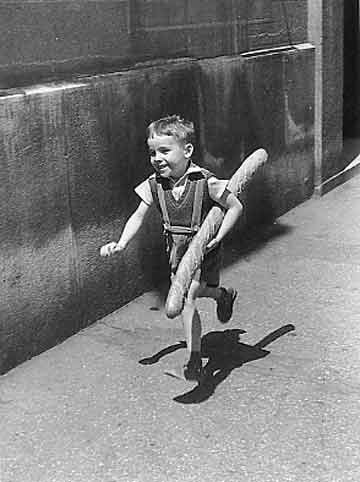
Different countries have artistic styles that reflect national sensitivities and France has had a remarkable group of photographers who have recorded life with humanity and humor - just looking at the photographs one is sucked into other people's lives. Robert Doisneau, Henri Cartier-Bresson and Jacques-Henri Lartique have shown all strata of society but they are not the portraits of alienated people passed in the street as Garry Winogrand would take them - here the photographer captures the rich small intimate moments of people's lives. Photographers such as Brassaï (Translyvanian born) and André Kertész (Hungarian) who adopted France for periods of their lives also reflected this approach. 10048.25 Europe > Henri Cartier-Bresson: The Decisive Moment About this photographer | Photographs by this photographer
These photographers roamed the streets looking for a single moment that would sum up the entireity of an event, emotion or person. Henri Cartier-Bresson came up with the phrase 'the decisive moment' that summed up this quest:
| "Above all, I craved to seize the whole essence, in the confines of one single photograph, of some situation that was in the process of unrolling itself before my eyes.." | | Henri Cartier-Bresson |
|
The French photographers are particularly interesting as they appear to be non-judgmental and are not about changing society but rather about recording it's diversity. It is the very humanity and joy in the images that makes them so universal. 10048.26 Europe > Classic French street photography
There are so many timeless images from street photography in France that selected iconic examples is difficult but one should include:
These are timeless images reprinted in the classic histories of photography and hung as posters on the walls of students around the world. Basically they show humanity with humor and warmth. When in 1952 the book The Decisive Moment (Images a La Sauvette) came out with the photographs of Henri Cartier-Bresson it became apparent that there was a mass market for this type of photography. They were creators of a trend towards a more ironic type of photography that evolved with the optimism and freedoms of the 1950's in the USA and western Europe - this included people like John Deakin (1916-1972) in the UK, or the Swiss-born Robert Frank in his book The Americans that was based on the images he took during his 1955 Guggenheim grant. Social conflict and war 10048.27 Europe > Year of Revolutions (1848): France - Paris
In 1848 Paris was in a state of revolution and this was the period described by Victor Hugo (1802-1885) in his novel Les Miserables:
"In less than an hour twenty-seven barricades rose from the ground in the single quartier of the markets...The narrow, uneven, sinuous streets full of turns and corners, were admirably chosen; the environs of the markets in particular, a network of streets more intricate than a forest..."
Victor Hugo Les Miserables
There are surviving photographs by Hippolyte Bayard (1801-1887) of the remains of barricades in Rue Royale and two daguerreotypes by M. Thibault of those on Rue Saint-Maur-Popincourt set up during the 1848 revolution in Paris. The Thibault photograph secured it's place in history as being the first daguerrotype that was copied as an engraving and published in L'Illustration on 1 July 1848 (nos 279-280, 1er-8 juillet 1848, p. 276.) with the title La barricade de la rue Saint-Maur-Popincourt le lundi après l'attaque, d'après une planche daguerréotypée par M. Thibault. When the Thibault daguerreotypes were sold at Sotheby's in London (Thursday, 9 May 2002) they were claimed to be the first examples of photoreportage. 10048.28 Europe > Gustave Le Gray: Camp de Châlons (1857) About this photographer | Photographs by this photographer
The 1857 albumen prints by Gustave Le Gray (1820-1884) of the French troop maneuvres at Chalon in France clearly show the limitations of the equipment available with the static shots and remote shots that were characteristic of war photography until fast films and hand held cameras became available far later. In 1860 Gustave Le Gray photographed the abandoned barricades of the fighting in Palermo led by Guiseppe Garibaldi.
A contemporary account of the military maneuvers of 1857 was published in The Spectator (Oct, 9, 1857)
"L'empire c'est la paix," but in the fashion of perfect equipment for the field. France possesses at the present moment two enormous assemblies of troops—one near Lyons, one at Chalons. This double muster would appear to be dictated by two objects, and we can easily divine them. Lyons is a point from which a weight could be brought to bear either upon Spain, upon Switzerland, or upon Italy. The other camp at Chalons offers a ground upon which the empire can develop its military resources to the highest degree of perfection; it is this camp over which the Emperor presides in person, surrounded by the elite of his generals, in Marshals Pelissier, Canrobert, Magnan, and General de Grammont, with many officers of high rank. Marshal Canrobert is the permanent Commander-in-chief. The camp comprises a complete army, with its infantry, cavalry, artillery, engineers, and even commissariat. Since June it has been undergoing thorough training, even in grand manoeuvres. Speaking in laudation of the Chalons Camp, the Moniteur says, that " the most redoubtable armies at the opening of a campaign have always been those familiarized by a long stay under canvass, in time of peace, with the rough exigencies of discipline and fatigue." Napoleon the First liked to have troops trained as armies, habituated to move in organized masses, and his nephew preserves the same strategy. The prime object in rendering the army available for immediate service, has already been attained. "It may now be said," the Moniteur announces, " that the education of the troops is complete, not only in a limited sense, as applied to one branch of the service, but as applied to the whole body of troops acting together on a vast field of operations." Has this camp a further purpose, or has it not? 10048.29 Europe > Franco-Prussian War (1870-1871): Introduction
The name Franco-Prussian War commonly used in English is inaccurate as it implies that only France and Prussia was involved and this was not the case as an alliance of German states including Prussia, Baden, Bavaria and Württemberg fought together. In French the war is called the La guerre franco-allemande de 1870 (French-German War of 1870) and in German Deutsch-Französischer Krieg (German-French War), both of these names are more appropriate.
The war was the result of growing international tensions between France and a confederation of German states led by Prussia with the catalyst being the possibility of a member of Prussia's Hohenzollern royal family being in line for the Spanish throne. Although after an ultimatum from France Prussia withdrew the candidacy it was forced into a humiliating series of demands that King Wilhelm could not agree to and this led to military conflict.
The French forces did not mobilize quickly enough and the German armies surrounded Strasbourg and on 15 August 1870 started a siege that lasted fifty days. The city was devastated by the bombardment and albumen prints of the ruins were made by:
- Charles Winter
- Firms: Baudelaire, Saglio & Peter
- Firms: Saglio & Peter
By the 17 December 1870 the German forces had surrounded Paris and a siege continued through the winter until the armistice of 28 January 1871 and Paris capitulated the following day. The siege of Paris is notable for the use of the pigeon post and delivery of mail by balloons in which photographed documents were regularly sent.
In the treaty that ended the war France ceded the lands of Alsace and Lorraine to Germany and this became one of the issues that provoked the First World War (1914-1918). The Franco-Prussian War also led to the unification of the German Empire on 18 January 1871 at the Palace of Versailles and that was to have significant impact upon subsequent European history. Within Paris the church of Sacre Coeur in Montmartre was built originally by subscription and later with government funding to commemorate the Franco-Prussian War.
Very few photographs survive of the battlefields - most are albums of carte de visite of the officers involved. The British Library has a series of albumen prints by an unknown German photographer that document the war from the battlefields of Alsace through to the German occupation of Versailles. 10048.30 Europe > Photomontage during the Paris Commune (1871)
During and after the Paris Commune of 1871 Eugène Appert (1814-1891) created photomontage albumen prints to highlight key events in a series entitled Crimes of the Commune (Crimes de la Commune). Each of the printed composites was accompanied with printed details that provided the evidence for what was being supposedly being shown. The prints were used as propaganda by the French National Government, led by Adolph Thiers, to justify the brutal suppression of the commune and the executions that followed. Photobooks 10048.31 Europe > French photobooks
alan@luminous-lint.com |
General reading Aubenas, Sylvie & Roubert, Paul-Louis (eds.), 2010, Primitifs de la Photographie: Le Calotype en France 1843-1860, (Gallimard BNF) [Δ] Bajac, Q. et al., 2003, Le Daguerréotype Français. Un Objet Photographique, (Paris: Réunion des musées nationaux - Musée d'Orsay) [Δ] Bajac, Quentin & Planchon-de Font-Réaulx, Dominique et al., 2003, The Dawn of Photography: French Daguerreotypes, 1839–1855. CD-ROM, (New York: Metropolitan Museum of Art) [Christopher Noey, producer] [Δ] Bellanger, Claude; Godechot, Jaques; Guiral, Pierre & Terrou, Fernand, 1972-1978, Histoire génerále de la presse française, (Paris: Presses Universitaires de France) [Δ] Brettell, Richard, with Flukinger, Roy, Keeler, Nancy & Kilgore, Sydney, 1984, Paper and Light: The Calotype in France and Great Britain, 1839–1870, (Boston: David R. Godine) [Δ] Buerger, Janet E., 1982, The Era of the French Calotype, (Rochester, NY: International Museum of Photography at George Eastman House) [Δ] Buerger, Janet E., 1989, French Daguerreotypes, (Chicago: University of Chicago Press) [Δ] Chantal, George, 2007, La forêt de Fontainebleau: un atelier grandeur nature, (Paris) [Exhibition catalogue] [Δ] Jammes, André & Janis, Eugenia Parry, 1983, The Art of French Calotype with a Critical Dictionary of Photographers, 1845-1870, (Princeton: Princeton University Press) [Δ] Jammes, André & Sobieszek, Robert, 1969, French Primitive Photography, (Millerton, NY: Aperture) [Δ] Janis, Eugenia Parry, 1986, ‘Demolition Picturesque: Photographs of Paris in 1852 and 1853 by Henri Le Secq‘, in Welch, Peter & Barrow, Thomas F (eds), Perspectives on Photography: Essays in Honor of Beaumont Newhall, pp.53 [Δ] Jones, Kimberly, 2008, In the Forest of Fontainebleau: Painters and Photographers from Corot to Monet, (Washington: National Gallery of Art; Yale University Press) [Δ] Kinnear, Charles George Hood, 1857, 21 December, ‘Abstract of an Account of an Architectural and Photographic Tour in the North of France‘, JPS, vol.4, pp.116-20 [Δ] Macek, Vaclav, 2011, The History of European Photography 1900-2000, (Central European House of Photography) isbn-13: 978-8085739558 [Three volumes] [Δ] Marbot, Bernard & Challe, Daniel, 1991, Les photographes de Barbizon - La forêt de Fontainebleau, (Catalogue BNF/ Hoebeke) [Δ] Marbot, Bernard & Naef, Weston J., 1980, After Daguerre: Masterworks of French Photography (1848–1900) from the Bibliothèque Nationale, (New York: Metropolitan Museum of Art; Paris: Berger-Levrault) [Δ] McCauley, Anne, 2008, February, ‘Merely Mechanical: On the Origins of Photographic Copyright in France and England‘, Art History, vol.31, no.1, pp.57-78 [Δ] Mondenard, Anne de, 2002, La Mission Héliographique: Cinq photographes parcourent la France en 1851, (Paris: Centre des Monuments Nationaux) [Δ] Morand, Sylvain & Kempf, Christian, 1989, Le Temps Suspendu: Le Daguerreotype en Alsace au XIXe Siecle, (Editions Oberlin) isbn-10: 2853690954 [Δ] Naef, W.J. & Marbot, B., 1980, After Daguerre. Masterworks Of French Photography (1848-1900) From The Bibliothèque Nationale, (New York: The Metropolitan Museum of Art) [Δ] Néagu, Philippe, et al., 1980, La Mission Héliographique: Photographies de 1851. Exhibition catalogue, (Paris: Inspection Générale des Musées Classés et Contrôlés) [Δ] Nilsen, Micheline, 2011, Architecture in Nineteenth-Century Photographs: Essays on Reading a Collection, (Ashgate) isbn-10: 140940904X isbn-13: 978-1409409045 [Δ] Pellerin, D., 1995, La Photographie Stéréoscopique Sous Le Second Empire, (Paris: Bibliothèque Nationale De France) [Δ] Rice, Shelley, 1999, Parisian Views, (The MIT Press) isbn-10: 0262681072 isbn-13: 978-0262681070 [Δ] Rouillé, A., 1989, La Photographie En France, (Paris: Éditions Macula) [Δ] Spearman, Edmund R., 1890, ‘French Police Photography‘, Nature, vol.42, no.1096, pp.642-644 [Δ] Voignier, J.-M., 1993, Répertoire Des Photographes De France Au Dix-Neuvième Siècle, (Chevilly-Larue: Le Pont De Pierre) [Δ] Readings on, or by, individual photographers Eugène Atget Szarkowski, John & Hambourg, Maria Morris, 1981, The Work of Atget. Vol. 1: Old France, (New York: Museum of Modern Art) [Δ] Édouard Baldus Daniel, Malcolm R., 1994, The Photographs of Édouard Baldus, (New York: Metropolitan Museum of Art; Montreal: Canadian Centre for Architecture) [Δ] Ganz, James A, 2006, Edouard Baldus at the Chateau de La Faloise, (Clark Art Institute) [Δ] Bisson frères Bisson frères, 1860, Haute-Savoie, Le Mont Blanc et Ses Glaciers: Souvenir du Voyage de M. M. L'Imperatrice, (Paris) [Album] [Δ] Brassaï 2003, Resonancias: Brassaï > Paris / Colom < Barcelona, (Barcelona: Fundacio Foto Colectania) [Δ] Robert Capa Kershaw, Alex, 2002, Blood and Champagne: The Life and Times of Robert Capa, (Macmillan) [Δ] Wertenbake, Charles & Capa, Robert, 1944, Invasion!, (New York: D. Appleton Century) [Includes 16 photographs by Robert Capa] [Δ] Henri Cartier-Bresson Cartier-Bresson, Henri, 1952, Images à la Sauvette, (Paris: Editions Verve) [Δ] Cartier-Bresson, Henri, 1952, The Decisive Moment, (New York: Simon and Schuster) [Δ] Cartier-Bresson, Henri, 1998, Henri Cartier-Bresson: Henri Cartier-Bresson: À Propos de Paris, (Bulfinch) isbn-10: 0821224964 isbn-13: 978-0821224960 [Reprint edition] [Δ] Joan Colom 2003, Resonancias: Brassaï > Paris / Colom < Barcelona, (Barcelona: Fundacio Foto Colectania) [Δ] Jean Baptiste Corot Daniel, Malcolm, 1996, Eugène Cuvelier: Photographer in the Circle of Corot, (New York: Metropolitan Museum of Art) [Δ] Eugène Cuvelier Cuvelier, Eugene; Weidemann, Henning & Challe, Daniel, 1997, Eugene Cuvelier: Legend of the Forest, (Cantz) isbn-10: 3893228578 isbn-13: 978-3893228577 [Δ] Daniel, Malcolm, 1996, Eugène Cuvelier: Photographer in the Circle of Corot, (New York: Metropolitan Museum of Art) [Δ] Robert Doisneau Doisneau, Robert, 1997, Three Seconds from Eternity: Photographs by Robert Doisneau, (New York: te Neues Publishing Co) [Δ] Doisneau, Robert, 2012, Robert Doisneau: Paris Les Halles Market, (Flammarion) isbn-10: 2080201085 isbn-13: 978-2080201089 [Δ] Hamilton, Peter, 1995, Robert Doisneau: A Photographer’s Life, (New York: Abbeville Press) [Δ] Louis-Emile Durandelle Baillargeon, C., 2011, ‘Construction Photography and the Rhetoric of Fundraising: The Maison Durandelle Sacre-Coeur Commission‘, Visual resources: an international journal of documentation, vol.27, no.2, pp.113-128 [Δ] Garnier, Charles, 1878, Le Nouvel Opera de Paris par Charles Garnier, (Paris: Ducher et Cie) [Illustrations are based on photographs by Louis-Emile Durandelle] [Δ] Nuitter, Charles, 1875, Le Nouvel Opera, (Paris: Libraire Hachette et Cie) [Illustrations are based on photographs by Louis-Emile Durandelle] [Δ] Claude-Marie Ferrier Cameron, John B. & Schimmelman, Janice G., 2012, The Early Paper Stereoviews of Claude-Marie Ferrier, 1852-1858, (The Collodion Press - Privately printed - Blurb / 3400181) [Δ] Robert Frank Eskildsen, Ute, 2008, Robert Frank: Paris, (Steidl) isbn-10: 3865215246 isbn-13: 978-3865215246 [Δ] Gaudin frères Pellerin, Denis, 1997, Gaudin frères: pionniers de la photographie, 1839-1872, (Société des amis du Musée Nicéphore Niépce) [Δ] Jacques-Henri Lartigue Lartigue, J. H., 2003, Jacques Henri Lartigue: A Life’s Diary, (Paris: Centre Pompidou) [Δ] Lartigue, Jacques-Henri, 1970, Diary of a Century, (New York: Viking Press) [Edited by R. Avedon] [Δ] Moore, Kevin, 2004, Jacques Henri Lartigue: The Invention of an Artist, (Princeton University Press) isbn-13: 978-0691120027 [Δ] Gustave Le Gray Aubenas, Sylvie et al., 2002, Gustave Le Gray, 1820–1884, (Los Angeles: J. Paul Getty Museum) [Δ] Barro, Lisa & Kennedy, Nora W., 2005, ‘Gustave Le Gray's Salted Paper Prints‘, in Pre-Prints of the 14th Triennial Meeting Amsterdam, ICOM Committee for Conservation, pp.533–540 [Δ] Janis, Eugenia Parry, 1987, The Photography of Gustave Le Gray, (Chicago: Art Institute of Chicago and University of Chicago Press) [Δ] Charles Marville Chambord, Jacqueline (ed.), 1981, Charles Marville: Photographs of Paris, 1852-1878, (French Inst/Alliance Francaise) isbn-10: 0933444397 isbn-13: 978-0933444393 [Δ] Marville, Charles, 1994, Marville Paris, (Hazan) [Δ] Nadar Nadar, Félix, 1982, Le Paris Souterrain de Félix Nadar 1861, (Caisse nationale des monuments historiques et des sites) isbn-10: 2858220557 isbn-13: 9782858220557 [Δ] Thomas Milville Raven Raven, Thomas Milville, 1858, 1 February, ‘Account of a Photographic Tour from Jersey to the Pyrenees‘, Photographic Notes, vol.1, pp.42-45 [Δ] Raven, Thomas Milville, 1858, 21 December, ‘Pau and the Pyrenees, with a Slight Sketch of a Photographic Tour Made to Them through the West of France‘, JPS, vol.5, pp.104-8 [Part 1 of 3] [Δ] Raven, Thomas Milville, 1859, 21 January, ‘Pau and the Pyrenees, with a Slight Sketch of a Photographic Tour Made to Them through the West of France‘, JPS, vol.5, pp.155-57 [Part 3 of 3] [Δ] Raven, Thomas Milville, 1859, 8 Januay, ‘Pau and the Pyrenees, with a Slight Sketch of a Photographic Tour Made to Them through the West of France‘, JPS, vol.5, pp.131-32 [Part 2 of 3] [Δ] Henri-Victor Regnault Dahlberg, Laurie, 2005, Victor Regnault and the Advance of Photography: The Art of Avoiding Errors, (Princeton University Press) isbn-13: 978-0691118796 [Δ] Camille Silvy Haworth-Booth, Mark, 1992, Camille Silvy: River Scene, France, (Malibu, CA: J. Paul Getty Museum) [Δ] Paul Strand Duncan, Catherine & Eskildsen, Ute, 2004, Paul Strand: The World On My Doorstep 1950-1976, (Aperture) isbn-10: 0893815454 isbn-13: 978-0893815455 [Δ] Roy, Claude & Strand, Paul, 1952, La France de Profil, (Lausanne: Guilde du Livre) [Δ] If you feel this list is missing a significant book or article please let me know - Alan - alan@luminous-lint.com François Arago (1786-1853) • Eugène Atget (1857-1927) • Alfred Backhouse (1823-1888) • Édouard Baldus (1813-1889) • Hippolyte Bayard (1801-1887) • Robert Bingham (1824-1870) • Auguste Rosalie Bisson (1826-1900) • Louis Auguste Bisson (1814-1876) • Bisson frères • Louis-Désiré Blanquart-Evrard (1802-1872) • Félix Bonfils (1831-1885) • Édouard Boubat (1923-1999) • Louis Boutan (1859-1934) • Léon Bouzerand (1907-1972) • Constantin Brancusi (1876-1957) • Brassaï (1899-1984) • Adolphe Braun (1812-1877) • René Burri (1933-) • Jean-Marc Bustamante (1952-) • Claude Cahun (1894-1954) • Désiré Charnay (1828-1915) • Choiselat & Ratel • Antoine Claudet (1797-1867) • Alexandre-Jean-Pierre Clausel (1802-1884) • Lucien Clergue (1934-) • Jean Baptiste Corot (1796-1875) • Henri Courmont (1813-1855) • Eugène Cuvelier (1837-1900) • Louis Jacques Mandé Daguerre (1787-1851) • John Davies (1949-) • Edgar Degas (1834-1917) • Delmaet & Durandelle • Eugène Delon • Robert Demachy (1859-1936) • Thierry des Ouches (1958-) • Achille Devéria (1800-1857) • Théodule Devéria (1831-1871) • Jean Dieuzaide (1921-2003) • André Adolphe-Eugène Disdéri (1819-1889) • Robert Doisneau (1912-1994) • Tom Drahos (1947-) • Maxime Du Camp (1822-1894) • Pierre Dubreuil (1872-1944) • Louis Ducos du Hauron (1837-1920) • Louis-Emile Durandelle (check) • Eugène Durieu (1800-1874) • Constant Alexandre Famin (1827-1888) • Claude-Marie Ferrier (1811-1889) • Armand Hippolyte Fizeau (1819-1896) • Gisèle Freund (1912-2000) • Gilbert • Jean-Jacques Heilmann (1822-1859) • Holder • Paul Michel Hossard (1787-1862) • Georges Hugnet • Izis (1911-1980) • Pascal Kern (1952-) • Charles George Hood Kinnear (1832-1894) • Jacques-Henri Lartigue (1894-1986) • Gustave Le Gray (1820-1884) • Henri Le Secq (1818-1882) • Auguste Lumière (1862-1954) • Louis Lumière (1864-1948) • F. Maxwell Lyte (1828-1906) • Man Ray (1890-1976) • Étienne Jules Marey (1830-1904) • Paul Martin (1864-1944) • Charles Marville (1813-1879) • Séraphin Médéric Mieusement (1840-1905) • Pierre Molinier (1900-1976) • Alphonse Marie Mucha (1860-1939) • Nadar (1820-1910) • Charles Nègre (1820-1880) • Joseph Nicéphore Niépce (1765-1833) • Roger M. Parry (1905-1977) • Louis Pierson (1822-1913) • Julia Pirotte (1911-) • Henri Plaut (check) • Bernard Plossu (1945-) • Alphonse-Louis Poitevin (1819-1882) • Emile Joachim Constant Puyo (1857-1933) • François Puyplat (1937-) • Thomas Milville Raven (1828-1896) • Henri-Victor Regnault (1810-1878) • Louis-Rémy Robert (check) • Willy Ronis (1910-2009) • Georges Rousse (1947-) • Jean-Baptiste Sabatier-Blot (1801-1881) • Camille Silvy (1834-1910) • Emmanuel Sougez (1889-1972) • Charles Soulier (check) • John Stewart (1814-1887) • J. Stone • Jean-Pierre Sudre (1921-1997) • Thomas Sutton (check) • Arthur A. Taylor (check) • E.K. Tenison (1805-1878) • Adolphe Terris (1820-1900) • Terris & Vitigliano • Iltid Thomas (1812-1889) • T. Thomson • Charles Trampus • Raoul Ubac (1910-1985) • Julien Vallou de Villeneuve (1795-1866) | Home > Geographical regions > Europe > France
|