Contents
| This theme includes example sections and will be revised and added to as we proceed. Suggestions for additions, improvements and the correction of factual errors are always appreciated. | Early photographers 10039.01 Asia > Eliphant Brown: Daguerreotypist on Commodore Perry's voyage to the China Seas and Japan (1850s) About this photographer | Photographs by this photographer
Eliphalet Brown Jr. was the daguerreotypist on the voyage of Commodore M. C. Perry (U. S. Navy) to the China Seas and Japan.
Published in "Reports of Committee: 36th Congress, 1st Session, Rep. Com. No.144", p.1-2,
IN THE SENATE OF THE UNITED STATES
March 14, 1860 - Order to be printed
Mr. Hale made the following
REPORT.
[To accompany Bill S. 286.]
The Committee on Naval Affairs, to whom was referred the petition of Eliphalet Brown, jr., asking for compensation for services rendered as an artist in the Japan expedition, have had the same under consideration, and ask leave to submit the following report:
The authority to employ artists for the Japan expedition was not directly conferred by Congress on the department having charge of it. As the employment of artists was so very essential to the success of an expedition like that in charge of Commodore Perry, the failure on the part of Congress to confer the authority may be safely charged to inadvertence rather than design. Commodore Perry foresaw what he supposed must be the evil results of this inadvertency, and engaged artists to join the expedition. They were enlisted as master's mates, with the understanding and expectation that they would seek a suitable compensation from Congress after the return of the expedition.
It appears from the rolls on file in the Treasury Department, that Mr. Brown served as master's mate on board the several vessels of the Japan expedition from the 24th of March, 1852, to the 15th of December, 1854, two years, eight months, and twenty-two days, for the insufficient sum of $300 per annum. He was the daguerreotypist of the expedition, as well as draughtsman, &c., and to him the country is undoubtedly largely indebted for much of the accurate delineations of the inhabitants, costumes, buildings, landscapes, &c., of that remarkable and heretofore almost unknown people and country.
Besides being employed in various ways on shipboard and on shore, in different artistic employment, he provided himself with all the apparatus necessary to the daguerreotypist, and took over four hundred pictures, all of which became the property of the government, and many of which were used in illustrating Commodore Perry's work on the expedition.
Commodore Perry, in a letter dated February 19, 1857, says: "I take pleasure in stating that Mr. E. Brown was employed as one of the artists of the naval expedition to Japan, and executed his work with talent and skill, and to my entire satisfaction."
As Mr. Brown left a profitable business, and joined the expedition on invitation of those having charge thereof, trusting to the equity of his country for only a just remuneration, your committee report a bill granting him a compensation at the rate of $1,500 per annum, for his entire services as artist and master's mate while attached to and engaged in the expedition.
The Japanese 10039.02 Asia > Japanese
10039.03 Asia > Japanese ambrotypes
These rare Ambrotypes rank as unique photographic treasures on a number of counts. It is important to note that the images you see before you were not intended for a Western audience. Rather, they are unique, one-of-a-kind images created by Japanese photographers exclusively for Japanese clients. Only in the last few years have they come to attention in the West.
Until now, the best-known images from Japan’s Meiji Period (1868-1912) were taken by Western photographers - Beato, Stillfried, Farsari, et al. They are paper prints (not unique glass, albumen works, as we see here), made by appreciative Western photographers for export to a Western public craving Japan’s exotic, cultural charm. Often the Japanese posed in them as paid sitters, garbed in outmoded forms of dress (a coat of multi-layered, medieval Samurai armor, for instance) or arranged in improbably artistic setups (a bare-chested lady at her toilette). They are exotic specimens of a time that had, or was soon to pass.
Once Westerners taught the Japanese the art of photography, the next wave of images that followed - by the Japanese - were also intended for Western eyes. Not so, here, however. Culled from villages and remote family collections, these photographs (small-scale images, encased in wood) were very private, personal, intended to be passed down as precious heirlooms. The "reformed Samurai" warrior, for instance, pictured here, may have sat for such a photo in order to give his family a record of his life, lest he die in battle. The woman whose traditional whiteface makeup is framed so perfectly by her black (Western) umbrella, would have seemed smartly Westernized to her contemporaries - despite her traditional "geta" wooden platform shoes. Such visual and cultural incongruities of East and West (now marvelous to our eyes) abounded for the Japanese as they found themselves, in the late 1800s, on the brink of huge political and cultural upheaval.
Note a few other formal points of interest: the way the Japanese photographers tend to craft their portraits in full-length pose - from head to feet; the slightly lowered, more respectful position of the camera angle (vs. to the more confrontational approach to portraiture of the West). Then, there is the Ambrotype medium itself, which creates one-of-a-kind images on glass, without a negative. Though the West had already begun to favor the Albumen paper-print process, Japanese photographers set about perfecting the soon-to-be retrograde Ambrotype process, teasing from it a greater tonal range. And finally, note the kiri-wood presentation cases, in which these photographs are housed: they are feather-light, perfectly hand-crafted to fit, just so, in your palm. Thanks to the wood’s natural drying properties, these ambrotypes have withstood the test of time (and humidity, quite prevalent in Japan) and have been preserved in amazing condition. The original owners of the photos have handled these cases, turned them over and over again - proof of their durability. On occasion, they personalized them with inscriptions. They are fascinating objects, in and of themselves.
Charles Schwartz Japanese artists and colourists 10039.04 Asia > Felice Beato: My artists About this photographer | Photographs by this photographer
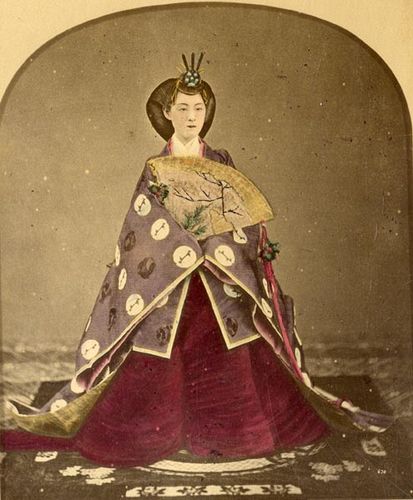
10039.05 Asia > Nineteenth century Japanese artists and colourists
From as early as the eighth century woodblock-printed works were seen in Japan. Although initially the technique was used for texts and religious works by the sixteenth century moveable type was being used. Gaining popularity with artists the technique expanded and individual prints became available. With the popularity for prints there became a need for artists who could paint them or had the skills to use multiple woodblocks for different colours. As photography became available within Japan, predominantly with foreign photographers such as Felice Beato and Baron Raimund von Stillfried, most of the prints through the second half of the nineteenth century had the brownish tones of the albumen print. Their skills with woodblock prints were perfect for painting photographs and some of the finest photographs of this type came from Japan. Royal family 10039.06 Asia > Royal family of Japan
Cultural stereotypes 10039.07 Asia > Samurai
10039.08 Asia > Japanese women sleeping
10039.09 Asia > Geishas
10039.10 Asia > Courtesans
10039.11 Asia > Sedan chairs (kago) in Japan
The Far East 10039.12 Asia > The Far East
The Far East was initially a fortnightly journal published in Yokohama, Japan by John R. Black 1870-75. The journal was a newspaper covering events mainly in Japan but also in other countries in the Far East. Importantly it was illustrated with actual photographs which were tipped in to each issue. Although the occasional volume has appeared at auction it remains an exceptionally rare work. Only two or three complete runs of the first series are known to exist. One regrettable reason is that when issues or the odd volume appears the rare photographs are sometimes removed and sold separately. After a short break, Black commenced a second series in July 1876 and the journal was then published monthly. It ran until December 1878. The second series was published in Shanghai, Tokyo and Hong Kong and had a much greater focus on China and appears to be even rarer than the first series.
Courtesy of Terry Bennett (Old Japan - www.old-japan.co.uk) Contemporary accounts 10039.13 Asia > Photograph of the deceased on a grave at a cemetery in Yokohama, Japan (1881)
Captain S.H. Jones-Parry, My Journey Round the World via Ceylon, New Zealand, Australia, Torres Straits, China, Japan, and the United States, Two Volumes (London: Hurst and Blackett, 1881), Volume II, p.28-29
Next day I took advantage of seeing the gate open to stroll into the cemetery, a sweet, sunny spot, very well looked after. Pretty shrubs are dotted about here and there; and many a sorrowing relative will be cheered by knowing that their dear ones, buried in this distant land, are still cared for, and that their graves are hidden by lovely camellias, cherry and almond trees. The tombs in some cases were very quaint. On the headstone of one I noticed half an orange and a saucer, put, as I afterwards learnt, by some faithful Japanese or Chinese servant, a simple token of love and regard for the little one whose body rested beneath; it was the one touch of nature, and made me feel so sad and choky that I had to turn away. I love that nigger, as they stupidly call these men, for that act. Another had a bouquet with a Christmas card attached, placed reverently on the grassy mound. Another foreign one had a ghastly photograph of the deceased lying surrounded by his sorrowing friends and active servants; it was let into the headstone, and covered with glass, but was much faded by the action of the atmosphere. I confess I liked the bouquet and pretty flowers better. Some English and American tombs were handsome. Altogether I was pleasantly impressed with this spot, and felt that I should not mind being buried there myself.
Concealed meanings 10039.14 Asia > T. Enami: A Japanese Farmer and his Wife About this photographer | Photographs by this photographer
A single photograph can have multiple facets to it and the stereoview of "A Farmer and his Wife" taken in around 1897 is an excellent example of this. On the surface all is quite straight forward - a Japanese farmer wearing a grass cloak against the rain, a hoe over his right shoulder and a harvest of long white radishes, daikon, in the other. Behind him is his wife carrying a teapot.
All appears obvious but the photographs were taken in the T. Enami studio in Yokohama as part of a larger series and in this exhibition we can see several other images using the same models and props that were presumably taken during the same session.
The pose itself tells us about the roles of men and women in nineteenth century Japan - in one image she walks behind him and in another she stands whilst he sits to eat. Perhaps we might be reading too much into the image, and those radishes to the unwary eye are just vegetables but look again. In the past in the rural areas of Japan, there were common expressions about the shape of a woman‘s daikon ashi "Legs like a Radish" as indicator of her potential fertility -- a large family being a good thing for a man and the labors of the farm. At the time of these photos, a typical mother might tell her son to look for a more "plump" set of legs, but the radishes seen here point to what most Japanese men really desire as ideal: long, slender, and white as snow...
In Japan the saying Daikon Ashi had deeper sexual meanings that become clearer with a re-examination of the images but were probably overlooked by the western audiences who purchased the stereoviews in the first decade of the twentieth century. In the Griffith & Griffith card from the 1905 series note the way the daikon are laying resting on the hoe. In the card sold by Rose in Australia the title is "Typical Japanese Farmer. See his grass cloak to keep the rain off, his pipe, his hoe for digging the ground, and the bunch of radishes he is carrying" and the farmer is proudly holding up his radishes or perhaps there is another message in this image about his desires?
The original images were taken around 1897 and so the question arises as to why photographs from the same session were first being sold as stereocards by Griffith & Griffith in the USA and by Rose in Australia in 1905. The answer to this lies in the commercial possibilities offered by global politics. Between February 1904 and September 1905 the Russo-Japanese War was fought and it stemmed from rivalry for control of Manchuria. Japanese forces consistently vanquished the Russian army and navy and this was a shock to both Europe and America. As the news spread the interest in Japan and all things Japanese was widespread and older photographs were purchased and reproduced to meet the demand.
Rob Oechsle and Alan Griffiths The Great Earthquake (1891) 10039.15 Asia > Ogawa Kazumasa: The Great Earthquake of Japan (1891)
Pictorialism 10039.16 Asia > Pictorialism in Japan
The Aiyu Photography Club was founded in Nagota (Japan) in 1912 and the Tenkyukai group was also influential. Yasuzo Nojima (1889-1964) started as a Pictorial photographer and a patron during this period and can be compared to his American contemporary Alfred Stieglitz. His photographic work made the transition between pictorialism and the New Photography that was embraced by Nakayama Iwata who founded the Ashiya Camera Club in 1930. 10039.17 Asia > Japanese pictorialism - Bunka Shashin-shu (1922)
Bunka Shashin-shu was the magazine published by the Tokyo-based photo group Shashin Bunka Kyokai. The publication was influenced by Stieglitz‘s Camera Work}>. The group held regular juried exhibitions that included work by leading Japanese pictorialists of the 1920s. Top selections were published their magazine. There were only three issues: June, August, and September of 1922.
Courtesy of Charles Schwartz Russo-Japanese War (1904-1905) 10039.18 Asia > Russo-Japanese War (1904-1905): Introduction
The Russo-Japanese War (1904-1905) was a conflict between the Imperial powers of Russia and Japan each with colonial expansion plans for Manchuria and Korea. After negotiations had failed on territorial rights hostilities began on 8 February 1904. Japanese army had recently been modified and although it was nowhere near as large as the Russian army it was well able to hold it's own due to the shorter supply lines. A large amount of the war concentrated on the Japanese siege of the well fortified naval base at Port Arthur which was held by the Russians. Russian fleet was destroyed at the Battle of the Yellow Sea (1904) and Port Arthur fell on 2 January 1905 after a series of brutal assaults. Japanese army now attacked northwards driving the Russians out of Shenyang (March 1905).
most extraordinary aspect of the war was the departure of the Russian Baltic Fleet under Admiral Zinovi Petrovich Rozhdestvenski to support the war in the east. This incredible trip was seemingly doomed from its start when on 21 Oct 1904 it fired on a group of British fishing boats that it mistakenly thought were attacking it. When the fleet finally arrived in the war zone the Japanese fleet under Admiral Togo was waiting for them. At the Battle of Tsushima (27-28 May 1905), named after the straits between Korea and Japan where the sea battle was fought, the Japanese fleet sunk 21 Russian ships and captured a further 7.
successive defeats both on land and sea broke the will of the Russian Government to fight on particularly as the internal politics of Russia were becoming increasingly unstable with the Russian Revolution of 1905. At the Treaty of Portsmouth on 5 September 1905, under the mediation of President Theodore Roosevelt, a peace agreement was signed that gave Japan control over the disputed areas. This eventually led to the full annexation of Korea by Japan in 1910. 10039.19 Asia > Photographers of the Russo-Japanese War Photographers of the Russo-Japanese War (1904-1905):
- Victor Bulla, son of the established St. Petersburg photographer, Karl Bulla, worked as a reporter and photographer for the Russian Magazine Niva during the war.
- Jimmy Hare (1856-1946) covered the war for Colliers Magazine.
Second World War (1939-1945) 10039.20 Asia > Joe Rosenthal: Flag raising at Iwo Jima (23 February 1945) About this photographer | Photographs by this photographer
10039.21 Asia > War: Atomic explosions: Hiroshima
10039.22 Asia > War: Atomic explosions: Nagasaki
Post-War Japan 10039.23 Asia > Provoke
Provoke (1968-) was a Japanese magazine with a subscription of less than a thousand copies in its early years. The founding editor was Takuma Nakahira. Original copies of the magazine are difficult to obtain and it was reprinted in The Japanese Box by Steidl in 2001. The term "Provoke" within Japanese photography is inclusive of photographers from the 1960s and 1970s who were active in experimental and confrontational photography and includes photographers whose work was not in the magazine.
Significant photographers of the time included Shõmei Tõmatsu, Eikoh Hosoe with his portraits of the highly controversial novelist, poet, playwright and nationalist Yukio Mishima, the voyeuristic surveillance-like night photographs of groping heterosexual and homosexual lovers in three Tokyo parks (Shinjuku, Yoyogi, and Aoyama) by Kohei Yoshiyuki, Daido Moriyama, Kikuji Kawada, the ever-prolific Nobuyoshi Araki, the Ravens of Masahisa Fukase and the founding editor of Provoke Takuma Nakahira.
Japan had been devastated by the Second World War, traumatised by the atomic bombs dropped on Hiroshima and Nagasaki, shamed by the American occupying forces and its impact on Imperial authority. There was no marketplace for photographic prints in Japan in the post-war period small apartment sizes restricted wall space and books, magazines and Xerox copies were the only ways to disseminate works by this prolific group of photographers. The work of the immediate post-war period was largely grainy black and white which reflects a hard documentary style which was often chauvinistic in its attitudes to women - women photographers were rare in Provoke world. 10039.24 Asia > Japanese protest books
10039.25 Asia > W. Eugene Smith: Minamata About this photographer | Photographs by this photographer
Between 1971 and 1973 W. Eugene Smith lived with his Japanese wife Aileen in Minamata, Japan during the period that deformities and health issues in the surrounding area were being caused by mercury poisoning. The poisoning was caused by the discharge of heavy metals from a Chisso factory into the water sources which was taken up by fish and so affected the human population. W. Eugene Smith documented the health issues and the public meetings leading to him being attached by Chisso employees.
The most famous photograph of the series was Tomoko Uemura in Her Bath which showed a severly deformed and naked child being held by her mother while being bathed. The photograph was withdrawn from circulation out of the respect for the family. Photobooks 10039.26 Asia > Japanese photobooks
alan@luminous-lint.com |
General reading 1980, A Century of Japanese Photography, (New York: Pantheon Books) [Introduction by John Dower] [Δ] 1995, The Founding and Development of Modern Photography in Japan, (Tokyo: Tokyo Metropolitan Museum of Photography) [Δ] 2011, Dawn of Japanese photography, (Tokyo) [Δ] Aubenas, S. & Lacarrière J., 1999, Voyage en Orient, (Paris: Hazan) isbn-10: 2850256889 isbn-13: 978-2850256882 [Δ] Bennett, Terry, 1997, Early Japanese Images, (Tokyo: Charles E. Tuttle Publishing Co.) [Δ] Bennett, Terry, 2006, Old Japanese Photographs. Collectors' Data Guide, (London: Quaritch) [Δ] Bennett, Terry, 2006, Photography in Japan 1853-1912, (Rutland, Vermont, Singapore & Tokyo: Tuttle Publishing) isbn-10: 0804836337 isbn-13: 978-0804836333 [Δ] Bethel, Denise, 1991, Spring/Summer, ‘The J. B. Millet Company’s Japan: Described and Illustrated by the Japanese‘, Image, vol.34, pp.3-21 [Δ] Boyd, T., 2000, Portraits in Sepia. From the Japanese Carte de Visite Collection of Torin Boyd and Naomi Izakura, (Tokyo: Izakura & Boyd) [Δ] Burns, Stanley B. & Burns, Elizabeth A., 2006, Geisha: A Photographic History, 1872-1912, (Brooklyn, NY: powerhouse Books) [Δ] Clark, John, 2001, Japanese Exchanges in Art, 1850s to 1930s with Britain, Continental Europe, and the USA: Papers and Research Materials, (Sydney: Power Publications) [Δ] Dobson, Sebastian, 2004, ‘'I been to keep up my position': Felice Beato in Japan, 1863–1877‘, in Rousmaniere and Hirayama, (eds.), Reflecting Truth: Japanese Photography in the Nineteenth Century<./i>, pp. 30–39 (Amsterdam: Hotei, 2004) ISBN 978-9074822763. [Δ] Dobson, Sebastian, Morse, Anne Nishimura & Sharf, Frederic A., 2004, Art & Artifice: Japanese Photographs of the Meiji Era, (Boston: MFA Publications) [Δ] Funkhouser, Elmer, 1999, March/April, ‘Japan: Described and Illustrated by the Japanese‘, Arts in Asia, vol.29, pp.133-138 [Δ] Gartlan, Luke (ed.), 2009, May, Photography in Nineteenth-Century Japan [Δ] Hight, Eleanor M., 2011, Capturing Japan in Ninetenth-Century New England Photography Collections., (Burlington, VT: Ashgate) [Δ] Kaneko, Ryuichi & Vartanian, Ivan, 2009, Japanese Photobooks of the 1960s and '70s, (New York: Aperture) isbn-10: 1597110949 isbn-13: 978-1597110945 [Δ] Maddox, Brent, 1990, winter, ‘Depictions of 19th Century Japan‘, Visual Resources Association Bulletin, vol.17, pp.35-37 [Δ] Morris, Rosalind C., 2009, Photographies East: The Camera and Its Histories in East and Southeast Asia, (Duke University Press Books) isbn-10: 0822342057 isbn-13: 978-0822342052 [Δ] Odo, David, 2008, Unknown Japan: Reconsidering 19th Century Photographs, (Amsterdam: Rijksmuseum) [Δ] Romer, Grant, 1986, August, ‘Near the Temple at Yokushen‘, Image, vol.29, no.2 [Δ] Rousmaniere, Nicole Coolidge & Hirayama, Mikiko (eds.), 2005, Reflecting Truth: Japanese Photography in the Nineteenth Century, (Hotei Publishing) isbn-10: 9074822762 isbn-13: 978-9074822763 [Δ] Schifferli, Christoph, 2001, The Japanese Box, (Steidl / Edition 7L) isbn-10: 3882433019 [Includes works from Provoke. Six volumes in a wooden box] [Δ] Tucker, Anne et al., 2003, The History of Japanese Photography, (New Haven, CT: Yale University Press) [Δ] Winkel, Margarita, 1991, Souvenirs from Japan: Japanese Photography at the Turn of the Century, (London: Bamboo Publishing in association with Ukiyo-e Books, Leiden, The Netherlands) [Δ] Worswick, Clark & Morris, J., 1979, Japan. Photographs 1854-1905, (New York: A. Pennwick/Alfred A. Knopf Book) [Δ] Readings on, or by, individual photographers Felice Beato Clark, John; Fraser, John & Osman, Colin, 1989, A Chronology of Felix (Felice) Beato, (Privately printed by the authors) [Δ] Lacoste, Anne, 2010, Felice Beato: A Photographer on the Eastern Road, (Los Angeles: J. Paul Getty Museum) [Δ] Werner Bischof Bischof, Werner, 1961, Japan by Werner Bischof, (Bantam Books) [Δ] Bischof, Werner & Guillain, Robert, 1954, Japan, (Simon & Schuster) [German] [Δ] William Klein Klein, William, 1964, Tokyo, (New York: Crown Publishers) [Δ] Klein, William, 1964, Tokyo, (Tokyo, Japan: Zokeisha Publications) [Δ] Kusakabe Kimbei Savelyeva, Anna, 2010, ‘Kusakabe Kimbei’s Photographs in the State Hermitage Collection‘, Reports of the State Hermitage Museum, vol.LXVII [Δ] Ogawa Kazumasa Milne, John, Burton, W.K. & Ogawa Kazumasa, 1892(ca), The Great Earthquake of Japan, 1891, (Yokohama: Lane, Crawford & Co) [Δ] W. Eugene Smith Smith, W. Eugene & Smith, Aileen M., 1975, Minamata: Words and Photographs, (New York: Holt, Rinehart and Winston) [Δ] Shõmei Tõmatsu Jeffrey, I., 2002, Shomei Tomatsu, (London: Phaidon) [Δ] Rubinfien, L.; Phillips, S. S. & Dower, J. W., 2004, Shomei, Tomatsu: Skin of the Nation, (San Francisco: Museum of Modern Art in association with
New Haven, CT: Yale University Press) [Preface by Daido Moriyama] [Δ] Tomatsu, Shomei, 1966, 11 ji 02 fun Nagasaki (<11?02?>Nagasaki, "11:02" Nagasaki), (Tokyo: Shashin Dojinsha) [Δ] Tomatsu, Shomei, 1969, Okinawa, Okinawa, Okinawa, (Tokyo: Shaken) [Δ] Tomatsu, Shomei, 1969, Oo! Shinjuku, (Tokyo, Shaken) [Δ] Tomatsu, Shomei, 1972, I am a King, (Tokyo: Dai Nippon Printing) [Δ] Tomatsu, Shomei, 1998, Visions of Japan, Tomatsu Shomei, (Korinsha Press, Distributed Art Publishers, New York) [Δ] Tomatsu, Shomei, 2000, Tomatsu Shomei 1951–1960, (Tokyo, Japan: Sakinsha) [Δ] If you feel this list is missing a significant book or article please let me know - Alan - alan@luminous-lint.com Resources
Japan, hand-colored photographs, ca. 1880 http://www.cmp.ucr.edu ...
| Photographic Views of Meiji: A Portrait of Old Japan http://albumen.stanford.edu ...
| Japanese Old Photographs in the Bakumatsu-Meiji Period (1860-1899) http://oldphoto.lb.nagasaki-u.ac.jp ... Database of early photographs of Japan held by Nagasaki University Library.
| Views and Costumes of Japan: A Photograph Album by Baron Raimund von Stillfried-Ratenicz http://www.slv.vic.gov.au ... by Luke Gartlan (Reproduced from The La Trobe Journal No 76, Spring 2005)
Very detailed description of an album with excellent scholarship.
| Ryoji Akiyama (1942-) • Hermann Andersen • Felice Beato (1832-1909) • Werner Bischof (1916-1954) • Eliphalet Brown • Wilhelm Burger (check) • Linda Butler (1947-) • Emile de Montgolfier (1842-1896) • Domon Ken (1909-1990) • T. Enami (1859-1929) • Adolfo Farsari (1841-1898) • Hideki Fujii (1934-) • Fukase Masahisa (1934-2012) • Hamaya Hiroshi (1915-1999) • Hatakeyama Naoya (1958-) • Hisaji Hara (1964-) • Hiromi Horikoshi (1968-) • Eikoh Hosoe (1933-) • Tetsuya Ichimura (1930-) • Ikkõ (1931-) • Ishimoto Yasuhiro (1921-2012) • Bishin Jumonji (1947-) • Kawada Kikuji (1933-) • Michael Kenna (1953-) • Kimura Ihei (1901-1974) • Ken Kitano • Shinchiro Kobayashi • Kohei Yoshiyuki • Kon Michiko (1955-) • Tamamura Kozaburo • Koichiro Kurita (1943-) • Kusakabe Kimbei (1841-1934) • Shinzo Maeda • Yoshito Matsushige (1913-2005) • Kozo Miyoshi (1947-) • Moriyama Daidõ (1938-) • Nagano Shigeichi (check) • Naitoh Masatoshi (1938-) • Nojima Yasuzõ (1889-1964) • Ogawa Kazuma (1860-1929) • Ogawa Kazumasa • Ken Ohara (1942-) • Herbert G. Ponting (check) • John Cooper Robinson (check) • Pierre Joseph Rossier (check) • Yuji Saiga (1951-) • Tomoko Sawada (1977-) • Shibata Toshio (1949-) • Shimooka Renjõ (1823-1914) • Kishin Shinoyama (1940-) • Jun Shiraoka (1944-) • W. Eugene Smith (1918-1978) • Kiyoshi Sonobe (1921-1996) • Chris Steele-Perkins (1947-) • Baron Raimund von Stillfried (1839-1911) • Hiroshi Sugimoto (1948-) • John Swope (1908-1979) • Shõmei Tõmatsu (1930-2012) • Kunihiko Takada (1953-) • Shigeru Tamura (1947-) • Tsuchida Hiromi (1939-) • Ueda Shõji (1913-2000) • Watanabe Yoshio (1907-2000) • Shikanosuke Yagaki (1897-1966) • Masao Yamamoto (1957-) • Yokoyama Matsusaburõ (1838-1884) | Home > Geographical regions > Asia > Japan
|