Contents
| This theme includes example sections and will be revised and added to as we proceed. Suggestions for additions, improvements and the correction of factual errors are always appreciated. | The daguerreotype in China 10037.01 Asia > Jules Itier: China About this photographer | Photographs by this photographer
10037.02 Asia > Daguerreotypes: Ethnic: Chinese
The Second Chinese Opium War (1856-1860) 10037.03 Asia > Second Chinese Opium War (1856-1860): Introduction
The First (1849-42) and Second Chinese Opium Wars (1856-1860) reflect one of the most unethical aspects of the foreign policy of the British Empire and the American, French and Dutch traders who were involved in the distribution of opium.
The wars were fought to prevent the Chinese government clamping down on drug use and the export of opium. British merchants traded opium as part of a global mercantile network and were perfectly prepared to fight for it. The catalyst for action was when the Chinese searched the British ship Arrow on suspicion of piracy and shipping opium - as the ship was Chinese owned they had a right to do this but as it was registered in Hong Kong the jurisdiction was open to dispute. The French joined the British using the execution of a missionary, Father August Chapdelaine, as the justification.
The allies began operations late in 1857 and the Chinese soon agreed to terms and signed the treaties at Tientsin (1858) that opened China up for foreign trade and missionaries. Considerable pressure was applied to force the Chinese to accept imports of opium. The Chinese didn't ratify the treaties and hostilities resumed. 10037.04 Asia > Felice Beato: Second Chinese Opium War (1856-1860) and the taking of the Taku Fort About this photographer | Photographs by this photographer
Felice Beato used multiple wet collodion plates to create panoramas of important sights including the ships and camp at Hong Kong preparing for the North China Expedition (taken 18-27 March 1860). The French and British forces landed at Pei Tang on 1 August 1860 and moved on. During this period Felice Beato documented the campaign and recorded the aftermath of the attacks with the Western allies on the forts at Taku, near Tientsin, on 21 August 1860. The photographs show the ravaged ramparts of the fort strewn with Chinese dead. It has been suggested that on occasion Felice Beato moved corpses around in order to get a more dramatic image - a practice that continues today with the more unethical war photographers. A contemporary account said:
"I walked round the ramparts on the West side. They were thickly strewn with dead - in the North-West angle thirteen were lying in one group around a gun. Signor Beato was there in great excitement, characterising the group as ‘beautiful‘ and begging that it might not be interfered with until perpetuated by his photographic apparatus, which was done a few minutes afterwards.."
D.F. Rennie 1863 British Arms in North China and Japan (Shanghai) p.112
10037.05 Asia > Felice Beato: Second Chinese Opium War (1856-1860) and the Pehtang fort About this photographer | Photographs by this photographer
10037.06 Asia > Felice Beato: Second Chinese Opium War (1856-1860) and the march to Bejing About this photographer | Photographs by this photographer
The allied forces marched on and by 26 September they arrived at Bejing and the city fell on 6 October 1860. The war ended with the Convention of Peking on 18 October in which the Chinese agreed to the western demands.
Some of the photographs of Felice Beato were used as the basis of illustrations for example in James Furgusson A History of Architecture in all Countries, from the Earliest Times to the Present Day, in three volumes (London: John Murray, 1867). 10037.07 Asia > Felice Beato: Prince Kung / Prince Gong Qinwang of China About this photographer | Photographs by this photographer
Robert Swinhoe, Narrative of the North China Campaign of 1860; Containing Personal Experiences of Chinese Characters, and of the Moral and Social Condition of the Country; Together with a Description of the Interior of Pekin, (London, Smith, Elder and Co., 1861), frontispiece
The taking of a portrait of Prince Kung by Signor Beato is given on. p.377-378.
The imperial edict confirming all that Prince Kung had signed was duly received, and large proclamations on the 6th [November 1860] were posted up all over the city, making the terms of peace patent to all the Celestials. This last performance of the great act was considered so important that the army interpreters were deputed to accompany the mandarins commissioned for the purpose of having the same placarded in all conspicuous parts of the great city; and parcels of proclamations were made up ready for posting at important places on the downward march. Much cordiality now existed between Lord Elgin and Prince Kung, and visits were frequently exchanged. The Prince threw off the nervous restraint and show of bad humour that marked his first interview. He sat with pleasure for his photograph before the camera of Signor Beato, and we are thus enabled to give a view of his far from comely visage to our readers. He is said to bear a strong resemblance to the Emperor; and, indeed, a carefully executed portrait of his Celestial Majesty, which was secured by an officer from the Summer Palace, called so forcibly to our mind the physiognomy of the Prince that we declared it could be no other, until, from the Chinese inscription on the top, it was deciphered to represent the Emperor.
Henry Knollys, Incidents in the China War of 1860 compiled from the Private Journals of General Sir Hope Grant, (Edinburgh and London: William Blackwood and Sons, 1875), p.209-210.
In the midst of the ceremony, the indefatigable Signor Beato, who was very anxious to take a good photograph of "the Signing of the Treaty," brought forward his apparatus, placed it at the entrance door, and directed the large lens of the camera full against the breast of the unhappy Prince Kung. The royal brother looked up in a state of terror, pale as death, and with his eyes turned first to Lord Elgin and then to me, expecting every moment to have his head blown off by the infernal machine opposite him—which really looked like a sort of mortar, ready to disgorge its terrible contents into his devoted body. It was explained to him that no such evil design was intended, and his anxious pale face brightened up when he was told that his portrait was being taken. The treaty was signed, and the whole business went off satisfactorily, except as regards Signor Beato's picture, which was an utter failure, owing to want of proper light.
The Far East 10037.08 Asia > The Far East
The Far East was initially a fortnightly journal published in Yokohama, Japan by John R. Black 1870-75. The journal was a newspaper covering events mainly in Japan but also in other countries in the Far East. Importantly it was illustrated with actual photographs which were tipped in to each issue. Although the occasional volume has appeared at auction it remains an exceptionally rare work. Only two or three complete runs of the first series are known to exist. One regrettable reason is that when issues or the odd volume appears the rare photographs are sometimes removed and sold separately. After a short break, Black commenced a second series in July 1876 and the journal was then published monthly. It ran until December 1878. The second series was published in Shanghai, Tokyo and Hong Kong and had a much greater focus on China and appears to be even rarer than the first series.
Courtesy of Terry Bennett (Old Japan - www.old-japan.co.uk) John Thomson in China 10037.09 Asia > John Thomson: Illustrations of China and Its People (1873-1874) About this photographer | Photographs by this photographer
John Thomson, Illustrations of China and Its People, a Series of Two Hundred Photographs with Letterpress Description of the Places and People Represented, 4 vols. (London: Sampson Low, Marston Low, and Searle, 1873 [vols. 1 and 2] and 1874 [vols. 3 and 4]).
Between 1870 and 1872 John Thomson made four journeys within China:
- Up the the north branch of the Pearl River
- Up the River Min to the area around Foochow
- To Peking
- Up the Yangtze River
These extensive travels provide one of the first detailed photographic documentations of China in the neneteenth century wth studies of the Treaty Ports and cities including Hong Kong, Hainan, Macau, Taiwan, Swatow, Amoy, Foochow, Ninpo, Shanghai, Nanking, Kiu-kiang, Hanchow, Chefu and Peking. This book is also notable for its occupational portraits of the Chinese. 10037.10 Asia > John Thomson: The Land and People of China About this photographer | Photographs by this photographer
10037.11 Asia > John Thomson: Physic Street, Canton, China About this photographer | Photographs by this photographer
The albumen print "Physic Street, Canton, China" by John Thomson was converted into an illustration, "A street in Canton", for his book reference|395|Straits of Malacca, Indo-China, and China; or Ten Years' Travels, Adventures and Residence Abroad (London: Sampson Low, Marston, Low & Searle, 1875), between p. 248 and 249. 10037.12 Asia > John Thomson: China, a travelling chiropodist About this photographer | Photographs by this photographer
Rural landscapes 10037.13 Asia > Afong: Banker's Glenn, Yuen-foo River About this photographer | Photographs by this photographer
The inhabitants of China 10037.14 Asia > Chinese
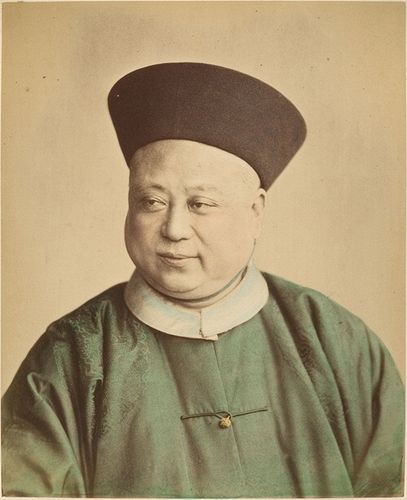
10037.15 Asia > Baron Raimund von Stillfried: Portraits from China About this photographer | Photographs by this photographer
10037.16 Asia > William Saunders: Studio studies of the occupations of the Chinese About this photographer | Photographs by this photographer
Documentary 10037.17 Asia > China: Typhoon (September 1874)
A Chinese photographer, Afong, who was active in the 1860s-1880s in Hong Kong (now China), took an album of albumen silver prints of the 22 September 1874 typhoon that struck Hong Kong harbor sinking the steamers moored there.
A personal account of the 1874 typhoon is provided in Walter William Mundy Canton and the Bogue. The Narrative of an eventful six months in China (London: Samuel Tinsley, 1875)
"...the storm commenced with a violent wind suddenly springing up, and it soon became so irresistible in its might that no obstacle seemed able to retard it. As the night wore on, the destruction increased, and each fresh blast of the hurricane was the doom of houses and of ships. The bars across the windows snapt one after the other with a report like that of cannon; and the Venetians, torn from their fastenings and banging against the wall, increased the noise, till at last the wind swept them completely off, and rushed into the house with a shriek, as if about to carry everything before it. The washing stands were in the verandah, and the wind caught the jugs and basins up as if they were but leaves, and smashed them in all directions. The glass doors leading into the bedrooms were then taken bodily off their hinges, and fragments of the glass were scattered throughout the house. Many pieces fell on my bed, but I escaped without any bad cuts. The doors throughout the different corridors were the next to succumb; and now the risk became very great that the wind would lift the roof completely off the house, which actually happened to many other houses in the colony. To add to the confusion of the scene, the wind got into the pipes and put the gas out, leaving us in total darkness." (p.237-238)
10037.18 Asia > Henri Cartier-Bresson: Notes de voyage en Chine (1954) About this photographer | Photographs by this photographer
The photo-essay "Notes de voyage en Chine" on China by Henri Cartier-Bresson published in Photo Monde, No. 31, Special Christmas issue, January 1954. Amateur photographers 10037.19 Asia > Amateur Photographers in China: Sketches by the Rev. R. O'Dowd Ross-Lewin, Chaplain R.N. (7 March 1891)
"Amateur Photographers in China: Sketches by the Rev. R. O'Down Ross-Lewin, Chaplain R. N." Illustrated London News (London, England), Saturday, March 07, 1891; pg. 311; Issue 2707.
- Messrs. Tripod and Focus go ashore from a river steamer.
- They decide to photograph a party of natives sleeping in a field.
- The Chinamen, awakening and alarmed, take flight with yells of terror.
- The mob of hostile peasantry is kept at bay, dreading the levelled camera as a new kind of artillery.
- But they drive some of their "water buffaloes," good beasts when yoked to a plough, in a fresh attack on the foreign intruders.
- Messrs. Tripod and Focus, leave their camera to destruction, take refuge up a tree.
- Ransomed by paying away all their dollars, they are permitted to embark in safety. China does not yet appreciate every art of civilisation!
10037.20 Asia > Donald M. Mennie: Pictorialist China About this photographer | Photographs by this photographer
Donald M. Mennie was a Scottish businessman and amateur photographer who was active in China. Arrived in China in 1899 working first at Mactavish & Lehman & Co. in Peking (now Beijing) and later joined A.S. Watson & Co. in Shanghai. A highly successful entrepreneur of pharmaceuticals, wine, spirits, cigars and photographic chemicals and apparatus he was well-able to support his photographic interests. He was influenced by contemporary pictorialism and his photogravures were well-suited to a slightly romanticised and soft-focus view of China.
His photographs were first published in Elizabeth Cooper's book My Lady of the Chinese Courtyard (1914) and through the 1920s he published under the auspices of the company he worked for, A.S. Watson & Co., a number of photographically-illustrated books on China of which the most notable are The Pageant of Peking (first edition 1920) and the The Grandeur of the Gorges (1926). The Cultural Revolution (1966-1976) 10037.21 Asia > China and the Cultural Revolution (1966-1976)
The Great Proletarian Cultural Revolution commonly known at the Cultural Revolution was socio-political movement in China between 1966 and 1976. The intention was to root out traditional and capiltalist ideologies throughout the country to promote communism. The formation of Red Guard units with their ideological and physical attacks on any ideas, or artifacts, that disagreed with the decreed pathways led to the distruction of cultural material in an unprecented manner. In a world where retaining photographs of pre-communist China could be used as evidence many public and private collections were destroyed. This has lead to a lack of early Chinese material within the country and most of the better photographs documenting China prior to this period is held externally.
In a society where people were denounced for counter-revolutionary thought, actions and possessions it was dangerous to take and preserve photographs during this period without official permission. There are cases where Chinese photographers, such as Li Zhensheng, hid their collections and these are proving to be of cultural and historical significance. Contemporary Chinese photography 10037.22 Asia > Zhang Huan: Performance art About this photographer | Photographs by this photographer
10037.23 Asia > Edward Burtynsky: China About this photographer | Photographs by this photographer
Edward Burtynsky in his 2012 book China (Steidl) captured the vast scale of the industrial plants of China where humanity is lost within organisations.
alan@luminous-lint.com |
General reading Aubenas, S. & Lacarrière J., 1999, Voyage en Orient, (Paris: Hazan) isbn-10: 2850256889 isbn-13: 978-2850256882 [Δ] Bennett, Terry, 2009, History of Photography in China 1842-1860, (London; Quaritch) [Δ] Bennett, Terry, 2010, History of Photography in China: Western Photographers 1861-1879, (Bernard Quaritch Ltd) isbn-10: 0956301215 isbn-13: 978-0956301215 [Δ] Bennett, Terry, 2013, History of Photography in China: Chinese Photographers 1844-1879, (Bernard Quaritch Ltd) isbn-13: 978-0956301246 [Δ] Capa, Cornell (ed.), 1972, Behind the Great Wall of China: Photographs from 1870 to the Present, (New York: Metropolitan Museum of Art) [Introduction by Weston J. Naef] [Δ] Falconer, J. et al., 1994, From Bombay To Shanghai, (Rotterdam: Museum voor Volkenkunde) [Δ] Jones, Ed & Welch, James (ed.), 2010, Happy Tonite, (Archive of Modern Conflict) [Δ] Li Zhensheng, 2003, Red-Color News Soldier, (Phaidon Press) isbn-10: 0714843083 isbn-13: 978-0714843087 [Δ] Morris, Rosalind C., 2009, Photographies East: The Camera and Its Histories in East and Southeast Asia, (Duke University Press Books) isbn-10: 0822342057 isbn-13: 978-0822342052 [Δ] Shing, Liu Heung, 2012, China in Revolution: The Road to 1911, (Hong Kong University Press) isbn-10: 9888139509 isbn-13: 978-9888139507 [Δ] Thiriez, Régine, 1998, Barbarian Lens: Western Photographers of the Qianlong Emperor's European Palaces, (Routledge) isbn-10: 9057005190 isbn-13: 978-9057005190 [Δ] Worswick, Clark & Spence, J., 1978, Imperial China. Photographs 1850-1912, (New York: Penwick/Crown) [Δ] Wue, R.; Waley-Cohen, J. & Lai, E.K., 1997, Picturing Hong Kong. Photography 1855-1910, (New York: Asia Society Galleries) [Δ] Readings on, or by, individual photographers Felice Beato Clark, John; Fraser, John & Osman, Colin, 1989, A Chronology of Felix (Felice) Beato, (Privately printed by the authors) [Δ] Lacoste, Anne, 2010, Felice Beato: A Photographer on the Eastern Road, (Los Angeles: J. Paul Getty Museum) [Δ] Edward Burtynsky Burtynsky, Edward, 2012, China, (Steidl) isbn-10: 3865211305 isbn-13: 978-3865211309 [Δ] Henry Collen Schaaf, Larry J., 1982, October, ‘Henry Collen and the Treaty of Nanking‘, History of Photography, vol.6, pp.353-66 [Δ] Schaaf, Larry J., 1983, April - June, ‘Addenda to Henry Collen and the Treaty of Nanking‘, History of Photography, vol.7, pp.163-65 [Δ] Wood, Rupert Derek, 1996, May, ‘The Treaty of Nanking: Form and the Foreign Office, 1842-43‘, Journal of Imperial and Commonwealth History, vol.24, pp.181-96 [Δ] Liu Zheng 2004, Liu Zheng: The Chinese, (International Center of Photography; Göttingen, Germany: Steidl) [Δ] Carl Mydans Mydans, Carl & Demarest, Michael, 1981, China: A Visual Adventure, (Bookthrift Co) isbn-10: 0671249460 isbn-13: 978-0671249465 [Δ] Pierre Joseph Rossier Bennett, Terry, 2004, December, ‘The Search for Rossier - Early Photographer of China & Japan‘, The PhotoHistorian (Journal of the Historical Group of the Royal Photographic Society) [Δ] Bennett, Terry, 2009, May, ‘Pierre Joseph Rossier - Pioneer Photographer in East Asia‘, Old Photography Study, no.3, pp.2-10 [Δ] Bennett, Terry; Bourgarel, Gérard & Collin, David, 2006, Pierre Joseph Rossier, photographe: une mémoire retrouvée, (Switzerland: Pro Fribourg) [French] [Δ] John Thomson Thomson, John, 1873, Foochow and the River Min. A series of photographs, (London: Autotype Fine Art Company) [Δ] Thomson, John, 1873-1874, Illustrations of China and Its People: A Series of 200 Photographs, (London: Sampson Low, Marston, Low and Searle) [4 vols, 1873 [vols. 1 and 2] and 1874 [vols. 3 and 4])] [Δ] Thomson, John, 1875, Straits of Malacca, Indo-China, and China, or, Ten Years Travels, Adventures, and Residence Abroad, (New York: Harper and Brothers) [Δ] Thomson, John, 1875, The Straits of Malacca, Indo-China, and China; or Ten Years' Travels, Adventures and Residence Abroad, (London: Sampson Low, Marston, Low & Searle) [Δ] White, Stephen, 1985, John Thomson: Life and Photographs, (London: Thames and Hudson) [Δ] White, Stephen, 1986, John Thomson: A Window to the Orient, (NY: Thames and Hudson) [Preface by Robert A. Sobieszek] [Δ] If you feel this list is missing a significant book or article please let me know - Alan - alan@luminous-lint.com Resources
Osvald Siren: (Images of China‘s Forbidden City from the 1920s) http://www.photo.ucr.edu ...
| http://
| The Basel Mission http://www.bmpix.org ... Photographs mostly taken by missionaries between 1850 and 1950. The primary focus of the site is the West African countries of Ghana and Cameroon, two Indian states (Karnataka and Kerala), China, and Hong Kong.
| Illustrations of China and its people: a series of two hundred photographs, with letterpress descriptive of the places and people represented / by J. Thomson. (London: Sampson Low, Marston, Low, and Searle 1873) http://lookup.lib.hku.hk ... Scanned by Hong Kong University Library.
| John Thomson: Glimpses into Life in the Far East http://resolver.library.cornell.edu ... Scanned by Cornell University Library.
| Historical Photographs of China http://hpc.vcea.net A collaboration between scholars at the University of Bristol, University of Lincoln, the Institut d'Asie Orientale and TGE-Adonis, this project aims to locate, archive, and disseminate photographs from the substantial holdings of images of modern China held mostly in private hands overseas.
| Afong • Eve Arnold (1912-2012) • Felice Beato (1832-1909) • Edward Burtynsky (1955-) • Linda Butler (1947-) • Giacomo Caneva (1813-1865) • Chi Peng (1981-) • Thomas Child (1841-1898) • Thomas Child (1841-1898) • Serge Clément (1950-) • Lois Conner (1951-) • Antoine Fauchery (check) • W.P. Floyd • Auguste François (1857-1935) • Georg Gerster (1928-) • Richard Harrington (1911-2005) • Tung Hing • Jules Itier (1802-1877) • Chen Jiagang (1962-) • G.R. Lambert & Co. • Lee Yuk Tin • Li Zhensheng (1940-) • Paul Maurer (1951-) • Donald M. Mennie (check) • Milton Miller (1830-1899) • Hedda Morrison (1908-1991) • Muchen & Shao Yinong • Carl Mydans (1907-2004) • Leone Nani (1880-1935) • Marc Riboud (1923-) • RongRong & Inri • Pierre Joseph Rossier (check) • William Saunders • Liang Shitai • Sze Yuen Ming • John Thomson (1837-1921) • Robert Van der Hilst (1940-) • Father R. Verbois • Wang Ningde (1972-) • Stephen Wilkes • Michael Wolf • Adam Woolfitt (1938-) • Zhang Huan (1965-) | Home > Geographical regions > Asia > China
|