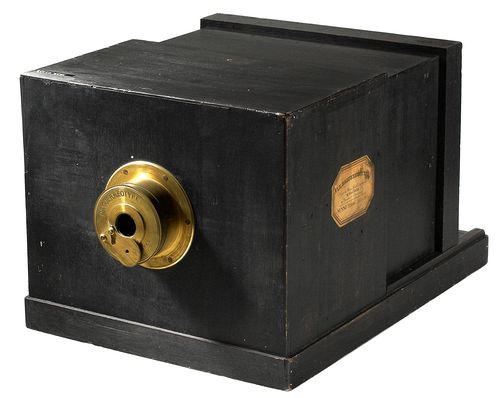
As there are many other resources on the Internet for those interested in the technical aspects of cameras and lens they are only covered briefly here and only when the details are related to the history of photography.
This theme includes example sections and will be revised and added to as we proceed. Suggestions for additions, improvements and the correction of factual errors are always appreciated.
Civil War Cameras - George Eastman House Curator of Technology Todd Gustavson discusses two examples of Civil War-era cameras - a stereo camera and the Lewis wet-plate camera.
The advent of popular, vernacular (or "found") photography essentially dates from 1888 when the Eastman Dry Plate and Film Company (later the Eastman Kodak Company of New York) of Rochester, New York, introduced the Kodak camera (later to be called the "Original Kodak" camera). This small, box-like camera came preloaded with paper-backed roll film, sufficient for 100 exposures. The camera sold at a price of $25 (a significant amount in those years), had no viewfinder, and was string-loaded/set (which means that the shutter had to be manually cocked or armed by pulling a string). The images, 2½" in diameter, were round (the crisp edges being produced by a mask, rather than by a focused lens). Once the film had been exposed, the entire camera was shipped back to Rochester where the images were printed, mounted on stiff card, and the camera reloaded and sent back to the owner.
A year after its debut, the Original Kodak was replaced by an improved version, the Kodak No. 1. The price, the diameter of the round images it produced, the lack of viewfinder, and the factory loaded—factory printed-and-returned nature of the apparatus remained, however, essentially the same. (Kodak remained true to its advertising slogan: "You Press the Button, We Do the Rest".)
The Kodak No. 1 remained in production until 1895, but was, in the same year of its first appearance (1889), replaced by a still more improved version, the Kodak No. 2.
The Kodak No. 2 produced round images, 3½" in diameter, and used roll film that was not paper-backed (and thus had to be loaded in a darkroom). It sold for a steeper price ($32.50) and again the entire camera was returned for processing to Rochester, reloaded and returned (later, processing in London also became an option for those abroad). The No. 2 used film that produced 60 or 100 images and, most significantly, had a viewfinder. It remained in production until 1897.
The advent of these cameras essentially paved the way for a revolution in photography. Removed from the exclusive hands of practiced craftsmen and women, photography became democratized—the ability to document, frame and capture life’s experience suddenly being made available to the amateur. What strikes me now about these images is—in the best of them—their remarkable quality (remarkable for what was essentially a somewhat crude instrument) with their rich tones and sharp focus. Equally important are the quaintness of the circular image itself and the elegance of its presentation: on many, the back of the mounting card is decorated by a fine printing of flowers and leaves with the Kodak insignia centered on the card; the front often has a dark brown-burgundy border and gilt edging.
As with any historical image, the window into the past that it presents to the contemporary viewer is fascinating. In these early Kodak images, this attribute is pronounced with its concentration on the lives of ordinary people and families, in addition to its documentation of the inevitable holiday trip abroad or voyage to foreign and exotic locales.
The images in my collection presented here are, for the most part, Kodak No. 2’s. The diameter of the individual image varies, ranging from 2½" (Kodak No. 1) through 2 5/8" (the early advertised size of the image produced by the Kodak No. 1) to 3¼" to 3½" (Kodak No. 2). This variation may come from the fact that Kodak produced 13 different models of the No. 2 between its debut and its demise. The images themselves come largely from two sources. One documents a mining town on the dry and dusty western frontier of the US; the other is a series of images from one family’s trip through the southern United States and Mexico. These latter images are particularly fine, in my opinion. Whoever the photographer was, he or she had a keen eye for composition and for the detail of life outside of the everyday. Some show a striking modernity in focus and structure. As with the best of all vernacular photography, in the hands of a gifted amateur the images produced transcend the documentary and attain the level of inadvertent artistic expression. It is this anonymous craftsmanship and artistry that attracts collectors of the vernacular. Here, at the dawn of a popular medium, the foundations of a worldwide obsession with documenting the rituals and passages of everyday life and experience can be glimpsed, and the potential for that documentation to extend, challenge and, indeed, define the way we view the world is given full rein.
A real step forward in camera size came at the end of the 19th century with the Block-Notes camera by L. Gaumont & Cie. a French camera maker. The camera was very small being only 1 1/4 x 2 1/3 x 3 1/2 when folded closed but it took a 4.5 x 6 cm glass plate. This was quite revolutionary as it allowed hobbyists such as Jacques-Henri Lartique (1894-1986) to carry the camera anywhere and that immediacy allowed for a totally different intimacy with the subject.
By the 1920s a number of portable cameras came out with fast lenses that were able to use lower level of available light. These allowed interiors to be taken without flash powder or the necessity of a tripod.
1924: Ernox / Ermanox - Ernemann-Werke E.G.
1924: Lunar - Hugo Meyer
1924: Leica (film and different lenses)
1932: Contax - Zeiss-Ikon (rangefinder and slit-image focusing)
The smaller camera with convenient rolls of film allowed photojournalists to capture non-posed views of events and famous people and
Erich Salomon, Felix H. Man and Alfred Eisenstaedt excelled at this. But another effect was that it allowed photographers freedom to explore their personal visions of the world. It was this that allowed a continuing stream of remarkable individuals to preserve their own insights of the changing world about them. They did not concentrate on the pictorial aspects of the image but rather the strangeness of the everyday and this is a theme that is as vigorous today as it was in the 1920s.
Coe, Brian, 1978, Cameras From Daguerreotype To Instant Pictures, (New York: Crown Publishing) [Δ]
Coe, Brian, 2003, Kodak Cameras: The First Hundred Years, (Hove Books) isbn-10: 1874707375 isbn-13: 978-1874707370 [2nd edition] [Δ]
Collins, Douglas, 1990, The Story of Kodak, (New York: Harry N. Abrams) isbn-10: 0810912228 [Δ]
D'Agostini, Corrado, 2011, Berthiot Chevalier Darlot Derogy Hermagis Jamin Lerebours Soleil: Photographic Lenses of the 1800s in France, (Bandecchi & Vivaldi editori) isbn-13: 978-8883414916 [With contributions by Ugo Menichini] [Δ]
Gustavson, Todd, 2009, Camera: A History of Photography from Daguerreotype to Digital, (Sterling Innovation) isbn-10: 1402756569 isbn-13: 978-1402756566 [Δ]
Gustavson, Todd, 2011, 500 Cameras: 170 Years of Photographic Innovation, (Sterling Signature) isbn-10: 1402780869 isbn-13: 978-1402780868 [Δ]
Hockney, David, 2001, Secret knowledge: Rediscovering the lost techniques of the Old Masters, (Viking Studio) isbn-10: 0670030260 isbn-13: 978-0670030262 [Δ]
Ilardi, Vincent, 2007, Renaissance Vision from Spectacles to Telescopes, (American Philosophical Society) isbn-10: 0871692597 isbn-13: 978-0871692597 [Volume 259 of Memoirs of the American Philosophical Society] [Δ]
Kingslake, Rudolf, 1989, A History of the Photographic Lens, (Academic Press) isbn-10: 0124086403 isbn-13: 978-0124086401 [Δ]
London, Ralph, 2013, ‘American 19th Century Camera Equipment: Wood, Brass, and Glass‘, in Ginns, Bryan & Ginns, Page, 2013, Antique Photographica: The Collector's Vision (Schiffer), pp. 23-38 [Δ]
Lothrop Jr., Eaton S., 1975, A Century of Cameras from the Collection at the International Museum of Photography at George Eastman House, (Dobbs Ferry, N.Y.: Morgan & Morgan) [Δ]
Lothrop Jr., Eaton S., 1982, A Century of Cameras from the Collection at the International Museum of Photography at George Eastman House, (Dobbs Ferry, N.Y.: Morgan & Morgan) isbn-10: 0871001632 isbn-13: 978-0871001634 [Revised and enlarged edition] [Δ]
Pritchard, Michael, 2013, ‘The British Camera: 1839–1939‘, in Ginns, Bryan & Ginns, Page, 2013, Antique Photographica: The Collector's Vision (Schiffer), pp. 19-54 [Δ]
Pritchard, Michael & Nourmand, Tony (ed.), 2012, Photographers, (Reel Art Press) isbn-13: 9780956648778 [Covers photographers and their cameras] [Δ]
Smith, R.C., 1975, Antique Cameras, (Newton Abbot: David and Charles) [Δ]
Stieglitz, Alfred, 1897, ‘The Hand Camera - It's Present Importance‘, American Annual of Photography and Photographic Times Almanac for 1897, vol.19 [Δ]
Wade, John, 1979, A Short History of the Camera, (Watford: Fountain Press) [Δ]
Wade, John, 1990, The Camera from the 11th Century to the Present Day, (Leicester, England: Jessop) [Δ]
Williamson, David, 2007, Comprehensive Guide for Camera Collectors, (Schiffer Publishing) isbn-10: 0764319760 isbn-13: 978-0764319761 [Δ]
